Yesterday, DeepSeek Connection released the official version of the DeepSeek V4 Pro model and the DeepSeek Harness developer preview, where the AI community continues to be rewarded, reviewed, and competing. As of this writing, the open-source DeepSeek Harness, which is only one day old, has close to 95,000 stars, and the fork number has reached 8.8k, and is still rising.
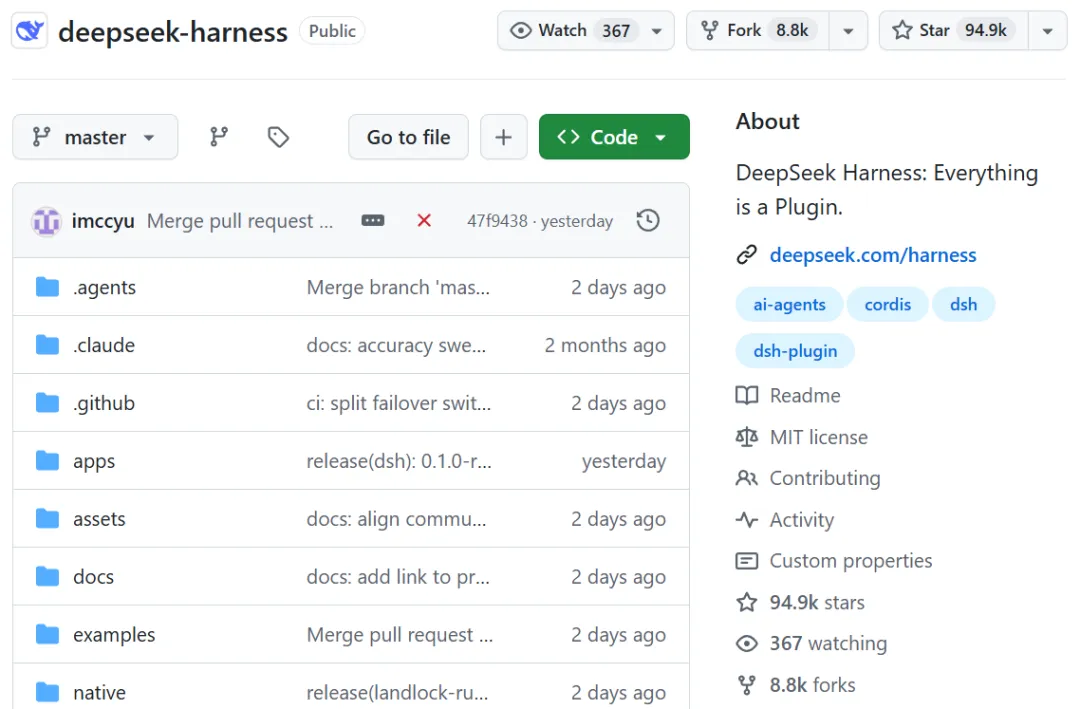
Yes, DeepSeek Harness is very popular, and a big reason for its popularity lies in a name many people haven't noticed yet: Cordis.
First of all, Harness itself. It's a locally programmed intelligent body that can be abbreviated as dsh, reading files, running commands, changing code, checking information, almost like Claude Code.
What really sets it apart from the rest is the way it's designed: it's all plugins.
Model access, tool logs, session logs, approval strategies, and even the main cycle that drives the operation of the intelligent body itself are all plugins.
If you want to change your search engine, get your company's model service, change the configuration and do it without using the framework code; adding functionality to the system is to install a new plug-in, automatically withdraw everything registered when unloaded, leaving no residue.
Supporting this is Cordis. It is a set of plugins that rely on injection and reversible side effects as the core with the context core, from the Koishi ecosystem, which is solely responsible for the loading, unloading and dependency of the plugins. All of the specific components of dsh are different plugins, dependent on service and event collaboration, free portfolio in the configuration layer.
A great use of this underlying set can be seen in the pattern selector of the interface.
In the four-tier mode, the standard mode is the most functional, the PTC mode allows the model to generate a piece of code to combine multi-cycle tool calls, and the shortcut mode leaves only one terminal and one text editor.
The fourth "create mode" is different, it is a set of self-referenced Cordis tools that are advanced inputs: after selecting this default, the Agent can check the plug-in tree that is currently running, and dynamically upload or unload temporary plug-ins. The model can temporarily write an event monitor, register a new tool, provide a service, and uninstall it after the task is completed.
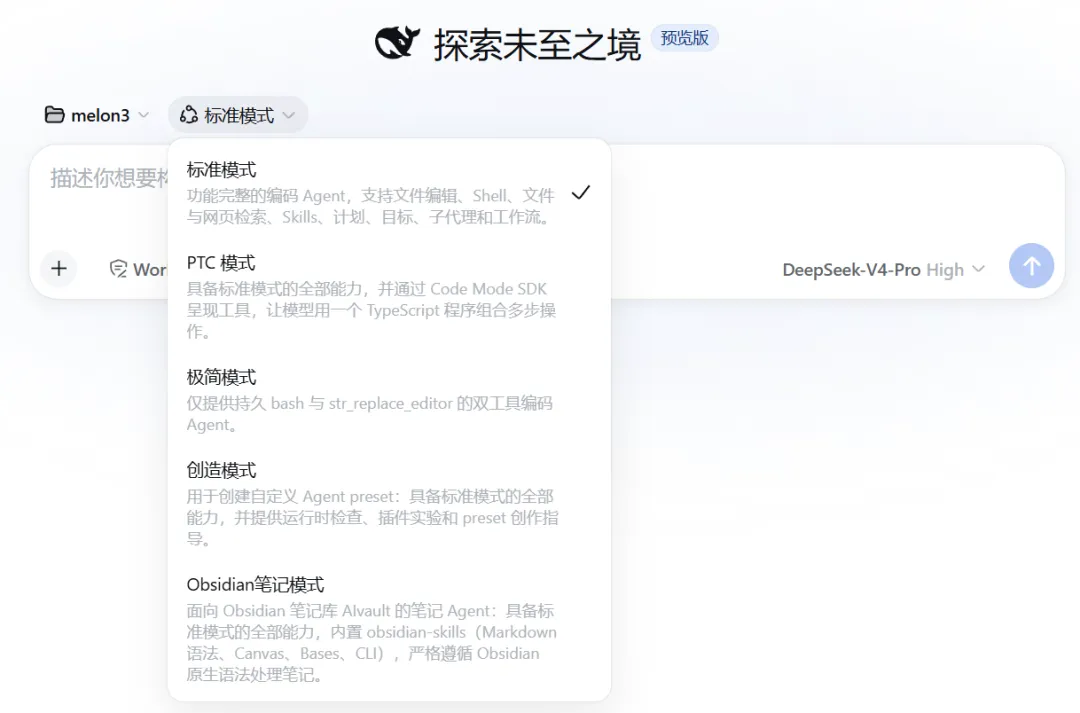
The four default modes of DeepSeek Harness and the Obsidian Note Mode built using the Create Mode
This sounds a bit like letting a car change its engine on a highway, so the project doesn't open it by default, and trust levels are marked as equivalent to shell access. Temporary plugins only exist in the process memory, without writing files, unpacking, configuring, or restarting.
One of the difficulties with the self-modified Agent is how to get the components clean after writing: once the self-modified event monitor is left, the connection is opened, the service is registered, and if there is no clear recovery path, the system runs for a few hours and becomes a stack of unauthorized residue. Dsh's practice is to keep the dynamic plugins in the existing plugins lifecycle, running under Cordis's Context and Effect mechanism, and registers have a defined clearance path.
The design basis for this mechanism has been written in a paper published simultaneously by DeepSeek: A Programming Paradigm for Spatiotemporal Composability, a programming paradigm for time-space-combinability. The authors include Yifan Shi of Beijing University, who is also a member of DeepSeek, Zhang Wei Zhang, and Tianyi Cui of DeepSeek. This is not an Agent paper, not even a model, it is a paper on the theory of programming languages, eighty pages long, with more than twenty theorems and proofs in formal writing.
Address of the paper:https://github.com/cordiverse/paper
The cornerstone of software engineering is a combination of
The question raised at the beginning of the paper has a long history: the foundation of software engineering is a combination of complex systems broken down into simple parts and reassembled. But the traditional combination is static: function calls, module import, class succession, compilation period is determined, the runtime does not change, and this set has an extremely rich formalized basis.
Modern software is increasingly in need of dynamic combinations: components are loaded, unloaded, and reconfigured while running.
The paper's conclusion is that theoretical foundations for the direction of dynamic combinations are still lacking compared to static combinations, and the industry's general practice is to bypass it.
The authors confirm that all of VSCode's extensions run in a shared process, although the extensions can be dynamically installed, but the Host does not provide any mechanism to uninstall a single extension code while running. Once an activate of an extension is executed, disabled or uninstalled, it needs to restart the entire Host, affecting all the extensions that have been loaded. The paper statistics the top 100 extensions installed, 87 of which contain executable code, i.e. remove them all at once.
VSCode does provide a deactivate loop, but it's just an elegant turn-off loop at the end of the Host process that can't be used for online removal; and the loop separates the destruction of side effects from the generation of side effects (in activate) that undermines the locality of the focus, and complete cleaning is difficult to verify.
VSCode provides the extensionDep.