
It's the first time in the history of the world.
388 PRs, 180 of which were merged.
All the code is written by AI.
Claude's father, Boris Cherny, recently posted the numbers on his X. They come from a "strange experiment" he's been doing for the past few weeks: getting Claude to take over the day-to-day maintenance of his app.
He said that, from some early indications, this path may be possible.

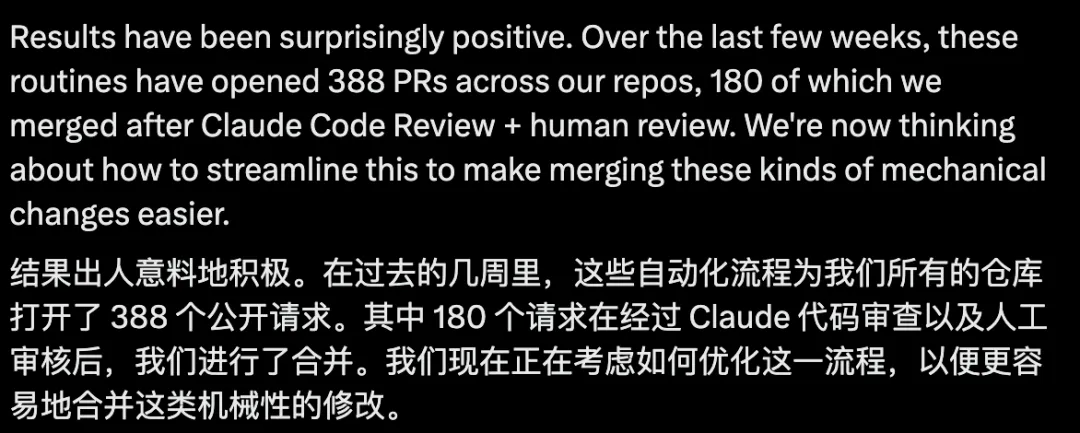
The experimental site is a Slack channel called "proj-claude-maintains-apps".
In this channel, Claude Tag runs a series of routine tasks every day, covering six environments: iOS, Android, desktop, Web, CLI, and Agent SDK, with each line running a separate routine, progressing to the top of the channel.
It's like a real colleague who doesn't send people to put themselves to work, to find problems, to change the code, to tip the PR, and then to be tried by others.
Regularly detecting problems, submitting modifications, receiving reviews, and adjusting missions according to feedback rules, such a closed loop has been in place within Anthropic for several weeks.
The engineer needs to do only one button to decide whether to merge.
Claude works every day.Dry things are dirty.What is it that Boris has arranged for Claude?
Crashed the patrol.
In the simulator, open the app at a disruption point, point it to collapse, then locate the cause, restore the PR, and each PR must be accompanied by a replay step and a true-value table.
Boris also wrote a statement in Claude's original instructions: Running must be a real app, not a fake replacement.
Re-abstract mergers. The scanning code library of implementations that look and feel the same but are not exactly the same, reminds PR to merge them into one.
Dead code clearance. This article is the most common: the static can determine that the code that can't run is deleted directly; only the "suspicious" can't run, first bury a log to observe one day, confirm that no one has passed, and then delete the next day.
Abstract leak repair. Whoever exposes a level that shouldn't be exposed, it will be corrected.
The next step is to get rid of all the tests that went through, get rid of all the bad tests when they came out, get rid of all the online switches from the code, get rid of all the internal functionality that's forgotten when it's done, and decide whether to send it out or delete it, depending on how much you use it.
It's the old engineer's way of deleting a diary.
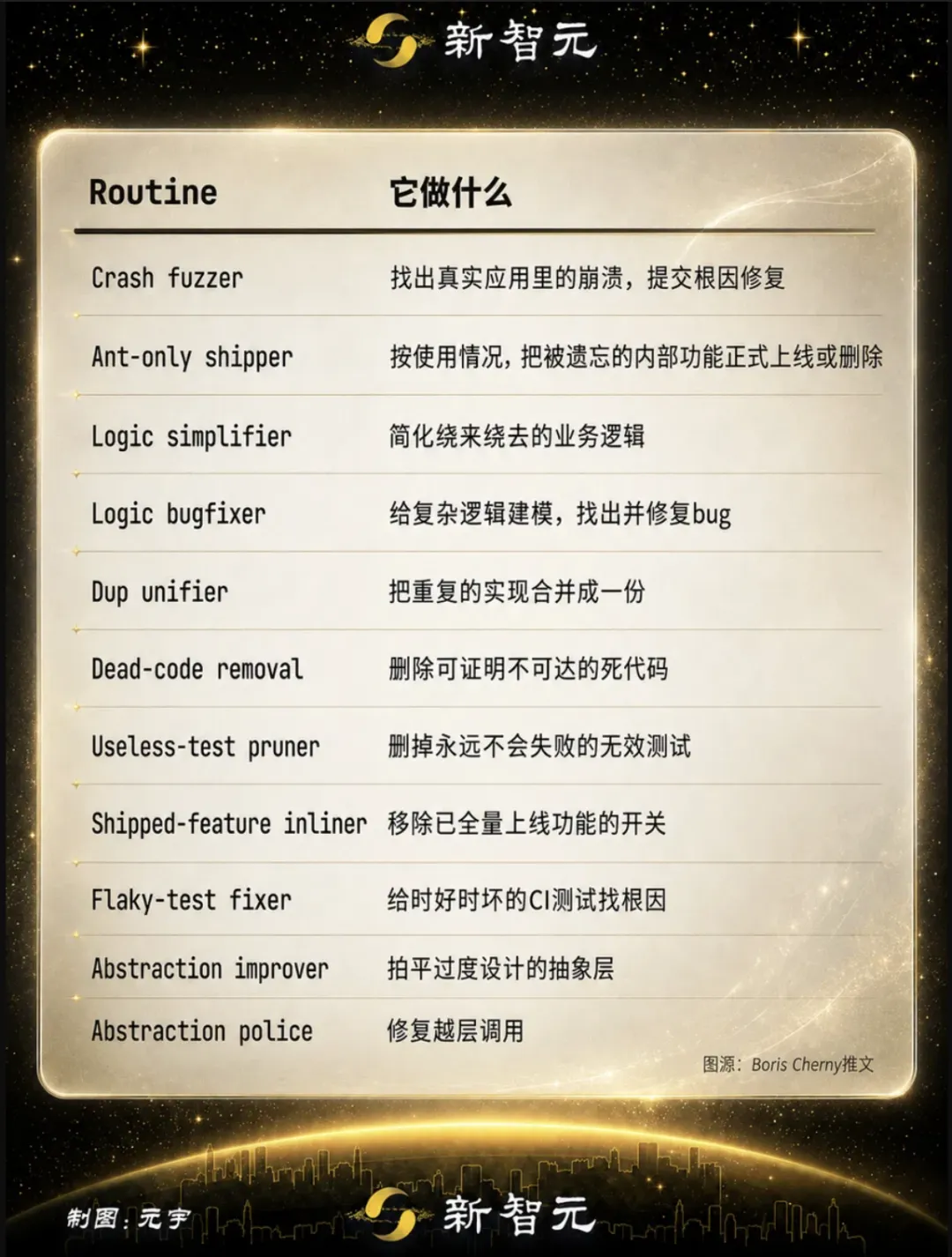
The list goes from beginning to end, with Claude taking over eleven lives, none of which are "doing something new".
It's the kind of life that nobody wants to do, that nobody wants to do, that nobody wants to do, that nobody wants to do anything, that nobody wants to do anything, that nobody wants to do anything, that nobody wants to do anything, that nobody wants to do anything, that nobody wants to do anything, that nobody wants to do anything.
Writing code is cheaperThe code is getting expensive.A team of 388 AI-generated PRs in a matter of weeks, who's coming to see?
Anthropic gave a figure in its Code Review announcement in March this year: Over the past year, the company's per capita code output has increased by 200%, and code review has become a bottleneck.
And it's not an anthropic issue.
Faros AI, an engineering data platform, released a two-year report in 2026 covering 22,000 developers and more than 4,000 teams.
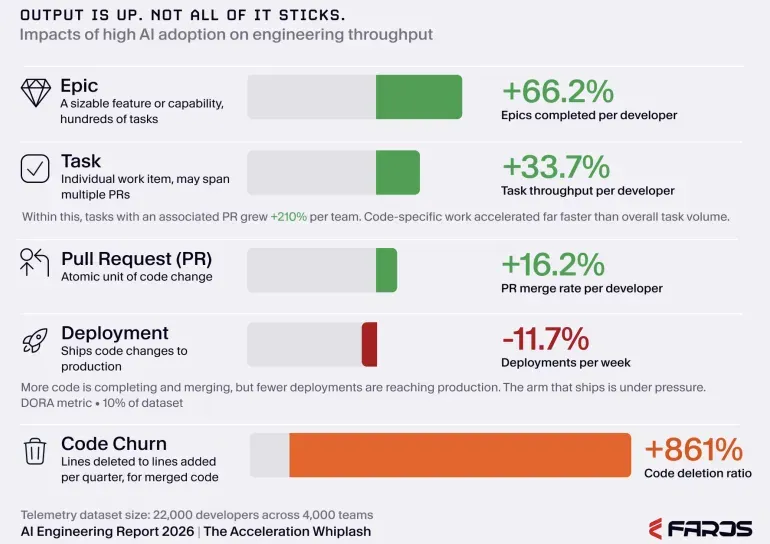
The Acceleration Whiplash: With high AI adoption, per capita epic completion is 66.2%, while weekly deployments are down 11.7%.
The output side was really good: 66.2 tonnes of epic per person, 33.7 tonnes of mission throughput, and 16.2 tonnes of PR merger.
However, the number of actual online deployments per week dropped by 11.7%.
More is merged and less is sent out. The middle link is blocked by the censorship.
It's a cost that developers have to pay.
The number of bugs on each developer has dropped by 54%.
Each PR correspondent's online accident yielded 242.7%; the combined and deleted code yielded 861%; the average volume of PR yielded 51.3%;
The most important thing is to wait.
The median time for a single person to be examined, earning 441.5%, and an additional 31% of PR, has not passed a single examination.
These numbers pile up, and it's a developer's day: pressing a button generates a thousand lines in five minutes; then spending an entire afternoon reading the thousand lines one line at a time.
Writing that part of the code was taken away by AI, but looking at that part of the code is still up to the developers.
Code Review was created to address this issue, and Anthropic has released a set of effects and cost figures:
Prior to the top, only 16% of PRs received substantive review comments, up from 54% after the top.
For large PRs over 1000 lines, 84% were detected, with an average of 7.5; for small changes below 50 lines, the proportion dropped to 31%, with an average of 0.5.
Less than 1 percent of engineers labeled discoveries as "mistaken".
A PR trial takes an average of 20 minutes to burn a $15 to $25 token.
The announcement also states that the system does not approve PR, approval is a human affair.
It defines the boundaries: AI can actively search for problems, change code, open PR, without human approval. But every change stops in PR, doesn't fit into the main branch, doesn't go online, and the last thing that has to be confirmed is people.
Boris wrote in the post: "Find a way to reduce the combined cost of these mechanical changes".
He wants to reduce the cost of the merger, because the card is no longer generating that one.
Boris Modi is not a PR.It's routine.If you look at how the system works, it's clear that there are three parts to it.
The Claude Tag is an input. It is connected to the Slack channel and is responded to at @, and actively activates to the extent permitted by authorization and instructions.
Anthropic just upgraded it on August 13 to combine the context of the entire channel to determine when to start and when not to move.
Routines (regular tasks) are the execution layer.
This is a feature that was introduced on April 14: one-time setup of prompt words, code warehouses and connectors, then running on schedule, triggered by an API call, or automatically triggered in response to a GitHub event.
It runs on Claude Code's cloud facilities and does not rely on local equipment.
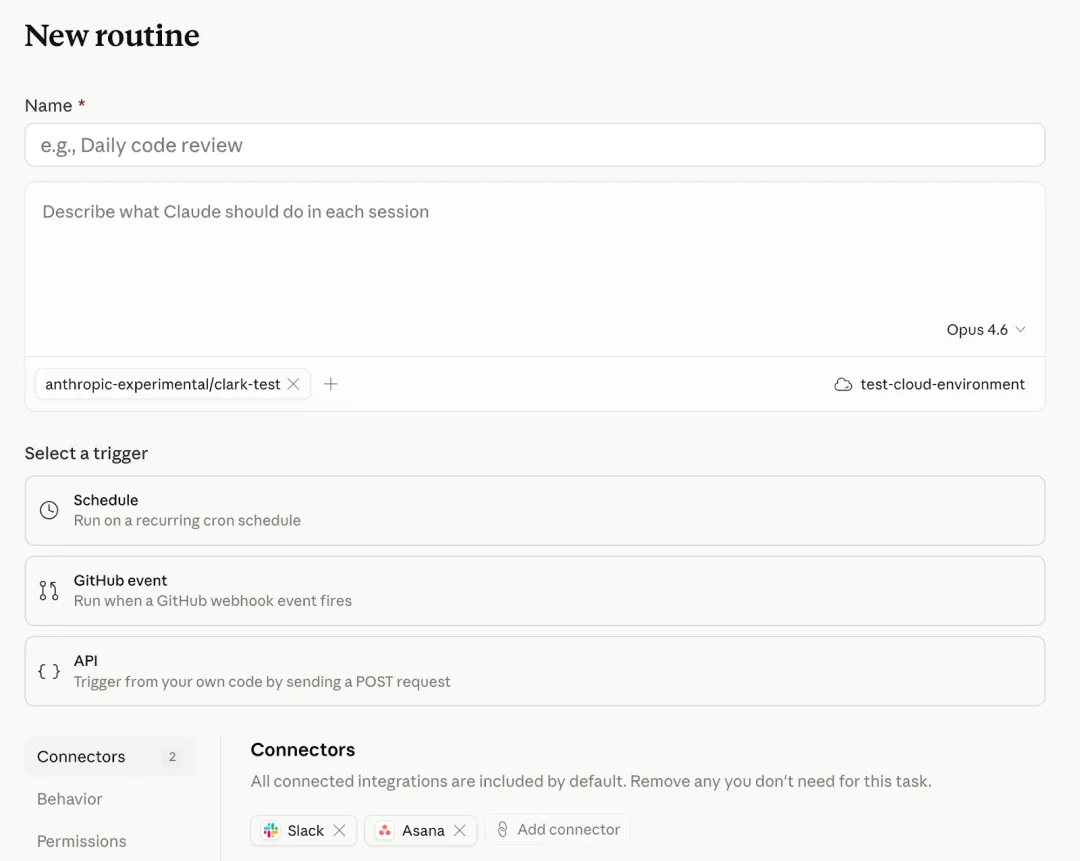
Claude Code Routines: In real time, API calls and three triggers for GitHub events run in the cloud.
Claude Code Review is the review layer, humans are the approval layer.
The four floors were joined together to create the channel that automatically opens every morning.
But the best thing to learn is Boris's way of tweaking.
One type of PR is always over and over, and he doesn't go one by one to change the failed PRs, he goes back to the routine of generating them and observes how they perform over the next few days.
Sometimes a task takes a few days to settle.
One sentence: not fixing results, fixing rules.
Tipping is no longer a one-time input, but a set of assets that must be maintained over the long term: writing well, connecting, observing, iterating, and maintaining an online service.
And that's why this thing is so fast.
Each adjustment is embedded in the rules, and in the next day's generated PRs, there are fewer that shouldn't appear.
I want to see it again.Let's go through these links.This layer of tools is public.
Routines are open to Pro, Max, Team and Enterprise, 5 Pro per day, Max 15, Team and Enterprise 25, and can be built in a few seconds in claude.ai/code, or tap one/schedule in CLI.
But the real threshold is elsewhere:
The extent to which the warehouse privileges dare to open, the testing of the coverage can't cope, whether the simulator environment can run the real machine, the scrutiny of the burning of the money can't be erased, and the most difficult: if anyone is willing to press the merger button for an AI-powered PR.
Also this month, the Rust project just contributed a rule to AI: code generated by AI must say goodbye beforehand, not touch critical paths, test sufficiently, and reveal it using large models; key modifications to soundness are not strongly recommended for large model generation.
Most importantly, the maintainer has no obligation to review the PR submitted by the AI, which can be turned off directly.
Individual developers can learn from the Boris experiment, and this is the rule: give out the kind of live ones that have the most definite acceptance conditions.
To verify the correctness of the error, the AI now gets it: this operation can't crash the app, whether the two writing methods are the same thing, whether the test will never hang, can be verified on the spot.
Those who don't know how to do it right, AI can't take: "This abstract layer isn't over-designed", "this restructuring direction is wrong", accepting the standard entirely on taste, and not writing suggestions.
So it took away the first living creatures, not the creation, but the cleansing.
The production side is no longer lacking in capacity, the review side is lacking: who sees first, what repetitions, and who signs last.
The engineer's reputation has also been changed by a set of algorithms: the faster it used to be to write, the faster it is to review.