Finally, the IMO Gold-winning version of the Little Red Book is available!
Last month, Little Red Book's self-developed dot-note 3.0 model set a new record: AI earned an official accreditation of 42 points for the first time in an international open-source competition.
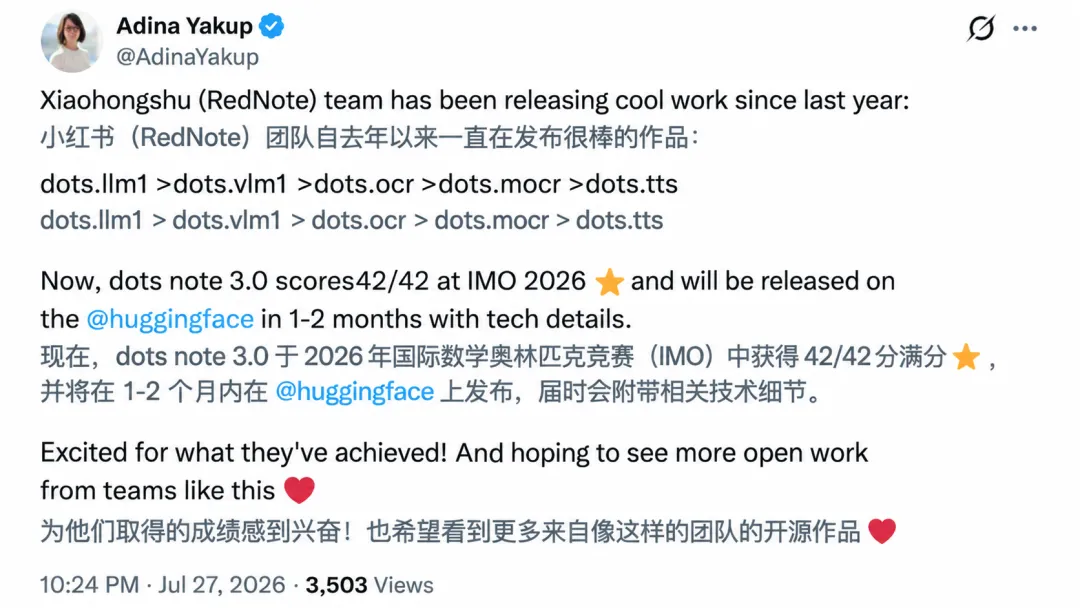
Adina Yakup, Head of AI Research and Community Ecology at HuggingFace.
Just today, Little Red Book Dots Model Lab (abbreviated as Dots Lab) announced the open-source dots3-note preview! It is also the first open-source version of the dots3 series of models, targeting longer-range tasks that are closer to reality and more difficult to evaluate.
In terms of parameters, the total parameter for the dots3-note preview is 280B, with the activation parameter being 16B, supporting 512K over-context windows, with multi-modal understanding of text, visual and voice, and optimization for complex reasoning, Agent and multi-modal perception.
Input of the API:
Huggingface:
GitHub:
IMO has successfully verified the model's ability in mathematical reasoning and proof, and this open source challenge leads to another more difficult type of standardized scenario: travel planning, wedding preparation, and store operations.
The dots3-note preview focuses on long-term tasks, but also paves the way for a main line of current Agent development: they are beginning to be required to independently take on longer and more complete tasks. OpenAI has revealed that in May, more than 70% of users let Codex handle tasks that take more than an hour to complete; by June, the top 1% of active users in OpenAI generated more than 60 hours of agent turns per day.
However, when tasks fall into different scenarios, the difficulty is quickly drawn out. In contrast to more mature scenarios such as mathematics, code and engineering, Agent's real-life environment is more open and demands are more vague.
Based on the mainstream benchmark data, in many reasoning and intelligent body tasks, models can outperform or even outperform large-scale models with parameters many times larger than their own, and visual ability stands out in the same size range.
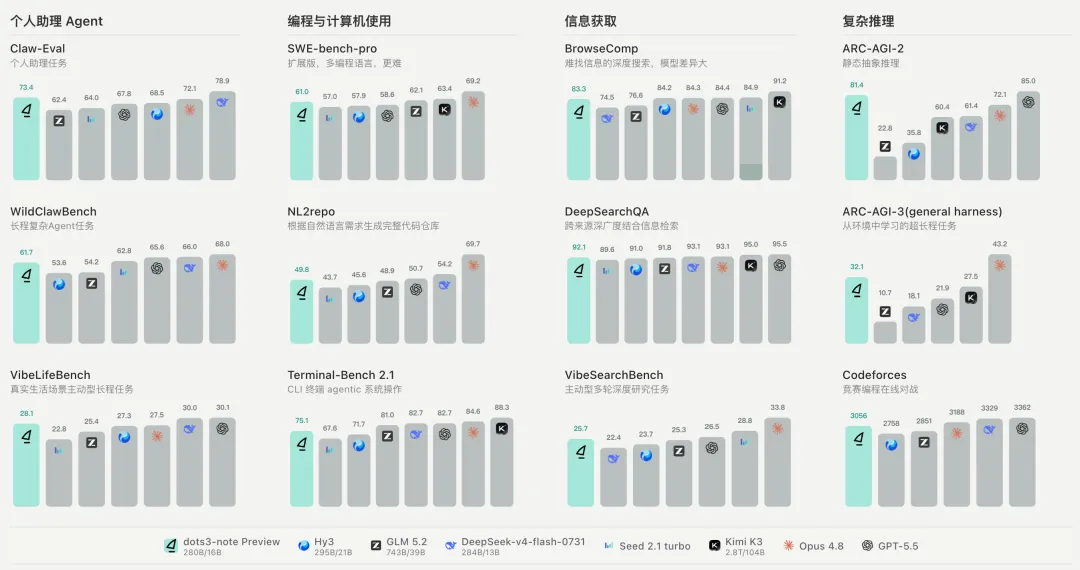 Source: The official tech blog
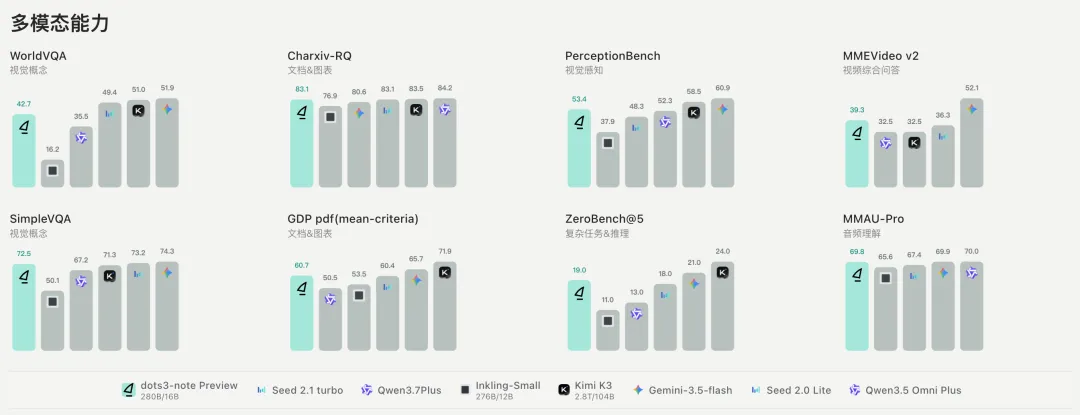
Source: The official tech blog
Previously, Little Red Book had continuously open source the text large model dots.llm1, the multilingual document layout analysis model dots.ocr and the multilingual visual understanding of the large model dots.vlm1.
One-handed test:
Is it really capable of accomplishing complex tasks?
The model's real capabilities, in terms of lists, are far from enough. Next, we go through a few cases to see how the model moves independently and delivers results in the face of fragmented information, multiple steps, and constantly changing environments.
Take over the killing of the Minarets II
First, let the dots3-note preview take over one shot of the killing spree.
The difficulty of the game is that which route to choose, which card to take, whether to challenge the elite, how to spend the gold, whether the camp chooses to rest or upgrade, all affect the chances of survival after dozens of rounds.
The model was not specifically trained for the game in advance, but could learn cards and enemy mechanisms based on battle feedback, while managing lives, battalions, gold coins and medicines, and balancing between shops, camps and elite warfare all the way up to 33 levels.
From zero to crack ARC-AGI 3
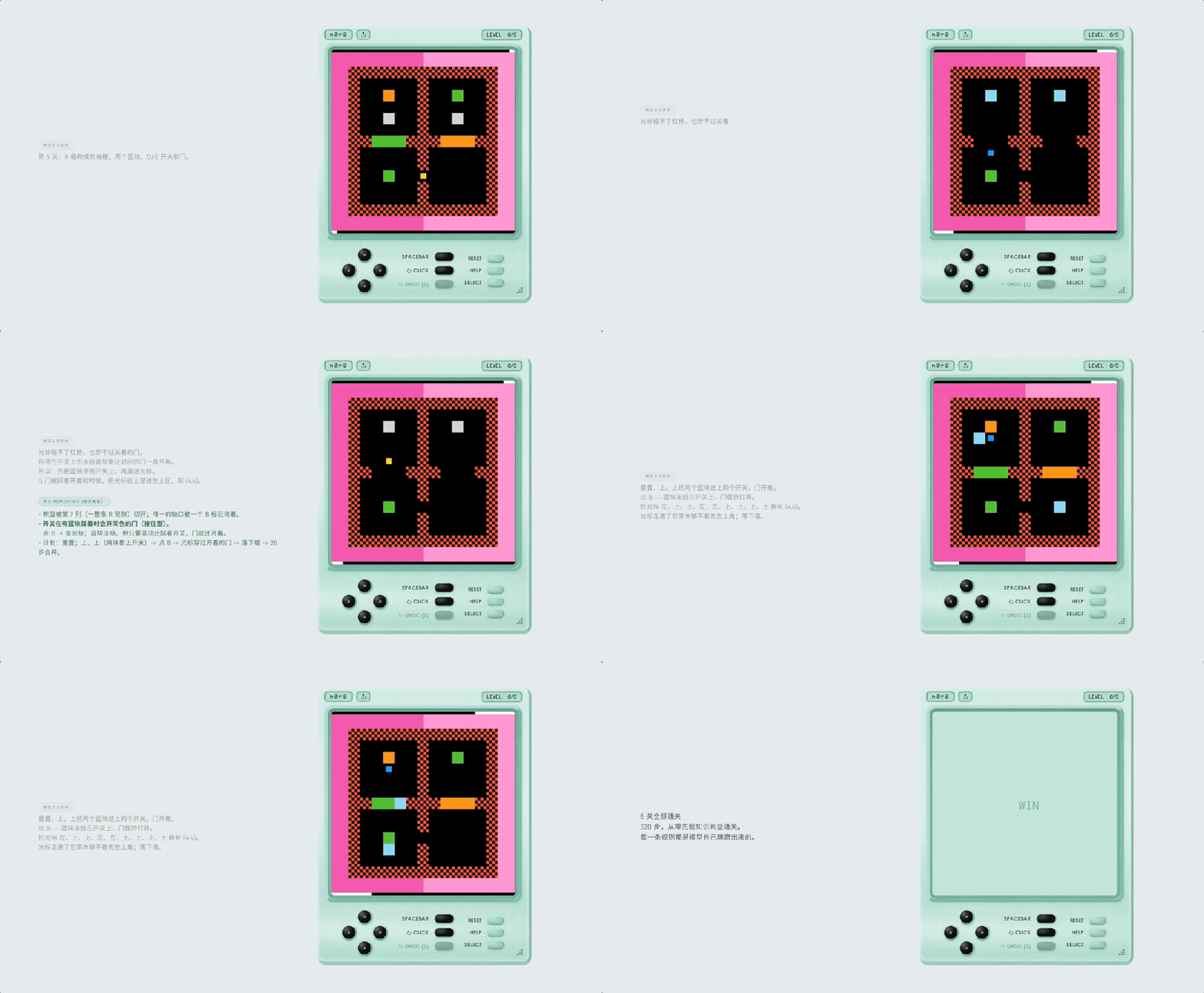
In the long-range reasoning task ARC-AGI 3, the rules are completely unknown, and the model needs to observe the image, make assumptions, and then verify them by operation.
The dots3-note preview gradually detects the two squares as they synchronize up and down, and explores the mechanisms of hazard charts, mobile markings, pressure switches, and valves.
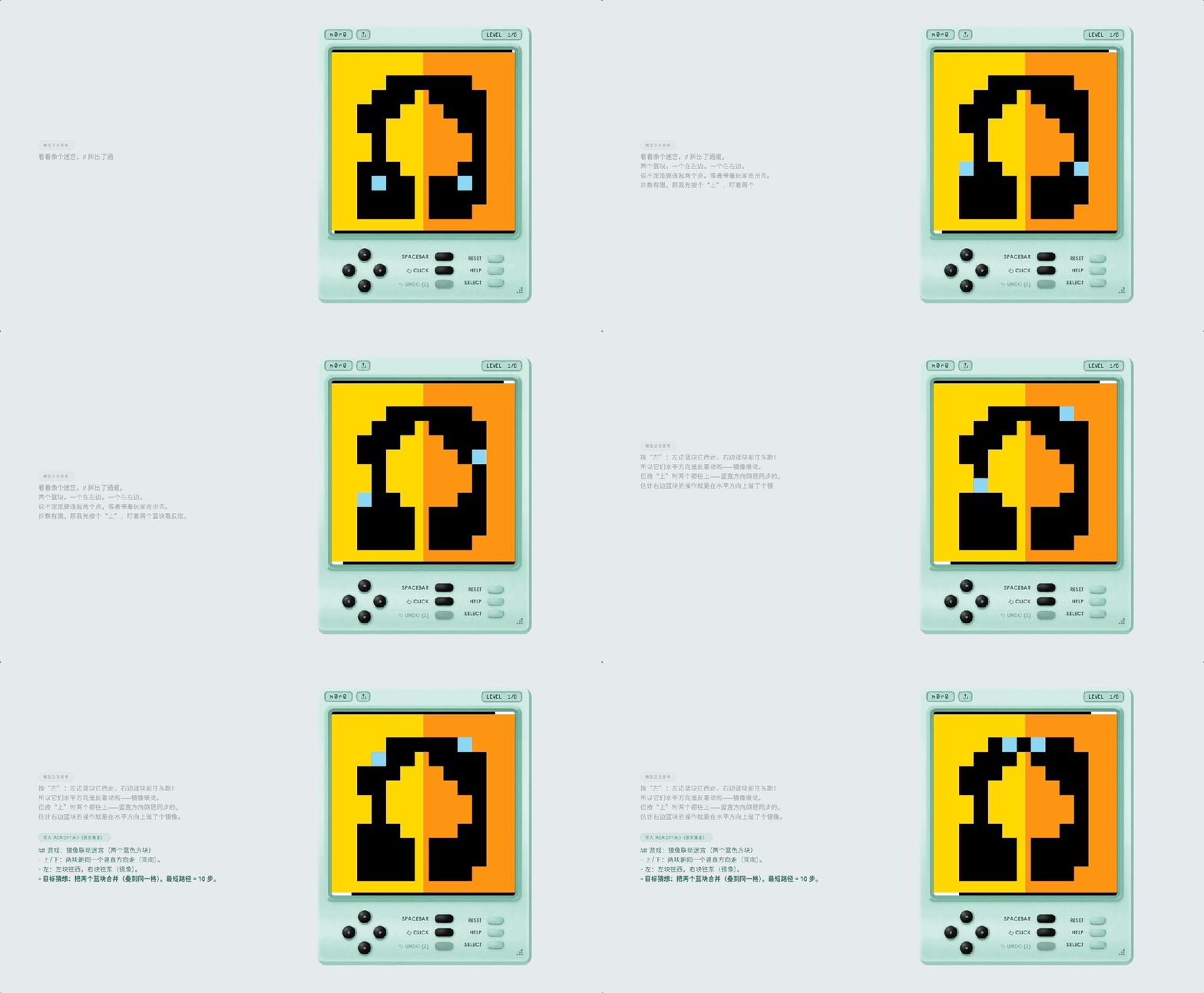
Whenever an error occurs, it starts re-evaluating the Self-Critiquing mechanism, writing the modified rules in memory.md, a file similar to the model's logbook that continues to preserve a dynamic understanding of the environment.

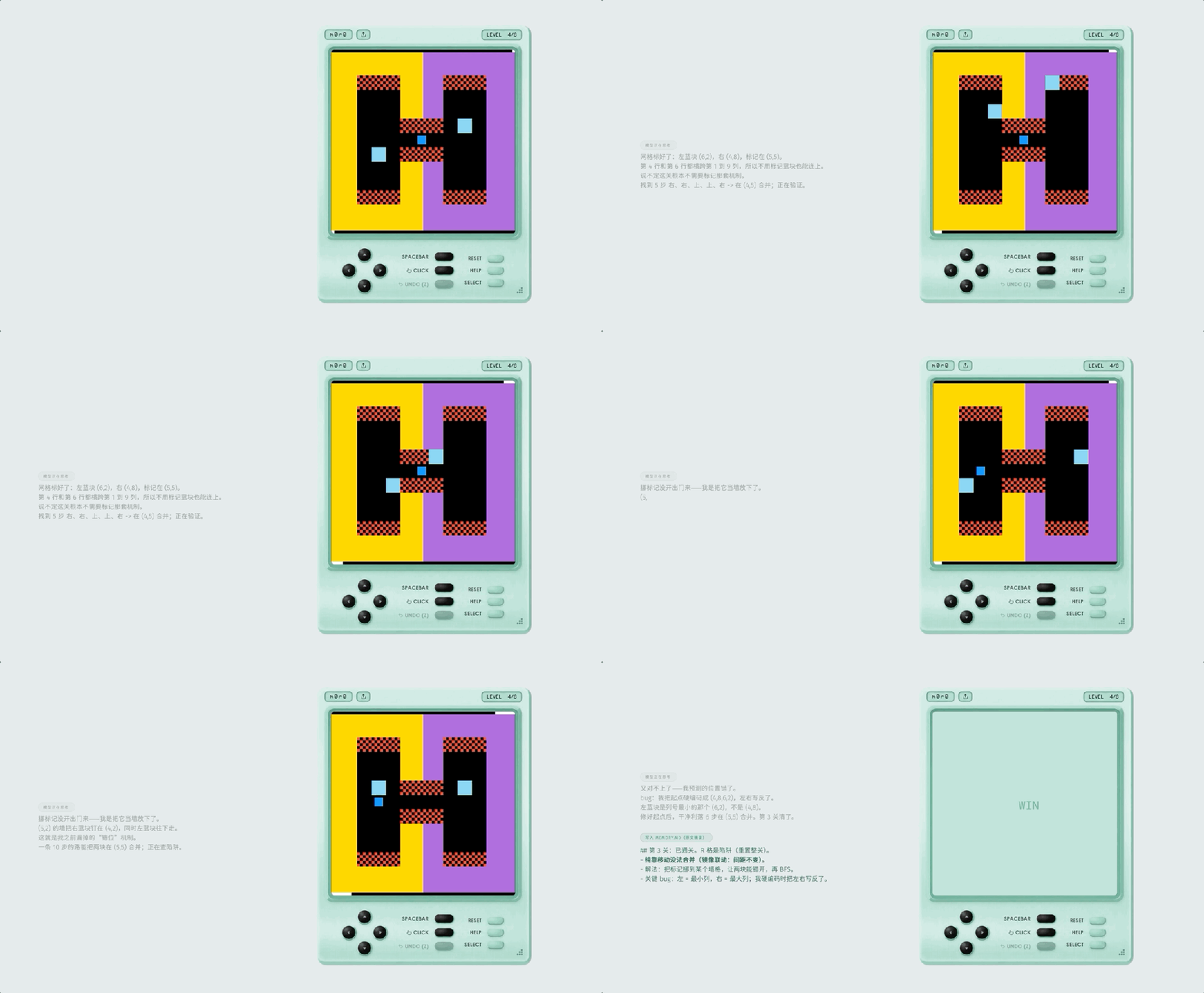
Eventually, the model unlocked all six nodes in a 320-step operation.
How to solve the problem of decoration
Continuous learning and reasoning are ultimately a return to the real world.
For example, here's the typical renovation problem: simultaneously uploading the layout map and the parameters of the two refrigerators and adding the information: the kitchen is close to the wall on the side of the library, there's already been a 1.5 meter long stage, and now you want to put the refrigerator on this wall, can you put it down?
Critical information is scattered across different images and textual expressions, and the model needs to combine a contour diagram, a set size and two refrigerator specifications, to calculate the remaining space on the wall, and to make appropriate conclusions. It also actively reminds users of the on-site counter confirmation.
The entire process involves the understanding of visual space, complex reasoning, and tool calling, as well as the ability of models to generate customized answers based on individual real-world environments.

Following the model's recent layout, the model continued to design several real-world woodwind renovation schemes for the library.
The model retains previously recognised dimensions and lighting information, searches for notes related to the Little Red Book, assembles four sets of real woodwind schemes and generates web pages, continuously completes reading, calculation, retrieval and content generation.

End-to-end running visionOS app development
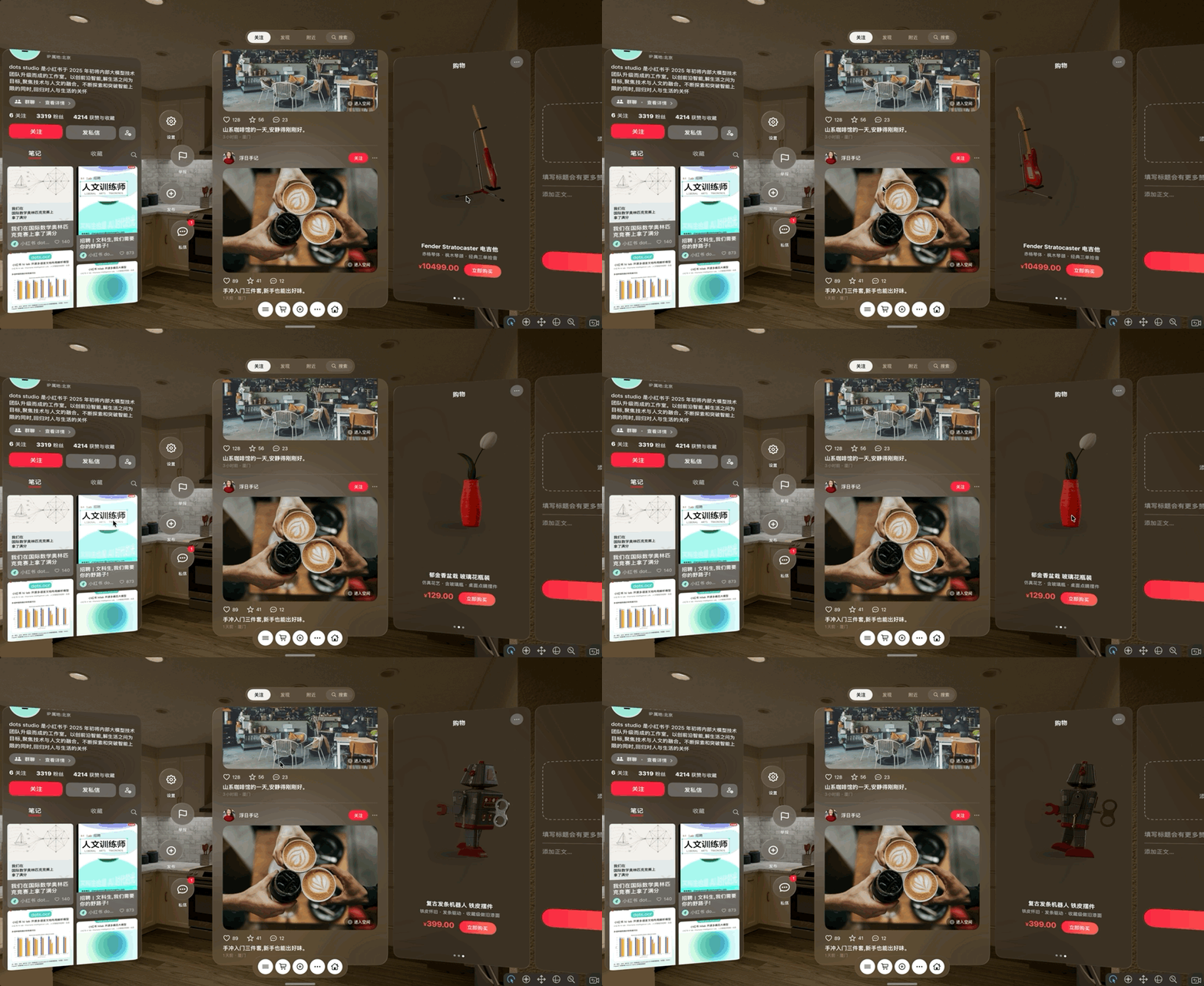
Finally, let's see if the dots3-note preview can independently complete a complete end-to-end software engineering task, allowing it to "refer to the design of the Little Red Book and develop a native Apple Vision Pro application".
After receiving the assignment, the model was not in a hurry to write the code. It first understood the needs of the product and referred to 9 interface charts, independently identifying the development plans, including the adoption of SwiftUI+RealityKit technical routes, planning organizing windows, immersive spaces and 3D merchandise displays. After finalizing the plans, it continued to prepare materials such as local images and 3D models, and then gradually completed the code implementation.
The entire project generated 12 Swift files, 1876 lines of code, an interface for information flow, personal homepage, private messages, commodities, and access to the USDZ 3D model. The model then automatically generated Xcode engineering, called for xcodebuild compilation, and completed checks in the visionOS Simulator, eventually showing "BUILD SUCCEEDED".
From the understanding of needs, the choice of technologies to the implementation, compilation and verification of code, the development process was finally completed.

In the final product, a more complete spatial interaction is already available. Information flows can be scrolling, notes can be accessed to detailed pages, personal home pages, private letters can be opened as a separate window.

Users can also view and exchange different 3D goods directly in the shopping interface.
There are no standard answers.
Models must continue to learn and correct their mistakes
From several test sets, the most prominent capability of dot3-note preview is to explore, remember new information, and adjust after changes or judgments are made, until the results are delivered.
One of the first problems to be solved by the dots lab is whether the model can continue to learn from the environment and users after the end of its training.
To train this capability, Dots Labs has built thousands of ultra-long-range novel environments that do not rely on prior knowledge, allowing the Agent to continue exploring in previously untouched scenarios, learning new rules and knowledge by interacting with the environment, for subsequent decision-making. And, when the task length significantly exceeds the previous context window of the model, the model cannot always rely on context-based information. After reinforcement training, it will gradually learn how to retain useful information for subsequent problem solving. This ability has been validated in ARC-AGI 3.
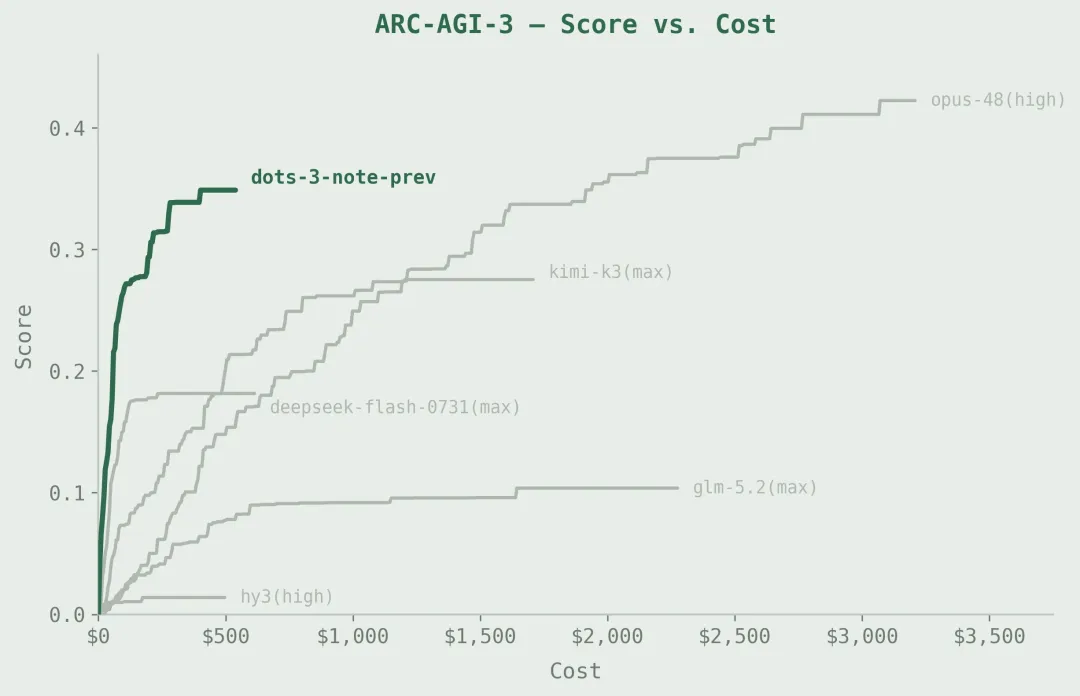
As can be seen from the chart below, the dot3-note preview was obtained on ARC-AGI-3 for about 0.35 points at a cost of less than $500, an absolute score lower than Claude Opus 4.8 (high), but significantly more cost-effective.
However, there is another problem with training such a process: the cost of exploring long-range missions is too high, and it can take several hours for an agent to complete an exploration. If you continue to use value-free reinforcement learning methods that rely on end-to-end rewards, you will often have to wait for the entire trajectory to end to get the training signal, which is not only inefficient, but also difficult to judge which final results or failures are attributed to the precise steps ahead.
Actor-critic methods such as PPO can mitigate this problem, but traditional critics typically estimate the value of the current state using a fixed-algorithm forward computation. In the face of complex Agent tasks, the actor can repeatedly reason and call the tool to decide the next step.
The dots lab proposed TEMPO (Test-time-scaled Value Estimation with Macro-step Policy Optimization), which divides a long trajectory into multiple macro-steps, each of which involves interaction between multiple models and environments. At the end of a phase, the model temporarily switches from actor to critic and, through reasoning, tool calls and test-time scaling, estimates how much returns the current state can get in the future, and then turns this evaluation into a training signal that has not yet completed the trajectory.
It is noteworthy that in the course of TEMPO training, the model learns both how to act and how to evaluate how it is doing at the moment. With this self-evaluation, reinforcement learning training can be put into longer tasks and continually optimize behavior on long tracks.
The results showed that the advantage of TEMPO was mainly after the mission entered the deep water zone. With the increase in interaction rounds, the score of the GRPO and Base checkpoint tended to stagnate, the TEMPO could still continue to improve.
With the introduction of the Self-Critiquing mechanism, the self-assessment capability of the dots3-note preview is stronger than initially anticipated. Even if a problem is not solved, the Agent can judge which of the two superficially similar intermediate states is more likely to breakthrough.
This self-assessment ability is also reflected in the reasoning stage in addition to being used for reinforcement learning training. In the previous IMO 2026 competition, the same branch version of the dot3-note preview generated proofs, called the proofs repeatedly through tools, and modified the optimization according to the evaluation results, ultimately scoring.
Future dots laboratories will explore recursive self-criticism in "open tasks", allowing models to self-judge task progress in the absence of clear external rewards and thereby adjust memory and plan follow-up.
The combination of "active memory + ultra-long-track reinforcement learning + intermediate self-evaluation" gives a concrete solution to the long-term entrance of Agent into the real world.
Why did Little Red Riding Hood choose "A Real Life Agent"?
For the community of life interest in Little Red Book, it is naturally close to this kind of real-life task. Many of the questions that users discuss every day are not only unanswered, but often even the users themselves do not have to figure out what they ultimately want.
Travel, weddings, home furnishings, dresses, etc. are characterized by varied preferences, constantly supplementing conditions, and multi-modal information density. These are the complex long-term needs that the Little Red Riding Hood faces, so it is natural to use them as the focus of Agent's research and application scenarios.
In other fields such as mathematics, code, and so on, Agent has shown the industry that in an environment where the objectives are relatively clear and the results can be verified, AI can break down complex tasks into numerous steps and continue to execute for a long time. Real-life conditions are much more troublesome, with no test cases available anywhere, and the goals and constraints change with the tasks.
dots The two open-source lab evaluation benchmarks intuitively set out the gap and insufficiency.
One set is the VibeSearchBench, which examines "when the user doesn't say what he wants once, the agent can't figure out what he really wants", covering 20 domains, 200 tasks. It evaluates the simulation of real users, adds requirements and constraints in multi-round conversations, and then sees if the model can accurately understand what the user wants.
The other set is the VibeLifeBench, which emphasizes time and environmental change, examines "what agents can't keep up with after external conditions change", covers 10 domains, 20 missions, each with 20 to 30 stages, and sets up 1247 atomic checks to check for consistency in status, improper execution of work, and final delivery.
The results showed that even the world's leading models, such as Claude Opus 5 and GPT-5.5, did not meet the set criteria.
To the left is the complete list of VibeSearchBench and to the right is the complete list of VibeLifeBench.
This is the first time I've ever had a problem with this website.
It's a great way to get to know each other.
These results reveal one thing: the model is strong enough for high-difficulty single-point missions, but maintaining this ability for hours or even longer is still beyond the reach of the Agent. Little Red Book's exploration and layout of this is just beginning.
The dots3-note is the lightest version in the dots3 series, and the current open-source preview version still has room for continuous optimization in terms of experience and detail. According to the dots lab, the official version of the dots3-note will also be open-source in the near future. The future dots3 series will also introduce jazz and aria, with notes consisting of three levels, covering the application needs of different task complexity, response speed and computing costs.
For more details on training methods, see the official tech blog (in Chinese):