It's hard to hide from AI's writing.
OpenAI's official announcement that a number of companies, including OpenAI, Anthropic, Google, Meta, and Microsoft, have signed the EU's Code of Conduct for the Transparency of AI in Content Production, pledging to promote the marking and detection of AI-generated content.
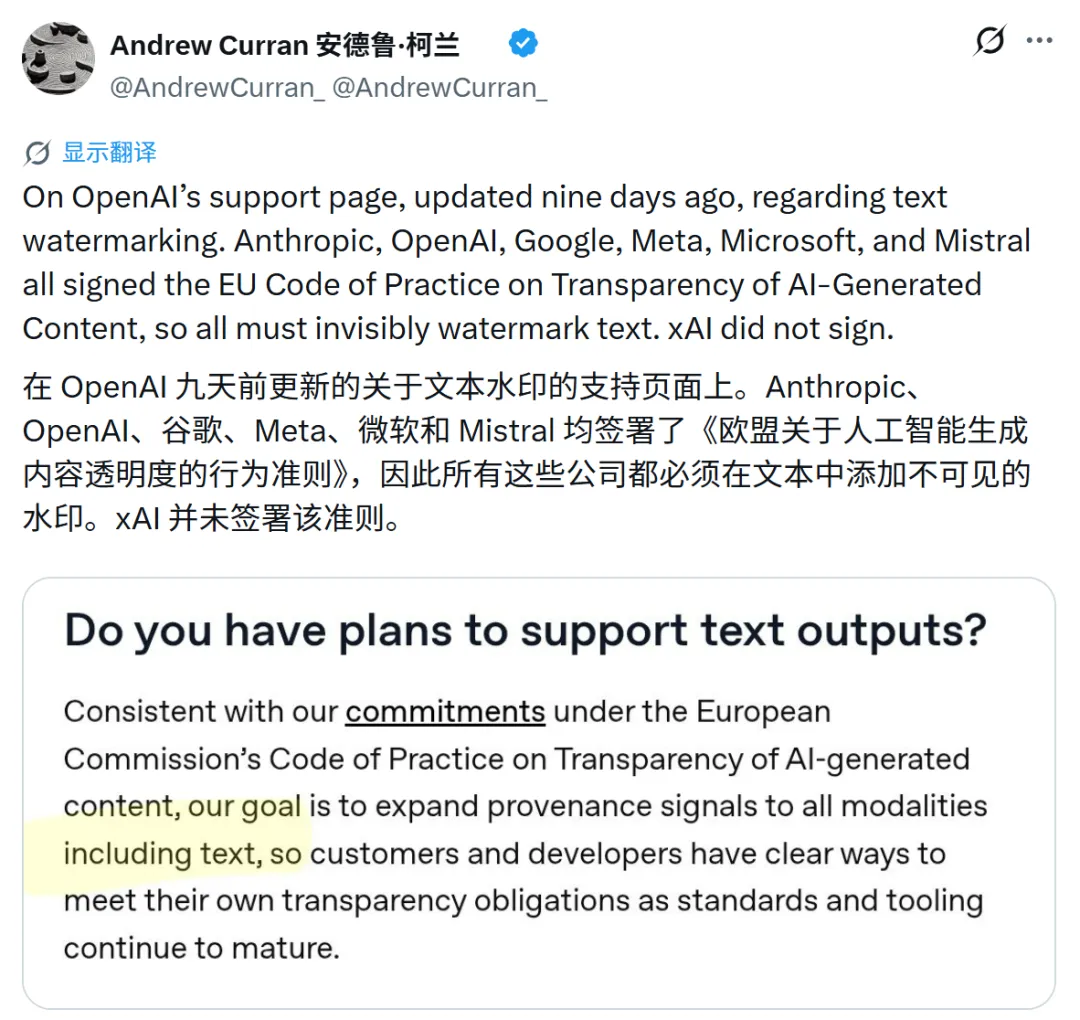
According to OpenAI, in line with its commitment to the EU's AI-generated content transparency guidelines, the goal is to extend future source signals to all models, including text.
It looks like the AI content will have a "signature" right away.
Recently, many of the leading companies are expanding their business in Europe, but the rules of the European Union are quite numerous, and the AI that produces the content transparency code of conduct is one of them.
As of 2 August, the requirements of the EU Act on transparency of content came into effect: text, images, audio and video generated or manipulated by AI must be labelled in a machine-readable manner and detectable.
However, the signing of the code is one thing, and Claude was the first to act accordingly.
Claude's "signature" rule
Recently, Anthropic published Claude's specific scheme for implementing this set of rules.
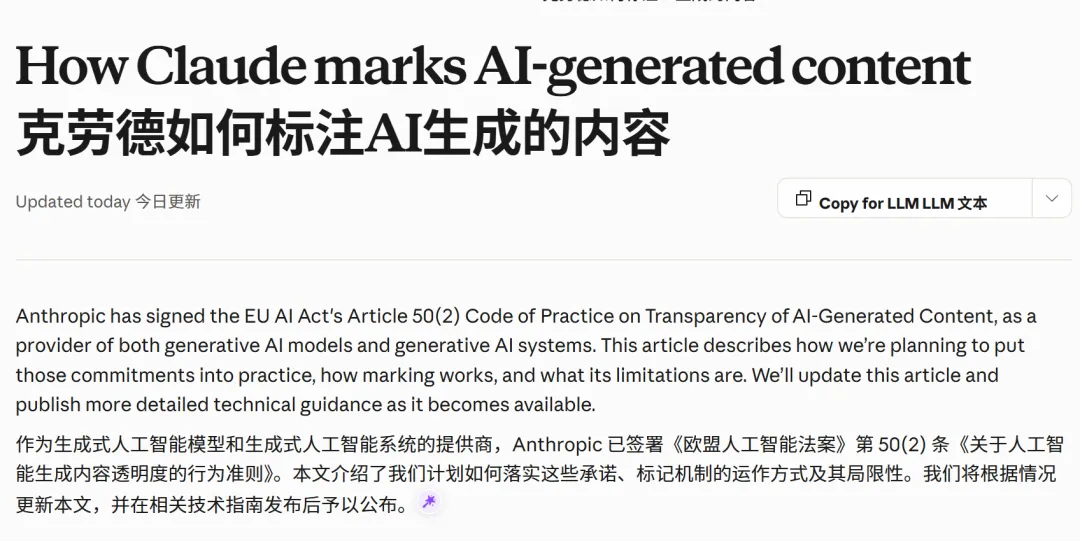
There are a few highlights:
1. from 2 August, if the new Claude model, launched in the EU, "AI Watermark", is enabled when online;
2) The "AI watermark" is directly embedded in the generated text, invisible to the human eye, but detectable by machines. The watermark is retained after copying and pasting, and even after some editing does not necessarily disappear;
For documents such as svg, png, jpg, and others, Claude adds digitally signed source metadata using the C2PA open standard. Such "AI watermarks" can indicate that a file has been processed by Claude and can help determine if it has been tampered with.
4 Although it is EU regulation, the mechanism is not limited to EU users. Watermarks are added from the model layer, whether from Claude, API or third-party cloud service calls, and the content generated by Claude carries an "AI watermark".
In addition to this, according to the transition period given by the EU, Claude's old model should be added to the "AI watermark" by 2 December.
In other words, at the current pace, after December 2, Claude's "AI Watermark" will further cover the entire model, the entire channel, globally.
The same is true for other signatory companies, but the approach may be different.
Watermarks have been around for a long time.
On how to add a "watermark", Anthropic said it would wait for further technical documentation.
However, this text watermark is not a new concept in itself.
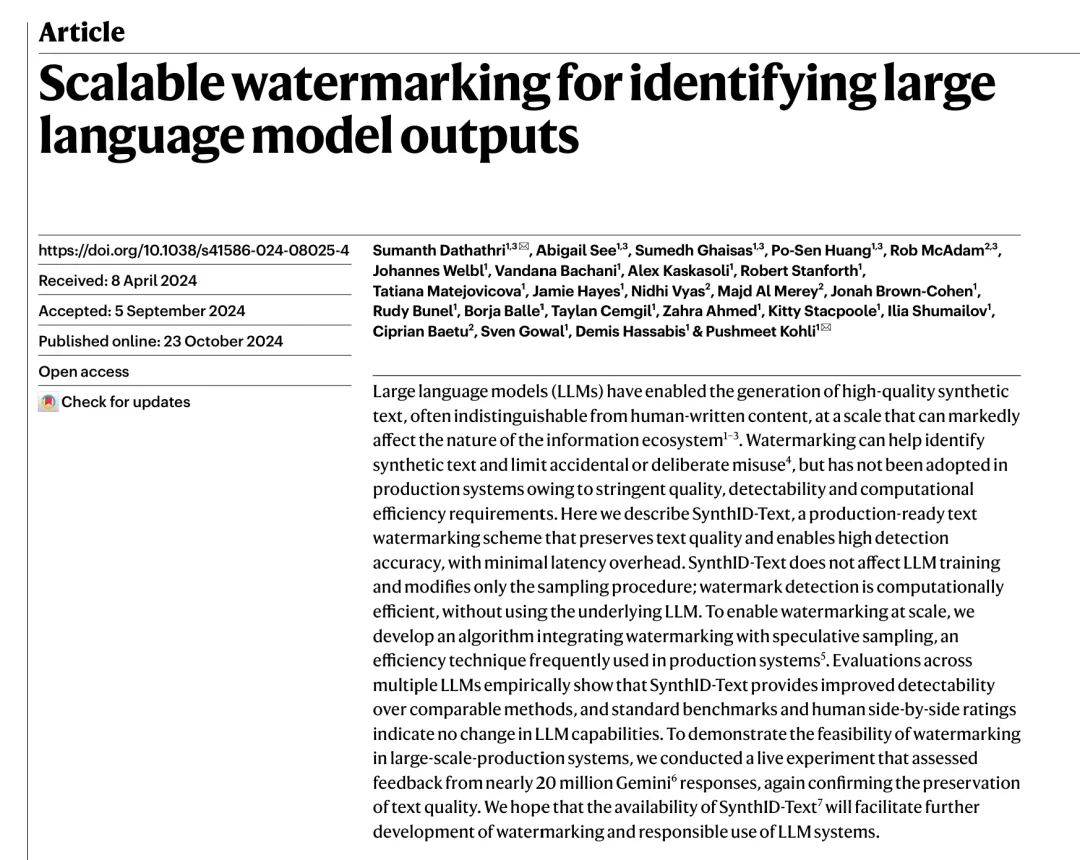
As early as 2024, DeepMind released a "SynthID Text" program, and it has been used in Gemini and Gemini Advanced.
If the word "watermark" refers to the coverage logo in the image, then you could be wrong.
SynthID makes very slight adjustments to the probability of generating a token in the process of generating text in a large model, leaving the model with a specific statistical rule when selecting a word.
When testing, the word selection is reversed to check whether the word selection corresponds to the statistical patterns that should be used with water-printed text.
Public testing by Google shows that the signal can still be detected when cutting out some text, modifying a small number of words, or slightly rewriting; but if completely rewritten or translated into another language, the confidence in the test can decrease significantly.
Google has also tested the program in nearly 20 million Gemini real responses, showing that user ratings for text quality have remained virtually unchanged.
"Signature? Is this really what you wrote?"
After the news broke, the netizens were shouting "re-subscribe".
The credibility of the "watermark" itself has been questioned, and even Anthropic itself has stated that "watermarks" are not necessarily AI, and that, after extensive rewriting or mixing of artificial content, "watermarks" can be weakened or even undetected.
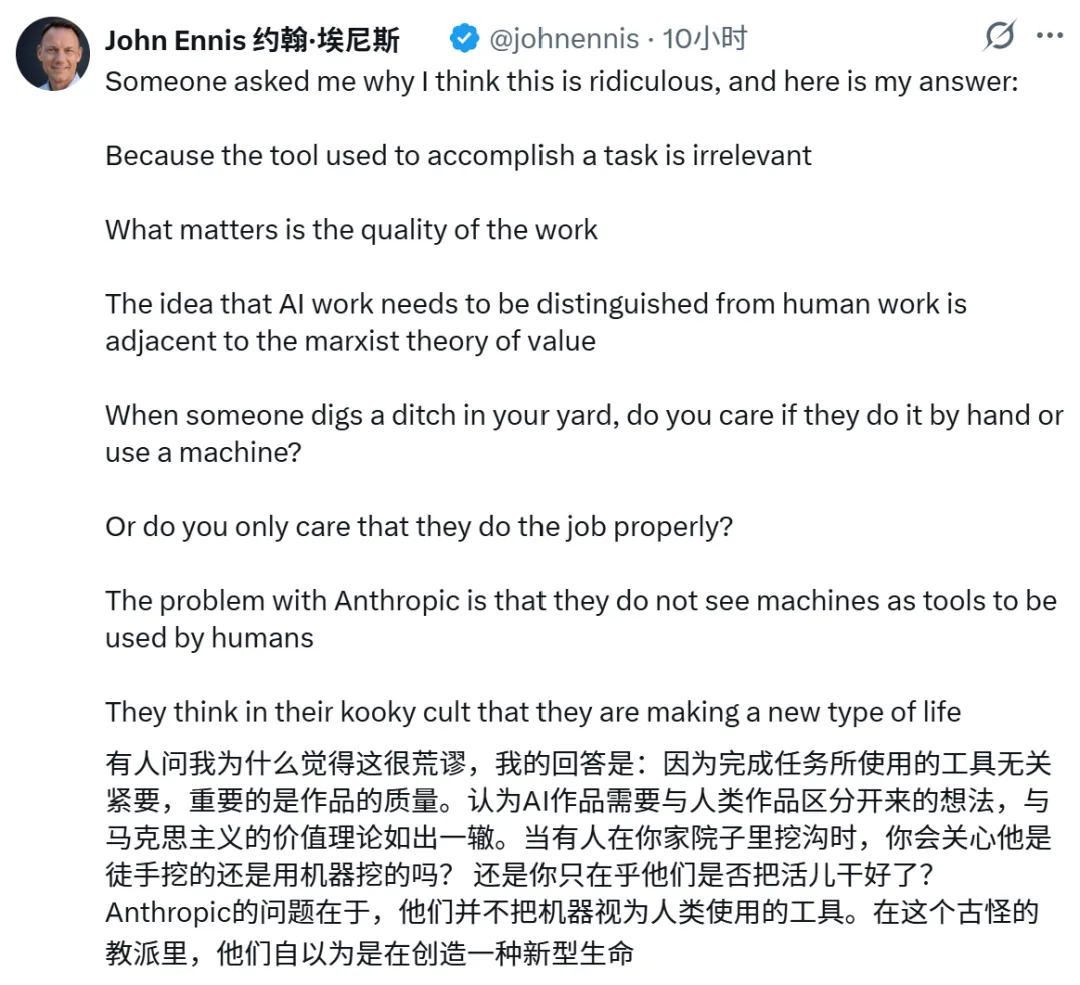
There's also a voice in the comments section: It's not about what tools are used, it's about the final quality.
Usually, readers or viewers are concerned about the authenticity of AI content, so the emphasis is on "this part uses AI" rather than "reminding readers to check the facts".
In the process, the verification pressure that originally belonged to content producers or platforms may unknowingly be pushed to readers and recipients.
On the other hand, if you want to "watermark", you have to ask the question: Is this really "AI written"?
What do you think?