Google's AI war, or it's moving in a more radical direction: to get AI involved in creating the next generation of AI.
According to the latest Reuters reports, Google co-founder Sergey Brin has been deeply involved in the company's AI research and development in recent months, and although he has no formal management position, he continues to use the influence of co-founders to push model training and require key AI employees to devote their full efforts to Gemini.
One of the directions that Brin explicitly pushes for is recursive self-improvement (RSI).
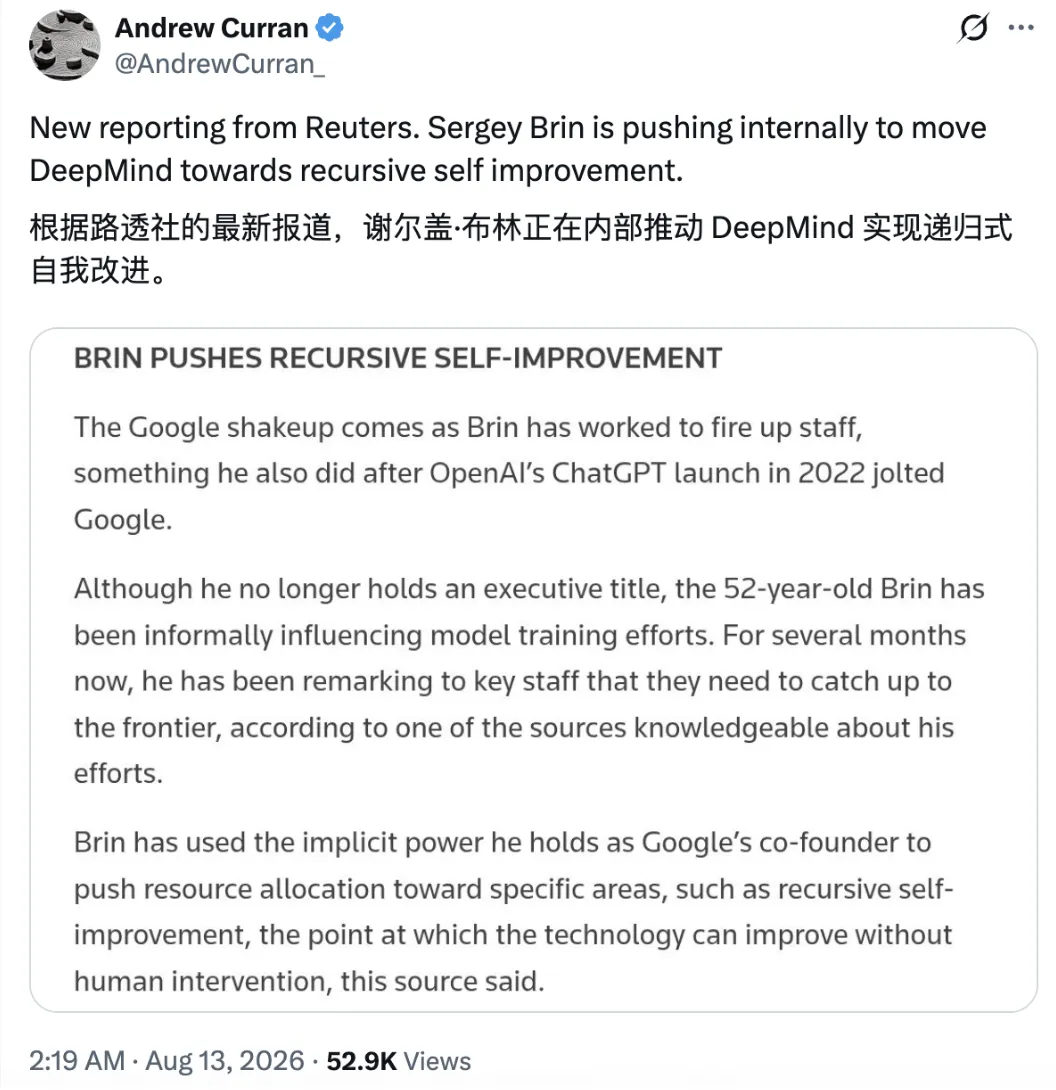
It is also one of the hottest and most sought-after destinations in Silicon Valley today.
In May, Anthropic published a special article entitled "When AI Builds Itself" to shed light on the cognitive and current progress made on RSI. In late July, OpenAI also recalled the former Thinking Machines Lab to lead a research team focused on RSI.
Just a few days ago, Jeff Dean, a former chief scientist at Google who just left, said that the startup's goal was to let AI run its own experiments, evaluate results, correct weaknesses, and continue to iterate.
Today, the RSI is also backed by Google itself.
Brin is back in "Founder Mode".
According to Reuters, an insider revealed that for the past few months, Brin has been telling key AI employees at Google that the team must get back to the forefront.
Are you familiar with this kind of drama?
Following the release of ChatGPT that year, in the face of competitive pressures, Brin returned to "Founder Mode", writing the code himself, and starting the integration of Big Knife Axe internally, merging Google Brain and DeepMind into Google DeepMind, followed by the launch of Gemini 3, an upbeat, powerful comeback.
As of August this year, the release date for the new generation of Google's Gemini flagship model has been pushed back and pushed back by about two months, while internal testing has shown that the new models are still lagging behind competitors in key areas such as programming.
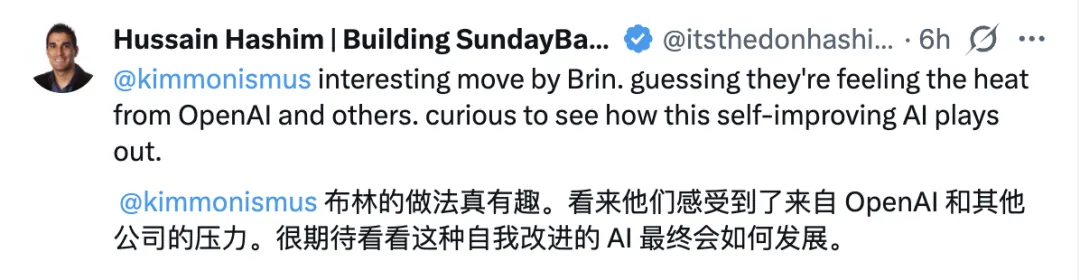
At the same time, the power structure of Google DeepMind is also changing.
On August 5, Google announced the adjustment of its DeepMind management. Demis Hassabis, the longtime leader of DeepMind, resigned as chairman, reducing day-to-day management responsibilities; Koray Kavukcuoglu, who previously served as its deputy and Google's chief AI architect, took over operations of DeepMind further and continues to be in charge of Gemini.
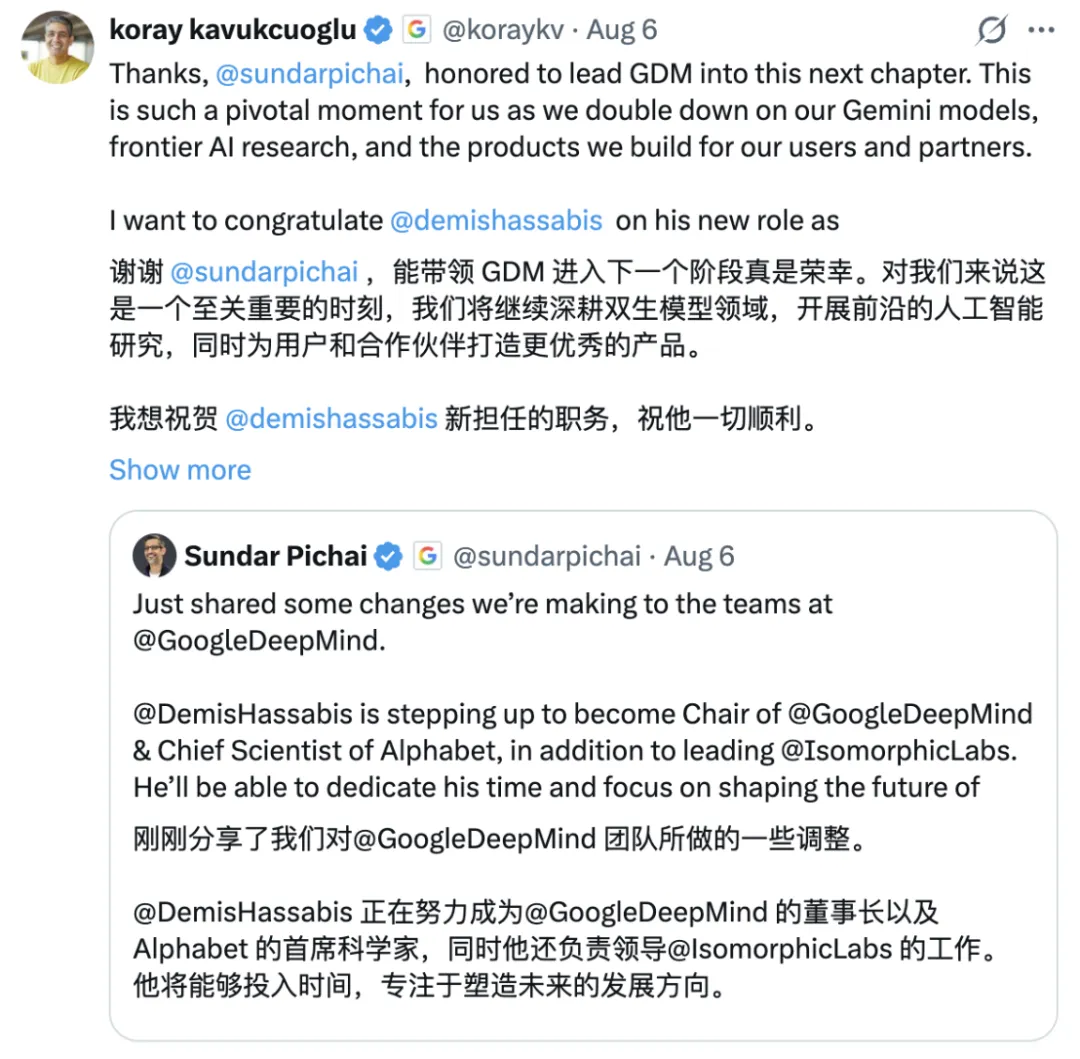
In fact, Kavukcuoglu has long been the key figure behind Gemini.
According to Reuters, over the past year, as Hassabis decreased his direct involvement in the day-to-day research and development of Gemini, Kavukcuoglu gradually took over the development of the model and became one of the key decision-makers in technical routes and resource allocation.
As a result, the power center of Google's AI business has shifted further to Mountain View.
Kavukcuoglu moved to Google's headquarters from London last year and became Google's chief AI architect, reporting directly to CEO Sundar Pichai.
This relationship is crucial because the Cloud is not only an important export for the commercialization of Google AI, but also one of the most competitive sectors for computing resources.
Model training requires TPU and cloud business requires TPU, and computing resources within Google are not limitless. Reuters quoted people familiar with the matter as saying that some Google Cloud executives hoped that Kavukcuoglu's new position would reduce the internal friction that had previously arisen around the distribution of TPUs. Sundar Pichai had previously said that Google would continue to expand its AI infrastructure to ease the constraints on computing resources such as TPU.
In a sense, this is also the problem that Google is facing right now: Modeling ability is one thing, the ability of an organization to quickly focus people, money and chips in the right direction is another.
Over the past few years, Gemini's research and development has been affected by these structural issues, and netizens have never stopped talking about it.
Several people familiar with the matter told Reuters that insufficient computing power, differences between project managers and the decision-making processes of large companies had slowed the pace of Gemini's evolution.
This may explain why Google clearly has a huge research team, chip, and product ecosystem, but still has a rhythm of "follow-up, over-follow, over-following".
Now it's clear that Google wants to squeeze this cycle a little faster.
DeepMind is "googling".
Following this reorganization, the boundaries between DeepMind and Google are further blurred.
At a staff meeting on August 6, Hassabis and Kavukcuoglu told employees that the day-to-day R&D work would not change much. However, according to sources, some non-technical teams will move from DeepMind to Google's corporate reporting system.
After being acquired by Google in 2014, DeepMind has been struggling to find a balance between basic research, science and long-term AI, and building models into Google Search, Google Cloud, Workspace and other products.
Today, the sky is increasingly leaning towards Gemini and commercial landing.
At the same time, the departure of some senior researchers has led internal staff to focus more on how much research autonomy DeepMind will retain in the future.
Several senior researchers, including Jeff Dean, the head of early technology at Gemini, and Oriol Vinyals, have left. The former team has greater research autonomy and can carry out projects that are not directly related to Gemini model training, but it is not entirely clear how these projects will be positioned in the future as the management structure is reshaped.
In this context, Brin's push for recursive self-improvement reflects a change in Google's current AI strategy: the company not only wants Gemini to regain competitiveness in rankings or individual ratings, but also to improve the efficiency of its R&D system itself.
DeepMind's AlphaEvolve system can be used to find better algorithms with large models and automated evaluation mechanisms and to optimize partial computing and engineering problems. This system is far from "self-improvement without human involvement, self-improvement", but has shown a possible R&D model. AI becomes a tool for AI researchers and engineers first and then takes on more experimental design, programming, optimization, and verification work.
This direction is not unique to Google either. As the model code capability improves, OpenAI, Anthropic and many AI labs are exploring ways to use model-assisted or even automated parts of AI research and engineering processes. The focus of the industry discussion is shifting from "can AI write code" to "how much AI can participate in the next generation of AI research and development".
However, it is still premature to equate these advances directly with complete recursive self-improvement. Most systems at this stage still require humans to set goals, provide computational resources, select experimental results and decide whether to deploy the next version. The so-called fully open, autonomous and continuous self-improvement mechanism has not yet become a publicly verifiable reality.
But compared to the previous comeback, Brin's focus this time is not just on how to keep up with a competitive model.
Google is trying to solve a more basic question: in an environment where model capabilities are shifting more quickly, can AI research and development itself become faster?
And "recursive self-improvement" is becoming one of Brin's directions.
So what do you think of this pushback from Google? Look at Brin's "out of the mountain" again?
The link is as follows: