Is AI starting to clutter information?
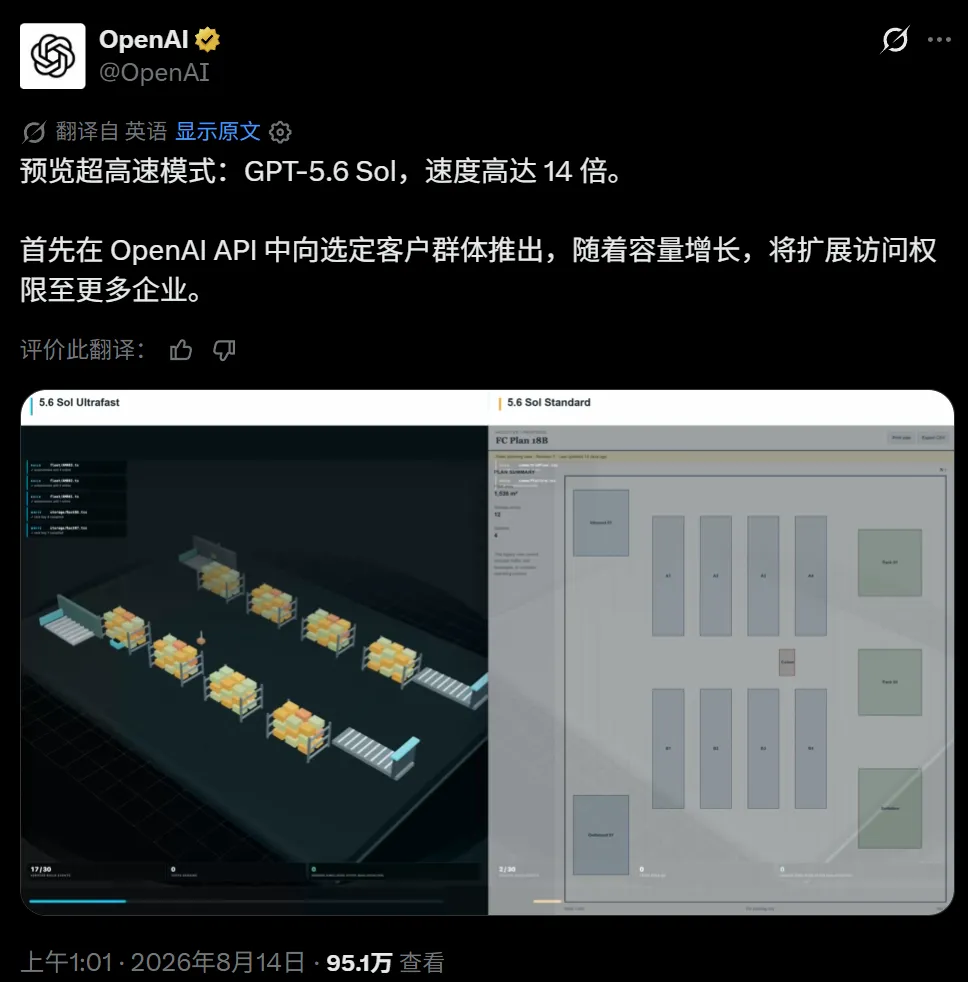
In the early morning hours of August 14, OpenAI's joint AI chip manufacturer Cerebras officially previewed its flagship model GPT-5.6 Sol's all-new service level "Ultrafast Mode".
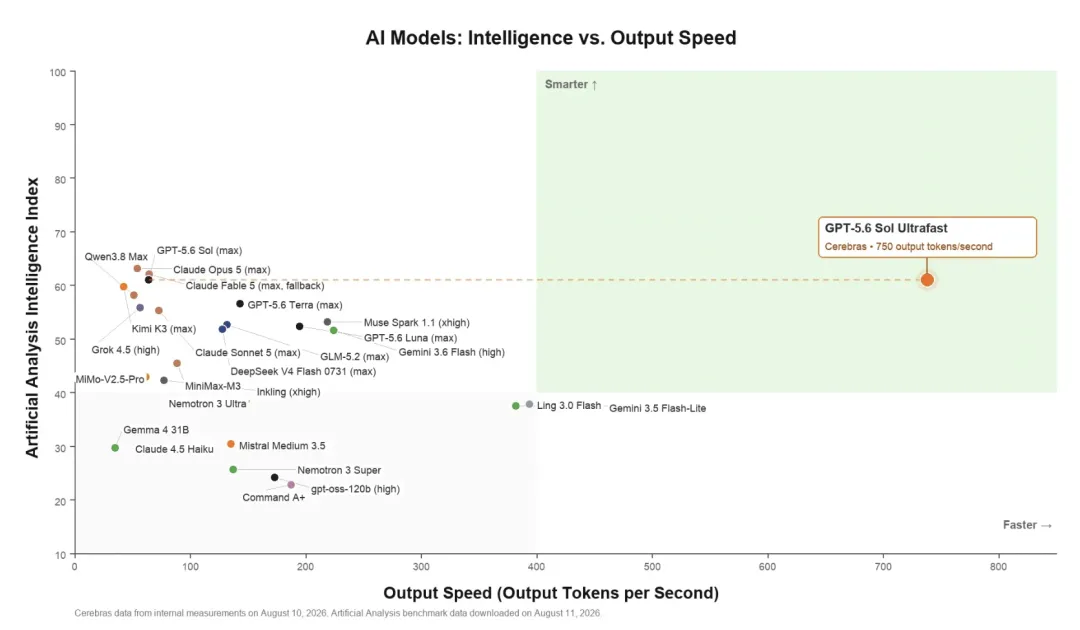
In this mode, the output speed of GPT-5.6 Sol is up to 750 tokens/s, up to a maximum of 14 times faster than the current standard model of about 53 tokens/s, while not reducing any quality. In horizontal contrast, the GPT-5.6 Sol accelerates 11 times faster than Fable 5 and 5 times faster than Opus 4.8 in Fast mode.
Ultrafast mode will be the first to be launched in the OpenAI API, with a limited preview version currently available for some customers.
To this end, OpenAI and Cerebras have compared the current speed and intelligence of the current advanced AI big model to a table, with the GPT-5.6 Sol Ultrafast in an absolute lead:
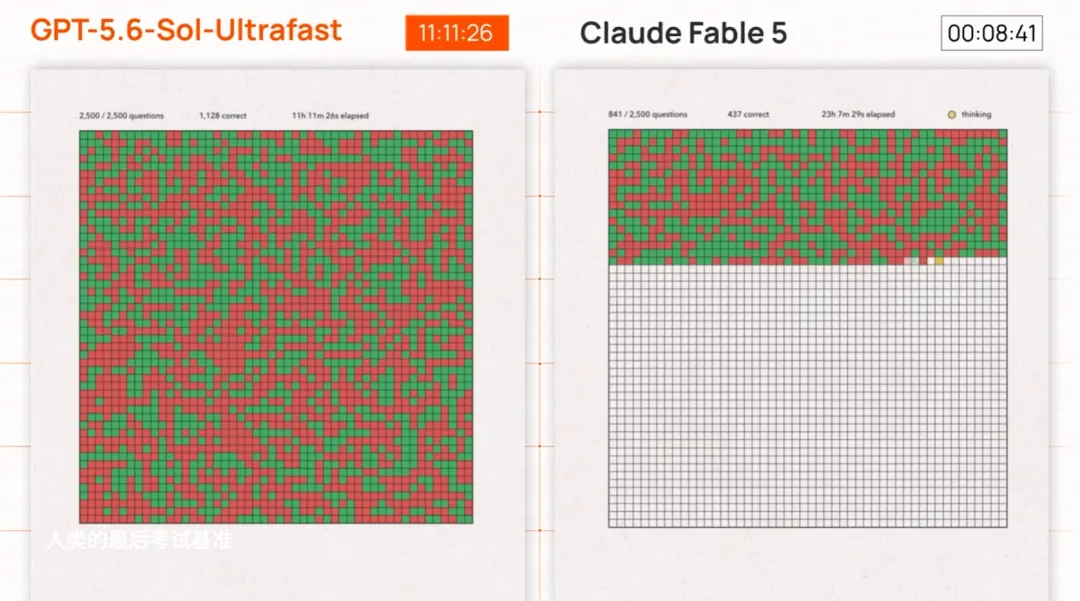
In a blog post on Cerebras, engineers presented tests on "Humanity's Last Exam, HLE", where they compared Ultrafast models to direct competitors. We know that HLE is a challenging model benchmark that contains 2,500 questions that can usually be answered only by PhDs in chemistry, economics, and literature.
GPT-5.6 Sol responded to all questions in 11 hours and 11 minutes in the superfast mode, while Claude Fable 5 took 78 hours and 27 minutes, or more than three days of continuous computation, to reach the same conclusion. The GPT superfast mode completed the cutting edge of human knowledge in just one working day, with almost seven times the accuracy of Claude Fable.
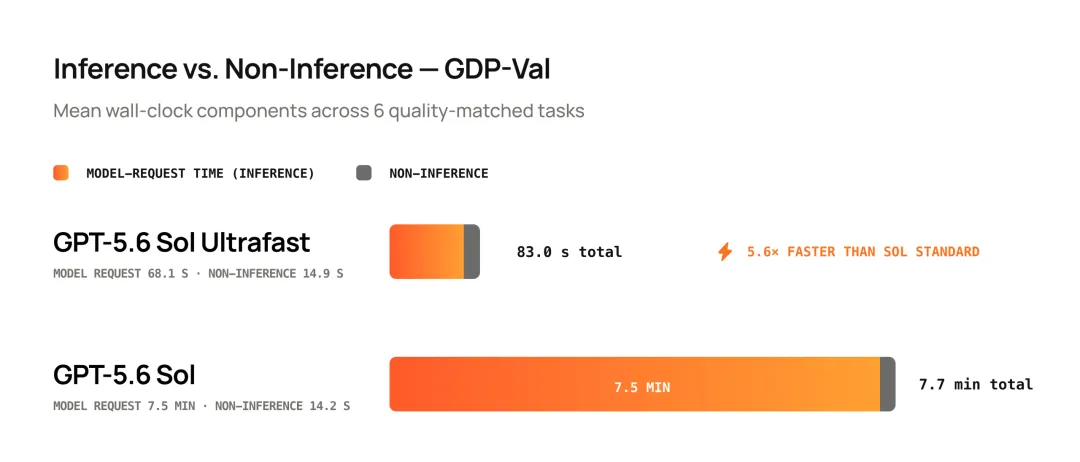
GPT-5.6 Sol is the best-performing model of OpenAI to date in legal documents, financial models, and engineering reports. Ultrafast has achieved an end-to-end speed increase of 5.6 times on the GDP-Val (measurement of economic value knowledge work task benchmark) and quality is unaffected, fully demonstrating how faster reasoning speeds can accelerate economic value work.
Faster AI processing speeds have increased the likelihood of emerging workflows, and people can now deploy smart bodies on key routes to the problem. OpenAI lists some application scenarios for you:
Incident response and reliability: When critical systems fail, AI analyzes application logs, recent code changes, and engineer reports to identify possible causes and help prepare a fix when a failure still occurs.
Financial research and security: analyze market signals, evaluate transactions and identify suspicious activity in the face of changing market conditions.
Customer support and voice: Resolving complex customer problems in real time without interrupting conversations, even if multiple steps or systems are needed to find answers.
Business: answering product questions, checking inventory, personalizing recommendations and solving billing problems while shoppers are still hesitant, to avoid hesitation evolving into abandoning a shopping cart.
Real-time research and experimentation: converting previously overnight research into interactive workshops that allow teams to test ideas, check results, adjust methods, and conduct another experiment without disrupting the workflow.
Within OpenAI, developers tested GPT-5.6 Sol in ultra-fast mode, an example of incident response using Ultrafast. When an alarm is triggered, engineers need to construct accurate event images while the system and evidence are still changing. With Sol-level intelligence, teams can quickly read logs, analyze tracking information, summarize conversations, determine next-step checks, and assist in preparing or verifying corrections. Ultrafast mode shrinks from observing signals, verifying assumptions to selecting the next action, while engineers remain responsible for judging and deploying.
In research, OpenAI teams use Ultrafast to quickly search for knowledge bases, query data, and quickly collect, organize, and aggregate information from different tools. A common process in previous studies was for team members to start a series of experiments at night and see the results the next morning. With Ultrafast, the discovery process can be shortened to support multiple iterations during the workday.
The breakthrough of the Ultrafast model was to break the memory bandwidth bottleneck of traditional GPU clusters in large models to understand the coding phase, achieving a wavelength hardware architecture that relied heavily on Cerebras.
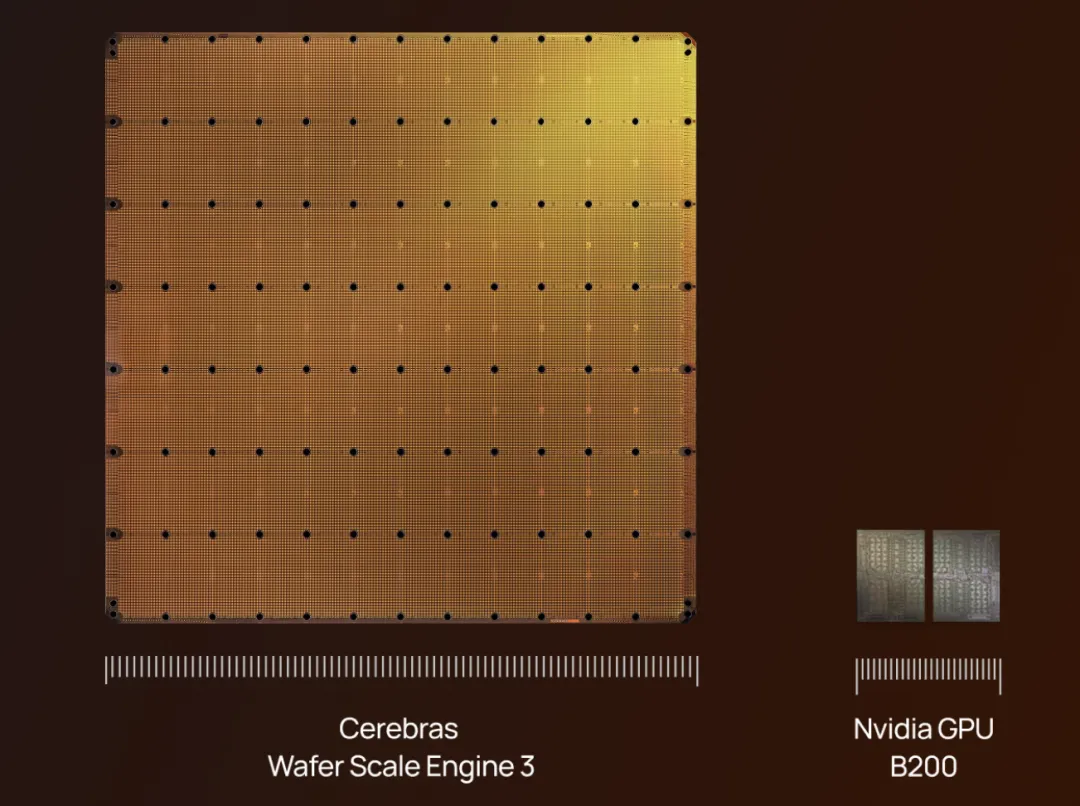
Among AI chip manufacturers, Cerebras's solution is unique: its generation of chips are made from whole wafers, integrating mass computing cores and ultra-high-speed networking into a single chip.
Traditional GPUs are limited to high-speed storage bandwidth when running large models of decoded tokens, requiring large model loads to be shifted back and forth between the HBM and the computing core, while multi-channel ports also cause communication delays across chip interconnections (PCIe/NVLink).
Each of Cerebras' newest wave-class chips (WSE-3) integrates 4 trillion transistors, 125 petaflops of AI computing power and up to 44 GB of high-speed SRAM on the chip, with model parameters directly residing entirely in the SRAM on the ultra-high-bandwidth chip, avoiding a repetitive waiting time for external memory load loads.
Of course, the GPT-5.6 Sol is the flagship model, with complete parameters clearly exceeding chip capacity. Cerebras also has a "multi-wavelength pipelined across wafers" mechanism, which distributes each network layer of the model on multiple wafers, with each layer's parameters permanently residing in the SRAM of their respective chips, allowing Token to flow seamlessly between wafers.
For many large-scale model users, the 14-fold speed of the flagship model means that previously many sub-models (such as Luna and Terra) have had to switch missions that can now be directly and confidently filled with blood, and for Agent tasks that require multi-cycle tool calls, code-generating layouts and complex chain-thinking, it would take hours to compress to minutes.
Faster speeds may also mean a shift in the way we use AI:
In the AI community, people are already waiting for the ultra-high-speed mode of the Luna and Terra versions, not knowing if the Cerebras chips are enough.
References are given below: