It's the first time in the history of the world.
The Chinese version of the Thinking Machines Lab has just been born!
Global speech and interaction have suddenly killed a hard-core AI startup that shocks the landscape.
It's called VUI Labs.
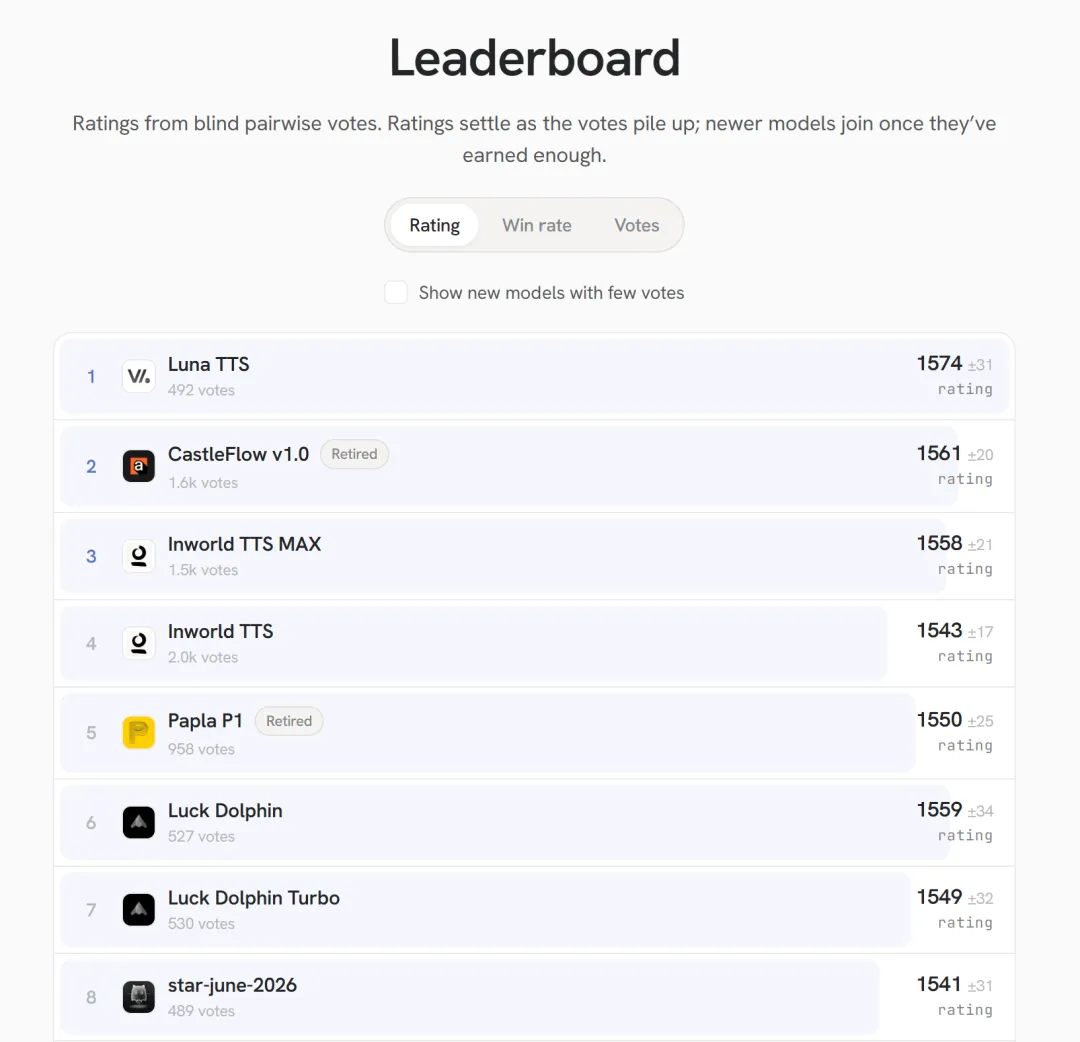
In one of the voice industry's most authoritative lists, the Hugging Face TTS Arena, VUI Labs' Luna-TTS models beat ElevenLabs, as well as domestic and international startups such as MiniMax, Cartesia, to the top of the world rankings!
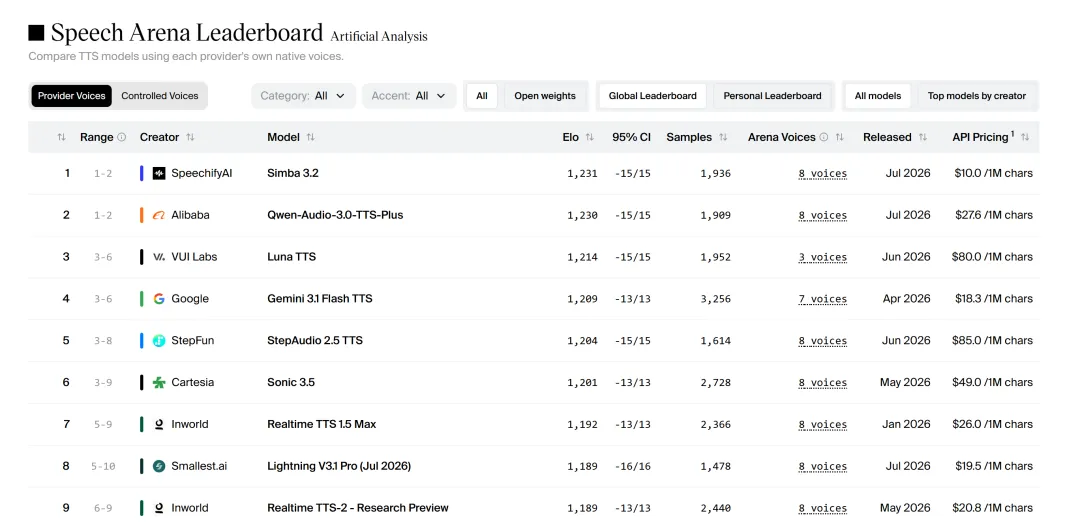
In the Speech Arena rankings of the independent AI rating platform Artificial Analysis, it surpassed Google directly and was ranked third in the world!
This stunning Chinese hard-core AI startup, with a vision of clarity and grandeur, is cutting from the high-precision TTS voice model to voice as the most natural and instantaneous interaction gateway, eventually embracing multi-mode and opening up the full-fledged Voice Agent loop.
Whether it's building a new generation of interaction paradigms with voice as a breakthrough, or the evolution of multi-modal baseline capabilities through real-time voice feedback, it shows a similar path to Thinking Machines Lab.
Now, the voice model from VUI Labs, which was released shortly afterwards, has swept through the list of global authorities and is unstoppable.
It's a great way to beat a giant to the top of the world's top 1.What is the Luna-TTS model?In the name of the people of Xi'an, in the name of Xi'an, the dialogue between Xi'an and Hu Liangping, is it real?
If I don't tell you the answer, you won't know.
It's true that this video is also about real AI.
In English, the game explains that the details of the physical pronunciation are very real, and the hearing experience is directly filled.
There is no contradiction to the soundtrack of the natural documentary, as if there were a voice actor behind it.
It is also very smooth in technical explanations.
Why is it that today's voice AI is so good to hear, but is so harsh when emotionally aroused, that it manipulates the unnatural voice cavity?
It's not that the non-mainstream self-reporting AR model isn't powerful enough, but rather that its "word-by-word generation from left to right" text logic makes it difficult to fully illustrate the complexity of multiple dimensional simultaneous changes in sound.
Emotions, sounds, and breathing are intertwined in human speech; and AR architecture, which forces single-directional generation, not only prolongs the delay of long sentences, but is also very likely to trigger cumulative "step-by-step errors".
In order to break through the mechanical ceiling, VUI Labs' Luna-TTS offering a completely new break-in route completely disrupts this traditional architecture.
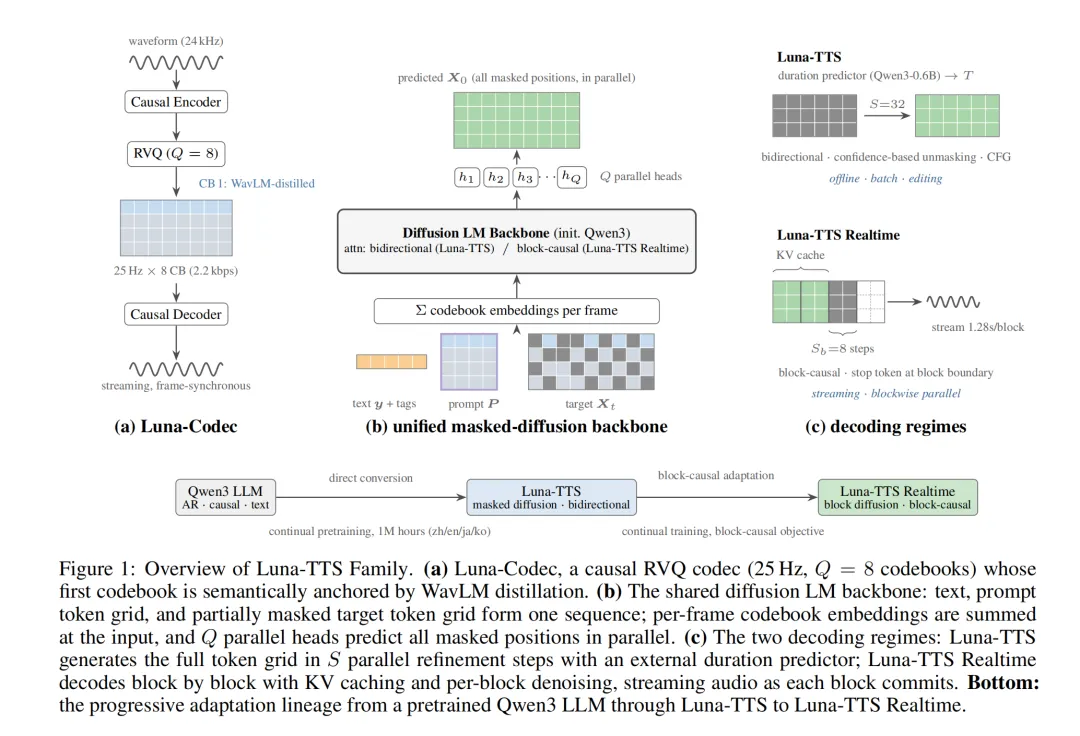
Luna-TTS has transformed the traditional "Token-by-Token voice generation" route into a voice generation system that is more like a distributed model, while also creating a dedicated real-time stream branch.
Specifically, it compresses sound into discrete tokens suitable for processing language models, and allows a Qwen3-based modified Diffusion LM to simultaneously predict the volume of voice tokens; when real-time conversations are required, it further transforms block-generated Luna-TTS Realtime.
The results of the architectural transformation are amazing.
arxiv:
github demo page:
World No. 1 in six indicatorsLuna-TTS has done a very prominent nature and stability on all five levels of "like a real person".
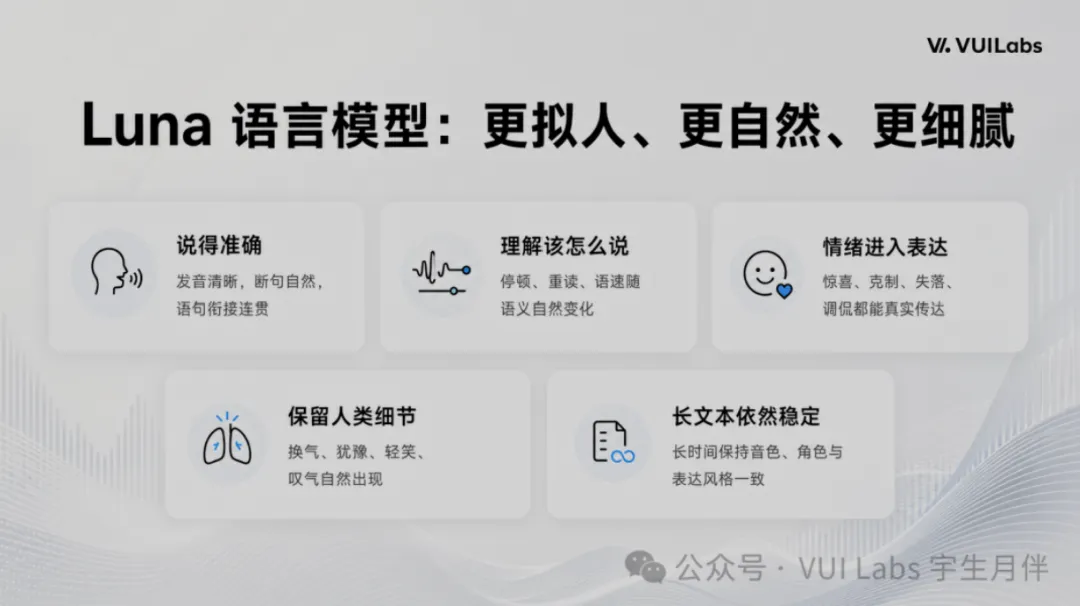
It speaks accurately, and the pronunciation, pronunciation, and syntax of sentences are naturally coherent.
It contains a sufficiently low-pitched tone and low-pitched pitch.
What is even more difficult is that it can switch emotions according to different contexts in a state of surprise, restraint, loss or toning, and it produces completely different sounds.
Humans' changes in mood, hesitation, laughter, sighs, and subtle changes in mood during speech constitute the essence of real communication, and Luna-TTS presents these messages in the voice.
Even in lengthy spoken text, it can still be expressed steadily.
It also has the ability to clone audio and video directly. It takes only a few minutes for a sample to reproduce a speaker's voice, tone and even breathing rhythm.
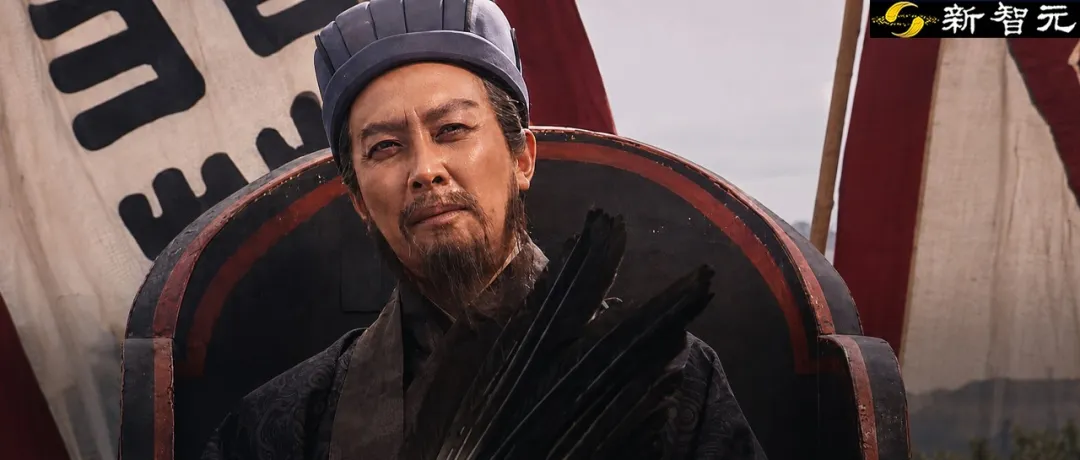
For example, the classic Italian cannon plot in The Bright Sword.
It is also the place where the Genghis Khan attacked Wang Long in front of the two armies.
The Han Chinese version of the soundtrack, which has been completely restored to the original soundtrack, is completely lost, and the soundtrack is oppressive.
Six firsts: four sound quality indicators + two model efficiency indicatorsIn the latest technical report, Luna-TTS not only took first place in the four indicators of voice quality in the Seed-TTS-Eval evaluation (which significantly outperform the byte Seed, MiniMax, Intelligent Spectrum and Qwen series), but also in the CV3-Eval evaluation, which demonstrated remarkable error correction and noise resistance in "outdoor" complex environments.
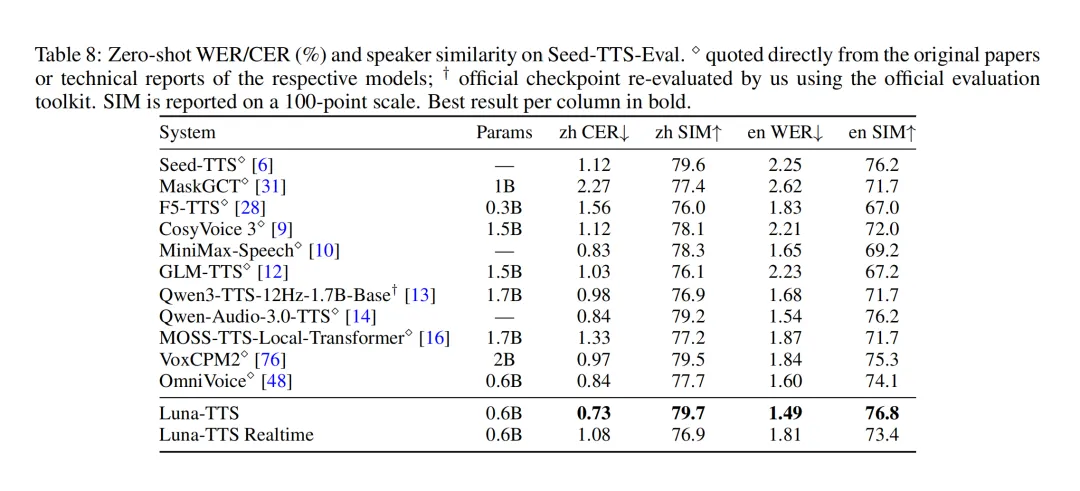
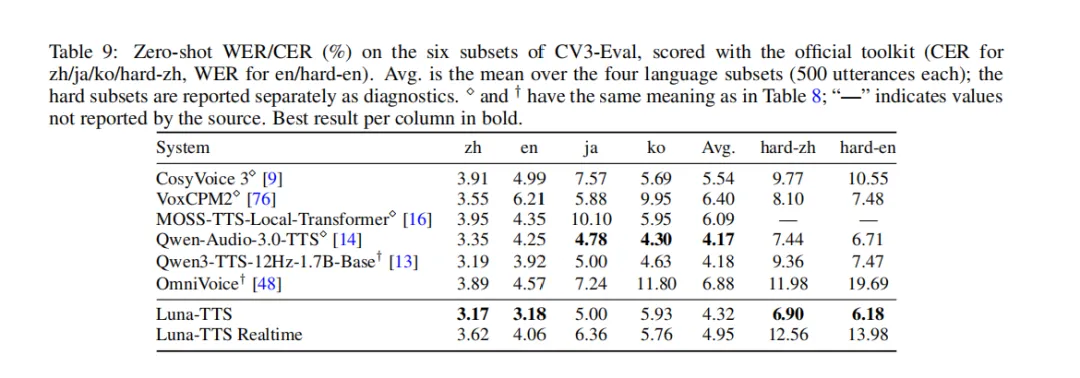
The first four are extremely high in gold.
In addition to the performance indicators of voice quality, it is also the first in the two efficiency indicators of first-pack delay and real-time rate.
In summary, the best voice quality, the highest production efficiency, the lowest initial packaging delay.
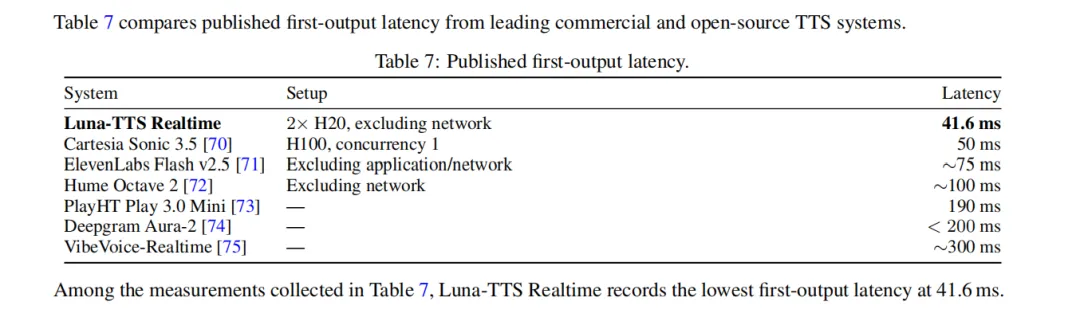
The first package delayed the world's first
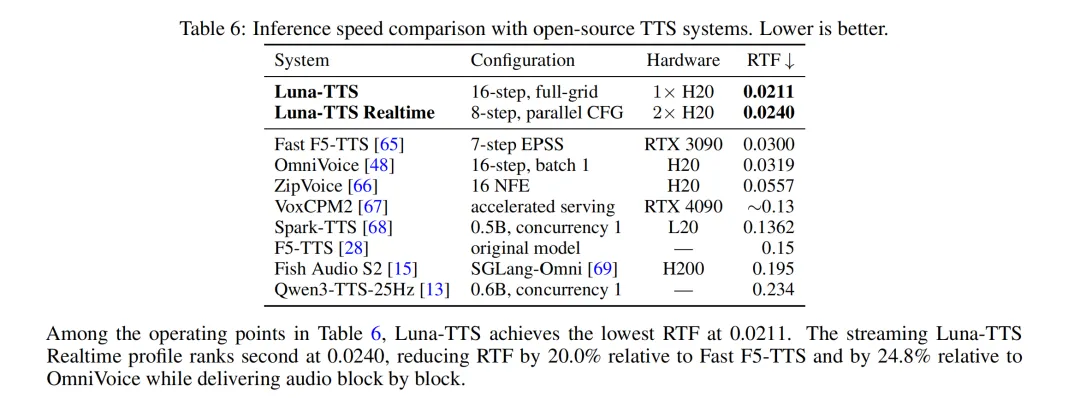
End-to-end real-time rate (RTF) is ranked first
Where is the cow? The core is the following breakthrough.
Architectural evolution: from pre-trained AR language models to Block Diffusion's "three steps"
In the field of TTS, starting from the baseline language model is an industry-recognised valid paradigm. The text model naturally has strong multilingual text understanding, word order, spelling rules, and writing system modeling capabilities in complex languages (such as Japanese).
Therefore, the team did not train the acoustic model from scratch, but started from Qwen3-0.6B and designed a clear progressive transformation route.

In benchmarks such as CV3-Eval, there is a large amount of "difficult text" such as long sentences, irregular punctuation, and complex vocabulary.
In the face of this difficult text, a two-way spread architecture is more appropriate.
The reason for this is that the AR model itself has great limitations.
The regression model uses the left-to-right Next-Token prediction that once a small deviation in the pre-period sample occurs, the error will permanently freeze in the Prefix and roll up as a snowball accumulation, leading to the common jump, repetition, and swallowing of TTS.
This reflects the advantages of two-way Diffusion: TTS differs from free text generation in that the semantic content of the audio output is essentially highly constrained by the input text.
Bi-directional masking diffusion allows the model to see the context of the global past and future at the same time while de-noise, by refining dynamics with confidence and correcting local errors, which greatly eliminates the exposure bias.
Tokenizer innovation: Luna-Codec's "semantic consistency" blends with acoustics
The second is the innovation of Tokenizer.
In multi-code Residual Vector Quantization neural encoders, if end-to-end reconfiguration training is conducted directly, the first few codebooks tend to get involved in subtle spectral details prematurely, leading to extremely unstable predictions of text to audio tokens.
For this purpose, Luna-Codec adopted an 8-code architecture, reaching 25Hz at a sampling rate of 24 kHz (~200 tokens per second).
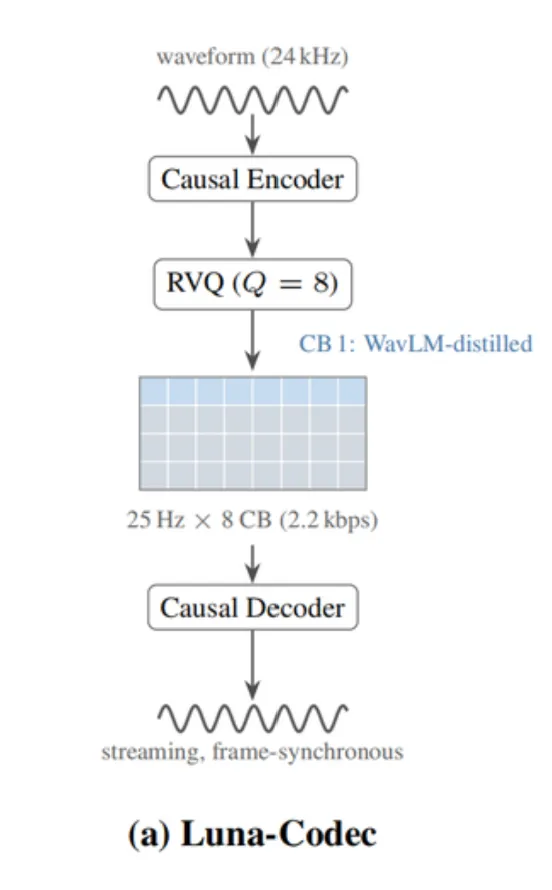
While training Tokenizer, the team distilled Loss semantically by introducing additional pre-training WavLM, forcing language/semantic information to be "determined" in the first layer of code book CB1.
CB1 is responsible for providing a stable language/syllable skeleton, while the remaining CB2 CB8 codes are free to capture tones, ambient sound pathways, emotions, and rhythmic details.
This layered design from "semantics to acoustics" significantly reduces the difficulty of spreadsheets predicting the entire audio grid from text.
Reinforced learning breakthrough: GRPO migration on discrete masks spread model
One of Luna-TTS's core algorithm innovations is to successfully migrate to a non-self-returning discrete masking scattering model based on GRPO reinforcement training.
In traditional self-recurring voice models, strategic gradient updates can be performed sequentially along a chain probability breakdown of "from left to right".
However, Luna-TTS, as a non-self-return masking scattering model, is capable of generating parallel audio grids through multi-step alternation of noise and cannot directly calculate the output probability according to the chain rule.
In order to solve this problem, Luna-TTS successfully migrated GRPO to a discrete masked scattering model, centered on trajectory perception and dictionary sequencing rewards.

Block Diffusion and Engineering Landing
In order to accommodate both Agent and real-time interaction scenarios, the team proposed Luna-TTS Realtime real-time voice synthesis.
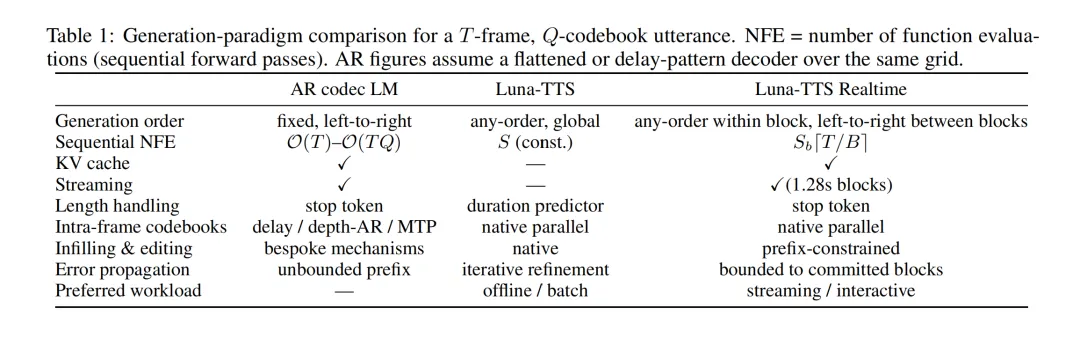
In this process, the voice is not generated step by step, but is cut into a small block of 1.28 seconds (32 tons) between blocks using a self-return method (supported by KV Cache acceleration), while the internal block goes through 8 to 16 steps in parallel to generate 32 tons and 8 codes at a time, which is extremely efficient.
Its detection performance was so impressive that when it was deployed in parallel with CFG on two H20 GPUs, the first packet delay (TTFT) of only 41.6 milliseconds could generate and decode the first 1.28-second audio block, almost without feeling the need to wait.
The real-time frequency rate (RTF) is down to 0.024, which means that it takes just 24 milliseconds to generate 1 second of voice, more than 40 times the real-time speed, and fully meets the needs of fluent conversations.
In order to make the commercialization of scenarios such as long-text readings, full-fledged business conversations, the team has done several key supports on the engineering side.
For example, they made reasoning synchronous with cache optimization, using the vLLM-Omni framework, to achieve cache resolution and streamlined chunk deliveries, ensuring that long-term reasoning does not explode cache and response is smooth.
In addition, the team normalized the text: "Models are easy to read" text for specific symbols and numbers, and built a complete set of front-end preprocessing modules to ensure that models can "read correctly, read smoothly", no matter how complex the input.
Data Engineering and Real Emotional Control
Luna-TTS surpasses ElevenLabs in dialogue hearing and performance, and is based on millions of hours of extreme data engineering and special firefighting mitigation.
First, before the Modeling Society "expressed emotions", the team built a database of up to 1 million hours of refined multilingual speech content, covering Chinese (43.4%), English (43.1%) and Japanese and Korean (13.6% combined).
Second, the team selected about 100,000 hours of "extremely high-quality" voice subset for firefighting training, which greatly improved the accuracy, robustness and natural pitch of the voice.
Finally, during the third phase of the training, the team introduced expressive voice data with fine labeling.
These tags are not only simple speech-level emotional tags (such as [happy], [angry], angry, [sad], sad) but also more innovative additions to non-African language pronunciation tags (NVV) such as [laughs] [laughs] [sighs] [sighs] [sighs] [gasps] [asphalt] [coughs] [coughs] etc.

These control tags are not extra modules, but are directly input to the model as a text prompt, without the need for additional style encoders or control heads.
In this way, the model can be placed in the right text position and naturally take out breaths, sighs, mood swings and sounds more like a real person than a mechanical reader of the manuscript.
In this way, Luna-TTS succeeded in bringing together "high-quality performance" and "extremely low latency" in the field of TTS.
It has both emotional performance and low latency requirements for real-time scenarios, allowing widespread voice generation to reach a new ceiling.
He is a left-handed top scientist, a right-handed commercial keyboard player:A dream-making iron armyIn this crowded racetrack of AI models, spelling and spelling parameters are important, but ultimately it's people.
VUI Labs has been able to bring the technology to the top of the world in a very short time, not separated from the luxurious core team.
If one word is used to describe the genes of VUI Labs, it is: dual-nuclear drive.
One of them is the absolute top power of scientific research.
Prof. Chen Yi, founder and chairman of VUI Labs, is an associate professor at the School of Computing and the School of Artificial Intelligence at Shanghai Transportation University.

This year, at the age of 38, he was selected as the top scientist by the Ministry of Education Jiangsu, with an excellent track record: a PhD in Electronic Engineering from Tsinghua University, a postdoctoral fellow at Cambridge University's Machine Intelligence Laboratory; a recipient of the National Excellence in Youth Science Fund; the first winner of the TCM Young Science Award - Information and Space Award.
Moreover, as the first person to complete the project, he won the highest honor in the Chinese AI community, the first prize in the Natural Sciences of Artificial Intelligence.
In this fragmented and highly barriered area of the end-to-end speech model, the research team led by Prof. Chan is ranked 3rd in the world and 1st in the country in terms of paper citations for almost 5 years.
Currently, he has published over 350 papers and has been cited over 20,000 times by Google Scholar. He is a recognized trailblazer in the international speech technology community and serves as chairman of the IEEE SLTC International Committee on Speech and Language Technology Awards.
The other core is the amazing commercial transformation capabilities.
Technological achievements can't just stay on a lab shelf. VUI Labs' founder and CEO, Megger, is a successful entrepreneur with a strong commercial sense.

During his tenure as Aircourse/Love Class COO from 2017 to 2022, he managed a huge team of 800 people in just three years, bringing the company's annual revenue to over 500 million yuan.
He is best known for transforming cutting-edge technology into delivered industry products, from POC verification to the "last mile" of scalable online delivery.
In addition to the two ghost characters, VUI Labs also brings together a group of "genius brains". The entire research and development team consists of nearly 50 people, with PhDs accounting for up to 50%.
Such an all-powerful team that knows the cutting edge of algorithms, understands the engineering landscape and understands the business cycle better laid the strongest foundation for the creation of the "Thinking Machines Lab".
$740 Billion Market: Let AI Really Make Money at WorkVUI Labs has been targeting real-world business from day one.
To this end, they have built a clear three-tiered product system:
Model API: provides the underlying capabilities of voice generation, voice cloning, recognition transcription, real-time translation, performance at the top level globally and service stability and reliability;
Creators and developers platforms: providing tools such as voice-creation, long-text synthesis, multi-character rendering, voice management and project outputs, and integrating image, video, and music generation capabilities to cover the entire creative process from creation to completion;
The VoiceAgent platform: enabling voice recognition, language modeling, tools for calling and voice generation, providing full-fledged services ranging from scenarios, knowledge base configurations, low-latency dialogue sorting to deployment online, helping businesses quickly build conversational, task-enabled voiceAgent.
This practical approach has been scaled up in scenarios such as logistics scheduling, Internet insurance, wine-growing SaaS, and more than one million real business conversations have been completed by several customers.
In these scenes, Luna-TTS is a real "super employee" who works as a customer, a salesperson, a conference assistant, a translator and a manager.
It is estimated that by 2030, the three-tier capability of voice + vision + collaboration will grow from $266 billion to $74 billion.
VUI Labs, standing right here at the entrance.
China's next AI campaign:Becoming a human AI TeammateIn the world of the future, we don't need more cold-cold questions-answering robots, we need AI voices that breathe, think, and collaborate like humans do.
They are using their full-scale SOTA technology to prove to the world that the Chinese team is leading the world on this AI Voice track.
The Chinese edition of Thinking Machines has arrived. It is on the rise in every corner of the industry.
This time, the most natural way of interacting will be the most powerful productive force in the business world.
Finally, the official website of VUI Labs: