It's the first time in the history of the world.
Yesterday, X account was registered in the wild by Huang In.
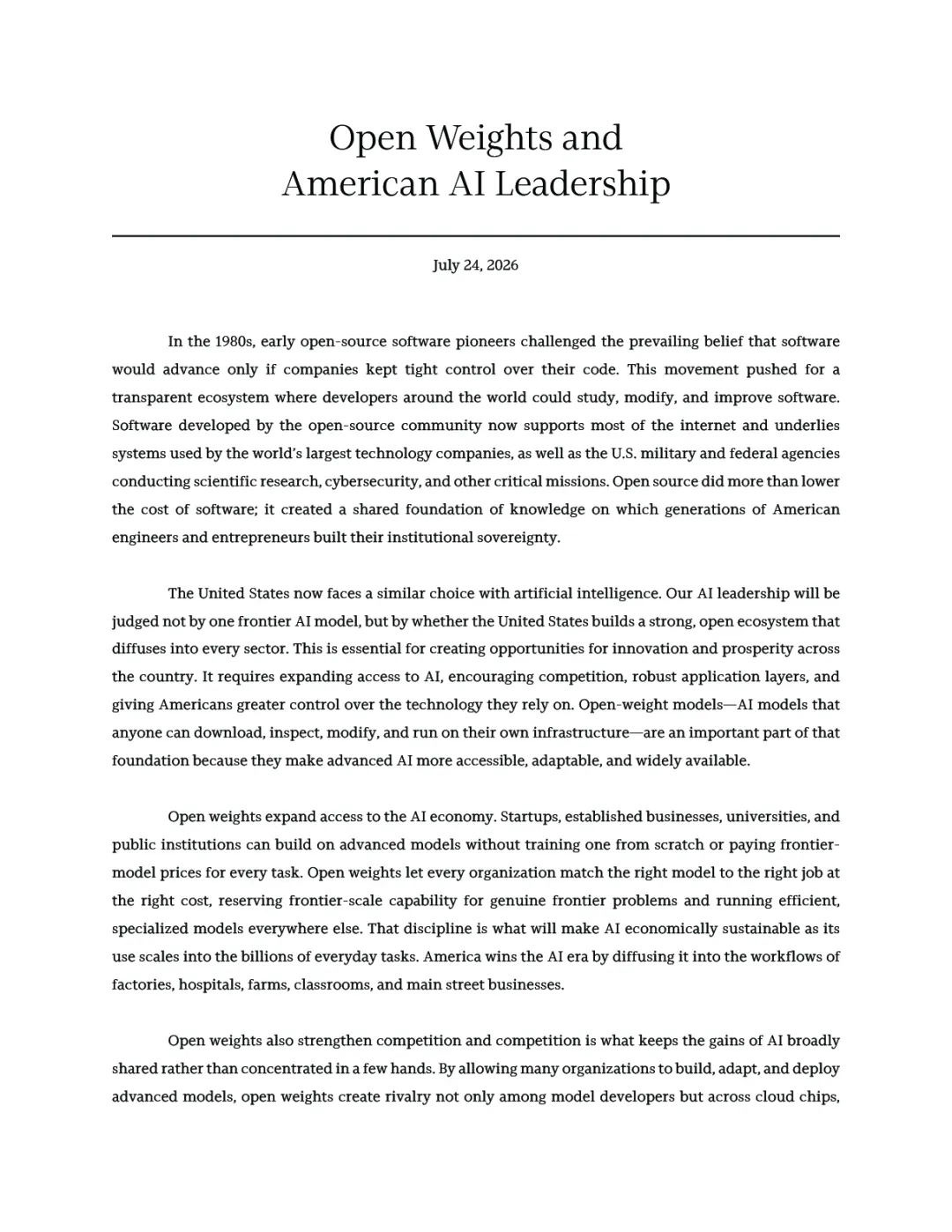
His first post, with no products, no chips, was an open letter titled "Open Weights and American AI Leadership".
Invisalign is one of the 25 signatories.
The list of signatories spans a number of industry chains: Intel and Dell for hardware, Meta and Microsoft for platforms, Hugging Face and Mistral for open source models, a16z and Y Combinator for investments, Mozilla and Linux Foundation for the open source community, Palantir for defense and intelligence, CrowdStrike for cybersecurity.
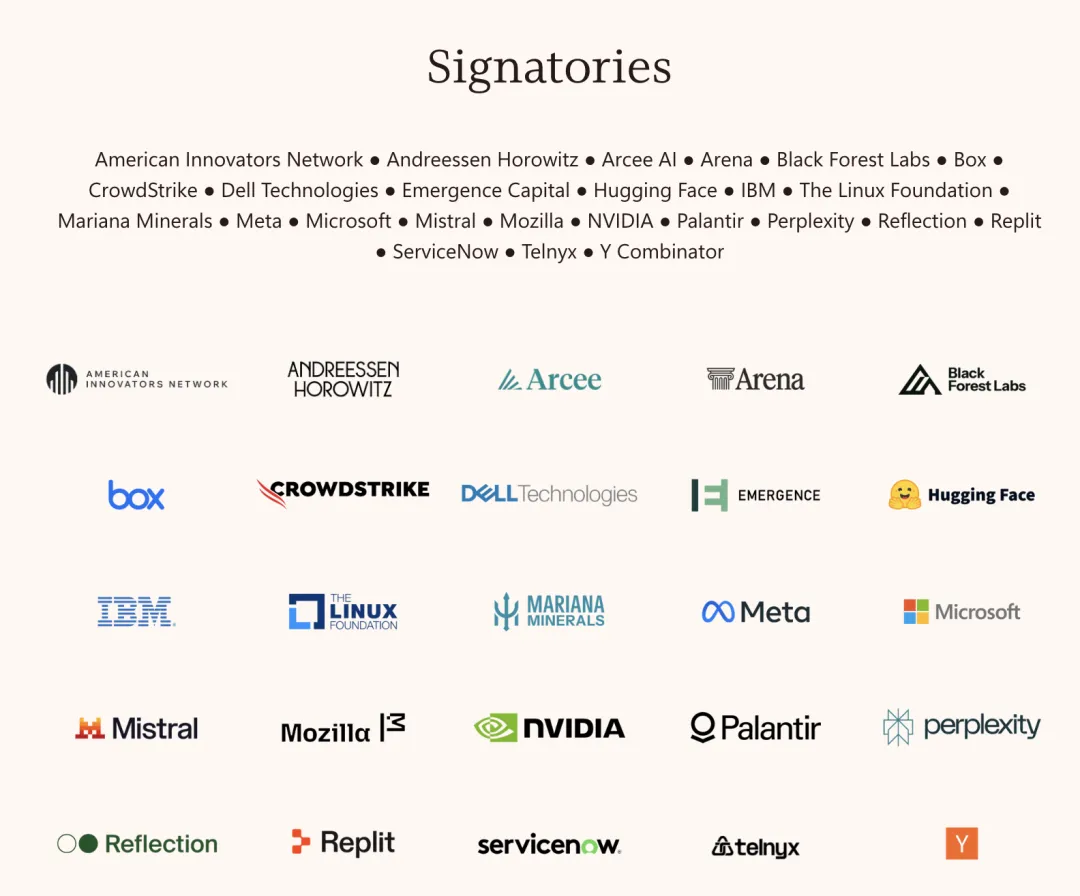
The three most important names are missing from the list.
OpenAI, Anthropic, and Google ranked the top three closed-source front-end labs in the U.S. without a signature.
Huang Yin wrote in a post:
The world needs both frontier closed models and frontier open models.
The world needs a cutting-edge closed-source model as well as a cutting-edge open-source model.
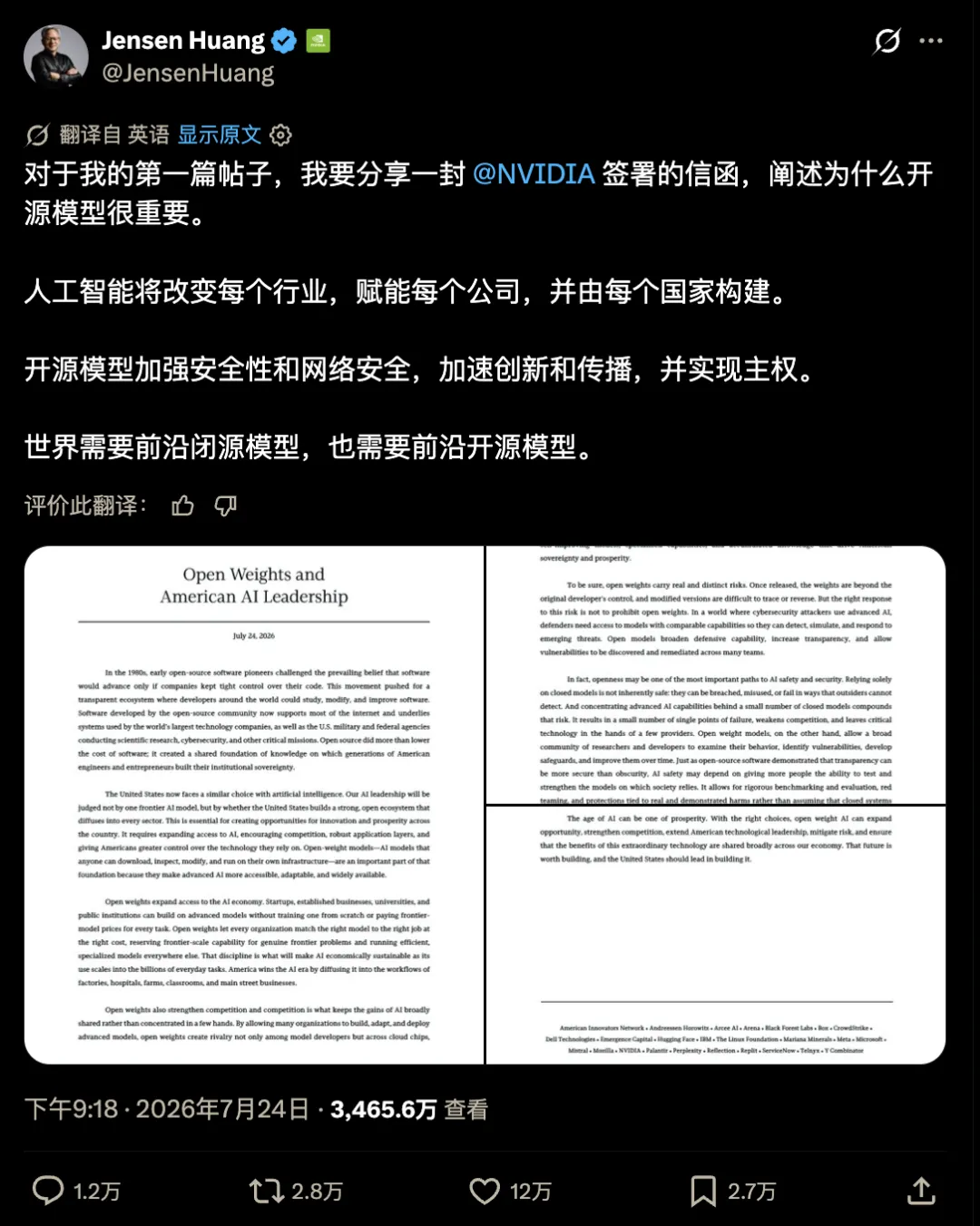
The sentence sounds like a reconciliation between the two sides, but he chose to write it in his first post to give a post to a closed-source camp that refused to sign.
One letter, two profit modelsThe letter, which is more than two thousand words long, summarizes the core argument in one sentence: The open-weight model allows AI to become the infrastructure of all industries from the exclusive technology of a handful of companies, and the leadership of AI in the United States depends on whether this proliferation happens.
Open empowerment means that startups, universities and public institutions do not have to train models from scratch, nor do they have to pay the price of a flagship model for each task.
The original text of the letter was:
Leave the front-end capability to the problem that really needs the front-end capability, and use efficient dedicated models for the rest of the scenario.
This multi-layered use could make large-scale applications of AI economically sustainable.
The letter also makes a safety argument: with only a few closed-source models focused on supplying defense capabilities, it is equivalent to manufacturing single-point failures, and open weights allow more teams to participate in security offensives.
But one of the most important passages of the entire letter is contained in the second paragraph of the countdown.
The letter asked policymakers to distinguish between two things:
The distillation of one model for training or improvement of another is a legal technique widely used in academia and industry, "reflecting a long tradition of learning, drawing on and improving existing technologies";
Trying to extract the wrong value from the closed source model is another thing.
The latter should be addressed through a "targeted legal and business framework" rather than restricting the distillation technology itself.
This passage directly addresses the most sensitive policy debate at the moment.
To understand why it is sensitive, it is necessary to understand the economic interests of the signatories and the parties absent.
The business model of the 25 signatories has one thing in common:Profits are linked to the popularity of AI.
Invidia sells training and reasoning chips, Meta uses Muse Spark to build a developer ecosystem, Microsoft sells Azure cloud computing, a16z and Y Combinator to launch application-level startups.
The more AI spreads, the better business these companies are doing.
The business model of the three absent parties is exactly the opposite: their valuation is correlated with the degree of exclusivity of the frontline capabilities.
Both OpenAI and Anthropic are valued at $1 trillion, and the core narrative is that "only a few labs can train the strongest models".
Their revenue comes from API call and subscription fees, with pricing based on ability to lead.
This pricing base would be eroded if the ability to open weight models approached the forefront.
One of the economic arguments in the letter reads:
The price of front-end models is not sustainable in the long term, so it is necessary to have open weights to take on demand.
For the signatories, this is industrial logic and for the absent party, it is an empty argument for valuation.
The three absent parties each have accounts.OpenAI's position is the most subtle.
CEO Sam Altman posted on X that day, expressing support for the United States to stay ahead on both open source and closed source lines.
But OpenAI did not sign the letter.
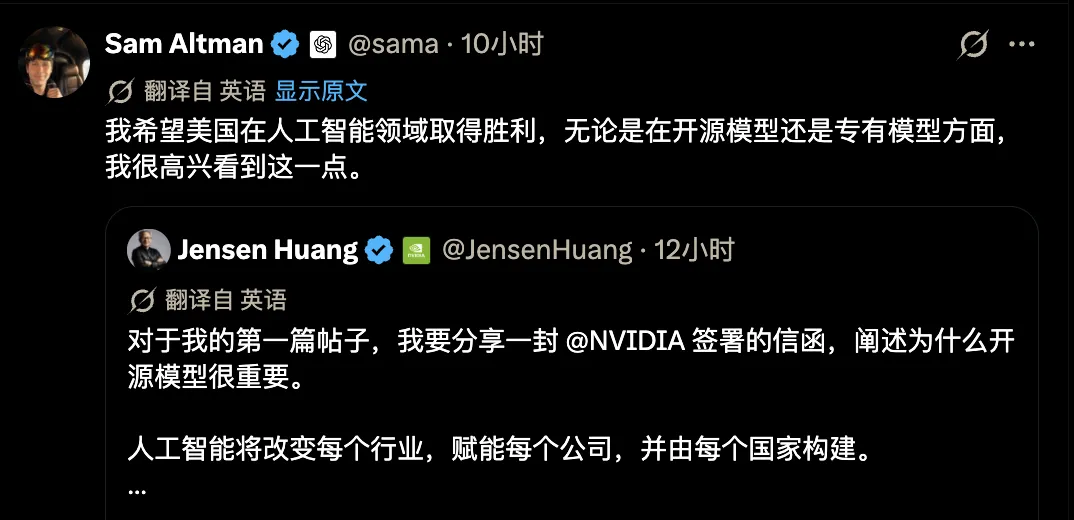
Oral support and refusal to signIt's not a big deal.The logic behind this operation is clear.
Musk also said "full support" on X, but SpaceX did not sign either.
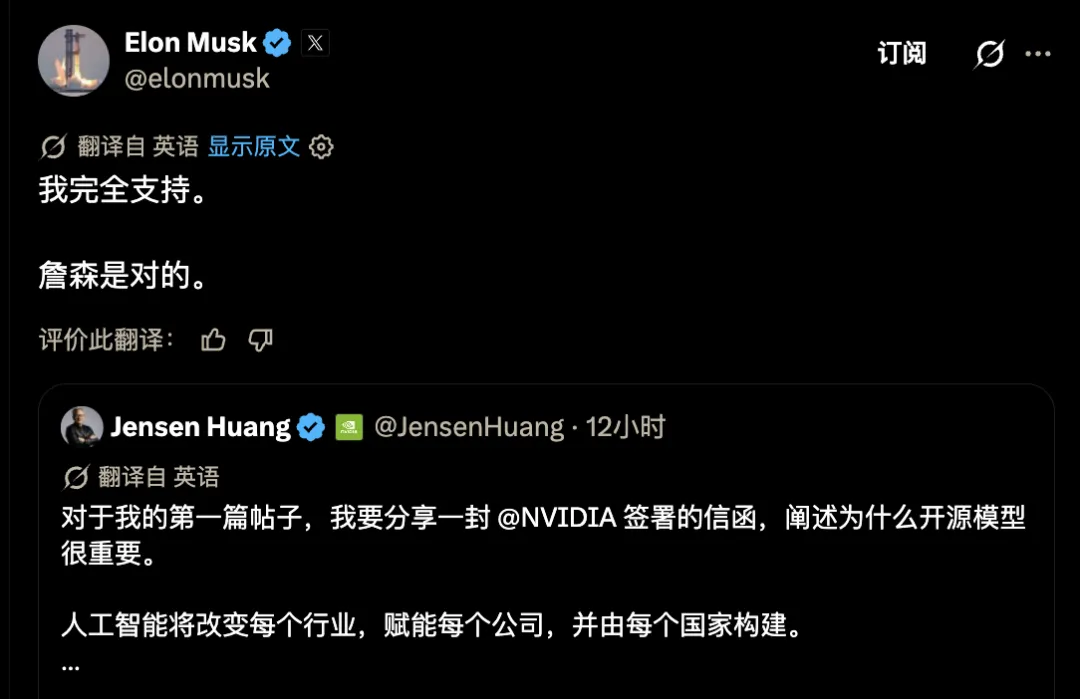
There is no cost to write orally, but there is a legal and political cost to sign.
For OpenAI, the distillation clause in the letter is dead-end.
OpenAI has continued to warn the U.S. government and the public about distilling over the past year, a position that is consistent with some government officials.
Signing this letter is the same as withdrawing the chips you have already placed on the policy table.
Both OpenAI and Anthropic are pushing for an IPO, signing an open letter during the S-1 secrecy review period stating "Front-end model prices are unsustainable".
The absence of Anthropic is not a suspense.
CEO Dario Amodei has publicly argued that once the weight is released, developers lose the ability to revoke access, update protection and prevent misuse.
Anthropic has not yet released any open-source models.
Earlier this year, Anthropic formally sent a letter to U.S. lawmakers expressing concerns about distillation.
It has a clear stance in this debate, signing a letter entitled "Distillation Technology", which is in direct conflict with this stance.
Google operates both closed-source Gemini and open-source Gemma, and the two product lines run in parallel.
Google is currently significantly lagging behind OpenAI and Anthropic in the front-end model competition, where it hopes to win the Gemini 4 back-to-back, a bet on the ability of the closed-source front-end model.
The three closed-source front-end laboratories are collectively absent, exposing cracks in industrial structures.
Distillation narrative: a bullet used by both sidesThe distillation took years for academia and industry to publicly describe it as "part of a long-standing technological tradition".
But in recent months, distillation has become the most controversial topic in the U.S. AI policy debate.
The debate focuses not on the technology itself, but on how to define the boundaries: what distilling behaviour belongs to normal technological improvement and what belongs to improper extraction of commercial value.
The position of the closed source camp is: stricter borders are needed.
The scenario they're worried about is: billions of dollars' worth of trained front-end models are being called up for large-scale extraction via APIs.
If this behavior is not constrained, the return on investment in the front-end model will be diluted and the economic incentive to continue training will be weakened.
This argument is reasonable, but it also serves the commercial interests of closed source laboratories: the stricter the boundaries, the stronger the monopoly of frontline capabilities, and the more stable the valuation story.
The position of the open source camp is written in this letter:
Distillation is a legitimate model improvement technology and should not be confused with misuse;
If it is necessary to address the latter, it should be addressed in a targeted legal and commercial framework and should therefore not restrict the distillation technology itself.
This argument is equally valid and serves the interests of the open source camp: distillation is unlimited, the faster the evolution of the open-weight model, and the larger the market for chips, clouds, and platforms.
There is also disagreement within the US government.
A party tends to include some distilling practices in the framework of intellectual property protection from strict definition;
The other side has publicly warned that excessive restrictions could evolve into the regulatory captivity of a small number of large companies, instead harming U.S. AI competitiveness.
David Sacks, a White House AI policy adviser, has publicly called for an end to "excessive panic", arguing that "the United States will continue to win as long as it does not bind itself to unnecessary rules".
Two camps, two interests, the same issue.
The distillation controversy is not the cause of the cracks, it is the cracks at the top of the cracks that are most noticeable at the bottom of the cracks that are the fundamental differences between the two business models in the direction of the AI industry.
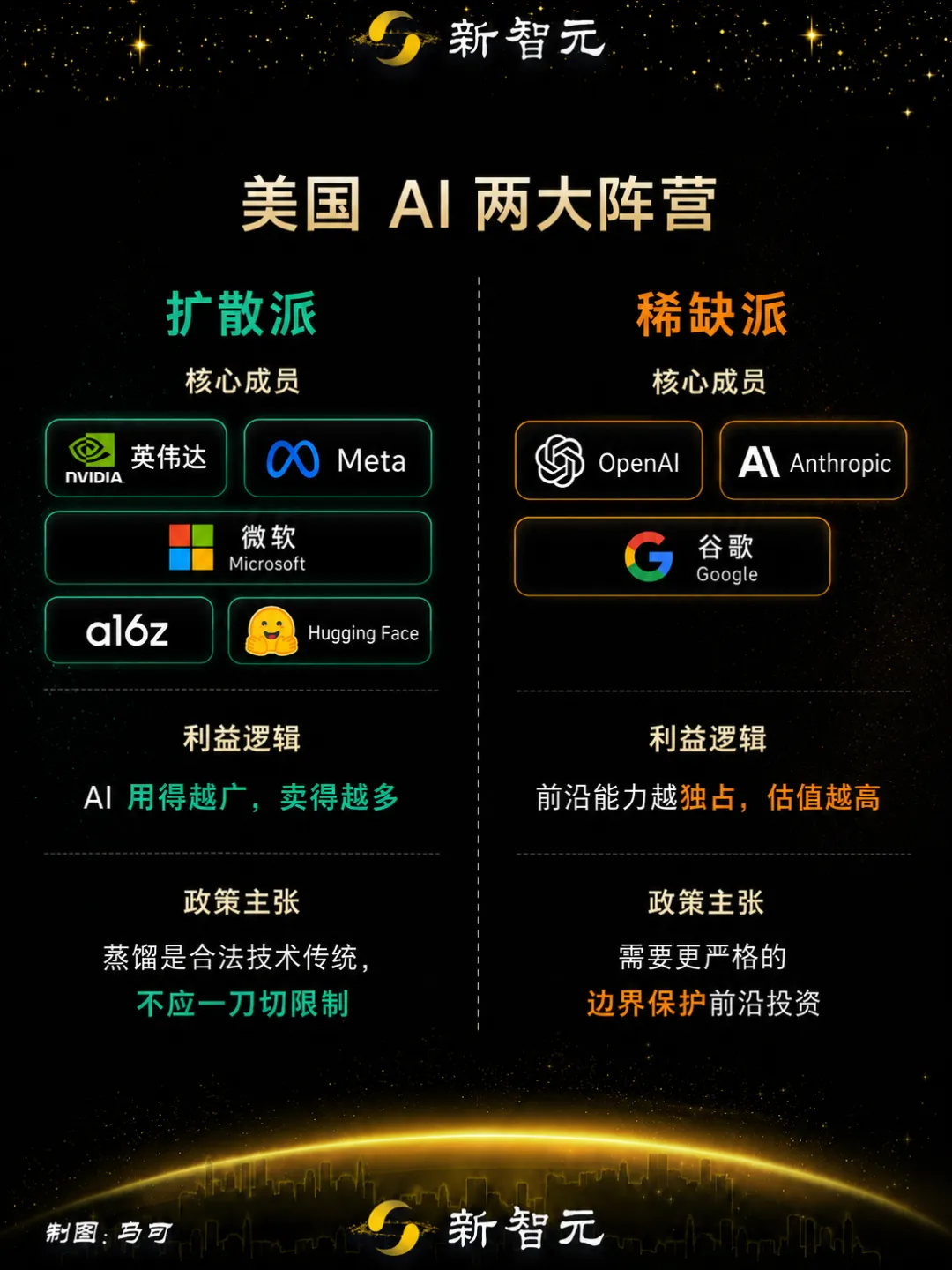
The two main camps are on the same page, but what Huang said is that the world needs top-notch closed-source models and top-notch open-source models at the same time.
That's why.Both occupy ecological spaces that cannot be filled by each other.
The open-weight model is irreplaceable, and the most direct layer is auditable.
When AI systems are deployed in high-risk scenarios such as medical, financial, and judicial, regulators and users need to be able to examine the behavioural mechanisms within the model to see the weight to do so.
The motto of the open letter is that open powers allow a broad community of researchers and developers to "examine model behaviour, detect vulnerabilities, develop precautions and continue to improve".
External auditors of the closed-source model do not see the weight and can only do black box testing.
Open Weight is also the infrastructure for AI security research.
Explanatory research, alignment experiments, and red team tests all depend on full access to model weights.
Researchers need to break down the model and look at the internal mechanisms to understand why the model produces a certain behavior and find ways to improve it.
These findings, such as vulnerability detection, assessment frameworks, and alignment technologies, ultimately flow back to the entire industry, benefiting from closed source models as well.
Many important advances in the field of AI security are based on experiments with open-weight models.
Open-weight models can be downloaded locally, run offline, customized, and have sovereignty in the hands of users.
But the irreversibility of the closed-source front-end model is also true.
Once weights are released publicly, developers lose the ability to revoke access and adjust security policies in real time.
The two models form a coexistence relationship.
The open source research community experiments, publishes papers, and builds evaluation frameworks on open weight models that are public knowledge throughout the industry;
Closed-source labs use this knowledge to improve their own model security and capabilities while pushing the boundaries of capability with cutting-edge models to provide the open-source community with tracking references and knowledge sources.
If you cut off anything on one side, the other side will become weaker.
But this open letter exposes a contradiction: both sides are aware of each other's values, but they are striving to keep the policy tilted toward themselves.
The dissemination mission calls for a looser definition of distillation and fewer release restrictions, while the scarcity mission calls for stricter capacity protection and higher thresholds of access.
In the dark circle of American AI, the struggle between the two routes has become extremely fierce.
Appendix: Open Letter translated in fullOpen Weight and U.S. AI LeadershipJuly 24, 2026
In the 1980s, early pioneers of open source software challenged the mainstream belief that only enterprises controlled their own code and software could progress. The movement advocated a transparent environment: developers around the world could research, modify, and improve software. Today, software developed by the open source community supports much of the operation of the Internet and forms the basis of the systems used by the world's largest tech companies, as well as the U.S. military and the federal agencies that undertake key missions such as research, cybersecurity, and more.
Today, the U.S. is faced with a similar choice in AI. Measuring our AI leadership is not about a single front-end model, but whether the U.S. can build a robust, open, and pervasive ecosystem across industries. This is critical to creating opportunities for innovation and prosperity nationwide. It requires that we expand the availability of adult AI, encourage competition, build a robust application layer, and give Americans greater control over the technology they rely on. Open-source models that anyone can download, test, modify, and validate on infrastructure are an important part of this process, as they make advanced AI more accessible, more adaptable, and more popular.
Open Weight expands the gateway to the AI economy.Startups, mature enterprises, universities, and public institutions can develop on top of advanced models without having to train a model from scratch, or pay for the front-end model for each task. Open-mindedness allows every organization to match the right model at the right cost to the right dynamics: leaving the front-end capabilities to the real front-end challenge, leaving the rest of the scenario to run on top of efficient dedicated models. When the use of artificial intelligence expands to billions of daily tasks, it's the only way to make it economically sustainable.
Open Weights Increase CompetitionCompetition is the key to ensuring that the benefits of AI are widely shared, rather than concentrated in the hands of a few. Since many organizations are able to build, transform and deploy advanced models, the cornerstone of open power is not only among model developers, but also across cloud computing, chips, applications, and services. Such competition stimulates innovation, reduces costs, and spreads the benefits of AI widely throughout the economy.
Open weight also gives customers more control.When organizations enter AI, they want to make sure they're not locked up in a single vendor and that they don't lose the knowledge and capabilities they've accumulated over the long term. Open Weight Models allow organizations to control their data, evaluate and customize models according to their needs, deploy them wherever business demands them, and when organizations create value with AI, open Weight actually gives that value to all of its constituents as self-improving models, specialization capabilities, and the continuous accumulation of knowledge, all of which contribute to American autonomy and prosperity.
Of course, open weights come with real and unique risks. Once released, the weights are out of the control of the original developers, and modified versions are difficult to trace or withdraw. But the correct way to deal with this risk is not to ban open weights. In a world where a cyber attacker has already used advanced AI, the defense team also needs adequate models to detect, simulate, and respond to emerging threats. Open models expand the boundaries of defense capabilities, increase transparency, and allow vulnerabilities to be detected and fixed in the hands of multiple teams.
In fact, openness is perhaps one of the most important pathways to AI security. Relying solely on closed models is not a natural security: they are equally vulnerable to attack, abuse, or failure unnoticed by the outside world. And concentrating advanced AI capabilities on a few closed models only adds to the risk: resulting in a few single-point failures, weakening competition, and passing key technologies to a handful of vendors. Open Weight Models are different, allowing large groups of researchers and developers to examine model behavior, identify vulnerabilities, develop life-saving tools, and make improvements over time. As open source software has proven to be "hidden security", it may not rely on transparent AI security tests, but on transparent human security systems. Open Weight Models are different, allowing large groups of researchers and developers to test models, identify vulnerabilities, and make improvements over time.
A strong AI ecosystem is not destined to arrive. There is an important window of action before policymakers. These include: the availability of computing power for startups and researchers; investing in shared training assets (data sets, tools, assessment frameworks); and avoiding restrictions that can stifle competition or drive innovation overseas to diversify the frontier. These initiatives must also consider how a strong application layer can extend the autonomous use of AI across the economy.
In shaping this ecosystem, policymakers should be careful not to confuse legitimate model development technology with improper theft. Distilling is the practice of using one model's output to help train or improve another model. Distilling is a widely used technique for model improvement, evaluation, and verification. It reflects a long-standing tradition of learning existing technologies, building on them, and making them better. It is this tradition that has been driving innovation since the rise of the open source software movement. Reasonable concerns should be addressed through targeted legal and business frameworks rather than imposing restrictions on technologies that play an important role in AI innovation.
The era of AI can be a thriving one. As long as the right choices are made, open-weight AI can expand opportunities, strengthen competition, sustain U.S. technological leadership, dismantle risks, and ensure that the benefits of this extraordinary technology are widely shared throughout the economy. Such a future is worth building, and the U.S. should be on its way to building it.
SignatoriesA16z, Arcee AI, Arena, Black Forest Labs, Box, CrowdStrike, Dell, Emergence Capital, Hugging Face, IBM, the Linux Foundation, Mariana Minerals, Meta, Microsoft, Mistral, Mozilla, Great Britain, Palantir, Perplexity, Reflection, Replit, ServiceNow, Telnyx, Y Combinator, which are listed in alphabetical order.
English translation