Plumbing robots are at a new height!
Robots with high traction and strong braking ability have been a major player in pipeline detection.
But there's been an awkward reality for a long time: portable robots with autonomous bearing modules, typically over 80mm in diameter. Small pipes (such as small oil and gas pipelines, human intestines, etc.) can't fit in.
Is it possible to make braided robots slim as well, while having active variations, independent braided modules, sensory sensation, and wireless autonomy?
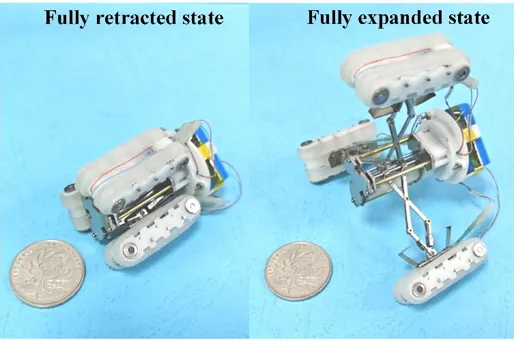
Recently, a team from the Chinese University of Hong Kong and Shanghai University of Transportation, jointly from the University of North China and the University of Shanghai, gave the answer. Their development of the variation-bearing micro robot VCMR, with a diameter of 34.6 mm and a length of 41 mm, achieved a range of active variations of 34.6 to 89.6 mm, as well as integrated contact sensing, wireless autonomous exploration of hard/soft pipes below 80 mm.
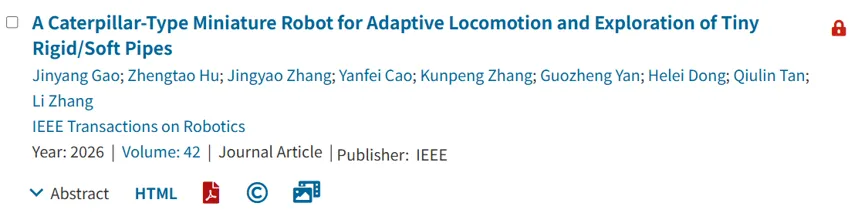
The results were published in the leading journal IEEE Transactions on Robotics (TRO) in the field of robotics.
This is the smallest-sized robotic footwear with active variation, independent footwear drive, and contact force sensing capabilities as reported in the current literature.
01.
Three pieces of ordinary brick design, spelled out in unusual microscopy
The core idea behind VCMR is simple: to redesign the three main components of a conventional robotic bearings, a bearings mechanism, and a magnetic sensor bearings, in order to micro-target them all.
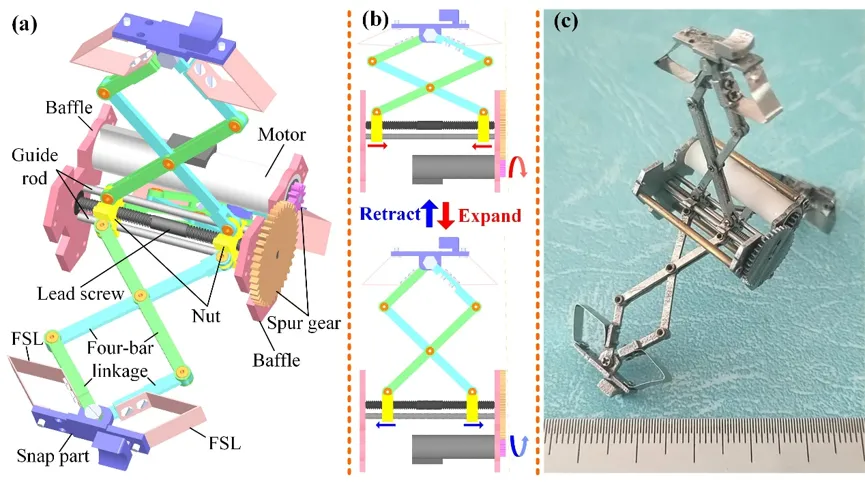
Diversion devices: Using a set of four-bar+two-piece folding slides (FSL) architecture, replacing traditional dual-bar design. Both provide elastic stable support for the carrying device and support for its passive tilt to adapt the diversion pipes and tubes, and effectively shorten the body shaft length.
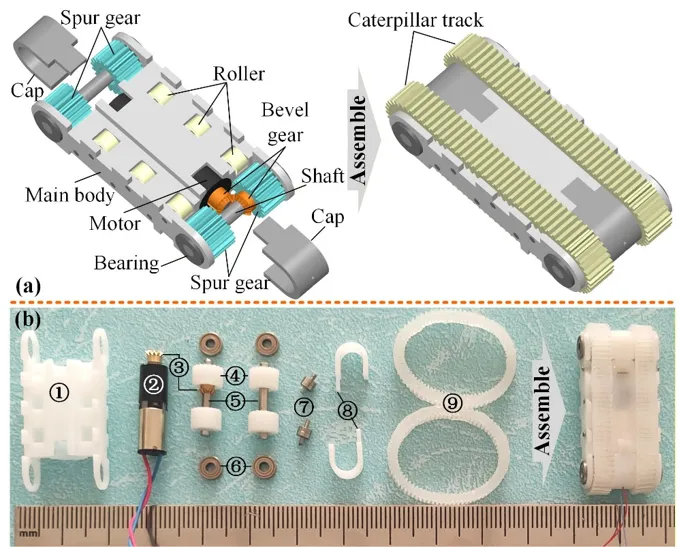
Carrier mechanism: optional 6mm commercial planetary deceleration motor, coupled with self-developed carrier and carrier drive wheels, which compresses the carrier to a height of only 9.5mm. The robot integrates three sets of carrier mechanisms, coupled with the passive differential speed formed by the FSL connectivity with the carrier characteristics of the motor, without the need for active differential speed control, and can be smoothed through a pipeline.
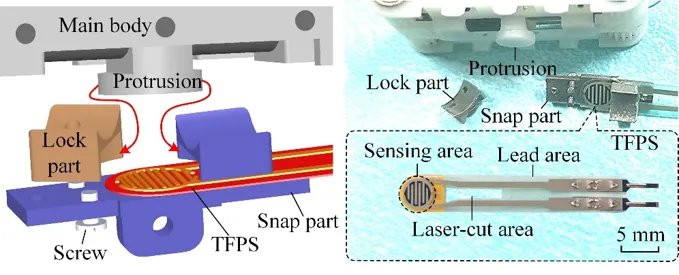
Ventilation perception: a commercial thin film pressure sensor is stored in the cartridge connections of the transition device and the supporting device, which can monitor the contact pressure of the supporting device with the pipe wall in real time.
02.
The VCMR will be able to adjust itself to the pressure.
With contact force N and two feedback values of motor current ICTM, VCMR can achieve adaptive motion in unknown pipes.
It uses the motion strategy of the steam state adjustment + active moving steam cycle in two stages: first with the contact force N as the feedback adjustment change mechanism, switching to the active moving phase after the torque is reached; continuous monitoring in motion of the bearing mechanism motor current ICTM, if there is an empty turn (pipe diameter increases) or a clogged turn (pipe diameter decreases), then switching back to the state adjustment phase to reconfigure the pipe diameter.
The whole process without the need for artificial intervention, without knowing the parameters of the pipeline in advance, without robots moving along the edges, really achieves adaptive exploration.
03.
Test performance: VCMR of 37.3g with a vertical crawling tube weighing 100g
The performance of VCMR has been verified in a series of experiments:
Vertical rigid tubes: VCMR with self-weight of 37.3g, capable of vertical crawling tubes weighing 100g, with an average speed of 3.54cm/s;
Vertical hard tubes
Vertical crawler tubes: VCMR is capable of carrying a vertical crawler tube weighing 50 g tonnes, at an average speed of 1.45 cm/s, even if the crawler effect of the crawler wrapper increases the resistance to motion;
Vertical soft tubing
The VCMR can drag 200 g of silicon wire through straight tubes (average speed 4.51 cm/s) + tubing (average speed 4.18 cm/s). It is worth noting that the entire filtration process relies on FSL passive connection and passive differential velocity without the need for active control intervention.
Flat hard tubes
Differential hard/soft tube adaptation movement: in 40-60-80mm differential hard tubes, 40-60-45mm differential soft tubes (concentrated at 10°) can be independently adapted to change the diameter of the tube, and the differential transition takes 22.43 to 42.68 seconds.
Changes in hard tubes
Changes in soft tubes
Colorectal model examination: VCMR relies on two-way voltage sensing feedback to autonomously respond to movement failure: 50s running at full speed under pressurized environments in a simulated body, 51s running at full speed under arbitrary paths, with average speeds approaching 3cm/s.
This speed is superior to other wireless colon detection robots (foot-shaped, gauge-shaped, magnetic-driven, etc.) and demonstrates the natural advantage of carrying motion in efficiency.
Colorectal model examination
arbitrary path
04.
Cableless: the reversal of traditional micro-motors
It is worth mentioning that the VCMR is completely wireless and is powered directly by a commercially available 3.7V lithium battery.
This answers an interesting question: In the endless supply of software robots, new types of drivers -- shape-memory alloys, intermittent electrical resistance, magnetic drives, etc. -- are the traditional micro-motor-powered micro-robots out there?
VCMR's answer is yes.
Micromotors can be powered directly by batteries, without the need for external magnetic fields, air pressure or high-voltage power sources, and with sophisticated mechanical design, can achieve truly autonomous wireless operation. This is a demand in many real-world scenarios (such as remote sensing of industrial pipelines, in-body detection).
05.
Limits and Prospects
Of course, VCMR currently has limitations, such as: not yet integrated vision and positioning modules, easy to flip sideways when the pipe diameter is large, unable to autonomously pass through the branch piping network, etc.
The follow-up team will optimize in three directions: one is to integrate micro-vision with positioning perception and complement environmental exploration capabilities; the second is to carry out low-power design and extend cable-free duration; and the third is to research and develop complex piping networks such as dual-module Active Direction Structures and T-type branches to drive the real-world small-scale complex piping detection scenario.
From 80mm in diameter to 34.6mm in diameter, this is not just a reduction in size, but a synergistic breakthrough in mechanical design, sensor integration and adaptive control. When the efficiency of the bearing movement is reliably met with microscopic fine design, the limits of the capabilities of the piping microbots are a step forward.