It's the first time in the history of the world.
Over the past year, the Agency's mission execution capabilities have improved rapidly.Agent will not accumulate and evolve autonomously。
The same type of task has been performed ten times, the tenth time still from a zero-planning path. The last time the error was corrected, the next time it was the same.
Ability grows, but experience does not sink.
It's not just about adding a long-term memory module. There are at least four links missing in the middle to make the experience truly mature:
Experience is unable to be absorbedThe system remembers the last time it succeeded but cannot automatically repeat the path the next time it does so.
One-point capability is not synergisticReal tasks require multiple capabilities to work together, but the way of collaboration itself is never retained and is re-planned every time.
I'm replacing the lack of arbitration.It is capable of replicating its own modules more than once, and once it fails, it triggers multiple modifications at the same time, producing results that conflict with each other.
The process of evolution cannot be auditedIt's not clear whether the changes are effective, what they are based on, or whether they can be reversed.
HugAgentOS, an open-source collaborative innovation center at Zhejiang Provincial University, was developed along these four lines:We're breaking up Harness into three self-growing engines and adding two switches to that growth.。
The code repository:https://github.com/ZJU-REAL/HugAgentOS
Downloads from the desktop:
Project website:
The memory engine:Keeping track of the execution of each task, the effective experience continues to fade, the repetition of content merges automatically, and the obsolete information gradually fades away;
Engine of skill:It's a good idea to distill the practice of repeated action into a reusable skill.It's not a coincidence, it's a coincidence.」It became the "necessity of copying".」;
This is the first time I've seen this.Using a stable collaboration of multiple Skills, tools, and sub-intelligences, we consolidate the whole into the default method for this type of task.
Additionally, in order to ensure that Agent Evolution can be controlled within a controlled range, HugAgentOS has also specifically designed two locks for protection:
I'm not sure what I'm saying.The three engines share the same execution evidence, and the attribution module unanimously decides which layer should not be changed; the change must also be verified by isolation relay and confirmed by the user;
I'm not sure what I'm saying.Writing the industry's concepts, relationships with hardness constraints into machine executable specifications sets the boundaries for the evolution of three engines.
So what HugAgentOS is trying to solve is not just how to make Agent remember, but how to make Agent remember.How the experience develops, how the ability to self-team, and how it all happens under control.。
It's time to see how this mechanism works.
Pre- and post-evolutionary control experiments
It can be contrasted with an industrial chain research task. Let it perform twice, once the ability to shut down the system itself, once the ability to open it, and the rest of the parameters are completely consistent.
The first one is closed.
It's written directly from the impression that the model already has. Which company is still in existence, whether it's on the market, what the number of patents means, what it's worth, what it's worth.Everything is judged by the model itself.The output stays in the dialog box.
The second time, open.
Its execution path has completely changed.First search, then individual verification of the enterprise subject, without entering the formal form without having passed the verification, and finally according to a fixed structure documentation, deliver a Word document.
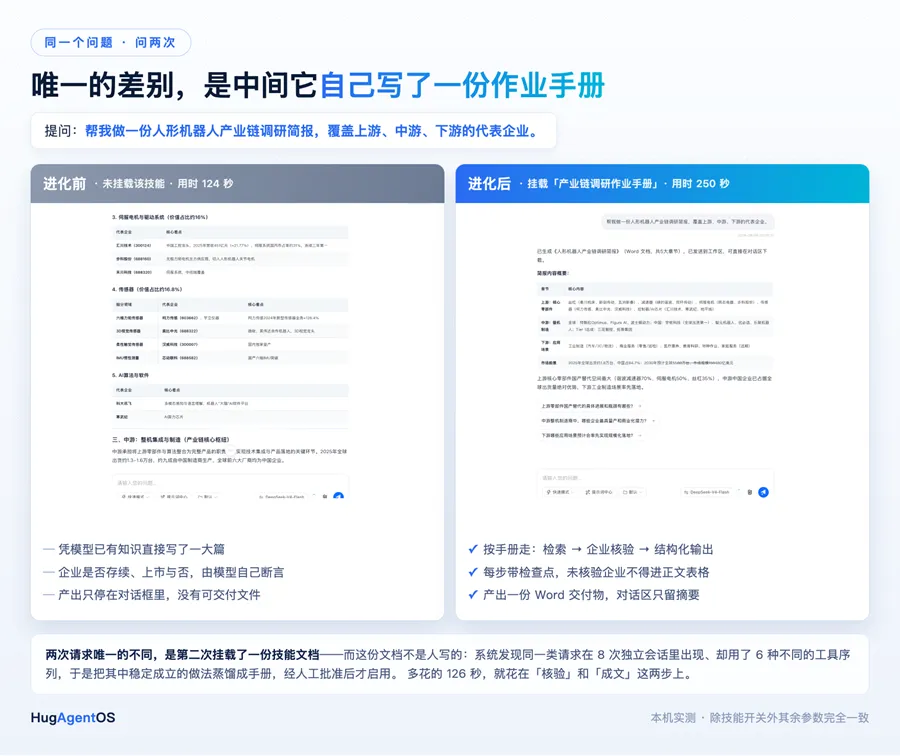
Before and after evolutionary contrast, all other parameters are perfectly consistent except for the sedimentation capacity switch
The second time it was executed, a skill was added to the body, known as the "smart body".Manual of Industrial Chain Research。
This skill is not artificially written, but rather distilled from the system's own historical execution records.
Step 1: Distillate skills from execution recordsThe distillation is done by memory engines and skill engines.
The memory engine is recognized in the remaining execution trail, and the same type of research request has appeared.Eight timesBut it worked.6 different approachesIt's like, "Every time I touch from scratch, I touch from scratch".
The skill engine immediately refined the two paths that worked repeatedly and combined them into a set of three-step processes, each with a checkpoint and a previous failure record at the end.
This distilled skill manual contains the following three treaty bundles:
Unapproved enterprises are not allowed to enter formal forms.
The results are all positive, not non-existent.The risksIt's important to mark the blind areas covered by the data.
The number of patents is not equal to the technological strength.
All three articles are not general writing recommendations, but ratherThe rules of judgement derived from the user's past failures。
Distilled products are stored in standard skill form with the same system as hand-written Skill: they can be edited directly in a skill library; they can be turned on or off at any time; they can be shared with other users and replicated.
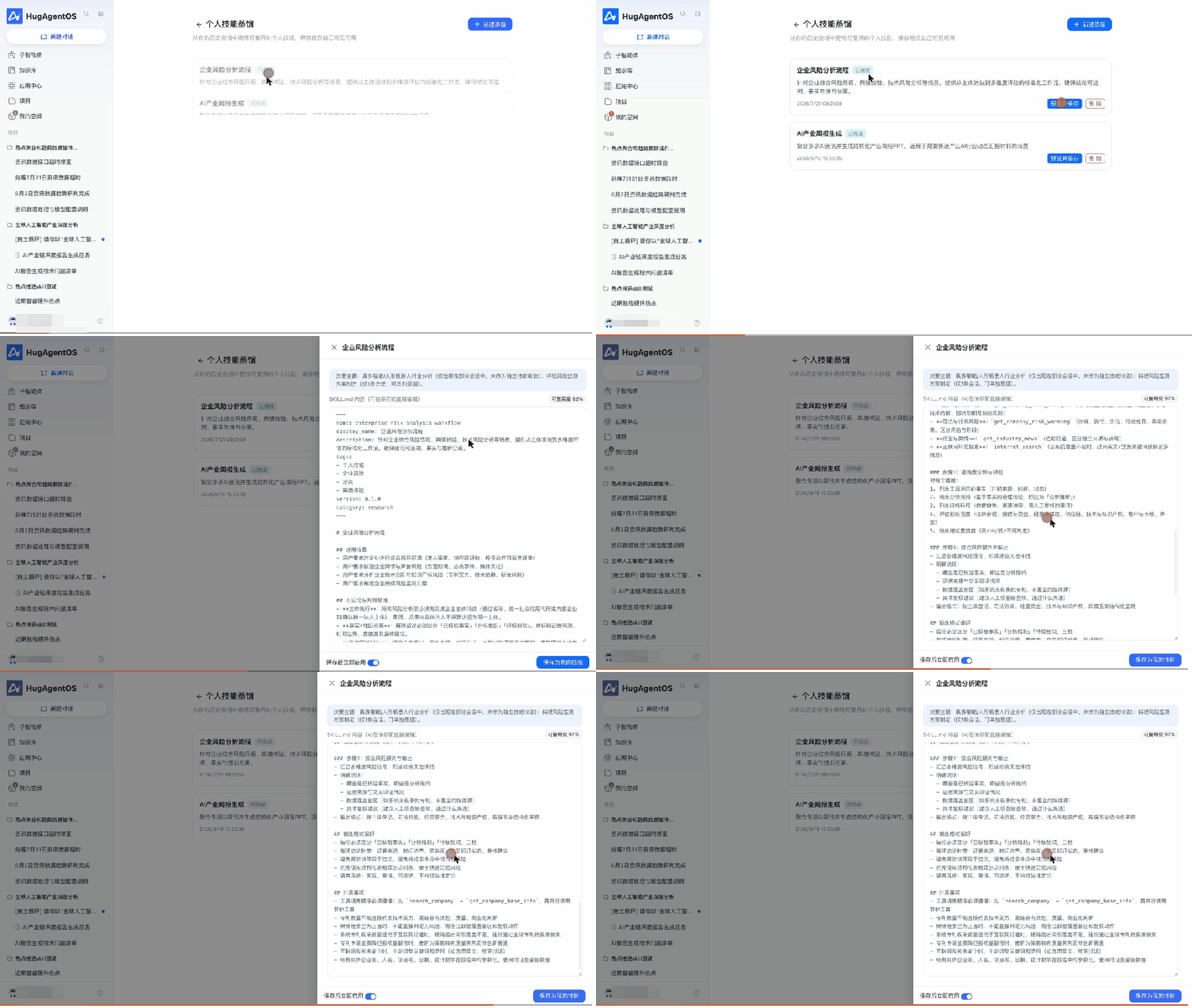
Personal skills distilled, refined from historical sessions to reusable SKILL.md
Step two: consolidate stable collaboration into the default methodIndividual skills are not enough to cover real tasks.
Complicated tasks often require multiple capabilities to work together.Arrangement engineI'm going to take the bat.
When multiple skills, tools, and sub-intelligences collaborate repeatedly and successfully in the same way, the system consolidates the entire combination into the default method for the class of tasks.
For example, industry-wide in-depth reports:
Reclaiming skillsResponsible for finding information;
Visual toolsResponsible for drawing;
Document generating skillsResponsible for the drafting;
The reviewer is intelligent.He's responsible for the stabbing.
Once validated, the collaboration of the four will be packaged as a set of default processes.
The next time it encounters a similar task, the intelligent body does not have to decide from scratch what to call, in what order to call, but comes in directly with the complete equipment.
This is what the three engines mean. The memory engine preserves experience, the skill engine transforms experience into a single capability, and the sorting engine transforms multiple capabilities into a set of techniques.Third-class propulsion, forming a more powerful propeller。
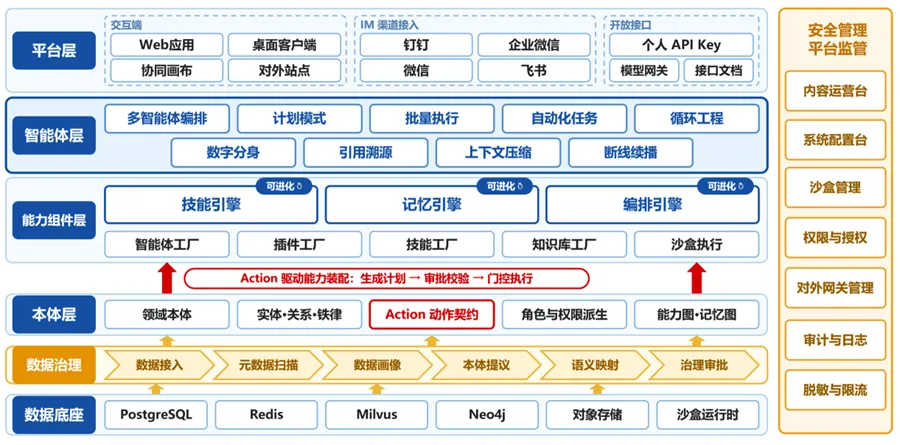
HugAgentOS is a multi-layered architecture, all three engines are self-evaluating, with the lowest layer responsible for defining boundaries.
A FailureOnly one level of responsibility is allowed
After the launch of the aircraft, new problems arose.
All three engines have the right to modify themselves, while a mission failure sends a signal to all three at the same time.
In a research report, a company that has already been delisted was mixed up.
Memory engines tend to record the state of the company.
Skill engines tend to add a verification step to the manual.
Classification engines tend to replace data source tools.
The three sides simultaneously acted on the three conflicting amendments.
So HugAgentOS is set up before the three engines.Modules of attribution。
It is not its duty to find out where the change should be made, but to decide in advance whether it should not be made this time, which layer is responsible.One failure allows only one level of responsibility at most.
What is even more important is thatIt has the right to decide that no layer needs to be changed.
Because a substantial part of the real failure is due to the fact that the content roots are not in these three engines: for example, there is no data in the knowledge base, the model cannot produce the required format, or the external interface changes back to the structure the day before.
These types of failures make no sense to modify memory, skills, or organization. Forced modification results in a program that can never fix the problem, while polluting statistics.
The attribution module is therefore setThree non-renewal rules:
Evidence refers to multiple modules simultaneously; it is not updated when it is impossible to distinguish responsibility; it is not updated when the evidence strength is insufficient; it is not updated when determining the root cause is not in itself.
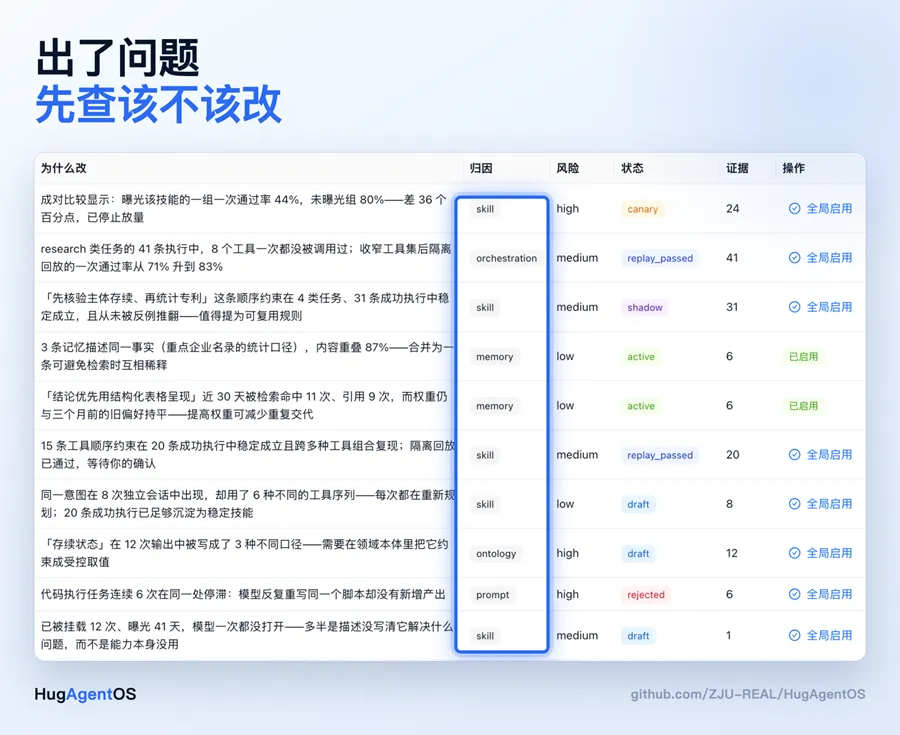
Once a failure, only one person is allowed to be responsible.
The new capability will not come into direct effect once it is confirmed that it needs to be modified.
It has to re-verify in isolation: repeat the same historical tasks over and over again, only to replace this and freeze the rest of the asset versions, rather than whether the results actually improved.
After passing, users must be confirmed to enter the formal capability system.
The entire process is fully visible on the Evolution Control Panel. The source of each modification suggestion, based on how many historical tasks, how much evidence has been accumulated, is presented in full. It is valid only after user confirmation and can be withdrawn at any time.
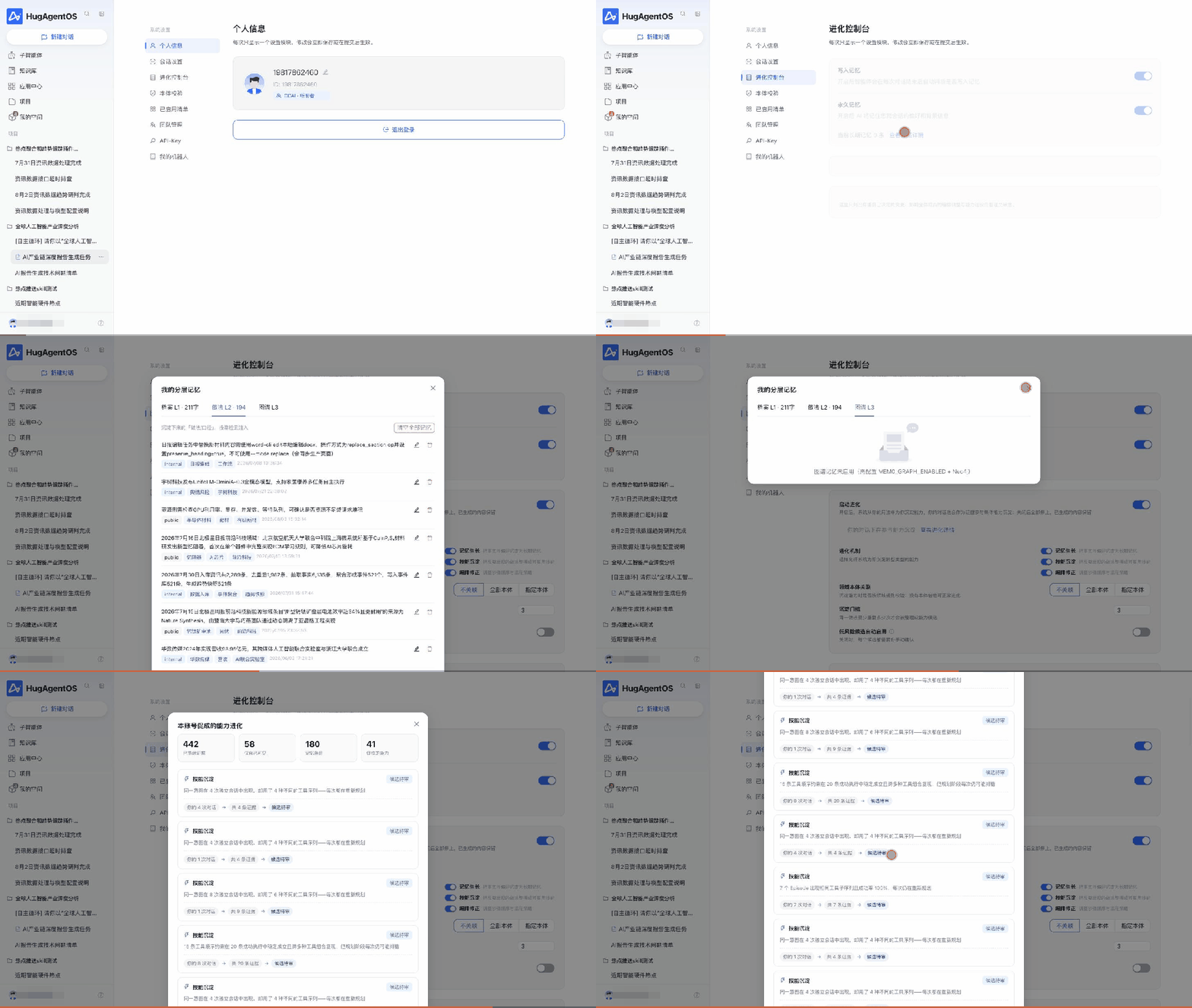
Evolve Control Panel, the ability of this account to promote Evolve
The field itselfDefining the boundaries for evolution
The other half of evolution is constraint, which is the domain itself.
The team writes the knowledge of an industry into a machine-executable field library containing four categories of content.
One is concepts.For example, the entity of the enterprise risk domain defines six concepts: the entity of the domain, the entity of the enterprise, the risk event, the risk grade, the source of evidence, the enterprise risk report. Each concept is defined as having a unique identifiable name or a unified social credit code.
The second is the relationship.For example, a risk event requires evidence to support this relationship, evidence to support it.The minimum base number is 1This means that high-risk conclusions require at least one traceable source.
The third is constraint.For example, the tool to query enterprise risk is required to complete two steps in advance: first to retrieve enterprise ID and then to verify basic enterprise information.
Four is workflow.This process of enterprise risk analysis has a high risk rating, and the review rating is an internal review board, requiring multiple review roles to make joint decisions.
These regulations precede all actions. If a smart body tries to bypass the risk of direct queries, a certainty lockdown will intercept it on the spot.
The curfewWithout an LLMIt's the first time I've ever heard of a serial number, the first time I've ever heard of a serial number, the second time I've heard of a serial number.Don't use any tokensIt also did not give a refusal, but a viable change path: first verify the enterprise ID, then verify the subject, and then use the same ID to query risk.
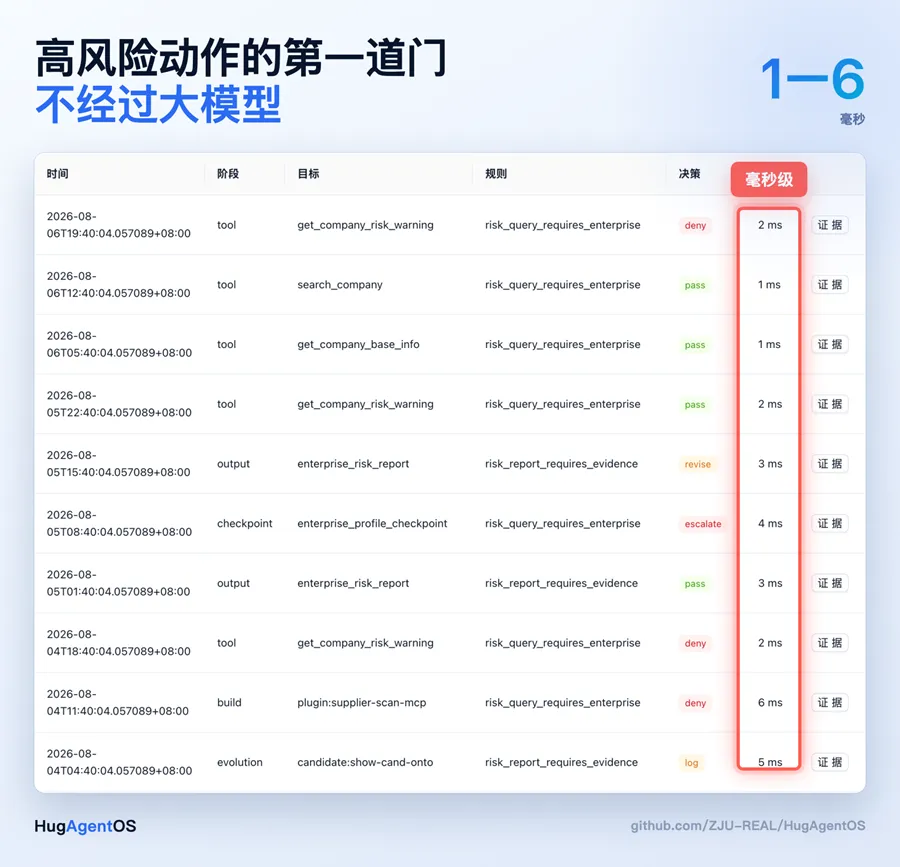
Restrictions on entry and return to life at milliseconds
What is even more important is thatThis boundary not only limits everyday tasks, but also limits evolution itself.
The new memory, skills and techniques of the three engines are also subject to field-specific testing prior to the official start. Concept compatibility, necessary tools, compliance of the output contract, individual verification.
Open source information
In addition to this main line of evolution, the basic capabilities of HugAgentOS cover the entire chain of intelligent systems from planning to delivery.
AgentSkills focuses on external services for office and professional scenarios such as Word, Excel, PPT, PDF, MCP tools to connect to Internet searches, web crawling, graphics generation, and reporting, and Plugins carry out more complete business processes.
With sub-intellectuals, private knowledge bases, scheduling patterns, timing tasks, autonomous cycles, safe sandboxes, a single link can be used to complete planning, collaboration, tool calls, document readings and results delivery.
Capacity overview, sub-intellectuals, knowledge libraries, skills libraries, MCP tool libraries and plugins libraries
The project, developed and maintained by the Center for Co-Creation and Collaborative Innovation at Zhejiang University's Department of Artificial Intelligence, offers Docker Compose deployment, single-key command installation and three ways for desktop clients. The desktop end includes Windows, macOS and Linux, and is free to switch between native and cloud services.
Back to the first four stages: experience can grow into a skill, ability to team up on its own, change mistakes without arbitration, change can go back.
After a hundred missions, Agent leaves behind an increasingly long, increasingly disordered historical record, or a set of assets that can be submerged, attributable, and reversible, becoming the new watershed.
It's about making smart bodies more powerful in a controllable range.