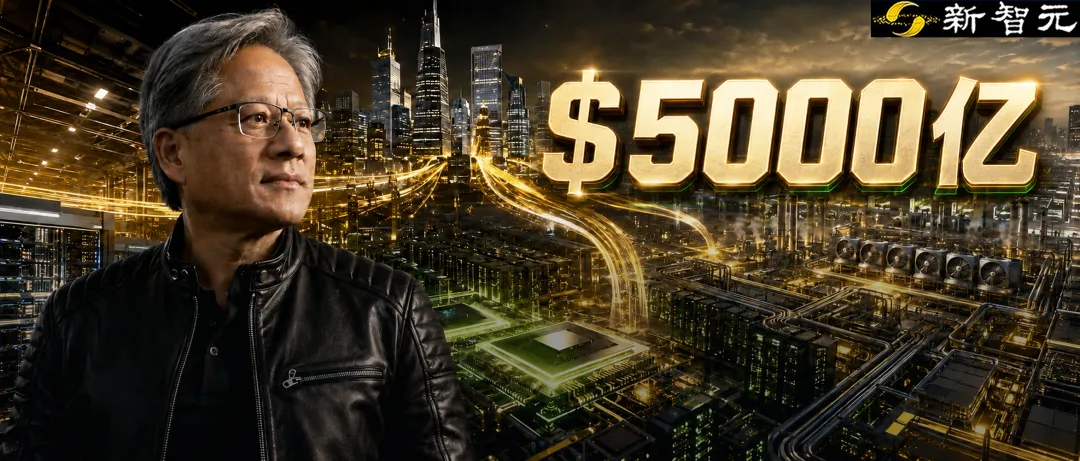
It's the first time in the history of the world.
50 billion dollars.
This is the money that Huang Rinpoche has just moved from Wall Street for his "AI Factory" project.
On 11 August, Invisalign announced a strategic partnership with six of the world's top financial institutions to create an independent computational finance platform.
The goal is to mobilize more than $500 billion in third-party capital specifically for AI labs, enterprises and cloud providers to build data centers and buy cards for these UK customers.
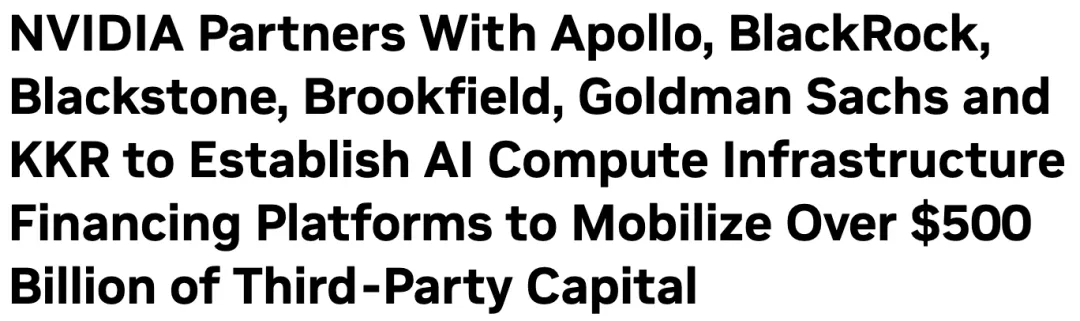
Apollo, Blade, Blackstone, Brookfield, Goldman Sachs, KKR, the world's wealthiest alternative asset management giants and top investment firms, all six of them are behind Huang Ren.
They have all signed a Memorandum of Understanding (MoU) with INVEDA to work together to create a business that can be financed, packaged and invested.
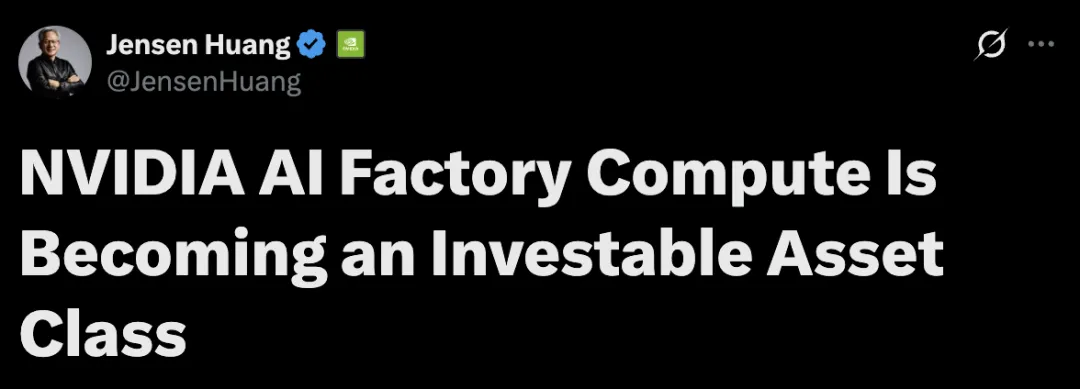
On the same day, Huang Rin published an article: AI Factory Computing at Ingweieda is becoming an investment-friendly asset class.
In a statement, Huang Jin said that India has reached an important milestone: Once a company bought chips, a project built a data center, and now AI factories can be financed like infrastructure.
He also said one thing about capital that is deadly: in AI, computing is income.
The 500 billion giants in New York are listening far away, but if you're not smart enough next year to pay the subscription fees, the answer might be in that money.
GPUs can also be mortgaged.In the last two years, the most expensive aspect of AI is computing.
A data center full of GPUs has generated tens of billions of dollars.
According to Reuters, the global tech giant's combined capital expenditure on AI this year will exceed $730 billion.
This is a huge expense that can't be put on anyone's account, whose balance sheet can't survive.
Everyone wants to buy more cards.
Laboratories need to practice stronger models, enterprises need AI, and orders from cloud providers need to be handled.
But Tuca is on the same page: money.
It's not that we can't get it, it's that we can't really get it.
In this case, the biggest cost of the project is to move it from the customer's account to the shoulders of the Wall Street gold master.
The core idea is to make Ingrid's full-featured AI infrastructure, from chip to CUDA ecosystem, an investment asset.
I'm telling you, this pile of cards is rented every year, rented monthly, retired and can be sold by hand.
In the eyes of financial institutions, this is not the same as rental offices, chartered highways, and rental airplanes.
That's what the airplane business does.
An airplane is so expensive that airlines rarely buy all of it, but it is paid for by rental companies who pay monthly rent.
A plane can fly for twenty-thirty years, and the rental company pays the rent for those decades, plus the money that ends up being sold secondhand.
Calculators are now following the same path: Wall Street makes money buying tickets, Great Britain ships, how much customers pay for it.
For customers, it's not a one-time drop in prices that can be used to calculate; for billionaire investors, it's finding a new business that can take decades of rent and hold hard money.
Blackstone, Apollo, these institutions have been around for a long time.

Just this June, two companies that had just finalized a $35 billion financing deal for Anthropic set up a dedicated entity to buy Google's TPU and lease it to Anthropic to repay the lease without entering Anthropic's account.
There are two guarantors behind the money.
Google secured the lease, and if Anthropic did not pay the lease, it was looking for five data centers; the second-hand price, the largest of which was $31 billion, and if the card did not sell, it would make up the difference.
Medium-sized entities buy cards, rent to customers, rent back debts, upstream to subscriptions, and this is the way to go with Ingrid.
This time, it's a standardised pipeline using a single operation.
The real meaning of the pipeline is more than taking away expenses for customers.
Once computing is officially recognised as an asset by the mainstream financial system, AI-based money will be generated not just by the cash flow of a few tech companies, but by pensions, insurance funds, and sovereign wealth funds.
The investment giant has spent the last two years searching for exports of digital infrastructure, with institutional funds and insurance funds waiting to be allocated.
In order to open this pipeline, what is missing is a clear account: how much these cards are worth, to whom, when the investment can be recovered.
This time, Ingrid has figured it out, the rules, the game, the way out, it's all set.
Once the pipeline is open, the source of the money is more than one dimension wide.
Its target customers are also clear: the world's deadliest cutting edge AI labs, big companies that don't want to spend huge amounts of money on AI, and AI cloud providers that want to go crazy.
Whoever lacks the ability to calculate, whoever is poor with money, whoever can become its customers.
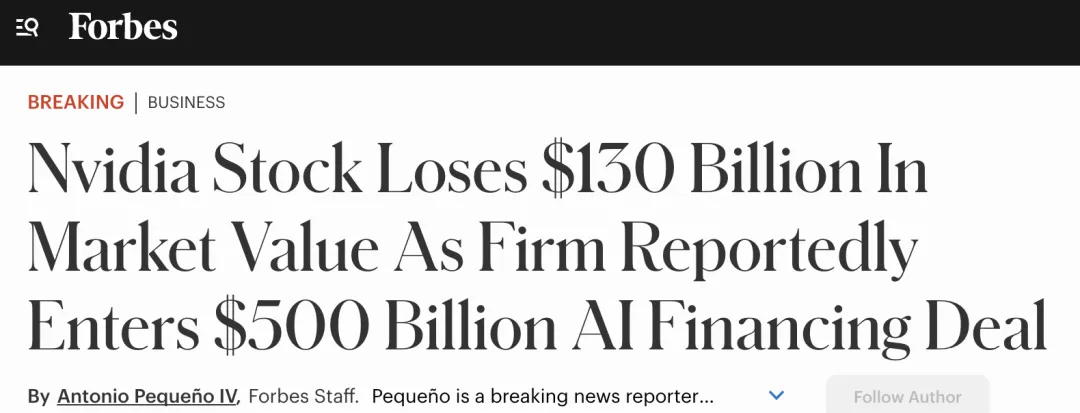
The other side of the 50 billionInterestingly, after the news, Ingrid's stock price fell steadily.
On Monday, U.S. stocks fell over 3%, closing at $217.55, down 2.86%, and evaporated about $130 billion a day.
Some of the companies that made the money were full-blown: Apollo aluminum 3.59%, Blackstone aluminum 3.30%, KKKR aluminum 1.18%.
It's clear what the market means: it's buying and selling, and it's more on the side of lending.
The shareholders are disturbed by four words: circular financing.
The chip factory finances the customers, the customers take the money back to buy the chips, the income from the accounts has plummeted, but the risk has shifted in the system.
This set of questions has been hanging over the head of British Airways since last year.
According to the Wall Street Journal on July 26, Invidia is talking about a $250 billion funding round for a 10 gigawatt data center park in Ohio where OpenAI is a potential tenant.
The reason why Ingrid is coming out is because OpenAI itself is not up to investment credit, lenders only recognize Ingrid's badge.
In this way, who owes to whom, and who guarantees to whom, is quickly outnumbered.
The fate of the entire AI industry has been tied up by these deals.
The word comes back, GPUs and airplanes can't just draw numbers.
Airplanes are outdated, how many hours to fly, how many miles to run, how much money to depreciate.
The GPU is different, it is eliminated by the next generation of products. When the new card is released, the price of the second generation will go down the same day.
This is one of the most important things for people who can afford to buy cards.
In this regard, Huang Rinpoche's answer is CUDA.
He said that Ingrid's cards are used everywhere, that any model can be picked up, and that customers can shake hands with each other; and that CUDA software is constantly being optimized, and that the more smoothly the card is used, the longer the years it will be able to function.
He also moved out of the A100.
The old card, which was released in 2020, was still in business six years ago, training, refinement and reasoning are still running, and customers are still signing long-term contracts, almost a decade away from using it.
The real problem is the rent.
According to SemiAnalysis' H100 year-on-year rental price index, the card's year-on-year rental price rose from about $1.70 per GPU hour in October 2025 to about $2.35 in March 2026, an increase of nearly 40%.
The median price on demand for cross-platforms rose from about $2.00 in October 2025 to $2.70 in June this year.
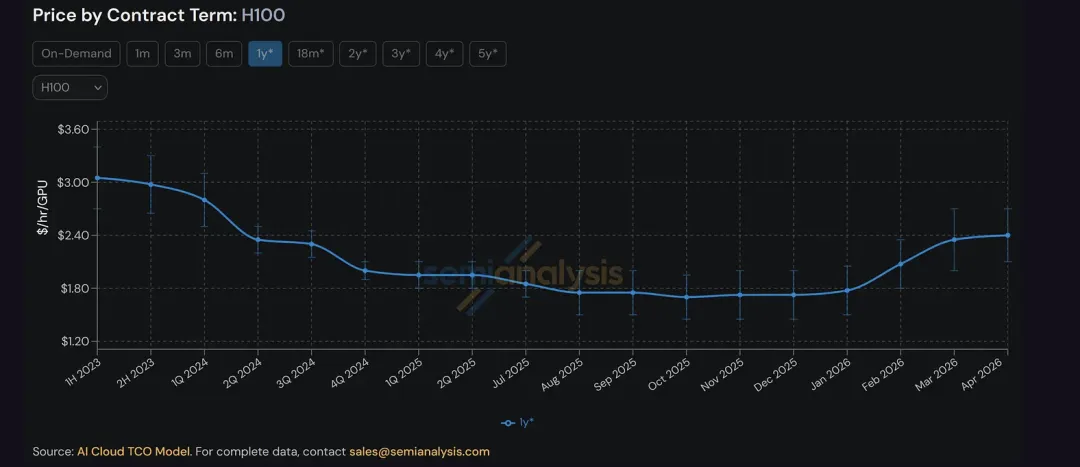
SemiAnalysis' H100 year-on-year rental price index: $1.70 at the bottom in October 2025, rising to $2.35 in March 2026.
Six years ago, Kar was still making money, and the rent didn't come back, which was the essence of convincing Huang Rinpoche on Wall Street.
In a nutshell, as long as the ecosystem is alive, Kar won't really die.
The game of algebra has changed.INVEDA signed a memorandum of understanding (MoU) with Wall Street, but the final agreement has not been reached.
How the platform works, how the money is distributed, who gets it first, is all on paper.
And the financial institutions will not turn a blind eye to making money.
In each project, they have to figure out for themselves: who the customers are, the cards run out of satisfaction, the rent does not come up, how much money they can sell in a few years.
Invisalign is the biggest sponsor of a second-hand card, with individual projects earning up to 25%, and one-on-one evaluation.
Huang Rinpoche pointed out that this proportion is much lower than other arithmetic financing arrangements on the market.
The real losers and the ones who make the money admit it.
The US$50 billion is the "target", and when and how many homes started investing, the company has not disclosed.
Although this is only an intention, the direction is already clear.
Invidia is no longer just a chip seller; it's a chip maker, a standard maker, and now has a Wall Street-class financing engine installed in the AI base.
When computing started to be packaged, priced, and loaned out like real estate, like airplanes, the focus of AI's competition shifted: from who's model is stronger, to who's cheaper, to who's faster to move it into reality.
And what Ingrid wants to take is the pricing power of the entire AI-era computing business.
It's hard to see how much money these cards will sell in the next two or three years.
It's worth the money, and the pipeline goes down: money flows in and out, AI gets stronger, cheaper and cheaper.
It's not worth the money, it could be halfway through.
The last to be paid, perhaps the Wall Street giant who made money this time, or the average person who paid for AI every month.