In March 2026, Yann LeCun and others proposed the LeWorldModel (LeWM) which uses a combined embedded predictive architecture (JEPA) to learn environmental dynamics from primitive pixels and represents collapse through the Gaussian distribution rule, allowing end-to-end world models to use more concise target stability training.
However, a research team from the Xi'an Transportation University found that even with the application of Gauss's rule, the sub-variable distribution studied in the model could still show a clear backward phenomenon: a small amount of sub-variable deviates from the subject's distribution to form extreme representations.
Further analysis suggests that the Epps Pulley (EP) normality target used by LeWM exists in an easily overlooked "tail-blind area": it is able to determine whether the overall distribution is deviating from the Gaussian, but it is difficult to continuously correct a small amount of the extreme potential variables that are already distant from the subject distribution. For such samples, the gradient of correction produced by the EP target will rapidly decrease, making it difficult to effectively pull back during training.
To address this problem, the research team proposed QQWorld: Quantile quantile matching, replacing the original EP rule of LeWM with quantile quantile matching.
Its core idea is very straightforward: no longer indirectly measuring the difference between the two distributions by means of a nuclear function, but rather sorting random projections of the underlying variables so that each sample moves directly to the corresponding standard Gaussian point in its sequence.
In other words, the model no longer only asks "how much of the current underlying variable's overall distribution differs from the Gaussian distribution" but further answers "where should each sample move?"
This direct point matching mechanism is able to provide an effective gradient continuously at the distribution tail, thereby better suppressing extreme subtractive variables and improving subtractive spatial structure.
The experiment showed that in the four control environments of Two-Room, Reacher, PushT and OGBench-Cube, QQWorld increased the average planning success rate from 79.75% to 85.08%, an increase of 5.33 percentage points.
In addition, the paper proposes Cross-Batch QQ, which supports a more stable sample sequence of current batch computations by introducing a small number of historical batch projection characteristics. Historical characteristics are used for sequencing only and are not involved in reverse propagation, so there is little increase in additional training and storage expenses.
Experiments have shown that even if physical training batches are reduced to a quarter of what they were originally and the residual inventory occupied is reduced by about 73%, Cross-Batch QQ can still make the model's average planning success rate significantly higher than LeWM. The results show that QQWorld can not only improve the potential variable distribution and planning performance, but also provide a simple and scalable solution for efficient training of larger-scale world models.
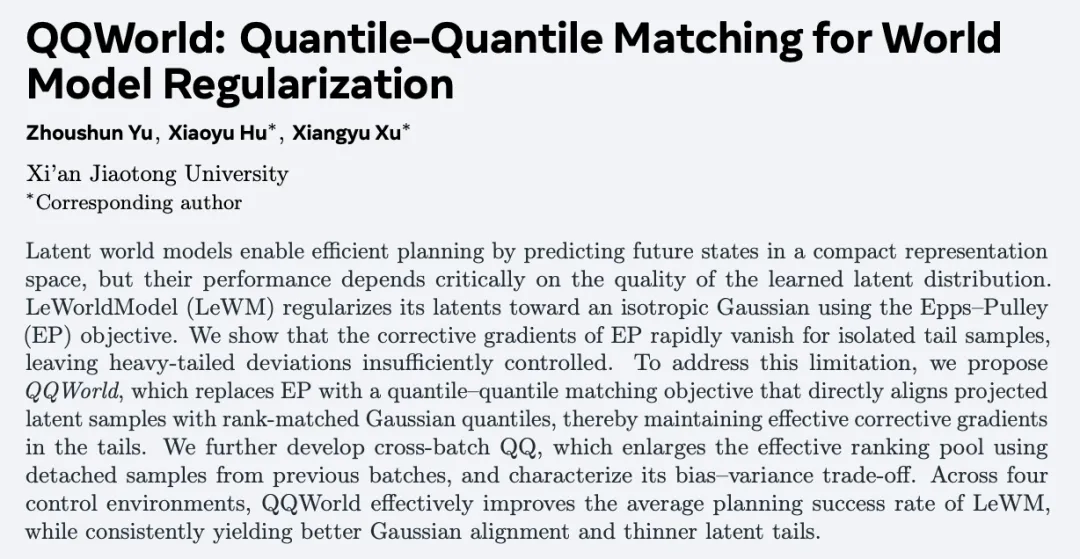
QQWorld: Quantile Quantile Matching for World Model Regularization
It was written by Zhoushun Yu, Xiaoyu Hu, Xiangyu Xu.
Unit: Xi'an Transport University
Link to the paper:https://arxiv.org/abs/2607.28415
Why is it so hard to control the tail of the EP?
Set a training batch containing N sub-variables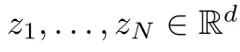 LeWM randomly samples one direction from the unit sphere.
 Then project each high-dimensional sub-variable into one dimension.
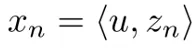 The project samples in this direction are as follows:
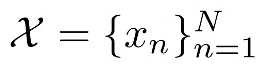
Subsequently, LeWM constrained these projection samples to approach the standard Gaussian distribution with the Epps and Pulley (EP) normality target. The paper notes that the EP target can be equally understood as the MMD between the experimental distribution and the standard Gaussian distribution, which uses the Gaussian nucleus:
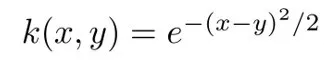
The problem also occurs in the limited scope of Gaussian nuclear activity.
Suppose a projection sample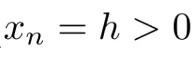 It has entered the tail, and the rest of the sample is still in the subject area. As the h continuously increases, the sample is pulled back to the subject area to satisfy the gradient:
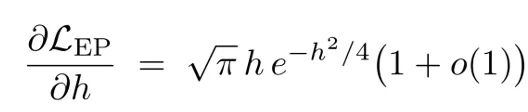
This gradient rapidly approaches zero at the tail. That is, when the sample has reached the farthest tail, the EP can almost no longer provide an effective retraction signal. It can measure the difference between the overall distribution and the Gaussian distribution, but it is difficult to continuously correct extreme samples.
QQWorld's practice: directly matching Goose's points
QQWorld no longer compares the distribution indirectly via local nuclear similarity, but matches each projection sample directly to the corresponding standard Gaussian location.
For a random projection direction, the model first collects the projection sample.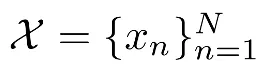 Sequenced and obtained sequential statistics
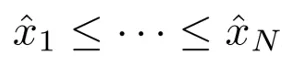 。
Among them, Indicates the projection sample at n after the sequence.
The model then calculated the corresponding standard Gaussian target locations according to the sample order:
QQWorld minimizes the square distance between the order sample and the corresponding Gaussian location:
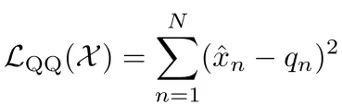
Thus, each projection sample has a target location determined by its sequence. The farther the sample deviates from the corresponding Gaussian point, the stronger the retrograde deviation signal obtained, which can more effectively suppress the retrograde end of the sub-variable distribution.
The paper also demonstrates a one-way control relationship between the two: when QQ losses approach zero, the EP difference approaches zero; in turn, the EP difference cannot control QQ losses, which again demonstrates the effectiveness of QQ normalization.
Cross-Batch QQ: Small batches can also stabilize order
QQ matching depends on the sample sequence within the batch. The larger the batch, the more stable the estimates of the experience locations, but the more intermediate activations that need to be saved, and the higher the cost of storing them. To mitigate this contradiction, the paper proposed Cross-Batch QQ: using an advanced prior queue to preserve the projection characteristics produced by several recent iterations, then combining the current batch with the historical batch to calculate the sequence.
Assuming the current physical batch size is N and a historical batch of K is stored in the queue, the effective sorting pool is expanded to:
Historical features are separated from the computational graph and are only involved in sequential estimates; gradients remain only through current batch propagation. Thus, Cross-Batch QQ can be used to obtain point estimates that are close to large batch trainings without significantly increasing reverse propagation visibility.
The paper further exposes theoretically the Bias-Variance Tradeoff of Cross-Batch QQ: Moderate increase in historical samples can broaden the sorting pool, reduce the disparity in the estimation of experience spots; but when queues get too long, earlier historical features may not accurately reflect the current changing potential distribution, thus introducing the estimation bias caused by distribution obsolescence.

This analysis explains why moderate queue lengths usually have the best results and provides a theoretical basis for the actual configuration of Cross-Batch QQ.
Better features indicate an improved submarine tail
The experiments were conducted in four environments: Two-Room, Reacher, PushT, and OGBench-Cube, using unified offline data, training settings, and CEM-based target condition planning protocols.
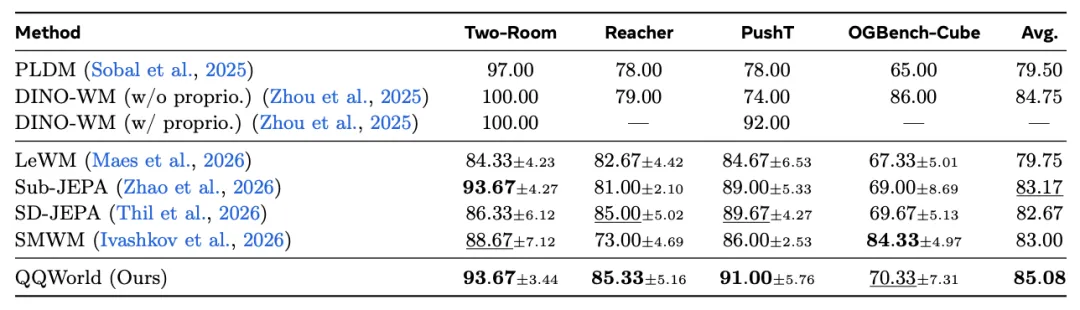
The results showed that QQWorld exceeded the baseline in all four environments, with the average planning success rate rising from 79.75% to 85.08%.
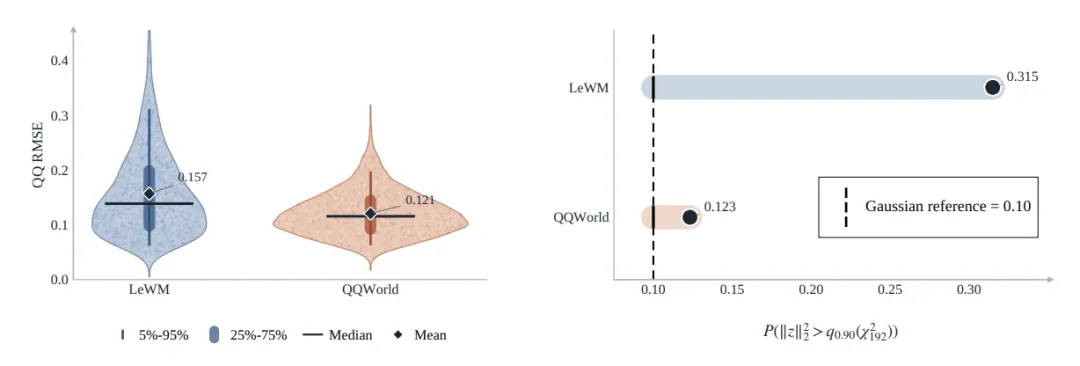
In addition, the distribution of sub-variables is significantly more regular. Compared to LeWM, QQWorld's average QQ RMSE decreases from 0.157 to 0.121; the probability of tail direction decreases from 0.315 to 0.123, which is closer to the standard Gauss correspondence of 0.10.
Furthermore, it is possible to visualize subterranean variables using linear probes to recover the two-dimensional trajectory of an intelligent body from subterranean variables. QQWorld's test set has an average RMSE of 2.58 and a LeWM baseline of 6.01.
This shows that QQWorld not only makes sub-variables "more like Gauss" in a statistical sense, but also makes their physical state structures more stable and easy to read.
4 times smaller batches retain most of the profits
The average success rate of the model is 65.42% when the physical batch size is N=32 and only the current batch computation sequence is used.
After adding one historical batch, the success rate increased to 80.67%; after adding two historical batches, it further reached 83.50%, but the GPU holds about 3435 MB. By comparison, the standard QQWorld achieved an average success rate of 85.08% at (N=128) and holds about 12747 MB.
In other words, using N=32 and two historical batches, it is possible to achieve a success rate of just under 1.58 percentage points, while still significantly exceeding the LeWM baseline, with four times smaller physical batches and about 73% lower survivability.
Summary
QQWorld addresses the hard-tail problem in the LeWorldModel subterranean space, replacing the easy-to-disappear tail gradient with a point matching EP. It not only measures whether the experience distribution differs from the Gaussian distribution, but allows each projection sample to move directly to the corresponding Gaussian gradient points in its sequence, thus maintaining a continuously effective corrected gradient at the distribution tail.
In the four control environments, QQWorld increased the average planning success rate from 79.75% to 85.08% while achieving thinner subspace tails and more accurate state trajectory reconstruction. Cross-Batch QQ expanded the ranking pool through historical samples, bridging the estimated accuracy of landing points with reverse propagation residual occupancy to provide a more scalable scheme for small batch training.
A deeper meaning: the work's core inspiration is not just a distributed normal method for improvement.
The ability of a statistic to distinguish between two distributions does not necessarily mean that it is naturally well suited to serve as a training goal for neural networks. For a model of the subspace world, what is really important is whether a normal object can continue to provide a sufficiently strong, directionally clear torsional gradient when abnormalities and reversals have occurred.
EP is better at measuring overall distribution differences, but the finite bandwidth Gaussian nuclear extreme sample punishment will gradually fade; QQ matching translates "distribution proximity" into sample-by-sample target transport, so that the more distant the sample deviates from it, the stronger the pull. This may mean that the world model potential space needs to move further from "judging whether the distribution is correct" to "effective correction gradients".
Introduction by the author
The first author of the paper is Professor Xu Xiaoyu from the School of Mathematics and Statistics at Xi'an Transport University. The research direction of Professor Xu Xiaoyu covers world models, 3D vision and physical intelligence.https://xuxy09.github.io/)