AI is challenging new mathematical puzzles, this time as "Liman's conjecture".
A mathematical conjecture born in 1859 and pending for 167 years, with a $1 million prize hanging over it. Recently, someone inside Anthropic put a nearly "irrelevant" task on an unpublished version of Claude's research:
It's a good idea to try and guess what Lyman thinks.
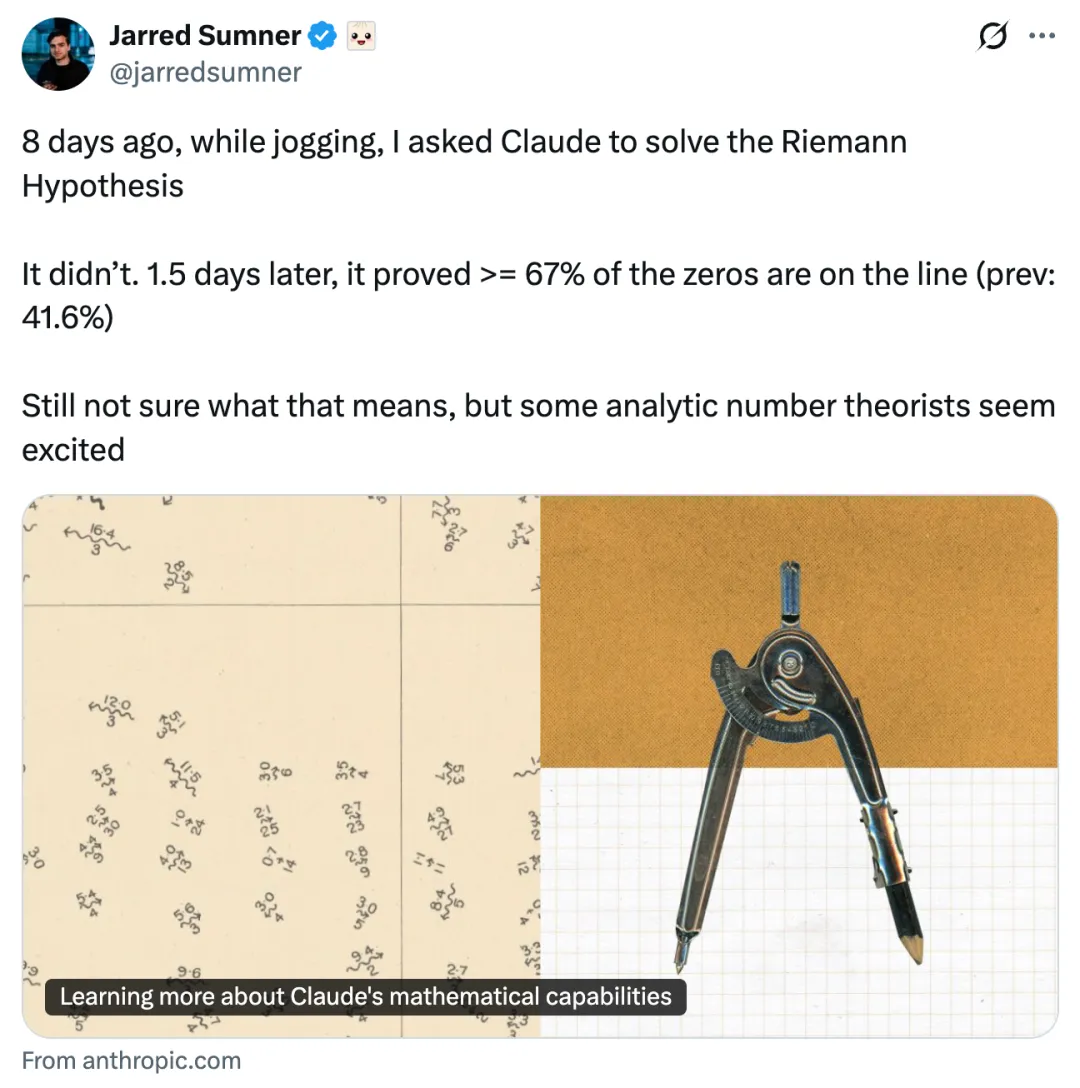
Bun co-founder Jarred Sumner, who joined Anthropic last December.
Claude did take it seriously. It came up with 650 ideas, all of which failed. It then reorganized about 60 of Claude's Agents, working continuously for a day and a half, executing 2,400 Shell commands, writing hundreds of Python scripts, and doing thousands of numerical checks.
But in this failed attempt, Claude encountered another result. Anthropic discloses that this unpublished version of Claude's study lowered the known zero-point ratio of the Riemann z-function to at least the critical line, increasing it from 41.6% to 67.2%.
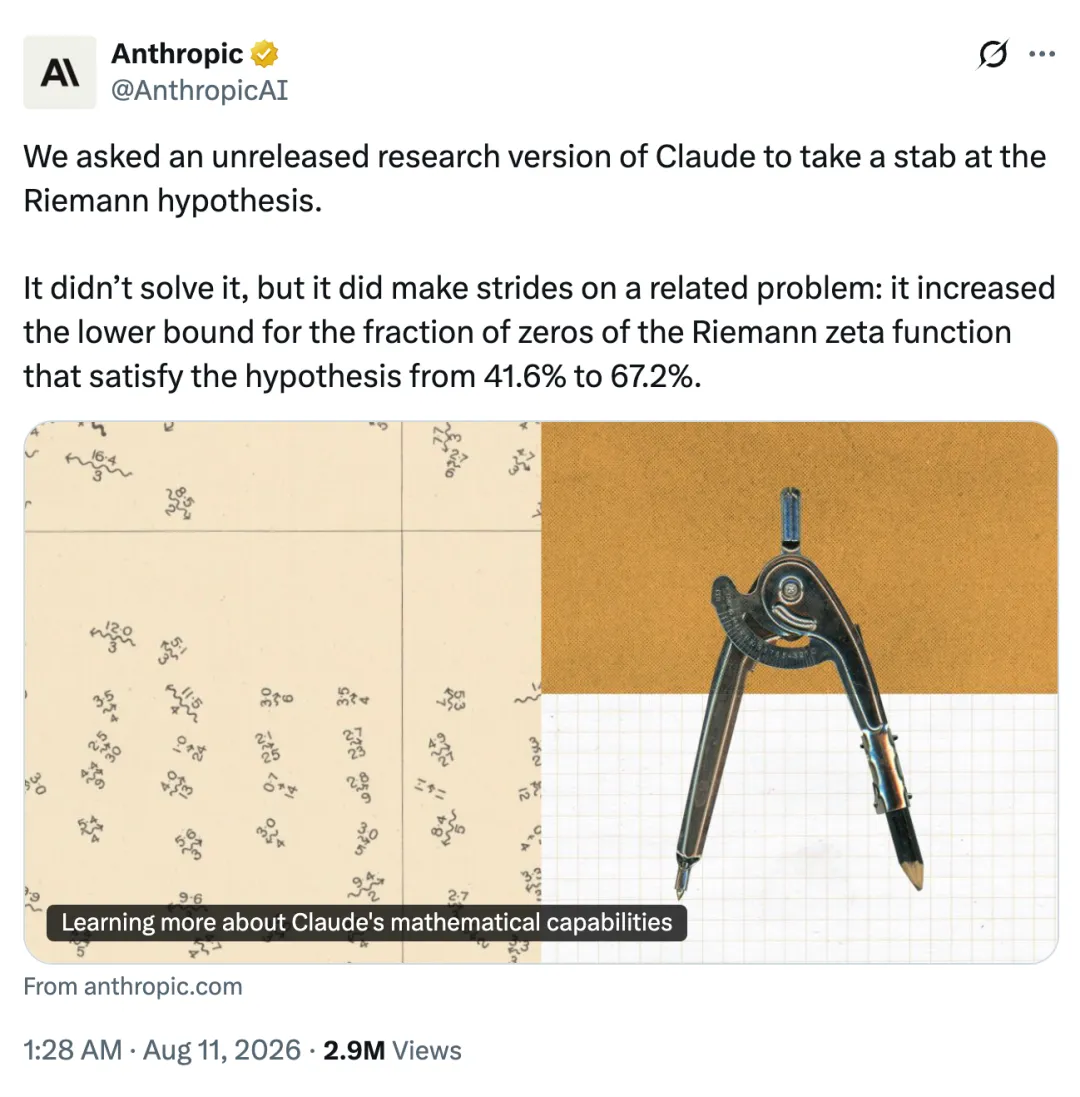
In other words, humans had previously been able to prove that at least 41.6% of the relevant zeros corresponded to the predicted position of Liman's conjecture; Claude's results pushed this provable proportion to 67.2%.
Deedy, a partner at Menlo Ventures, a venture capital firm, said: "Claude's results are quite odd, and may be the most significant breakthrough in parsimonial arithmetic since the breakthrough of the differential equation in 2013. It has been able to rigorously demonstrate the zero-point ratio of the Riemann function on the critical line, with an increase of 25.6 points per annum. Over the past 37 years, mathematicians have only increased this figure by 0.8 points".
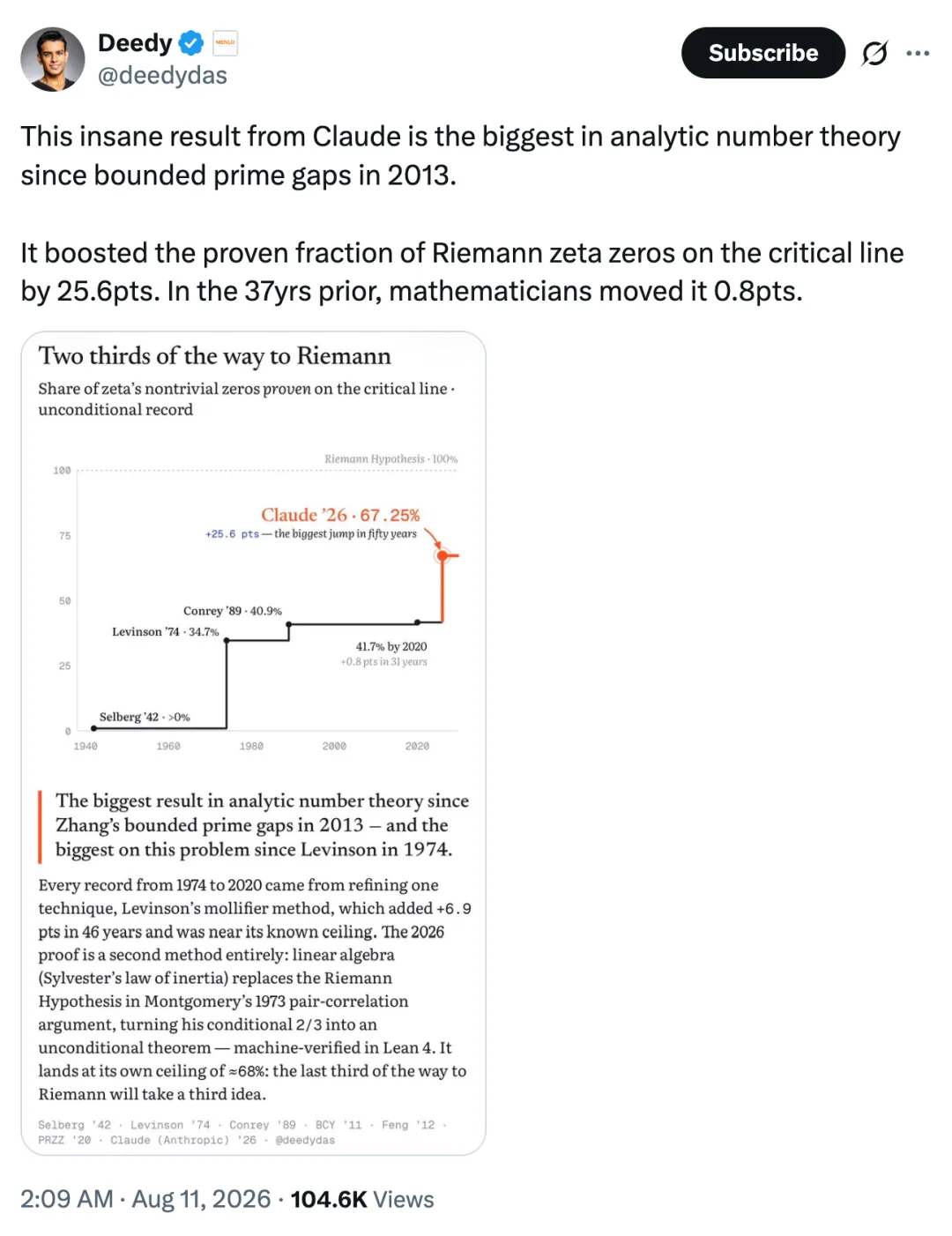
Two mathematicians from Anthropic subsequently studied and validated Claude's paper, and Claude gave a corresponding Lean formalization proof. Mathematicians Brian Conrey and Dan Goldston also reviewed the paper in a shorter period of time.
Anthropic emphasizes that this approach is not expected to directly lead to the final proof of Liman's conjecture. However, this result still provides a noteworthy signal: the mathematical ability of the front-end model is beginning to address research problems that really don't have an answer.
The unresolved Lyman conjecture in 167
The importance of Liman's conjecture is related to prime numbers. The distribution of Liman's functions to prime numbers is deeply linked. In 1859, German mathematician Bernhard Liman suggested that the prime of all non-ordinary zero-pointed vertices of Liman's functions should be equal to 1/2.
In a repeating plane, this means that the zeroes all fall on a vertical line, the famous line of demarcation.
This seemingly abstract problem is very influential. Many mathematical conclusions about the distribution of prime numbers can be made more accurately on the assumption that Lyman's conjecture is true. It is also one of the seven "millennium problems" of the Clay Mathematical Institute, which can be proven or overturned with a $1 million prize.
Over the past century, no one has been able to prove that all unusual zeros are on the line, but mathematicians can prove that some of them must be there.
Thus, a relatively realistic question arises: how much of a percentage of zeroes we can at least prove fall on the line of demarcation? After decades of progress, this proportion of the known bottom line has gradually risen to about 41.6%.
This is exactly the number that made Claude move forward.
From 41.6% to 67.2%
Claude is based on the outcome, not on a random appearance.
In 1973, mathematician Hugh Montgomery introduced a series of important methods when studying the distribution of zero points of a function ζ. However, some of the analysis relies on Liman's conjecture to establish this premise. In recent years, a series of mathematicians have further developed related techniques that allow some of these methods to be used without prematurely assuming the existence of Liman's conjecture.
This means that they have the opportunity to in turn help study "how many zeros are on the critical line". On the basis of this work, Claude combined the relevant research published by Enrico Bombieri before 2000 to find a new way to combine them.
The final result was that at least 67.2% of the relevant zeroes were on the critical line. This was an increase of 25.6 percentage points from the previous 41.6% known bottom line.
From a technical point of view, Claude constructed a suitable function space and used the secondary model induced by Weil to correspond to the positive and negative directions respectively of zero points on the critical line and zero points away from the critical line.
Mathematicians at Anthropic argue that one of the key points is that Claude did not treat the positive and negative parts separately, but instead placed the entire space within the same framework of analysis, while allowing the secondary type to have a non-contact structure. Combined with the results previously established by mathematicians, this step ultimately led to a 67.2% lower bound.
Here's a special note: Anthropic does not currently claim that the technology can continue to progress to 100%, nor does Claude claim that the distance to prove Lyman's conjecture is only 32.8%.
67.2% is a lower bound improvement on a related problem, and there is still a huge theoretical gap between the complete proof of Lyman's conjecture.
There are 31 million tokens, 60 sub-agents,
How did Claude find it?
This experiment is equally noteworthy, as is the way in which Claude solved the problem. The entire result was obtained in two rounds of Claude Code sessions, consuming a total of about 31 million tokens.
At first, Jared Sumner was very open about what he wanted Claude to do: seriously try Liman's guess.
Sumner himself was not a mathematician, nor did he specify a specific mathematical route for Claude.
In the first round, Claude produced and tried about 650 ideas. All failed.
Sumner then allowed it to continue to try. The second round lasted about a day and a half.
Claude organized around 60 agents to simultaneously explore the problem in multiple directions. Together, these agents executed about 2,400 Shell commands, wrote hundreds of Python scripts, and performed thousands of numerical checks on known z-function zeros.
The results will also be reviewed by different Agents.
According to Anthropic, Sumner provided little mathematical guidance at this stage. What he did mainly was constantly tell Claude to "continue" to "try again" to "believe in himself".
After finding the results, Claude started a round of self-verification. Some agents specialized in verifying proofs, some looking for counterexamples; Claude also downloaded 54 arXiv papers to check whether similar results had already been obtained by other mathematicians.
After confirming that there were no obvious problems, Claude proactively suggested that the results be compiled into a paper and made it clear that a real mathematician should be found for artificial verification.
Anthropic internal mathematicians Levent Alpöge and Ralph Furman subsequently began examining the paper and analysing its relationship to existing literature. Meanwhile, Claude worked with Eric Easley of Anthropic to formalize key results into Lean proofs. This formalization was already done through the Lean standard verification tool Comparator.
Anthropic also invited the mathematicians Brian Conrey and Dan Goldston to review the paper to study the Riemann function. Thus, it is more accurate to say that: Anthropic internal mathematicians have already studied and verified the results, and have completed machine-checkable formalized proofs, while two outside experts have reviewed the paper. This is still two different stages with the traditional academic peer review, forming a consensus in the mathematical community.
More links:
Claude Project address:https://github.com/anthropics/zeta-23-lean
The link is as follows: