In early 2026, the mainstream narrative of physical intelligence was still revolving around the VLA (Visual-Language-Action) model, world model and end-to-end learning.
Its team is somewhat special: from 2016 to 2023, a teacher in the Department of Mechanical Engineering in China brought his PhD students from eight different years into the same project, eventually forming a nine-person core team, all struggling with an operating instinct that was not understood by mainstream viewpoints at the time.
From this point onwards, Apple has taken a downward and upward path. They have tried to empower the robot with an operational instinct, allowing it to emerge autonomously in interaction with the physical world, instead of using large models and bulk data to teach the robot every move. It took nine years from theoretical discovery to the commercialization of products.
01.
Is it really instinctive to operate?
The founder's academic trajectory is somewhat cross-cutting. He holds a Ph.D. in mechanical engineering from Harvard and a Ph.D. in neuroscience from Harvard. During his time at Harvard, he studied how the human brain controls hands, gradually forming a judgment that the tongue does not have an innate instinct to operate.
His observation is simple. If a child is born without contact with a language, he will not learn to speak for a long time, and learn which language to speak. But grasping behavior is highly consistent globally, regardless of age, culture, environment, and no one systematically teaches humans how to grasp something, but almost everyone does.
This judgment is guided by a technical assumption: at the bottom of operational behaviour, there may be a set of innate expectations, not specific action planning, but a tendency to behave in a continuous cohesive manner. Robots, if implanted with this instinct, may not need to mimic massive amounts of human operational data and may develop stable operational capabilities on their own in interaction with the environment.
This has distanced itself from the mainstream robotic simulation of learning robotic logic. Most people want robots to adapt to human actions, while Apple wants to let robots have an underlying instinct to operate like humans and then let them find their own way.
02.
Evaluating the structural problems of VLA failure in the last centimetre of aluminum
The current mainstream VLA architecture in the physical realm is essentially a huge fluid perception-action black box, with task planning and operation execution combined to fit end-to-end through bulk data and supermassive computing. This path progresses rapidly in language and multimodal understanding, but problems begin to emerge from three directions when it comes to physical execution.
One is that the problem of data size is more acute than imagined. Language has only a single information model, but operations involve vision, touch, intuition, etc., and the output of actions and specific hardware (motor characteristics, motion form, number of fingers and even trajectory) deep binding. Once tasks and hardware are combined, the amount of data required for generalization is indexed. As of early 2026, there are only about 500,000 hours of compliant robot operating data available globally, missing more than 99 percent. It is difficult to expect any company to collect enough data to cover all hardware and operating scenarios.
Second, real-time is a hard constraint in the physical world. Operational execution requires milliseconds of response, and an action is either instantaneously completed or fails. Cloud-based models can tolerate a word-by-word slurry while generating text, but robots do not wait for the luxury of computing to generate the next action when the object slips off its thumb.
More importantly, the logic of task generalization and hardware generalization is not the same. Tasks are knowledge-level and can be abstractly unified; but execution must be adapted to the individual differences of each hardware, the two claws look the same, the directional impedance is different, and the control parameters can be very different.
This leads to an anti-intuitive conclusion: at the level of physical execution, there is probably no best pre-training model for a mouse, only the model that is best suited to current hardware.
03.
Disconnect task planning and operation execution
Based on the above judgments, Apple chose to completely unravel its mission planning and operation execution, each evolving independently, through standardized interface collaboration.
The task planning layer can use large models to solve the puzzle: reasoning, task decomposition, the output is not specific action instructions, but key image puzzles and semantic constraints, such as keeping puzzles level.
The operational execution layer is where they really put their bets: no longer trying to use neural networks to fit the trajectory of action end-to-end, but going back to the very bottom of physical interaction, allowing their instincts to drive behavior.
The core of this architecture is two models.
Natus AGE-0 AGE-0: Operating instinct model with zero data cold start
On August 10, Apple released the "Natus AGE-0 AGE-0 Intuitive Model", the world's first general-purpose operating base model with touch perception at its core, reproducing human operating mechanisms.
Specifically, the Natus AGE-0 is fully embedded in the end-user, driven directly by touch stimulation, and responds at milliseconds. It incorporates three types of hard-coded cubic sensors: orientation instinct, target movement, exploration instinct, automatically seeking stable contact patterns through touch information after contact with objects through sliding, shapeshifting, and so on.
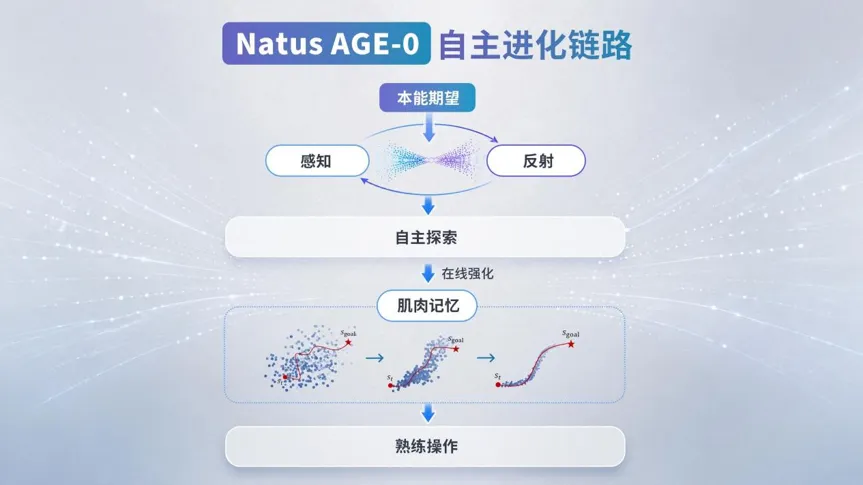
This means that it does not need any pre-collected operational data. The factory has the basic operational instinct to face an object that has never been seen before, and it will explore, test, slide, adjust along the surface of the object autonomously until it establishes a stable contact.
A typical example is having a single-freedom industrial claw pick up a bank card that is less than 1 mm thick on a desktop. There are no external cameras, no cloud brains, and no demonstration trajectories studied. Claw keeps trying to push, pull, button, and after eight or nine attempts, finds a strategy to raise the card with the edge.
Magis: From a mouse to a mouse to an operational skill model for a skilled mouse
Natus AGE-0 addresses zero-sample startup and adaptability, and Magis' mission is to make robots from pumps to pumps skilled pumps.
Interestingly, Magis does not train with human demonstration video, but uses data generated by Natus AGE-0 to explore itself in a real-world physical environment. When Natus AGE-0 completes a successful operation, it records not only the result of a successful collision, but also a wealth of physical information: body weight, mass position, surface softness and roughness, grip strength distribution and slippery movement trends. These are used by tactile automated marking to superimpose on visual data, training skills models.
The benefits of doing so were immediate: the need for training data was greatly reduced; models learned deep physical properties and instead were more easily generalized to unseen objects and scenes.
04.
Touch as the base of information
All instincts require information input, and Apple chose to make the touch profound.
They divided the tactile information into three layers: the interface information ((distribution on the contact surface, shape change, slippage, where slippage is one of the hardest to measure and the most critical); the object information ((mechanical properties such as softness, friction coefficients, mass and mass distribution sensed indirectly by contact); the environmental information ((contact location, rigidity, resistance sensed indirectly by tools or objects, which determines why assembly is harder than grabbing).
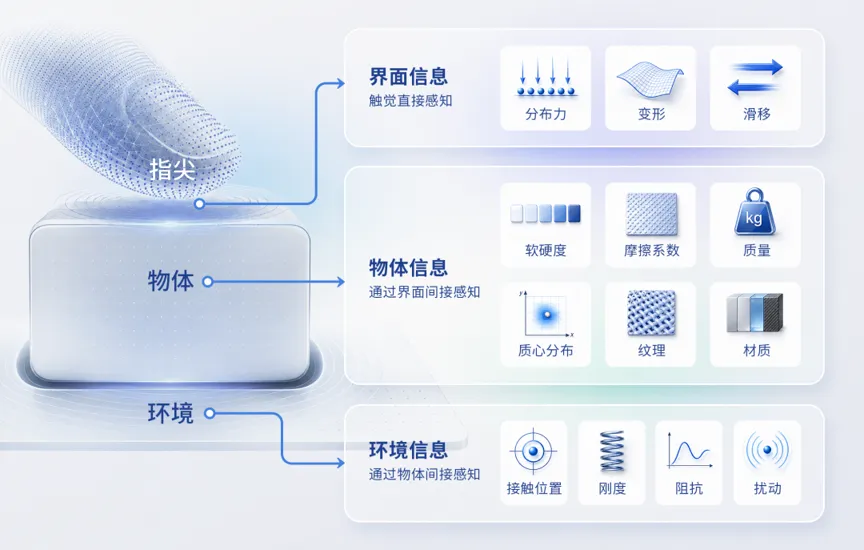
In order to obtain this information, the team developed its own visual touch sensors. The principle is an elastic-body micro-camera, which uses image representation algorithms to reverse elastic-body deformation and calculate the required multi-modal tactile data. In which dynamic sliding motion representation technology was first publicly proposed in 2020, five years earlier than the industry was generally concerned. Sensors to date have replaced more than a dozen prototype machines, with third-generation products achieving engineered quantity output, which can directly output standardized touch information, avoiding hardware differences that lead to subsequent model failures.
05.
What is the meaning of this verse?
With Natus AGE-0's zero-data cold-start pump, Apple's solution can quickly enter the production line.
It was officially commercialized in 2025, and in just two months, POC verification and revenue were achieved on the production line of one of the world's leading cosmetic ODM manufacturers. The production line required robots to grab, rotate and place large differences in shape, size and material. Cosmetic packaging materials softened tubes, bottles, boxes, shape irregularities, surface quality from smooth to grinding.
Recently, the company has completed its angel round of financing. This round of financing is jointly owned by the Advertising Bureau of Investments, and is jointly funded by the Seed Fund of the alumni of HCMC. The General Manager of the Advertising Bureau of Investments said: "We have long focused on the underlying innovation in the field of hard technology. The team of the company started from neuroscience and contact behavioral mechanics, and has proposed and verified this new path that drives instinct, which is very promising in the smart industry. They are blind to the mainstream, dare to come out of the principle of 'first gender', to find a more efficient, more elegant general operating solution.
The story is told here, and both the charm and the doubts float to the surface.
The exciting thing about Apple's route is that it has responded positively to the current structural challenges of smart pump data hunger pumps and the difficulty of widespread pumps, and has found a way to get rid of pumps. Operating instincts have already proven their effectiveness in basic operations such as crawling, spinning, and enough to cover the vast majority of production needs in the industrial scene.
Another unresolved question is interface standards. After solving the puzzle of task planning and operation execution, what is the standardized interface between the large model layer and the instinctive execution layer? Who defines it?
Apple's founders have said that their barriers come from the lack of cognitive leadership and engineering details. That's fine, but the width of the ramparts will ultimately depend on what results can be achieved in more industry scenarios over the next two years.
At a time when the entire industry is looking for bigger models, more data, and more powerful computing power, Apple's choice seems to be to rethink a more basic question: Do you need to have a hydrogen instinct before robots start?