In an interview with the Financial Times last year, Invisalign CEO Huang Rinpoche said: "China will win the AI competition".
He believes that the threshold for future arithmetic explosion is not in chips, but in infrastructure such as networks, electricity, energy storage, heat dissipation, etc.
In April of this year, OpenAI's gate was hit with three pause keys: the Stargate UK project was halted because "energy costs were too high, the regulatory environment was uncertain"; the data center in Norfolk, Norway was halted; and plans to expand the flagship station in Abilene, Norway, were also abandoned.
More than 60% of the planned U.S. data center capacity to be operational by 2027 has not yet been operational, and another 7% has been explicitly delayed, with infrastructure issues stuck.
This is not a problem unique to the United States. When computing power moves from 100,000 to millions of cards, the competition will no longer be limited to chips. Factors such as network, electricity, heat dissipation, etc. will determine how much real computing power a cluster of computing power can release.
This is the physical constraint that AI faces together after entering supermassive clusters. Infrastructure in the past is in the background and is moving to the forefront of AI competition.
In Inner Mongolia, Ulaanbaatar is geographically stable, the climate is cool and full of electricity. It is one of the eight hubs of the country's "Eastern Calculus", and the network time lag is ranked first in the country, accounting for 67% of the total area of green electricity.
Recently, the Vision Technology Group officially launched the "Vision Ulancha Busstar River Base", the world's largest AI computing superunit simultaneously debuting in the park.
It answers a long-held question that has plagued the industry: What should a data center look like when AI enters the million-card era?
In a million-card era, why do we need a "super unit"?
Vision announces the world's largest AI computing superunit to be built: over 120,000 square meters of building area, equivalent to 20 standard football fields, refreshing the computing density of the AI data center, which is the world's strongest single AI data center capable of Token production.
This marks the official launch of the "Vision Ulanchabu River Base".
From a spatial point of view, an AI computing superunit is a single data center that carries high-density computing within a park to achieve ultra-high computing density and output.
Visions Star River Base, a supercomputer hub containing computing facilities and supporting all infrastructure such as energy, networking and transportation systems, is the first flagship project to land on the Visions Gobi Mission.
With a total planned capacity of 2GW, the entire park will be capable of supporting millions of cards running simultaneously, with a computing scale of millions of P-levels, and is the largest AI computing park in the country.
In contrast, OpenAI's first interstellar gateway station in Abilene, Ga., is planned to hold about 400,000 cards, according to people familiar with the project.
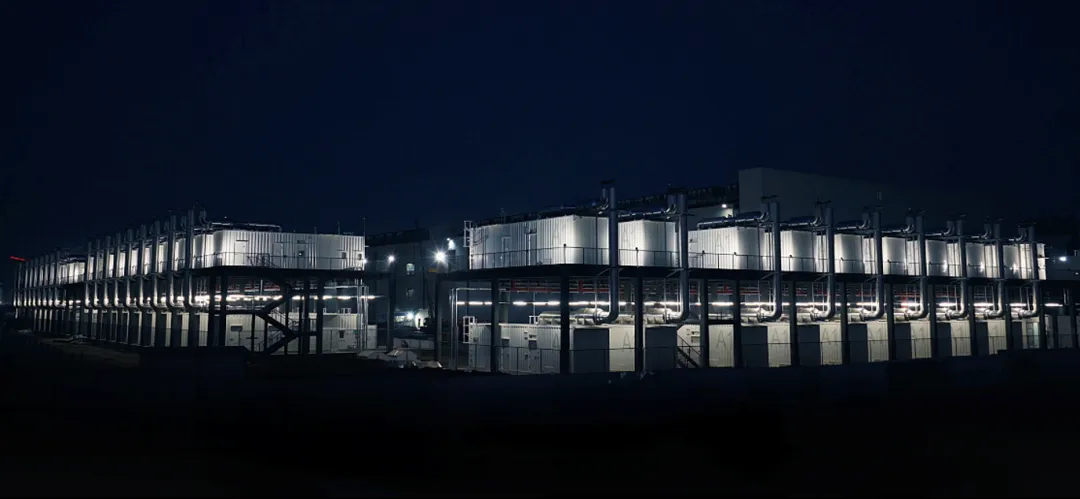
The "Vision of the Uranchaburst River Base" officially lit up production
Once the data center cluster is pushed to a million-card scale, physical constraints are immediately transferred from the chip to another location. Power must be continuously and steadily delivered to each row of cabinets, mass heat must be efficiently removed, and high-speed connectivity between hundreds of thousands or even millions of cards must be maintained.
This means that AI infrastructure is undergoing a structural change: a data center is no longer just an architecture for hosting servers, but a complex system designed specifically for AI computing.
Therefore, the "AI computational superunit" was born.
It is not a simple enlarged version of traditional data centers, but a form of infrastructure redesigned for ultra-large chip clusters, and the result of AI's reversal in the definition of data centers.
It concentrates computational deployment, network connectivity, power supply, energy storage, heat dissipation, and intelligent scheduling in the same highly integrated building and system. Only when these infrastructures can work in sync, can the number of chips be truly transformed into a callable, sustainable, and scalable computation.
Vision AIDC's general manager, Liu Xiaobo, summarized this logic as a logistical problem for the Group forces: "China's chips are on a clustered path of turmoil, and the superunit must provide a large enough deployment base, enough power grass and a power supply line".
The core of the super-unit is a completely new AI power system.
Scale is a result, ability is a prerequisite.
One hundred thousand cards, one million cards, must be put together as a whole, and there is no shortage of connectivity, power supply, heat dissipation.
The GW-class electricity load is close to a medium-sized city. Traditional data centers rely on a model of passive power supply from the public grid, and at such a scale face multiple constraints such as grid capacity, construction cycles, energy costs and reliability.
The need for a million-card pool is not just more electricity, but a whole set of energy and heat management systems redesigned for AI.
The vision is to synchronize power generation, power grids, energy storage, computational loads and AI scheduling into the same set of systems.
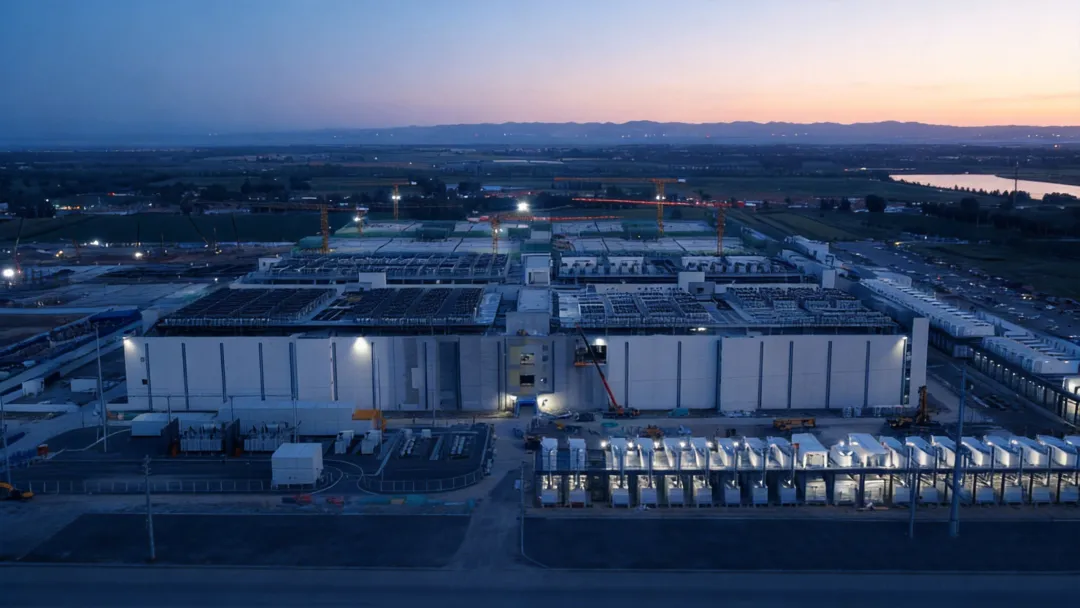
"Vision Star River Base" AI supercomputer looks like a single entity
Zhang Lei, chairman and founder of Vision Technologies Group, explained the vision for AI power systems at the National Energy Agency's National "AI +" Energy Field Promotion Meeting.
His judgement was that the large model had a major mutation about every six months, and the chip had a version about every 12 months, while the electrical system responsible for energy conversion had barely changed structurally in the last 100 years. When the index-developed chip and the model collided with the linearly evolving electrical system, contradictions inevitably arose in the latter.
The vision is to address three questions: how to turn volatile green electricity into stable computational energy, how to deliver more electricity efficiently to the chip, and how to sustain the heat generated by high-density computational energy.
It's about transforming fluctuating green electricity into stable computational energy.
Over 80% of the electricity generated directly from the wind turbine is sent to the engine room through a direct line through a self-constructed wind farm. This leads to an inevitable contradiction: wind power is naturally highly volatile, but AI training requires industrial-grade stable electricity.
The first step is forecasting. The "Vision Meteorological Big Model" combines satellite, radar, ground-based weather stations and equipment operational data and introduces physical constraints such as atmospheric dynamics, geography, and climate change to convert wind power forecasting to different time scales. Long-term forecasting is used to arrange power generation and storage plans, while short-term forecasting identifies power surges, drops, and extreme weather risks in advance.
Under the conditions of a high proportion of direct renewable energy supply, the climate system itself is part of the energy system and directly determines the maximum degree of accuracy of weather prediction.
The second step is optimization, which combines forecasts and real-time equipment status with a continuous search for advantages between power generation, energy storage, load and computational demand: the capacity to store energy in advance when wind power is increased, reserve power and spare power before wind power decreases.
The premise of unified scheduling is to get different devices into the same control system.
Intelligent IoT operating system EnOS connects fans, energy storage, electrical equipment and computing facilities to the same set of systems, with upper-level models responsible for prediction and optimization, station controllers rolling adjustment strategies, and lower-level devices executing quickly, forming a closed loop from perception, decision making to control.
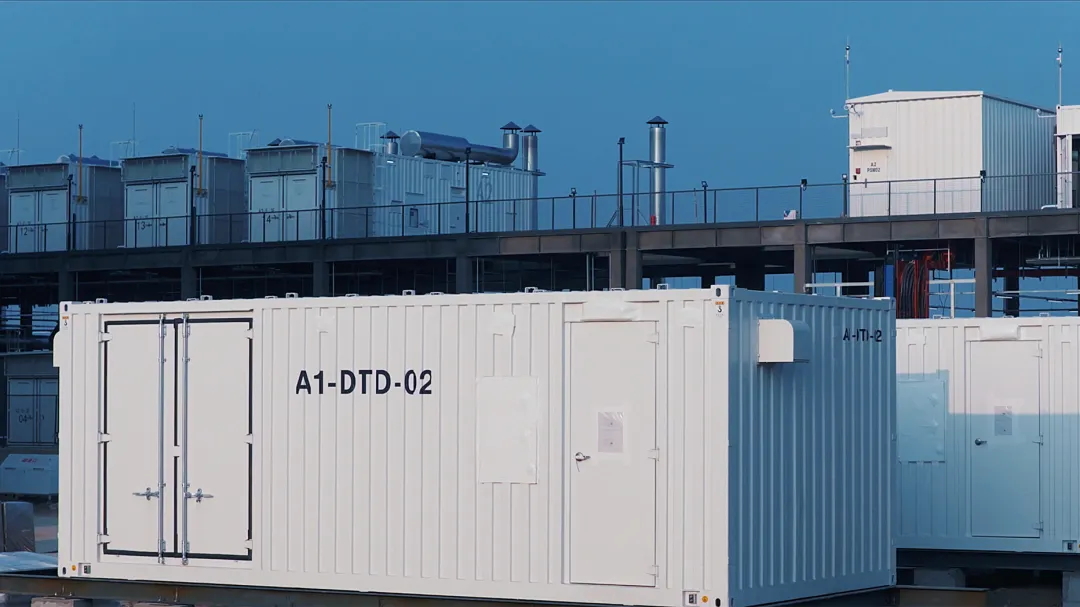
"Vision Star River Base" is a storage facility
At the same time, hourly storage is responsible for smoothing wind power and scheduling biases, secondary storage responds to computational load changes with SST and 800V direct current architectures, and faster power compensation is used to address instantaneous power quality problems caused by AI training and reasoning.
This multi-time-scale energy storage system enables a high proportion of green electricity to be truly transformed into stable, adjustable computational energy.
The long-term implicit cost of a data center power supply chain: from the mid-voltage transmission to the low-voltage direct current at the end of the chip, the mid-voltage switch consumes a portion of the efficiency each time. In other words, the power supply architecture itself determines how much electricity actually reaches the chip.
The vision in the Uranca project is the 800V direct current architecture of SST plus BESS, where the solid state transformer is responsible for direct switching of the pressurized to direct current to reduce the intermediate linkage, and the battery storage is embedded in the power supply chain to provide instantaneous power support.
At its core, it is able to shorten the entire power supply chain from the central compression grid to the chip, so that more power actually enters the GPU, rather than being lost in the middle of the conversion link.
Heat management must be designed in conjunction with electricity
The other limit of supernodes is heat.
After hundreds of thousands or even millions of chips are deployed, the power supply density and heat flow density are amplified at the same time. Most of the electricity from the input server is eventually converted into heat, and any heat dissipation bottleneck directly affects the chip's continued full-load operation.
The low-temperature climate of Ulaanbaatar creates the conditions for natural cooling, and the superunit combines high-density cooling schemes such as wind and liquid cooling to reduce non-calculative energy consumption for cooling.
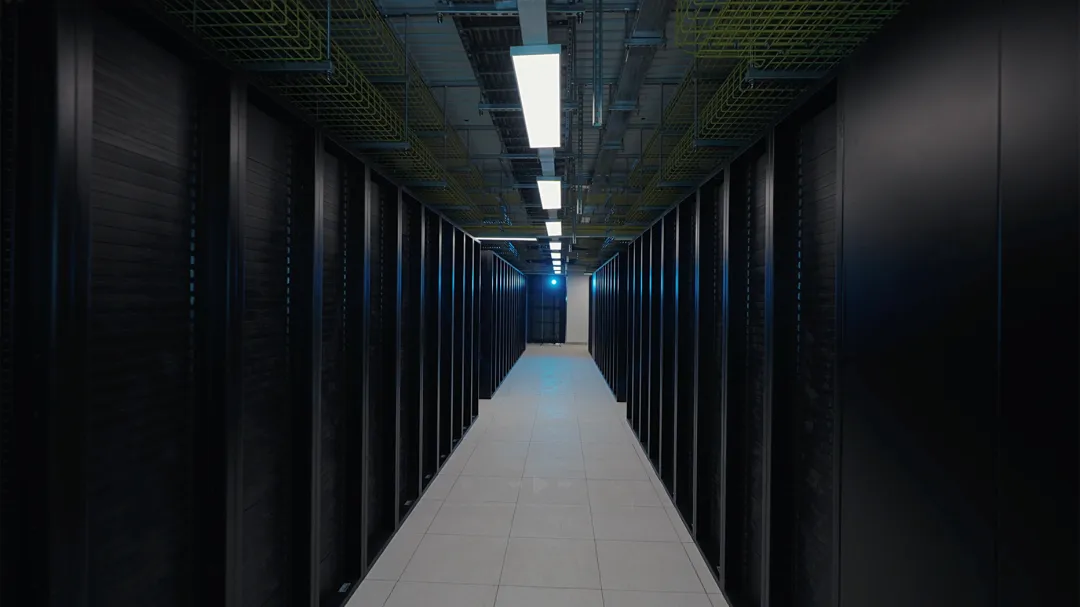
"Vision Star River Base" air conditioning room
Therefore, an AI power system is not just a hydrogen power supply system. It combines energy management, chip power and heat management in the same architecture: electricity must come in steadily, efficiently, reach the chip, and heat must come out continuously.
The AI power system solves how the chips work sustainably, efficiently, and at low cost.
Extending from the Energy Side: How the Vision Rebuilds AIDC Delivery
In the past, data centers were dominated by telecommunications operators, professional data center developers, and internet giants: operators provided networks, developers built machines, Internet companies deployed servers, and more power was just a production element purchased from the grid.
But when the IT burden reaches the megawatts to GW level, energy acquisition, power supply, storage and heat management begin to determine whether the project can be completed on time and run efficiently. AIDC's technological focus is shifting significantly from conventional mechanical engineering to energy infrastructure.
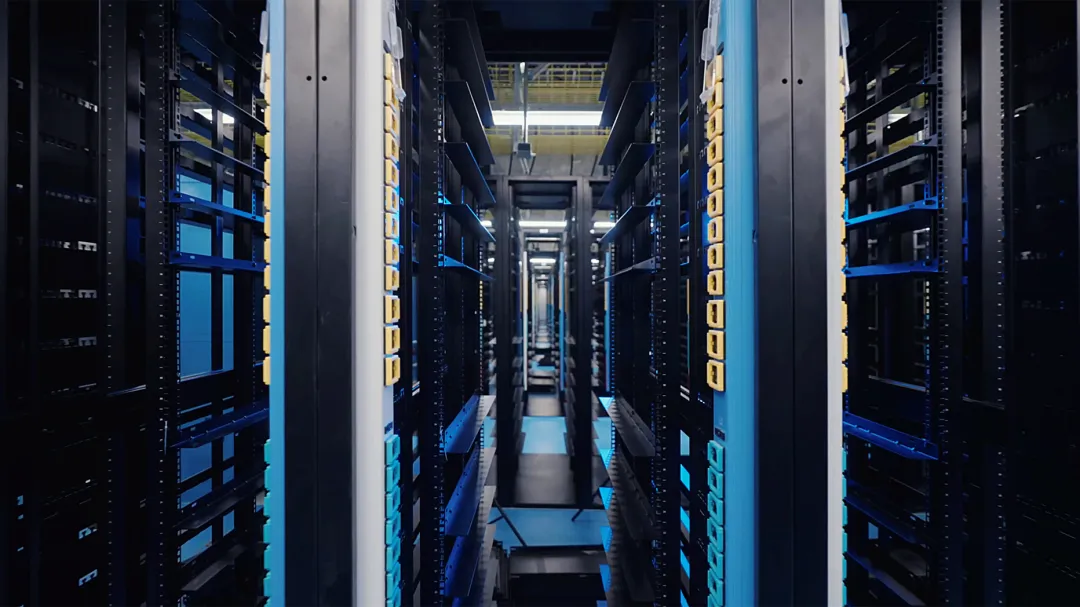
"Vision Star River Base" cabinets and PDU
This also explains why an energy company enters the field of AIDC.
The vision does not extend from the server and chip side to the energy side, but extends from the energy side to the inside of the machine.
From wind farms, green power lines, energy storage and electrical electronics, to in-wall power distribution, cooling and super units, the vision tries to integrate links from the past to a complete AI infrastructure that has been handled by different suppliers separately.
This is different from the delivery boundaries of most equipment vendors and solution providers in the industry.
Vision is responsible for the construction, distribution, green electricity, energy storage and support systems, while customers deploy and manage their own servers and chip clusters. For customers, the ideal state is to "deploy the card with delivery", reducing the time and uncertainty of building from the ground up and the grid to the energy system.
In other words, the customer is responsible for the calculators, the vision is responsible for making these calculators have the infrastructure that can run directly and the AI power system behind them.
More importantly, Vision's Urantabus River base has been built and put into operation, and the world's largest AI computing superunit has been synchronized. This means that Vision has completed the transition from technical programming, engineering construction to AIDC actual delivery.
What is the potential of a super-unit to replicate from Uranus?
In June 2026, Vision launched the Gobi Mission, which aims to build a 5GW-scale green AI computing center in the Gobi Desert region around the world by 2030.
"Vision Ulanchub River Base" is the first flagship project of the Gobi Mission.
The vision is not to replicate a 120,000-square-meter superunit, but a green data center model of "energy-rich zones + superunit + AI power system".
In the past, data centers often revolved around cities, networks and existing power grid layouts. The Star River base attempted another logic: to move large-scale computing closer to land and green energy, to synchronize energy planning with AI infrastructure in energy-intensive areas, and to connect key computing needs markets via high-speed networks.
The vision does not involve customer chip and computing operations, but is to transform its capabilities in the delivery of wind turbines, energy storage, power electronics, energy management and engineering into infrastructure capabilities to support large-scale AI computing operations.
This also reflects a characteristic path that China's AI infrastructure is taking. China has a huge demand for computing, a rapidly developing domestic computing ecosystem, while also having the world's leading capacity to develop new energy, a complete chain of energy and electrical equipment industries, and the ability to build large-scale infrastructure.
The supernodes transformed more chip organizations into efficient collaborative computing systems, with superunits providing high-density physical load to these clusters, while the AI power system further organized green electricity, energy storage, power supply and heat management. Computing, energy and infrastructure were no longer optimized separately, but began to co-design the efficiency around the entire system.
In this sense, the Vision Star River base is not merely a "compensation" for a single point of lack of infrastructure, but an expansion of China's existing industrial advantages by using systems engineering capabilities to transform chips, energy, land and infrastructure into larger, more efficient computing capabilities.
Therefore, what really needs to be verified is not how many cards this superunit can load, but whether this model of "superunit + AI power system" can be replicated on a global scale in more energy-rich regions.
If it could be replicated, Star River Base would no longer be just a record-scale Ulanchubu, but could become a new form of AI infrastructure in the million-car era: computing follows the energy layout, computing in sync with the electrical design, and systematically releases the value of each chip and electricity at a time.
Super-units are not the end of the arithmetic race, but a starting point for AI infrastructure from "device stacking" to "system collaboration".