On November 3, at the Shanghai New International Exhibition Centre, CeMAT 2026, an influx of people came to the scene, with a robot perched between the shelves, showing the seizure, sorting and transportation of goods...
Look closely, a noticeable change is taking place: exhibitions that originally belonged to the fashion industry have suddenly become a new platform for competing in real-world warfare, and there has been an influx of collective "cross-border" players such as U-Tree, Star Wars, Auto Variables, etc.
Storage logistics, it seems, is becoming the "main battlefield" of physical AI coming out of the laboratory and industrial landings.
However, real warehousing is different from the laboratory, posing a more difficult challenge to robots, with mass SKUs changing every day, with different materials, shapes, reflective properties and stacking postures.
This means that physically capable robots must have a strong enough generalization capability and maintain a steady pace of operation. However, in reality, manufacturers often face two difficulties: either have generalization capabilities but are reluctant to move, the pace is too slow to meet the pace of commercial production; or move agile but rely on predictions.
On the podium, Zhigeya showed another possibility.
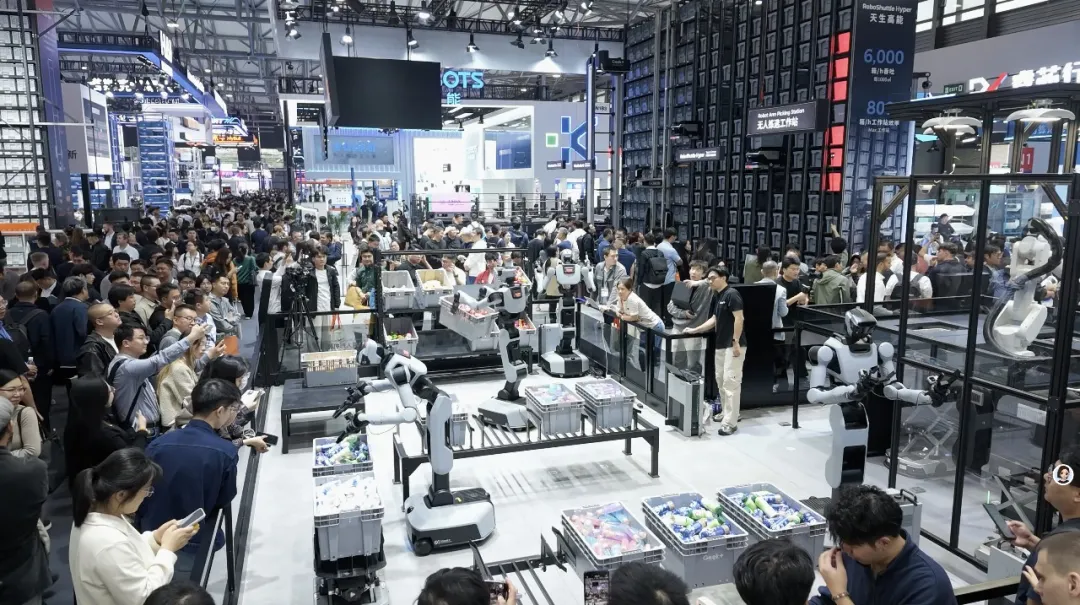
The mechanical arm of the Gravity body model, which can respond randomly to uninhabited objects passed by on-site audiences, completes the challenge... In the face of different types of goods, such as solar products, bottled beverages, the general humanoid robot Gino 1 is able to continuously pick up, pick up, and move the containers. Throughout the process, the movement is fast flowing, maintaining extremely high continuous operating stability.
From single-handed operation to collaboration with warehouse robots, it is clear that ZTE's ambition is not just to build a high-performance, physically-smart robot, but more importantly, how to integrate physically-smart robots into the entire warehouse, working in collaboration with other robots, and unleashing system-level warehouse productivity.
Gravity's core capabilities behind amplification and efficiency
The high-performance performance of the Gino 1 and the Snap Arm on the podium is based on the integrated capability system built by the Intelligent Gravity model, developed independently by Intel.
In this complex long-range task, Gino 1 was given the task of preparing a breakfast, in which the model handled a variety of fine-grained tasks, arranging and assembling autonomously, and maintaining a steady completion of the entire set of tasks, even if the operating conditions changed.
The big screen next to it shows a preview of the action, from understanding the state of the object, planning the path, to determining the action and executing it, showing the entire process of "thinking clearly, then doing it again".
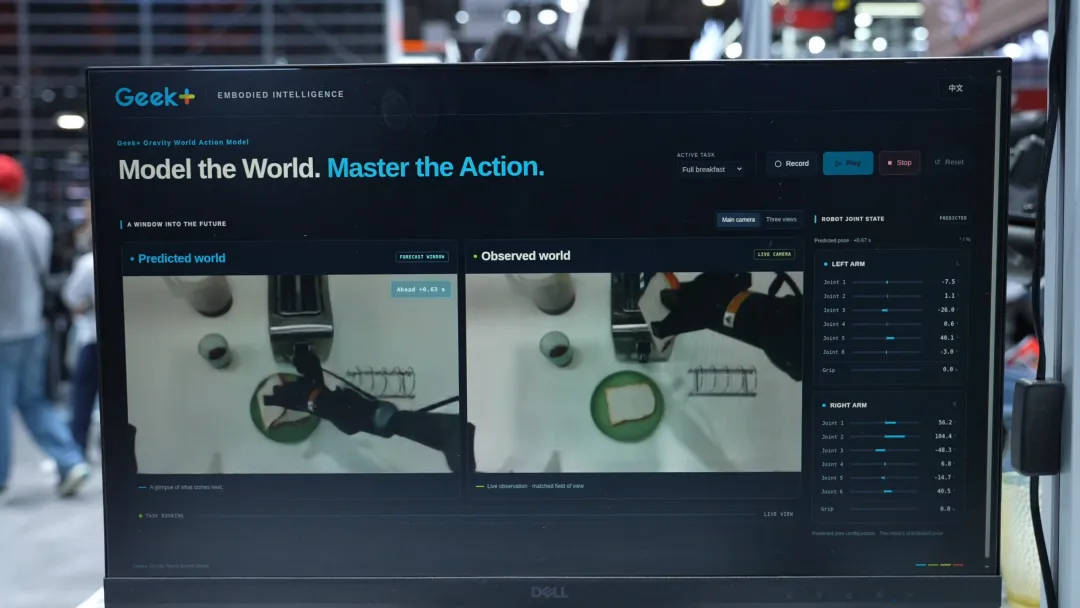
In addition to this, the on-site psychic also set up an alien object challenge, where the viewer can bring the accompanying object to "difficulty" Gravity, allowing the model to face the unknown objects offered on the site and intuitively present its generalized performance.
After this, Gravity first adopted the hybrid Transformer (MoT) dual-brain synchronous architecture, separating the understanding of complex tasks from the execution of specific actions. The cognitive side is responsible for understanding the objectives of the task, the environment and step relationships, and the action side is responsible for planning specific actions according to the current state.
At the same time, the use of a layered memory mechanism helps robots continue to manage tasks. Short-term memory tracks recent observations and movement changes, while long-term memory preserves task objectives, execution phases, and critical events, which means that robots do not have to take each action as an independent instruction, but can continue to move around a longer task goal.
Additionally, Gravity has an important ability to correct natural language biases, which means that when robots encounter non-distributed tasks, operators can correct biases using natural language cues to improve task success rates.
For example, operators only need to enter a "crawling point", and the model can modify the action online by retrieving the characteristic vocabulary in the concept table. Experimental data show that the overall success rate of complex operational tasks has increased from 17.5% to 87.5%.
From the generalization of non-biological objects, to the continuous execution of complex tasks, to natural language biases, Gravity attempts to create a more complete system of physically intelligent capabilities, "resolving three types of efficiency tests using the same model":
Efficiency of movements: through asynchronous reasoning mechanisms, allowing the execution of the movements to overlap with subsequent computations over time, and the single selection movements to stabilize in about 2 seconds, avoiding the calculation of waiting for the slow overall beat;
Adaptation efficiency: In the face of unprecedented transparent bags, easy rolling cylinders and soft bags, models do not need to add special data collection and individual fine-tuning, directly understand spatial geometry and grappling laws, and significantly compress the adaptation costs of new SKUs;
Unusual recovery efficiency: In the face of goods sliding or rolling, robots do not have to stop, but autonomously adjust the configuration or redesign crawling, reducing maintenance to an intermediate state after a single failure, greatly ensuring the continuous operation of the production line.
This reflects a trend: the commercialization of competition with physical intelligence, which is shifting from the demonstration of generalized capabilities to the challenge of generalized efficiency. Whether robots can adapt to new tasks, maintain operational rhythms and respond autonomously to anomalies, determines whether they can actually enter the real world.
One robot isn't enough to make the entire warehouse work together
One-piece robots, however, are more efficient, and if they cannot be connected to cargo access, transportation and workstations, they could still be a bottleneck in real warehouses.
This is also the difference between ZTE and many of the companies with physical capabilities that are mainly focused on single machines: integrating physical robots into existing warehouse robot systems, forming end-to-end warehouse productivity through the collaboration of multiform robots and unified software systems.
Over the past decade, Toshiba has developed a complete set of AMR solutions, and today the addition of physical intelligence together with the original AMR forms a more complete operating system, forming end-to-end robot systems to meet the needs of different storage processes and a wide range of operating scenarios.
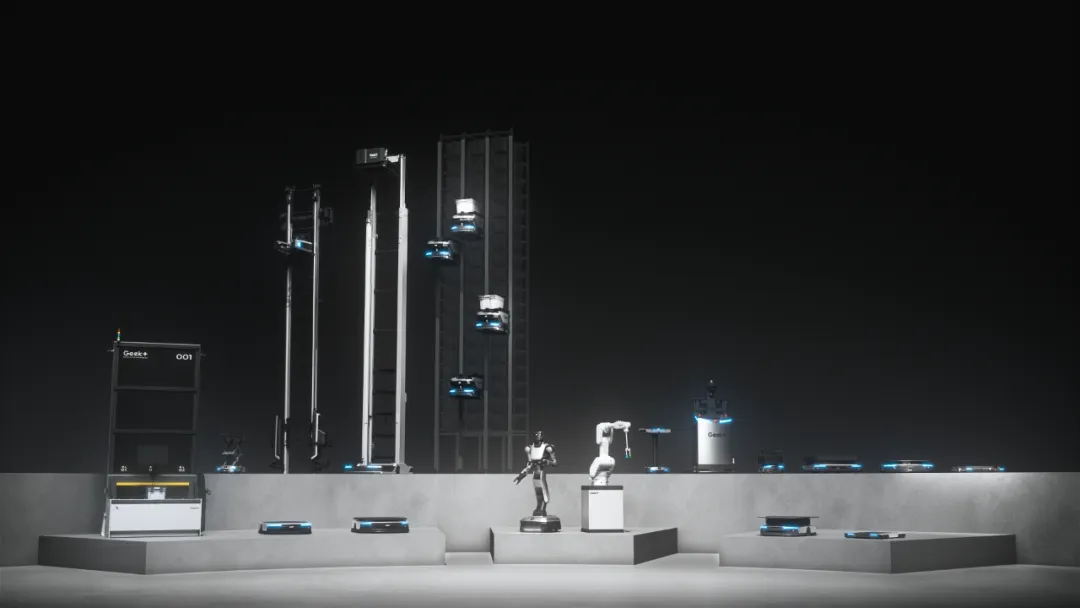
Specifically, the full range of AMR programming combinations covers structured operations such as transportation and pick-up in containers, trays, shelves and warehouses in different storage formats to achieve efficient order fulfillment.
But this isn't simply putting more robots in the same warehouse, with end-to-end robot solutions continually expanding the warehouse's autonomous scope of operation, while AI-powered warehouse brains allow the entire robot system to achieve more efficient collaboration, intelligent decision-making and operational optimization.
For example, when an order needs to take goods off the shelf and then be transported, sorted and incorporated, the system needs to decide which robot performs the task, when to call the workstation, how to plan the route, and how to connect between different devices.
By using RMS (robot management system), WES (storage execution system) and multi-robot collaboration scheduling algorithms to complete task allocation, route planning, traffic management and workflow compilation, allowing different robots to work together in the same set of systems.
The ability of a single robot determines what the robot can do, and the collaboration between devices determines what the entire warehouse can accomplish. This is also the reason why Zidakar emphasizes end-to-end robotic solutions: the delivery of not just one device, but covers multiple storage processes, and the productivity of a whole warehouse that can operate in sync.
It takes an AI brain to go from synergy to autonomous evolution.
When different robots are able to work together, the next question is: Who decides how the entire warehouse should work?
After all, orders will change, equipment will be abnormal, and the workload in different areas of the warehouse is not balanced, requiring the system to have dynamic adjustment capabilities.
It is the core of Geek+ Warehouse Brain. Through AI, it continues to enhance the two "co-intelligence" and "operational intelligence" capabilities that drive warehouses from automated execution to higher levels of autonomous decision-making and operational optimization.
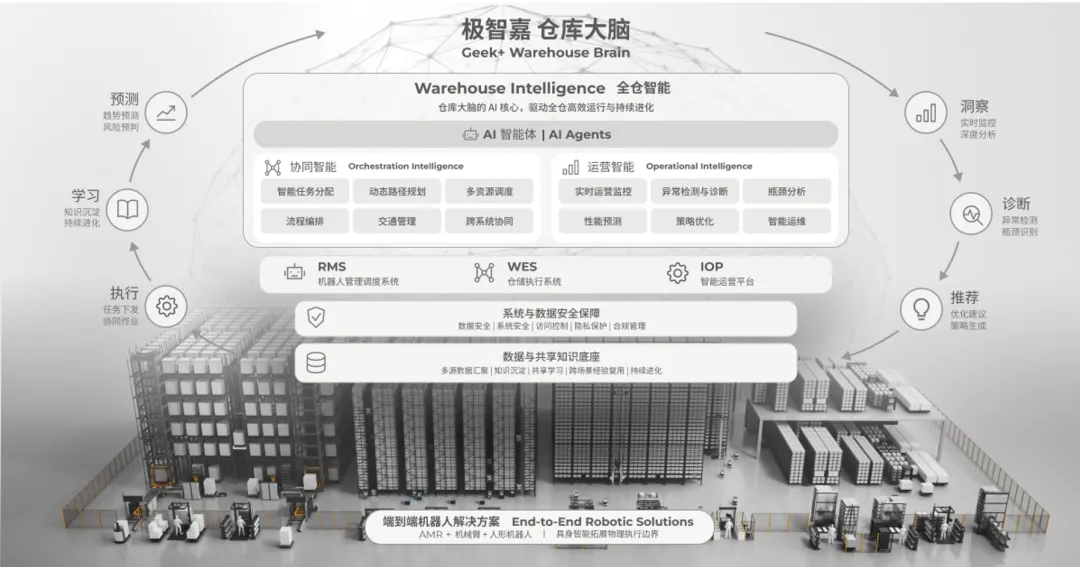
The ongoing evolution of the system is supported by real operational experience accumulated over a long period of time. At present, with over 1,000 terminal customers and over 81,000 robots deployed globally, these real projects accumulate operational data, unusual processing experience and operational knowledge that can be continuously synthesized and replicated through the sharing of knowledge base, and in turn enhance AI capabilities.
From robot execution of tasks, to system detection of problems, to continuous optimization of operational strategies, AI wants to build an intelligent closed loop that can continuously accumulate experience and continuously improve operational performance.
This also means that the way smart enterprises create value is changing: from delivering a set of robot solutions to helping customers continue to improve the operational efficiency of their warehouses.
7×24 hours of autonomous operation and autonomous evolution
With the gradual integration of physical intelligence, end-to-end robotics and warehouse intelligence, the next step is to make warehouses autonomous and evolve 7x24 hours a day.
Recently, ZTE officially announced the launch of the ZTE 24/7 autonomous smart warehouse plan, which will establish full warehouse autonomy as the next stage of development. Because in ZTE's view, the key to the next generation of warehouse intelligent revolution is to achieve 7x24 hours of unmanned autonomous operation and continue to evolve in real operations.
It will focus on three areas: "Opening up the entire process, strengthening the smart closure, making autonomous smart warehouses scalable".
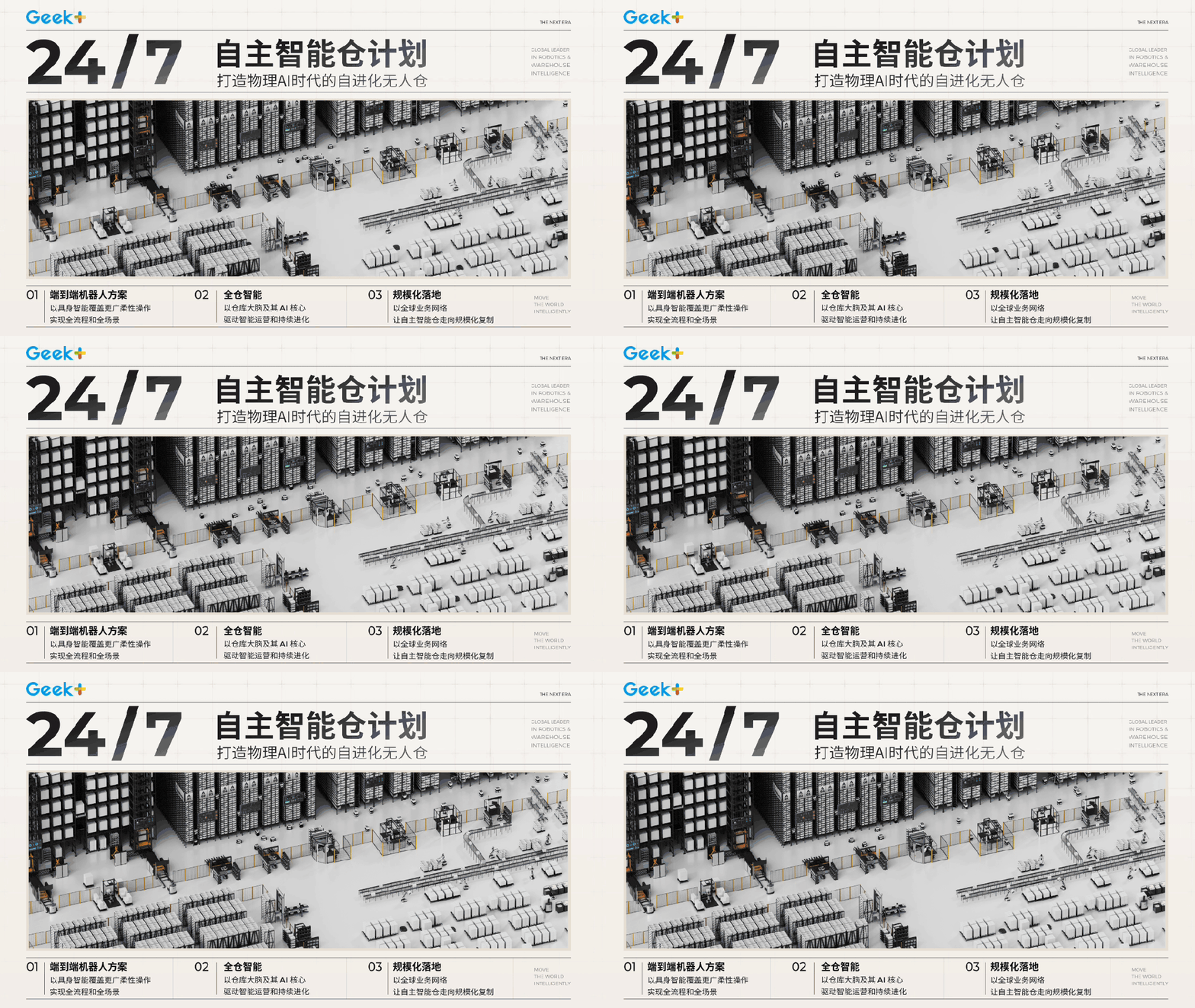
One thing to note here is that as opposed to 7×24 hours of operation, Toshigawa emphasizes that 7×24 hours is "autonomous". This means that warehouses are no longer restricted by man-made shifts and on-site patrols. Whether at night, weekends or orders peak, systems can continue to respond to business needs, improve order fulfillment efficiency and supply chain response speeds, while easing the pressure of overnight work and on-site management, and further unleashing the capacity potential of storage facilities and robotic systems.
But to really achieve this goal, the technological challenge is much more than keeping robots working.
Faced with long-tail scenarios and unknown anomalies in real storage environments, embedded models require stronger scenographic generalization, multi-modal perception and long-range task planning capabilities; faced with dynamic changes in large clusters of robots, automation equipment and business processes, software systems require real-time decision-making, adaptive scheduling and holistic optimization. More importantly, when equipment fails, operating processes are disrupted, the entire system must also have sufficient robustness, error tolerance and self-recovery capabilities, and continue to evolve through continuous learning and cross-scene knowledge replication.
This also explains why physical intelligence needs to be co-developed with full warehouse intelligence: the former improves the ability of robots to physically operate and cope with abnormalities, while the latter provides the entire warehouse with independent decision-making and continuous optimization capabilities.
This time around at CeMAT, it's an example of a smart landing storage scenario worth watching: from single-step breakthroughs with physical technology, to end-to-end storage collaboration, to fully warehouse autonomous smart blueprints.
For ZTE, the value of this path is not limited to warehousing. In the future, ZTE will continue to promote autonomous intelligent warehousing and will gradually expand its real-world-verified robotics, AI and system capabilities into a broader field of physical operations.
© THE