“ Opening up comes with tightness.
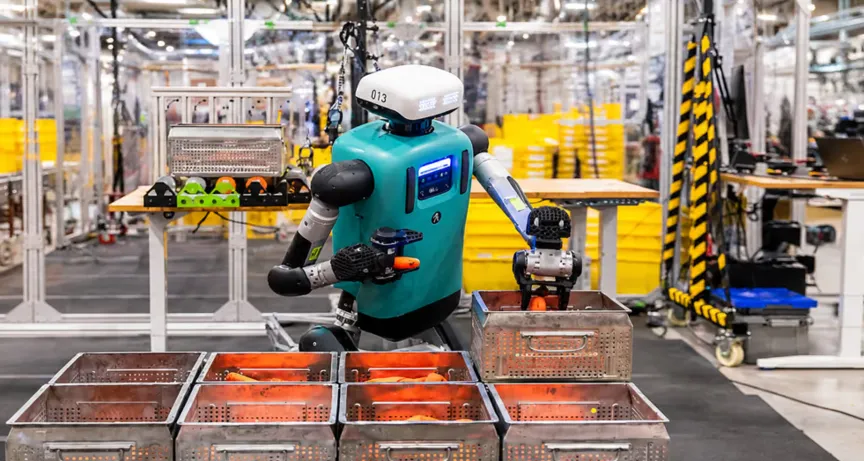
On November 5, 2026, American robot-carrying humanoid robot company Agility Robotics is about to be listed on NASDAQ, code AGLT. It is the world's first pure humanoid robot company to be publicly traded in the United States and has a real commercial deployment.
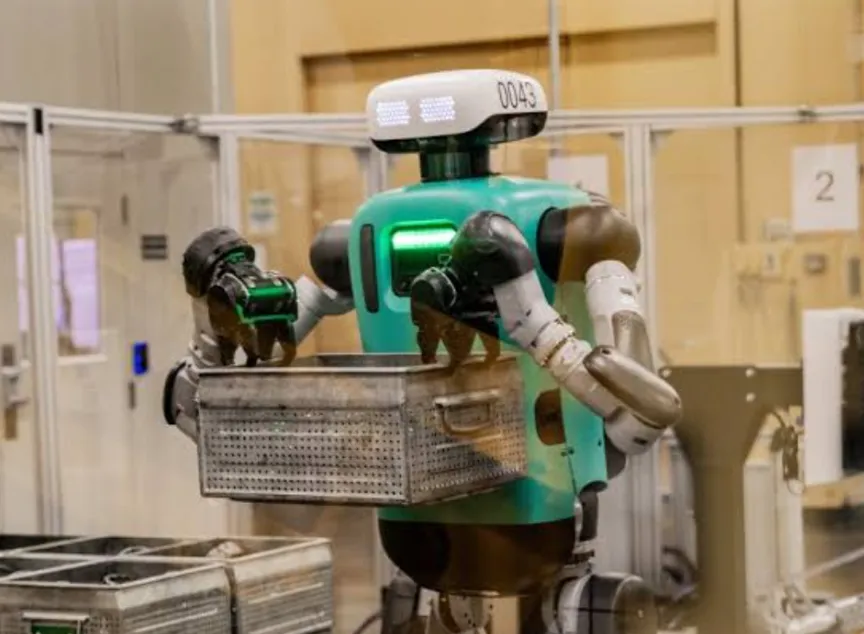
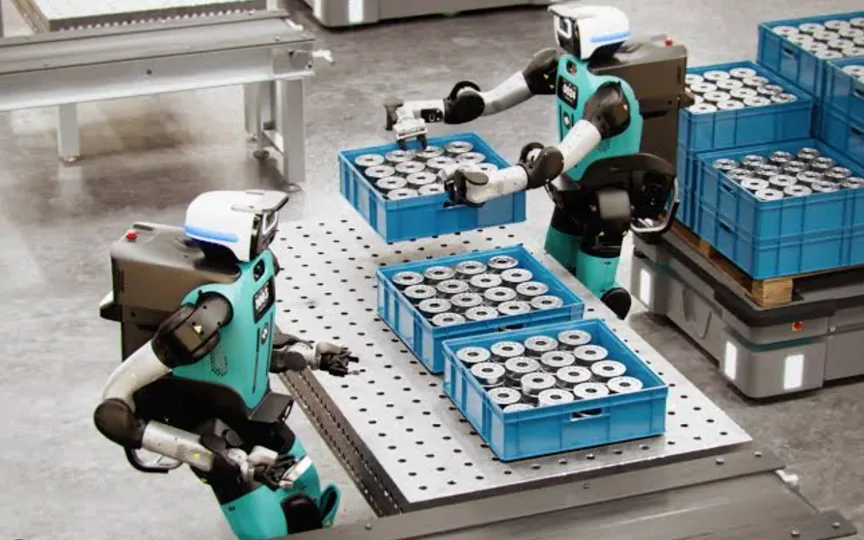
Digit doesn't do anything but move, its headquarters is in the warehouse to move plastic rotary boxes from A to B, people can stand by and continue to work, and the most eye-catching numbers in the bidding materials are 1000 three-year orders for the Digit 5 model, worth up to $300 million. But in the same document, Agility Robotics had net sales of $178.2 million for the full year of 2025, of which 64% came from affiliates, the company's net loss of $138.1 million, gross profit of 151%, while sales were 251 times the cost of revenue.
Most U.S. media outlets still believe that the launch of a humanoid robot company is the starting point of the industry's story, and that losses are a necessary link along the way, not evidence of a business failure.
01.
Agility's account
In terms of financial data, Agility spent about $91.64 million on R&D in 2025, about $45.84 million on sales and management, and operating expenses increased to $111 million from $71 million in 2024. Operating cash flow was about $99.84 million, cash and equivalents were about $103 million at the end of the year.
As of the end of 2025, the company had a cumulative deficit of $3131 million, totaling about $261.9 billion in cash used for operating activities since its inception; total liabilities of $565.758 million, 317 times that of the same period in 2024.
Digit 5 is the next generation of Agility, priced at $200,000 a unit. In May 2026, Agility signed a three-year robot-service contract with a customer, or RaaS. RaaS is the industry's main payment method, and robots are owned by Agility.
Agility reports a total of more than $300 million in orders. The contract involves 1,000 Digit 5, but this is not a receivable that can be discounted on time, the definition in the S-4 is clear, it is a single customer, with delivery and product milestones required. Digit 5 is expected to be commercially available by the end of 2026, which means it is a conditional long-term order.
The second was a confirmed income of $178.2 million. Approximately 64% came from a related party, that is, one with a shareholding relationship with Agility, and only $650,000 actually came from an independent third party.
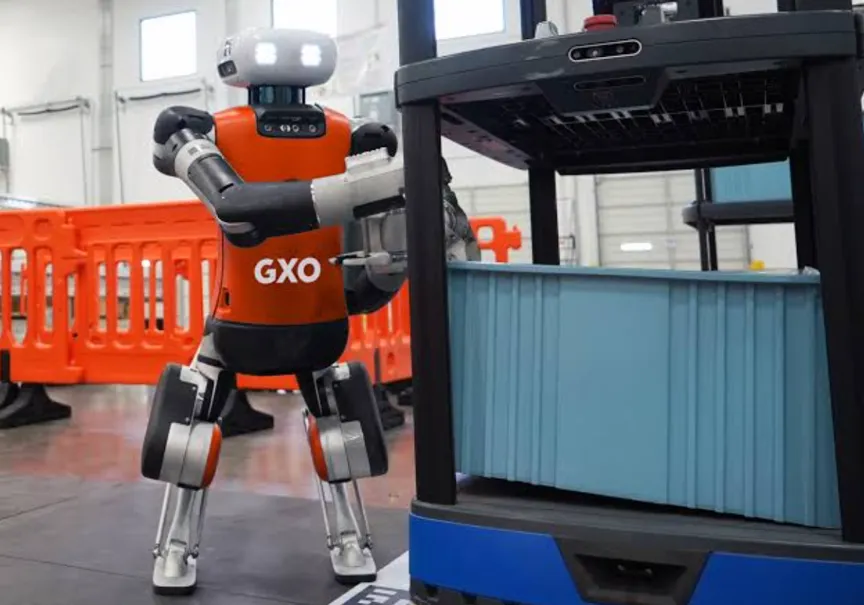
But CFO Peggy Johnson believes there is a loss-covered positive signal in the ledger. The previous generation of Digit 4 has accumulated more than 65,000 hours of on-premises work for nine customers, including the world's largest logistics service provider GXO and auto parts giant Scheffler.
When asked about the losses, the response from the Agility official in the announcement was also strong: "We are pioneering a new era of automation".
02.
Capital's Triple Fault
The real problem facing the domestic robotics and physical intelligence industry today is not that companies are not working hard, but that capital is using a short scale.
Human robots, from PoC, pilot to large-scale deployment, typically take years. But capital often wants companies to go public before the scene is fully operational. Lock the financing window. Going public is not a bad thing in itself, it is a tool for early hard-tech companies to get long-term capital. The problem is that when the market counts down, the company's movements are distorted when the scene milestones are overtaken, and companies start adjusting the pace of revenue confirmation to show good looks, in order to estimate pre-release orders, and in order to compress the deployment verification to more robust windows.
The demand for continued operations, cash flow, and a narrow path to losses is a basic mechanism for protecting investors, which is not in itself wrong. But there is a systematic mismatch between the time at which the metric is used and the stage in which the robotics industry is actually located. Utrecht has proven itself to be profitable, but the market is still pushing it back to $1,100 with more than 200 times the market rate, and then it is too expensive to put it back to $400 within two months.
If capital has to choose between too hot and too cold, the fluctuations it creates will be the most unstable variable on the industry's path to financial transformation. Capital moves according to the industry's average time difference, but the cycle of scenario exploration is naturally three to five years, while the emotional cycle of capital is three to six months.
Tolerance is not ignoring reports, it is essentially not using a quarterly report to deny a technological direction that takes years to land.
03.
New technology landing scenarios would have taken time
The stage in which humanoid robots are today is no different from the early days of new energy cars, industrial robots and smartphones.
During this period, it has been profitable for several quarters, but the quality of the entire year is continuous loss. AWS was more direct, officially launched as a business in 2006, with revenues of only $21 million, two services, and the first positive operating profit by 2013, seven years.
In an interview with users in 2025, Li Feng, the founder of Huawei, said that if it loses 16 years, the market will give us 16 years.
These companies rely on time. The difference is that the market gives them time.
For the robotics industry, the four major families of industrial robots also experienced long-term scenarios of verification and cost decline before stable profits were generated. The arrival of new technologies has never been a direct line between mass production and profitability.
This is especially true of humanoid robots. It can be accessed through the highly non-standard warehousing, manufacturing, logistics, commercial services, and highly demanding security and reliability scenarios, where a robot has to run for hours on the customer's premises long enough to demonstrate that it can stabilize the boxes, adapt to the rhythm of the production line, and reduce maintenance costs to the level that customers are willing to buy back.
Research and education procurement is not a false demand, but a normal early market for the spread of technology. Universities and developers buy first, ecologically grow first, and industrial customers only follow after reliability verification is completed.
Hwang He, a North Pole investment partner, said more directly that China must respect the laws of technological development, whether at the policy, capital or industrial end, and can't help Liu Xiaobo. Wang Yi, the three general managers of Huawei Investments, focused on the industry for a long time, and his judgment was direct.
04.
Tolerance is not about not looking at reports, it's about seeing the right ones.
We call on capital to be more tolerant, not to defend against losses, not to demand that markets ignore risk. What really should be argued is that at this stage of the humanoid robot, capital should shift its valuation focus from a portion of the annual profit margin to the slope of deployment conversion rates and improvement in the unit economy.
For example, look at the number of deployments and hours of operation, look at the customer PoC conversion rate, look at the declining curve of single-stage material costs, look at the continuity of improvements in gross interest rates, look at repurchases and acquisitions, look at the order delivery rate, look at the timeline of operating cash flows.
Capital can ask for a return, but it should not ask a child who is still learning to run a marathon. The market is not the end, and profitability is not the only progression line. For the robotics industry, the next two or three years are the most important not which companies will deliver the perfect profit margin first, but the scenario of whether it is possible to expand from scientific research procurement to industrial productivity procurement, the unit economy can not continuously improve at the thousand-tonne level, the supply chain can reduce costs and raise good rates.
Looking abroad, Agility's huge losses can also go on the market, not a bigger evidence of a foreign industry bubble, but rather a roadmap for the industry moving from the laboratory to the real scene.
They're still a long way from a complete financial shift, but that's the normal distance from a technological landing, not the proof of a failure. If capital is willing to change the scales and extend patience a little, the humanoid robot will move more steadily and will go even further.