It's the first time in the history of the world.
What happens when thousands of large language model intelligences are connected to the same network so that they can freely communicate with each other and keep updating their views?
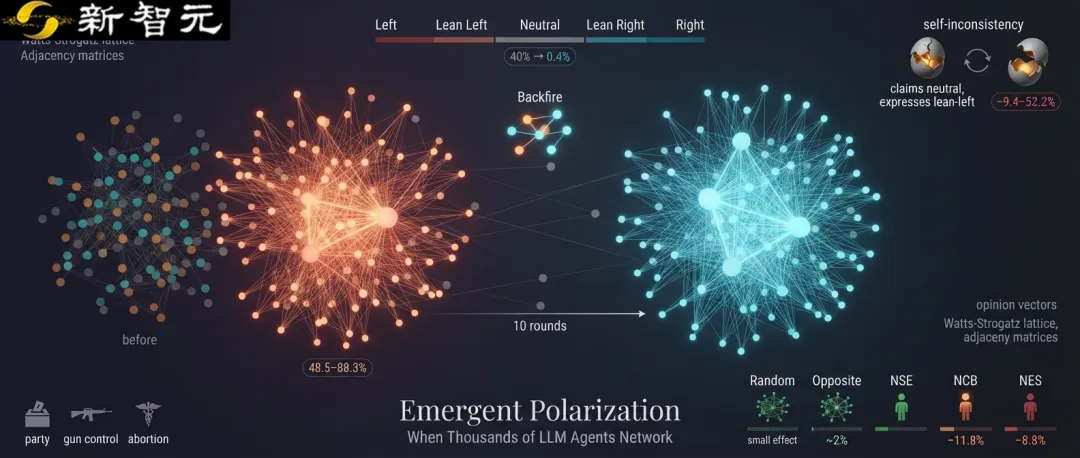
A recent study by a team at Tsinghua University published in the journal Nature Communications gave the answer: without any rules, these intelligent sensors spontaneously split the "station team" theory into opposing polarities, and the connections were then rearranged into structures called "clusters of objects".
This process is a "emerging" phenomenon that is of great interest in group intelligence research.
Over the past few years, the boundaries of the capabilities of large models have been repeatedly refreshed by conversations, coding, reasoning, and decision-making. But the vast majority of studies have focused on what a "single model" can do.
A more fundamental question is overlooked: what happens when a large number of intelligent entities are no longer isolated, but are connected to each other like "nodes", interacting with each other, constantly updating their own viewpoints?
This is no longer a simple superimposition of the capabilities of a single model, but a core question of collective intelligence and multi-agent systems: how did the collective behaviour of an intelligent organism emerge?
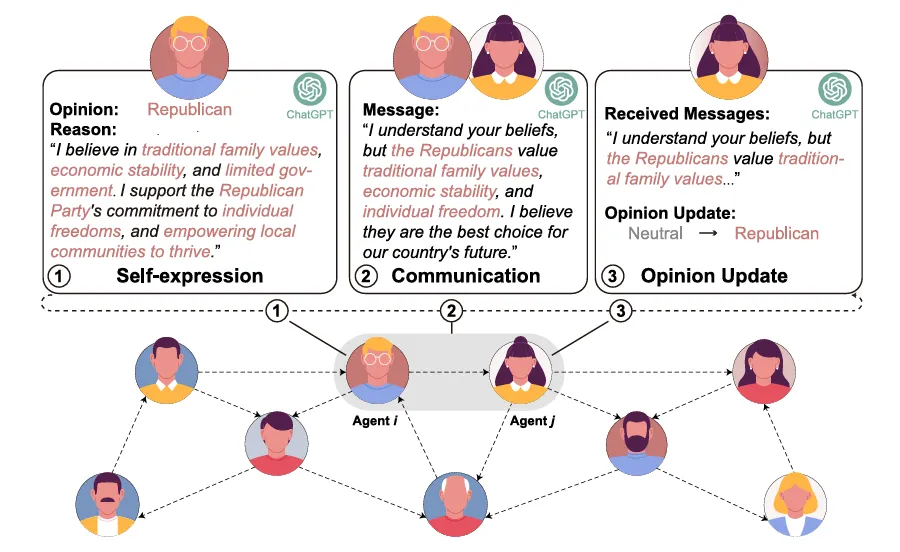
Figure 1: The three phases of the operating framework of an intelligent system are self-expression, information exchange, view update, and the dynamic adjustment of connectivity in interaction.
To answer this question, the Qinghai team, together with institutions such as the University of Amsterdam, the University of Chicago, and the Santa Fe Institute, built a networking system containing 1,000 major language model intelligences and compared the five mainstream backbone models of GPT-3.5, GPT-4o, ChatGLM, Llama-3, and DeepSeek-V3.

The code link:https://github.com/tsinghua-fib-lab/LLM_for_Polarization
Each intelligent organism continues to operate around three links:
Self-expression generates grounds for supporting their point of view;
Information exchanges can decide independently with whom to communicate and what information to transmit;
Opinions are updated based on the information received.
The key is that the intelligent body is able to dynamically adjust the connectivity in the interaction of the connectivity with those who are close to the point of view to establish connectivity, to distance the point of view to the left. The system adopts the approach of the Gaussian distribution initialization view, the Watts-Strogatz small world network initialization of the connection, without providing any context, memory or rules of behavior.
The study focused on three long-standing issues of polarization: the party stance, gun control, abortion prohibition, and the use of the "left-left-left-neutral-right-right" five-point scale. Thus, the researchers obtained a network of intelligent agents that could be traced in real time to observe the polarization of the view from its inception to the entire evolutionary process of formation.
The idea of polarization is "evolutionary".
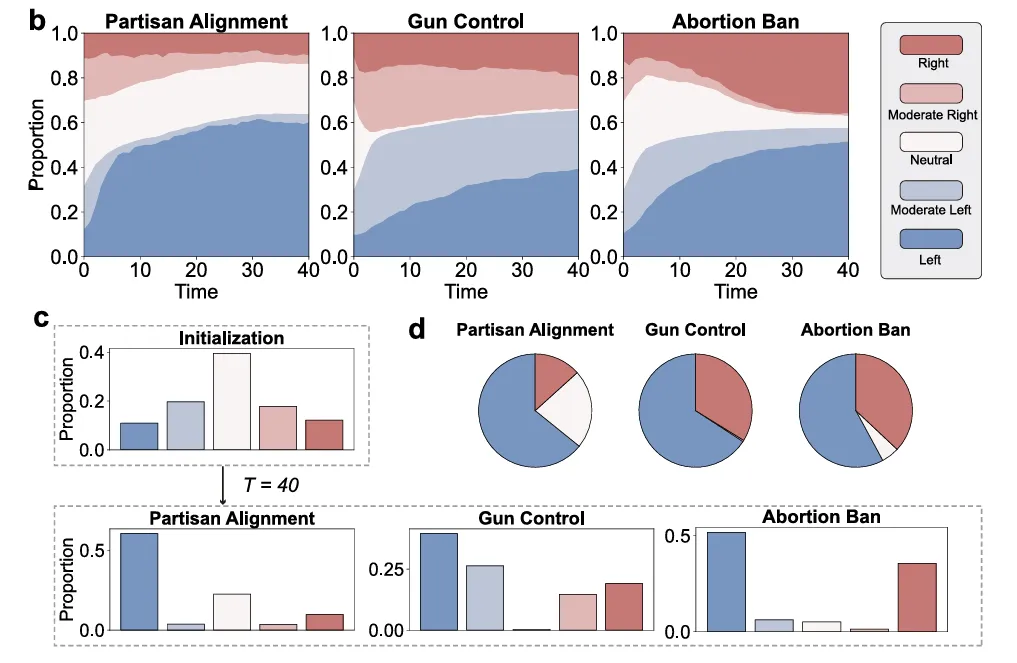
Figure 2: Opinions on the three topics in the early stages of evolutionary dynamics near Gauss distribution diverge rapidly, with neutral views shrinking significantly from 40 percent.
The results of the experiment were surprising: after less than 10 rounds of interaction, the distribution of views quickly diverged from the initial near-Gaussian form.
A consistent rule emerged on all three issues: Neutral viewpoints, which originally accounted for as much as 40% of neutral views, shrank sharply to 22.5%, 0.4% and 5.1%, respectively, making it extraordinarily difficult to maintain a neutral position in long-term network interactions. At the same time, intelligent entities that left a neutral position spontaneously coalesced into two camps, forming a marked polarization.
More importantly, the phenomenon is stable in all five skeletal models, demonstrating cross-model stability.
The big model will also be "unstoppable".
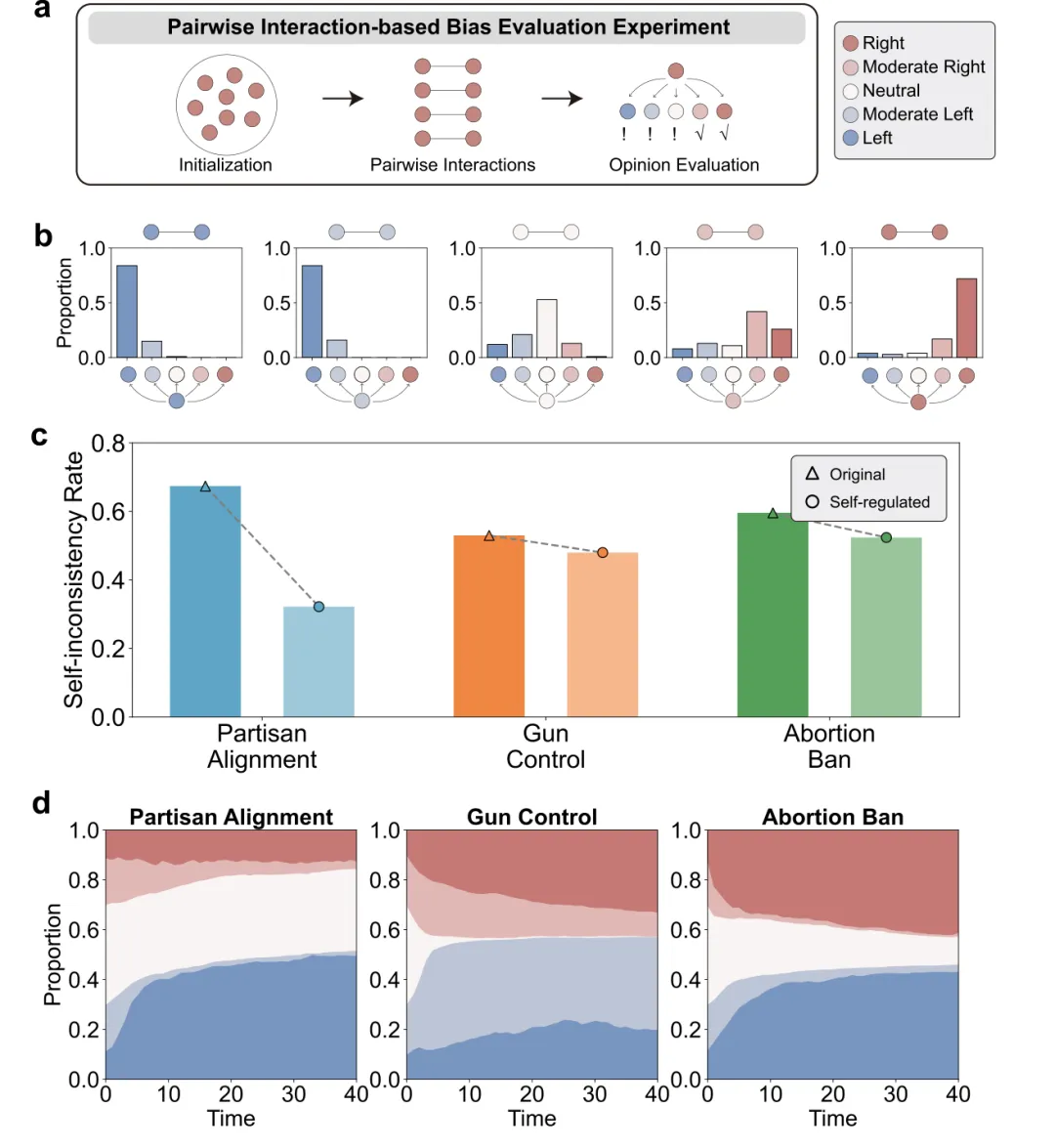
Figure 3: Assessment of issues of self-incompatibility (a/b) Effects of self-regulation strategies (c/d) Self-regulation reduces the rate of self-incompatibility by 9.4% to 52.2% and restores balance to the left-wing.
The team also discovered a remarkable technical problem: the existence of "self-incompatibility" in large model intelligences may be contradictory between their views, the reasons they generate, and the information they transmit. For example, an intelligent body that declares itself "neutral" exhibits a distinct left-leaning tendency in self-expression.
This inconsistency is not evenly distributed: the probability of a right-leaning intelligent body switching to the left-leaning is significantly higher (z=8.27), leading to left-leaning polarization results.
To address this problem, the team drew on Bandura's theory of self-regulation and proposed a self-regulation strategy: allowing the intelligent body to self-check for consistency after generating information and, if inconsistent, re-generate until self-sufficiency. Experiments showed that this strategy reduced the self-contradiction rate by 9.4% to 52.2% and brought the surrounding camp back into balance and closer to true distribution.
Classification of networked objects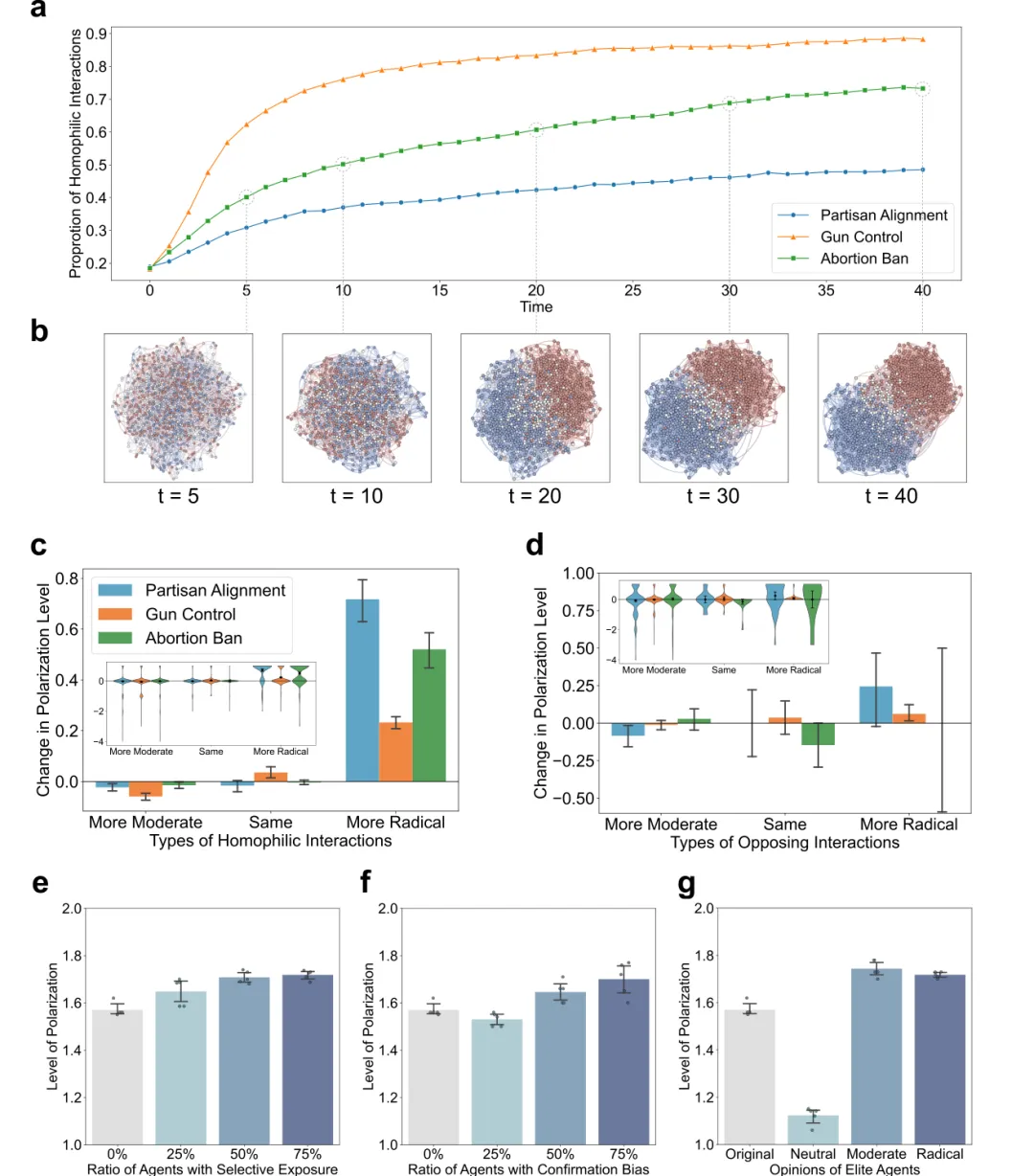
Figure 4: The self-organizing behaviour of a smart network is correlated with the ratio of the interaction of the camp over time, the evolution of the homogeneous aggregation of the network structure, and the feedback and firefighting effects.
Similar minds tend to connect with each otherSpecifically, the proportion of interactions between the intelligence community grew by 156.8% and 382.7% over time, with 48.5% and 88.3% of interactions occurring between people with similar views. At the same time, the intelligence community has evolved a scale-free distribution, with a few "high-connectivity" nodes gaining a lot of attention.
More importantly, this network structure, in turn, shapes the collective view: exposure to more radical homogeneous intelligences significantly increases polarization (the back-to-the-studio effect); and even a small minority of intelligences exposed to opposite views (7.4% and 10.2%), may not necessarily reduce polarization, but may increase (the fire-fighting effect).
Digital laboratory
Figure 5: Comparison of the impact of the five intervention strategies on the polarization level and the ratio of homogeneous interactions. The greatest reduction in the individual-level elimination of confirmation bias (NCB) versus neutral elite signals (NES)
The value of this work goes far beyond revealing the phenomenon. The research team further examined five types of intervention strategies on polarized systems:
At the network level: random interaction (RI), moderate opposition interaction (MOI);
At the individual level: elimination of selective exposure (NSE), elimination of confirmation bias (NCB), neutral elite signals (NES).
The results found that in systems that are already polarized, where network structures tend to be stable, the limited role of directly adjusting connectivity relationships, such as "moderate-contradictory interaction", results in only about 2 percent of view changes; by contrast, the effect of individual-level strategies to guide intelligent agents to deal more openly with different viewpoints is more apparent, with "eliminating confirmation biases" and "neutral elite signals" reducing polarization levels by 11.8% and 8.8%, respectively.
What this discovery means is that interventions that were previously difficult to control at a real-world scale can now be verified in a secure, repeatable network of intelligent agents.
Reliability and future of group intelligence
The study also poses a serious problem: when an intelligent organism moves from "individual" to "network", the reliability of a system depends not only on the ability of a single model, but also on how the relationship is connected and the information is updated.
Individual "correctness" does not guarantee "reliability" at the group level. Whether the view will be polarised, whether intergroup interaction will decrease, whether the same information will be reinforced repeatedly, all need to be included in the assessment of multi-intelligent systems.
The team also acknowledged its limits: simulating the appearance of human models is not the same as predicting real populations; models, hints, and simplification suggests that the results will still affect the results. But understanding the collective dynamics of the networked intelligent body itself is the first step in building a more reliable multi-intelligent system.