It's the first time in the history of the world.
What kind of picture is that of 500 people "brainwashing" a mouse at the same time?
It's not faster than the hand, it's faster than the brain.
On the evening of October 31, at the Ice Palace of Beijing's First Steel Park, nearly 500 spectators stared at the brain's electrical equipment, the mice on the big screen, and tried to kill them with "intent".
There are 500 brain waves on the big screen, and this is not an exaggeration in science fiction.
But it's true, it happened inThe scene of the fourth Bilibili Super Science Night in 2026
More interestingly, there has been a huge outcry overseas.
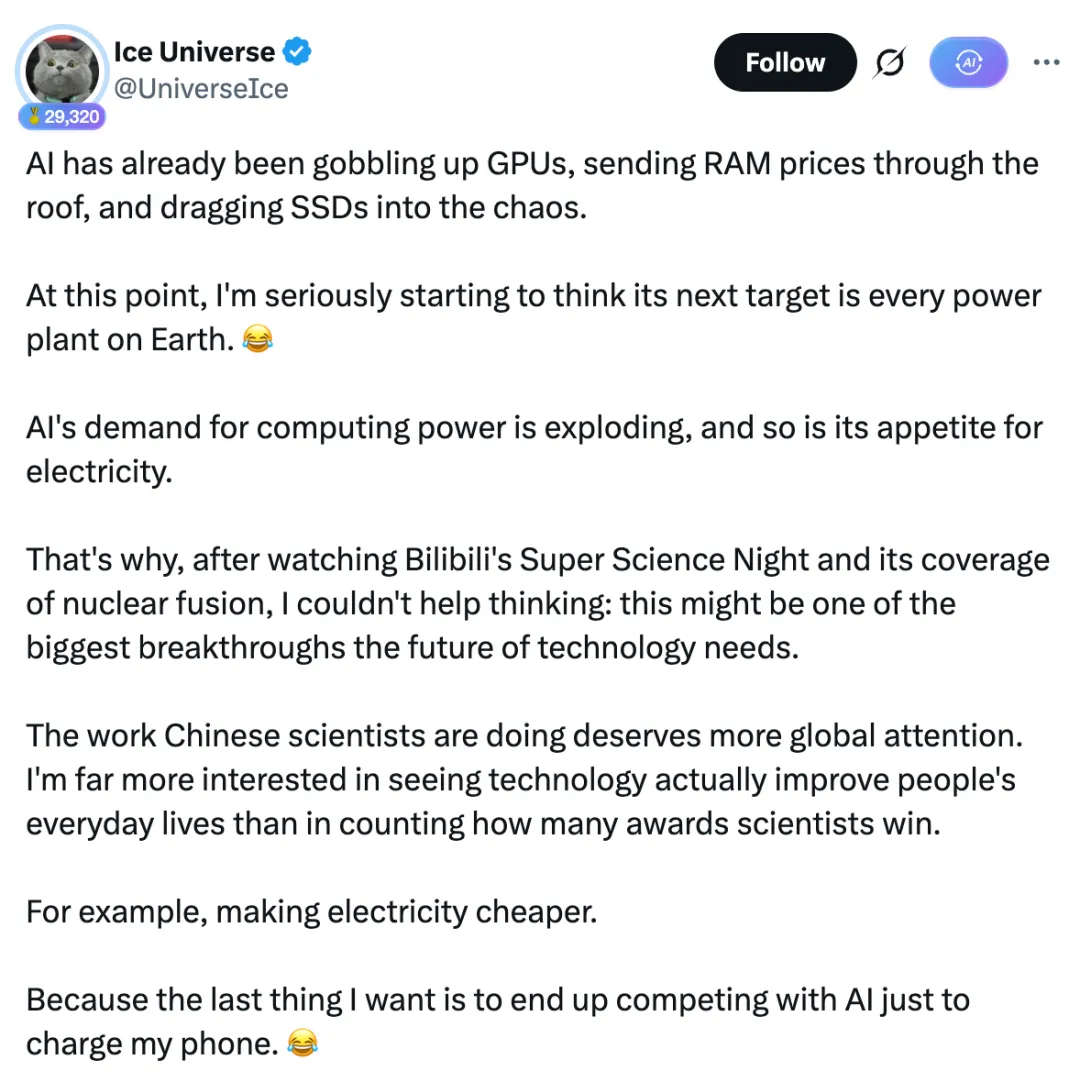
The tech blogger, Ice Universe, can't help but be shocked after the content of Science Night's nuclear fusion on X: AI has taken the GPU, memory is stuck, and SSDs aren't, and the next target is probably not global power plants.
So the Chinese scientists who are working on this nuclear fusion, the whole world needs to look at it seriously.
He's more concerned about how technology can make electricity cheaper than how many prizes he's won. "I don't want to go after AI chargers after all".
 |  |
The post received 300,000 views, and the comment section chats directly on the timeline for the commercialisation of nuclear fusion.
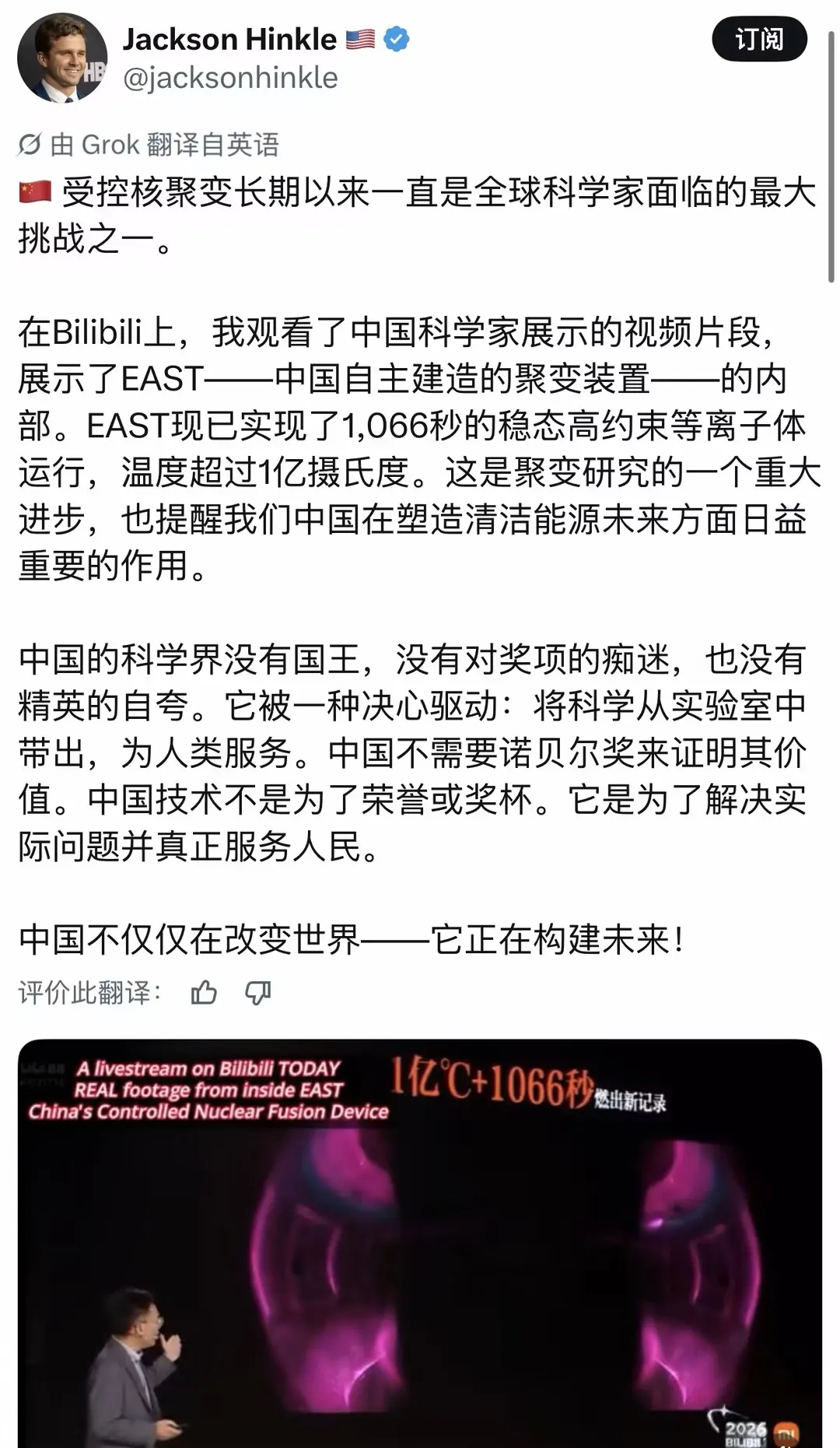
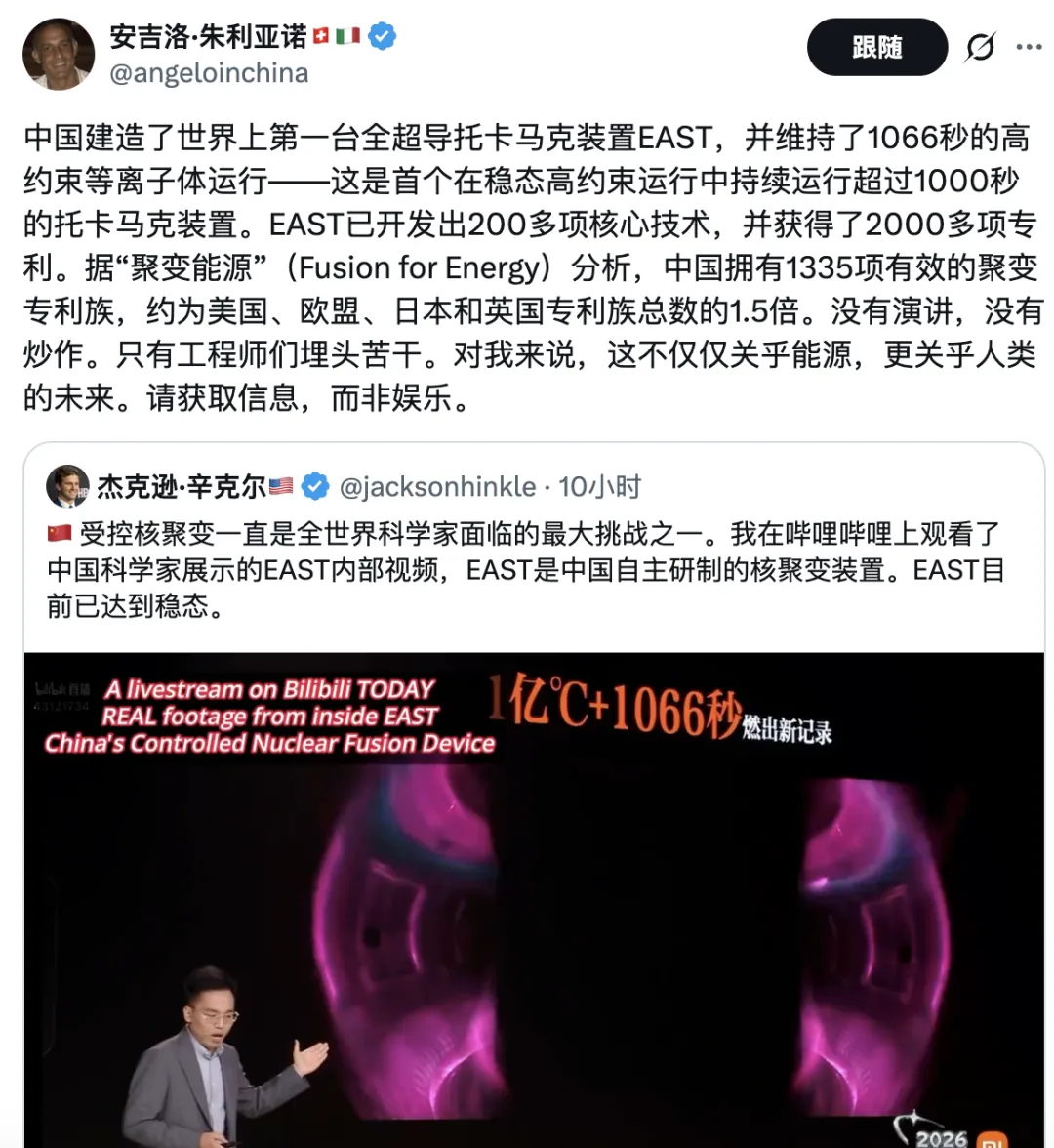
U.S. blogger Jackson Hinkle moved the live footage of "100 million degrees C+1066 seconds" inside EAST directly to X: the Chinese scientific community is not attached to the prize and does not need the Nobel Prize to prove itself.
It's building the future.
The comment section was also hot: some responded with "Humanity thanks the Chinese people" and some seriously chanted "Footfoot 20 minutes, this is a breakthrough".
Some bloggers have also turned down data about 1.5 times the number of Chinese fusion patents in the U.S., Europe, Japan, and the U.K., exclaiming, "No speeches, no fakes, only engineers bury their heads".
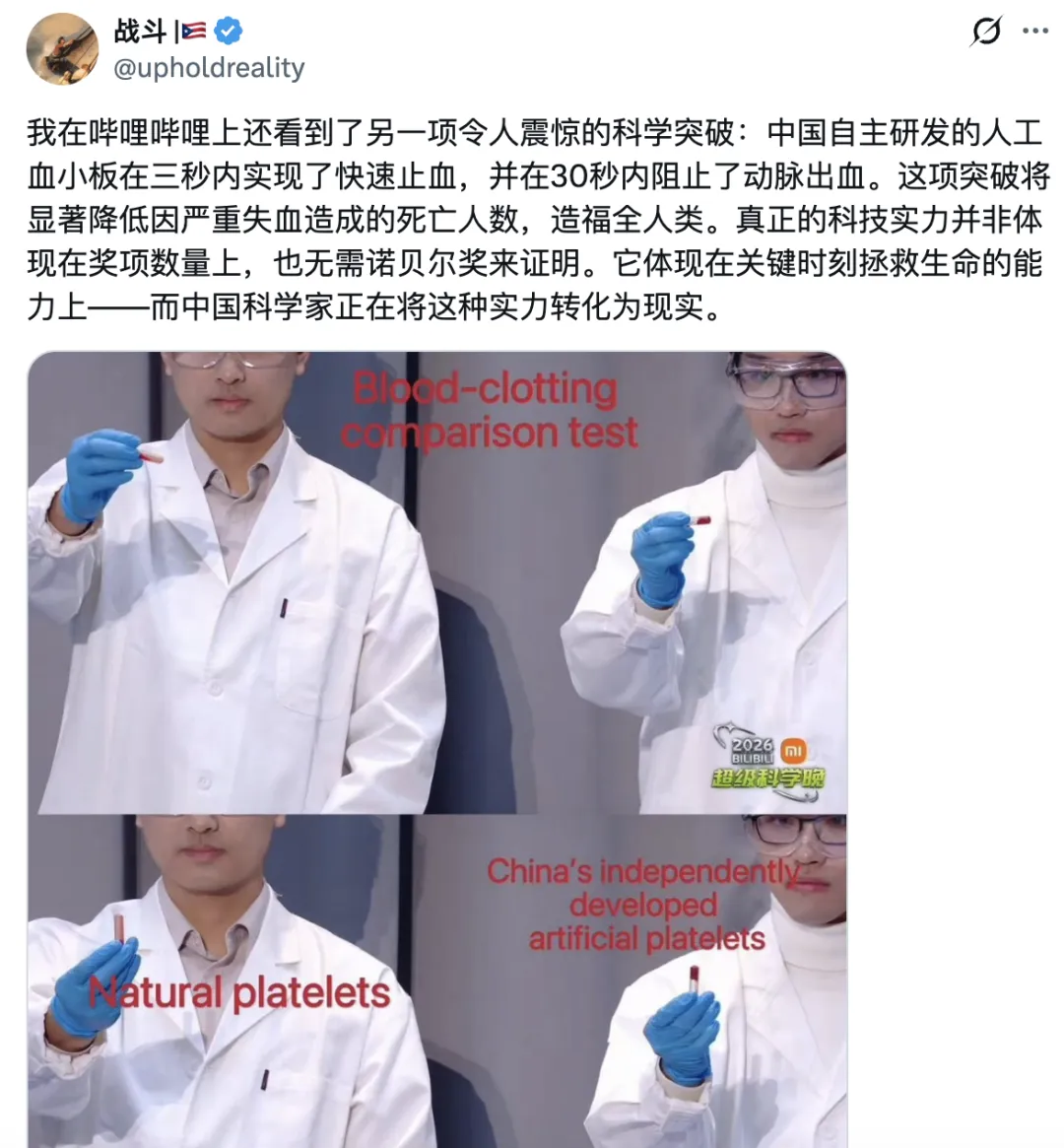
The contrasting image of the 3-second stop-blood was also retransmitted: the real power of technology is not the number of awards, but the ability to save lives at critical moments.
A Chinese video platform's science evening brought overseas tech circles into the picture.
This raises a worthy question: every October, when the Nobel Prize is announced, the world's scientific attention is "absorbed" by Stockholm. These cows, of course, are the great discoveries that push human cognitive boundaries.
But apart from the spotlight, should those tech stories that Chinese youth are watching, participating in, or even creating themselves be seen?
The answer lies in this "abstract" and "hardcore" party.
Artificial sun, three seconds to stop bleeding, four grams of flights.Cook the dishes first.The scientific community has a classic cold joke:There's no such thing as a controlled nuclear fusion in 50 years.
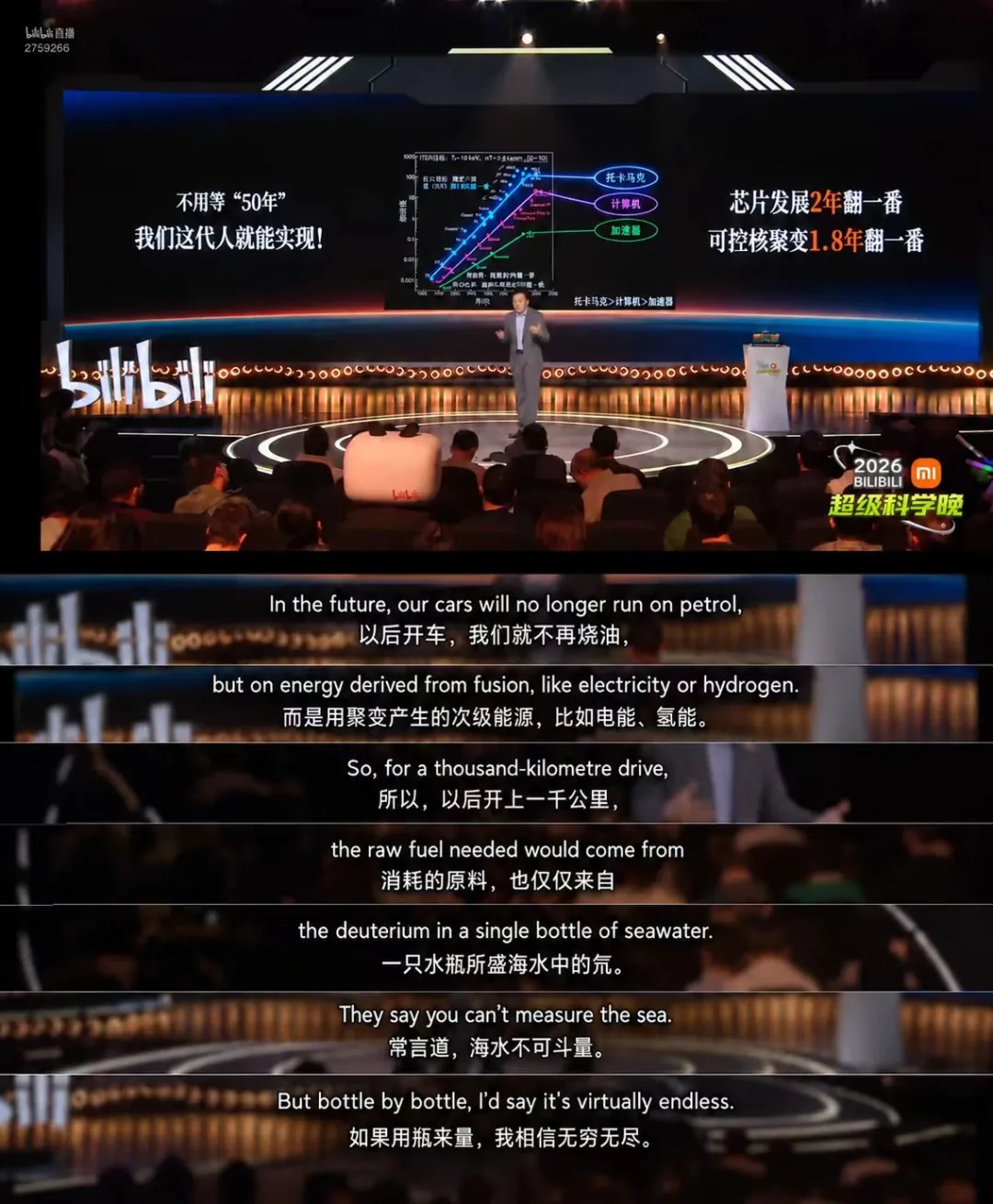
On this science night, Wang Yang, an associate researcher at the Institute of Co-Operative Materials at the Faculty of Medicine, directly dismantled this thread.
In January 2025, China's "artificial sun" EAST burned 100 million degrees Celsius, setting a world record of 1,066 seconds.
Wang Yi said on the ground that the artificial sun has achieved nine levels of numerical elevation, advancing at the same speed as Moore's Law.
What is the number nine? It is the same as the brightness of your light bulb, which turns from a match into a star.
The next generation of BEST is already under construction, with the goal of demonstrating electricity generation by 2030 and commercial use by 2040.
"50 Years Forever Bad" is being rewritten to "About 15 Years Bad".
It's a long way off, a short way off.
In Shanghai, a special assignment professor at the University of Shanghai took out two test tubes on stage, a natural blood panel and an artificial blood panel.
The artificial platelets are blocked. What about natural? It's still slow.
At the scene of a car accident, on the operating table, this three-second rapid clotting can take 180 seconds of life back to the window.
And then there's a more bizarre one.
A professor at the University of North Carolina at Chapel Hill has painted out a toy-looking static-electric flyer, CoulombFly.
Weighing 4.21 grams, it is lighter than an A4 paper, but it can fly and can only fly by natural sunlight.
Remember the first 500 brains running at the same time? It was one of the largest group brain electrical interaction experiments ever undertaken by the founder of dance technology, and the last 500 people's brain electrical signals were written into a song.
This size is enough to apply for a Guinness.
Who says the most amazing tech story ever happened only in Stockholm?
Young people are not just applauding on stage.They're making things for themselves.According to statistics, the average age of B users is 26 years old.
In the barracks, young people were asked how bad nuclear fusion is and when artificial blood panels can get into the hospital.
But the key is:They're not just watching.
Over the past year, users have viewed over 2.3 billion hours of COP, technology-related content on the B-Site, 1.3 million U.P. users, and more than 3,200 professional researchers and technology companies have joined the B-Site to share content.
Bringing hard nuclear technology to the young people and getting them to try it together and question the principles is the "old tradition" of Station B.
Renting a few satellites to shoot video sounds a little odd. But at Station B, someone actually turned this idea into reality. UP's main TV channel Hurricane leased hundreds of billions of yuan worth of satellites from Earth's hundreds of thousands of meters orbit to see how the ground can be photographed.
In his chip processor series, there is also a harder operation: using an 18-ton light scraper, engraving "28-nanometer characters".
The relationship between China's youth and technology has not always been the same as "following the heat of the moment".
They are not bystanders of the technological revolution, they are themselves part of the technological revolution.
In contrast, this year's Nobel Laureate in Chemistry, Karen, is 95 years old.
In China, there is a group of young people in their 20s and 30s who stand behind these tech stories.
Instead of waiting for the crown to be crowned, I put my hands on the platform first.
Why is station B preferred?The question has to go back to the scene of the Science Night.
This year's Super Science Night is a full-fledged upgrade: 15 TED Talks and Conversations during the day
"Will the meaning of human learning change as AI accelerates?" "What business is space with so many people building rockets?"
The nightclub is the science party that brings 500 brains online simultaneously.
The guests, including academics, scientists, entrepreneurs, entrepreneurs and UP owners, were all drawn to the same stage.
But what's really great about B-station isn't how much space is online, but the ecological closure of the "screen+review+creation" online.
For example, a U.P. owner filmed a 3-second clotting experiment and sent it out on video, where medical students asked about the clotting mechanism, engineers questioned the feasibility of the milling product, and ordinary users exclaimed, "This is the real life-saving technology".
A video isn't a one-man show, it's a multi-faceted discussion involving hundreds of thousands of people.
In October, the B station launched the "AI Infinity Arena": UP owners test hundreds of models, codes, reasoning, collaborations, and knowledge in all dimensions with their real workflows.
It's not that kind of runner-up list, it's "You can't walk, you can't walk". In the first list, the country's biggest model took three places in the top five.
From the three previous science nights, where professors practiced hiding techniques, making water on the moon, giving mosquitoes "variability", and developing supersliding toilets, to this year's comprehensive upgrade, Station B has been doing the same thing:
To take science out of papers and laboratories and throw it in front of young people.
China's youth have their own "Nobel moments".It doesn't have to happen in Stockholm.Does China have its own Nobel Prize?
If you're talking about a gold medal, a Stockholm awards ceremony, you'll have to wait.
But if you're talking about a genuine respect for science, a massive public debate about the achievements of technology, it's happening, and it's much hotter than the Nobel Committee imagined.
It's in the ice cream parlour of the first steel park, in the brain waves of 500 people, in a 3-second condensed test tube, on the wings of a 4-gram aircraft, in a flash of 100 million degrees of plasma.
It wasn't selected by a committee; it was viewed hundreds of millions of times, hundreds of thousands of posts, countless screenshots, and comments to "votes".
The Nobel Prize is important, of course. But it's because the basic research is great enough that it needs someone to get it out of the papers and put it in front of young people.
That's what science does late.
Recall the words of the overseas blogger: He hopes that nuclear fusion will one day make electricity cheaper than the number of awards scientists have won.
It sounds simple, but isn't science ultimately about making energy more abundant, making life safer, and making life better for ordinary people?
And the "Nobel Moment" of Chinese youth, perhaps in the middle of the night in a lab, in the comment section of a video, is the moment when a young man gets his hands on something for the first time.