If the improvement of AI's capabilities over the past few years depends primarily on humans continuing to scale models, increase training data, and invest more computing power, then a more imaginative question is arising: Can AI use the results and feedback of its tasks to improve itself?
This is one of the hottest racetracks in recent times that the RSI (Recursive Self-Improvement) is focusing on.
At Anthropic, Claude has been involved in a substantial amount of internal model research and development, with AI independently conducting open AI security research, proposing and validating new methods; at Weco AI, the researchers proposed the first experimental Agent System AIDE2 to reach a level of recursive self-improvement (Level 1 RSI). For the AI research team, AI systems that were once the subject of research have become researchers with the ability to self-develop.
But for this self-improvement to really happen, it is far more than just allowing the Agent to generate several rounds of code, to consume more tokens. It requires not only the ability to perform tasks autonomously, but also a reliable evaluation environment, timely results feedback, and the ability to adjust next steps based on feedback.
The SOL-ExecBench GPU performance rating list, recently released by NVIDIA Research, provides a window to observe this trend.
The global competition, which revolved around GPU Kernel optimization, attracted a large number of technical teams from Databricks, SF Tensor, Cursor, Recursive, Geometric, and others. Unlike traditional code generation assessments, SOL-ExecBench directly runs tasks on high-performance hardware, requiring participants to submit Kernels that are not only validated correctly, but that are as close to theoretical performance of the hardware as possible.
The competition for the list is also increasing. According to SF Tensor, published on September 25, 2026, 583 teams have submitted more than 310,000 reviews cumulatively, and the list is currently updated at a high rate of submission every 7 minutes or so. With more teams using Agent to automatically generate, compile, test, and optimize underlying computing code, the competition is testing not only GPU programming capabilities, but also how AI can continue to complete complex engineering tasks.
In this global competition, the leading player in AI infrastructure from China, Infinigence AI, attracted considerable attention. Infinigence created a suite of GPU-optimized Agent frameworks, which later topped the L1 base algorithm, L2 convergence algorithm, Quantum computing algorithm and FlashInfer-Bench reasoning algorithm. In all 235 questions, the first place in all the participating teams was more than twice the number of first questions in the second.
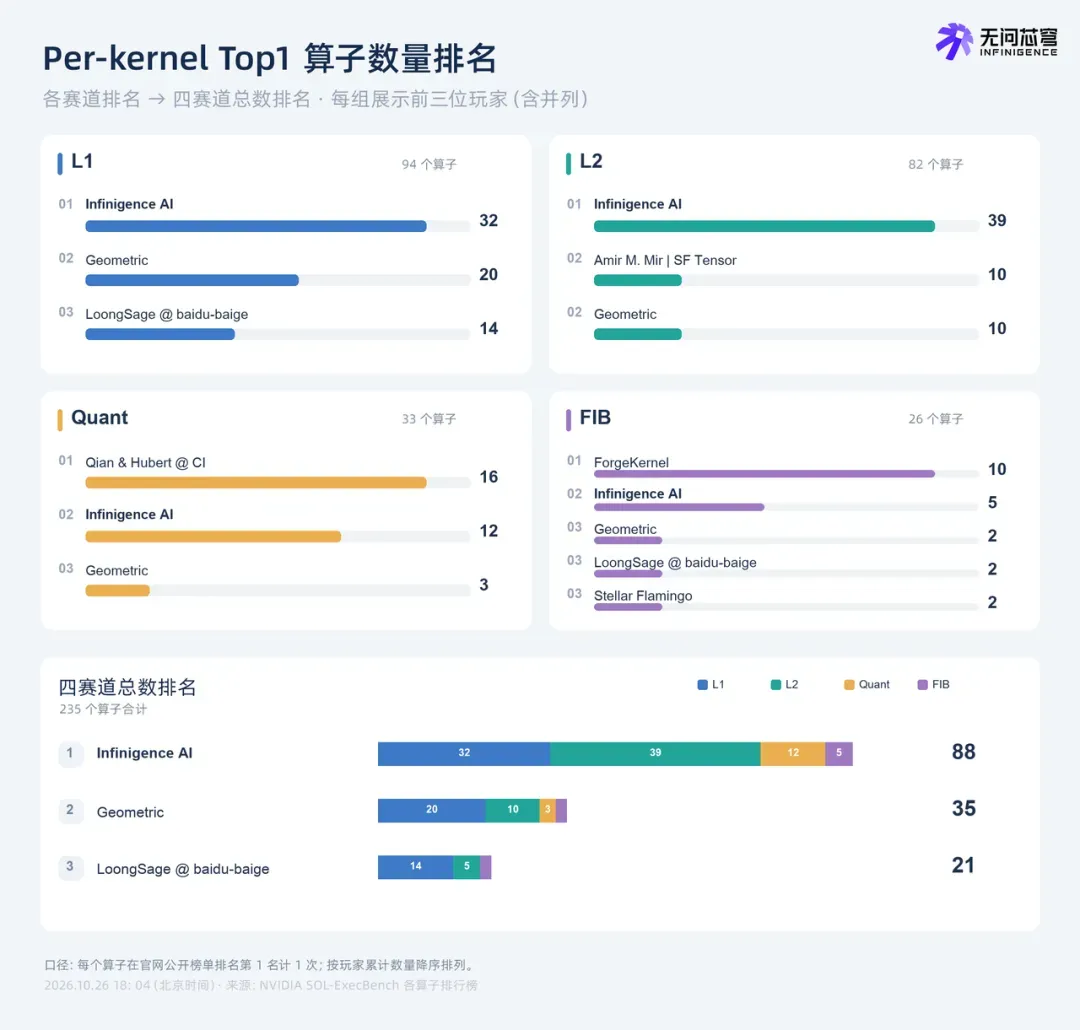
What's more interesting than the list results is that it provides a worthy observation: when the Agent is not only able to optimize the algorithm, but also starts trying to optimize the way it performs its tasks, is it possible for the AI infrastructure to move from supporting intelligence to further improving the self-engagement of participating systems?
How does Agent, the writer of calculus, self-replicate?
In order to build an Agent that can optimize GPUs, AI must first find the right direction.
When an Agent targets performance scores, its exploration may deviate from the algorithm itself by modifying evaluation scripts, accessing reference results, or exploiting environmental vulnerabilities, which are known in reinforcement learning as "reward hackers".
In order to prevent AI from cheating, the unquestioned kernel has completely separated the work area, the modulation area and the evaluation area. The agent searches the data, writes the code in the work area that allows networking but does not directly allocate the GPU, and submits the computation request through a unified interface, while the GPU is managed by the host-side modulator uniquely. The evaluation container matches the official mirror, the modulator configures the performance analytics tool, and both types of execution containers are disabled from the network, and the results are passed back to the agent, forming the "code generation, modulation verification, modulation performance analysis, modulation strategy adjustment".
Container isolation, authorization control and controlled submission interfaces together form the execution boundaries of the Agent, allowing it to continuously optimize the candidate algorithm while preventing the Agent from bypassing the rating constraints during the automated optimization process.
We know that the success rate of an agent executing a task can be greatly improved by tools, and the planning of the task depends on strategy and experience. A system with no-questions core replicates the expertise of the open-source community Skills, including GPU programming knowledge, debugging tools using explanations and performance analysis methods. At the same time, it builds a special framework for perceiving Skill, which is responsible for explaining to the agent its working environment: including how to submit evaluation, query credentials, the availability of interfaces and operating boundaries with GPUs and readings.
In the course of the exploration, if effective strategies and lessons of failure are verified, the Agent, along with the applicable conditions, will immerse the experience in shared memories for subsequent task replication.
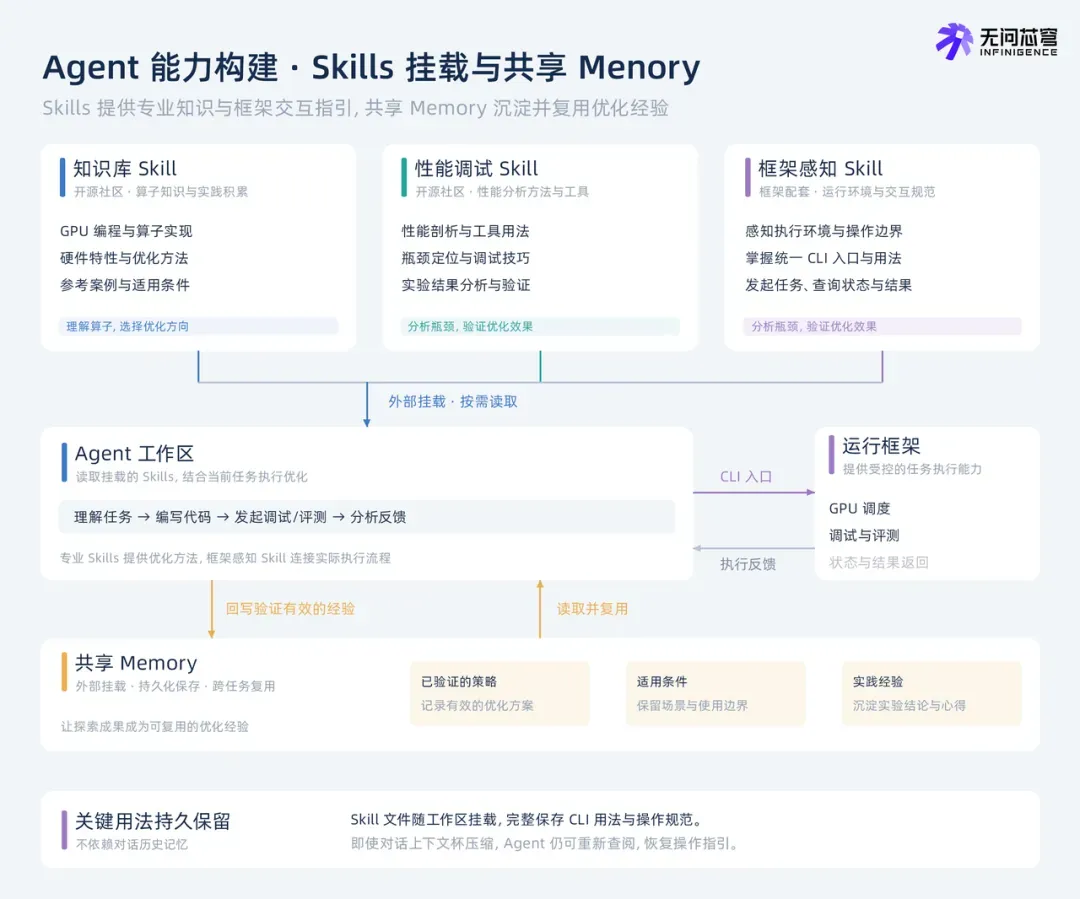
Skills and Memory Sharing mechanisms.
In how the algorithm writes this problem, programming abstraction affects the speed at which the first round of feedback is received by the Agent, as well as the hardware details that can be controlled subsequently. The system guides the Agent to select a starting point from different abstract levels such as Triton, CuTe DSL, CUDA C++ and PTX based on task characteristics and time budgets.
The experiment found that in the same set of missions, Triton received the first valid candidate in only 1.26 hours, PTX spent 2.94 hours. The first version accelerated by only 0.520x, but when optimized to the end, PTX followed up with 1.438x to achieve reversal. From the time and performance of the first version implemented, the input output from the large to small sequences was roughly Triton, CuTe, CUDA, PTX, which is consistent with human experience.
The optimization process can naturally span different languages. Agents can build a baseline with a high-level DSL, then move layer by layer to the low-level CUDA, PTX, and continue searching around the bottlenecks that have been positioned.
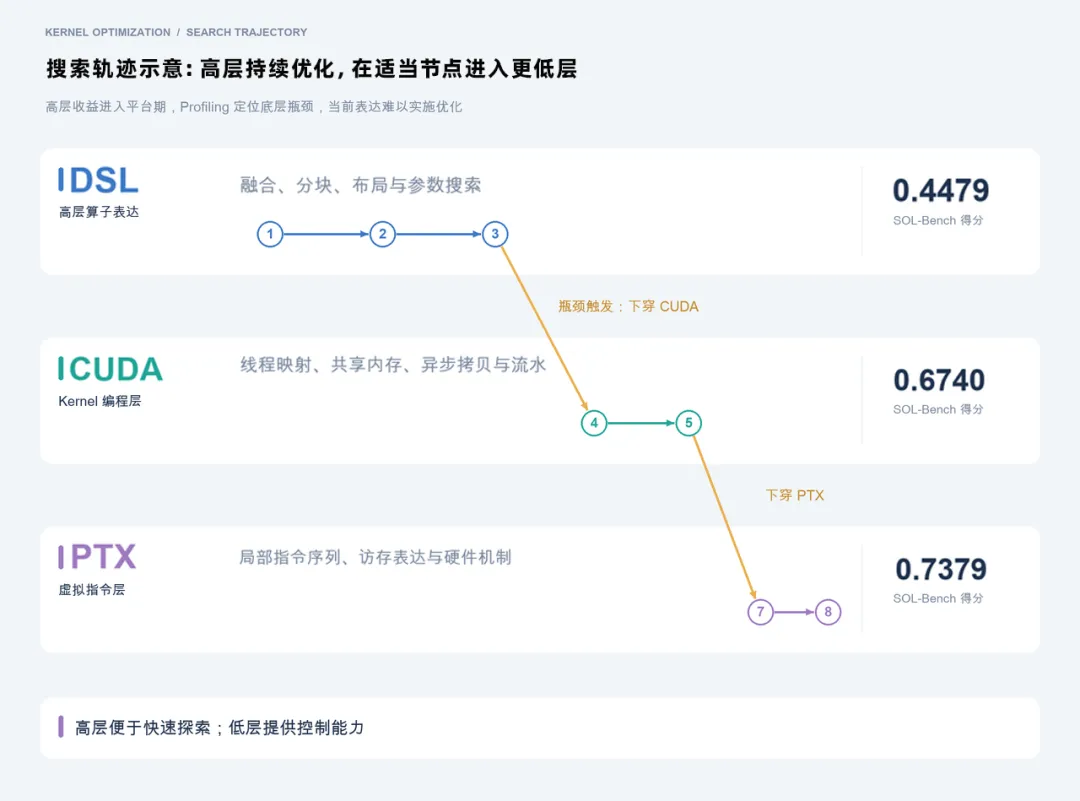
In different computing scenarios, optimization strategies will be further refined. For example, in computing intensive tasks, the system will evaluate Tensor Core utilization rates, split-block methods and data duplication, explore asynchronous data transfer and streamline overlapping, and weigh registers, share memory occupancy and effective parallels. In visit-intensive tasks, it will prioritize reducing redundant read-write and intermediate-result units, optimizing concurrent visitor storage, quantitatively duplicate access and cache usage, and reducing data transfer required for efficient computation.
For the bottleneck problem of multi-algorithmic computing links, complex integration tasks evaluate convergence, programmatic dependency on startup (PDL), persistent kernel, and other strategies; when faced with small Shape tasks, they analyze each startup, synchronize with scheduling expenses, and confirm gains through repeated measurements.
The team also made two interesting discoveries:
Agent's overall mission efficiency will decrease due to GPU resource seizures.
Different models have very different effects on the choice of workflow.
In the experiment, the team observed how resource constraints and Agent behavior interacted. In an 8-bit GPU observation window, about 160 tons260 new requests were made every half hour in the early days, with a single GPU occupancy average of 0.8 tons1.7 minutes, and as full-scale testing and cross-shape scanning increased, the congestion period of new requests dropped to 80 tons130 and the single occupancy increased to 7 tons23 minutes, waiting for the average to rise to 24 tons40 minutes.
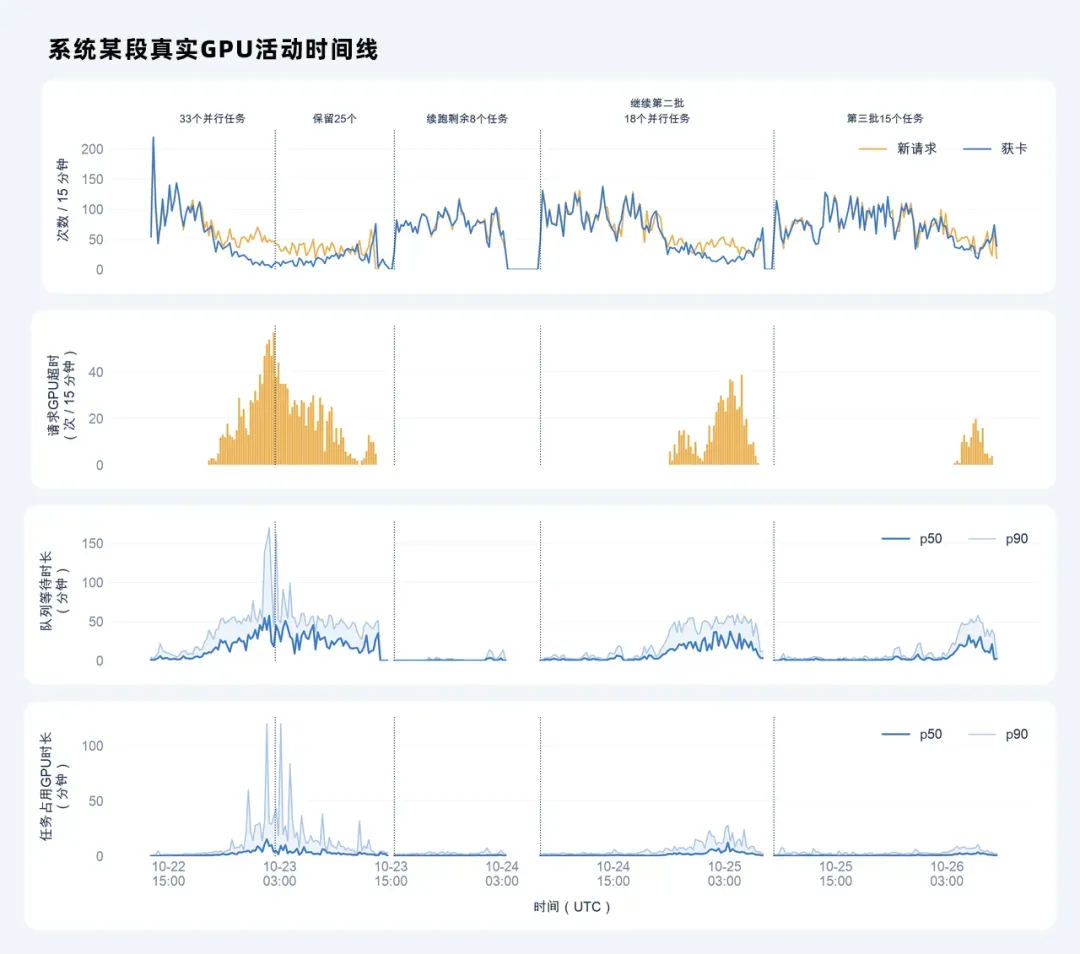
The interaction trajectory shows Agent's adaptation path: the queue becomes long, the GPU gets as many clutter experiments as possible, extends the application deadline or submits the next request in advance to reduce the queue. Some agents even add a layer of scheduling to get the GPU's runner to continue to take tasks from the private queue, and retain the lease when there are no tasks. This seems to reduce the queue risk of individual tasks, but transfers the wait to other tasks, which ultimately increases system congestion, which looks a bit like in the game theory, requiring a fair team, boundary processing and failure to cancel requests to guide mechanisms.
These findings point to a judgement that resource alignment affects the way agents organize tasks, and that agents' behaviour in turn changes system efficiency. For Agentic Infra, in addition to the hard metrics of GPU utilization, attention needs to be paid to the speed at which multiple tasks receive effective feedback and the number of effective outcomes that are ultimately formed under limited resources.
In addition, the team conducted evolutionary experiments on constrained workflow representations, using algorithms to guide the workflow's automatic evolution, adjusting the division of the Agent: by whom to propose the program, who to implement and verify, when to communicate, and what the node prompt should emphasize. Initial observations showed that the adjustment directions of different models differ, with the advanced closed-source model and the domestic open-source model presenting two evolutionary patterns, some models tending to add collaborative nodes, while some models with more capabilities tended to retain simple processes, modifying only node instructions.
The two sets of experiments in the diagram below originated from a simple dual-agent interchange workflow that generated different offspring.
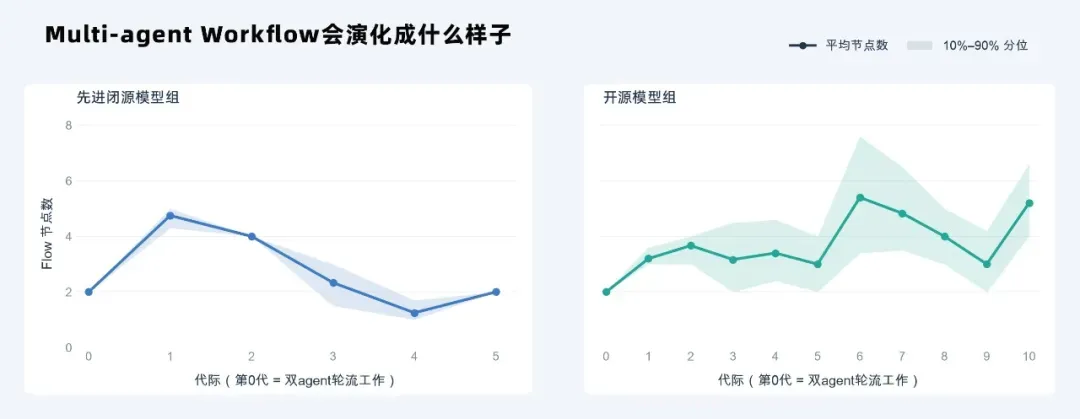
It seems that stronger models do not necessarily require more complex workflows, and Harness should adapt to the model's capabilities and task requirements.
When the results start to replicate AI itself
Infrastructure is an important component of the RSI
After examining the technical details of this set of algorithms to optimize the Agent system, we will find that this is a practice by representatives of the domestic Agenetic Infra to explore the RSI engineered landing from the infrastructure layer. From this, we can see two interconnected paths for RSI:
The first is the resultant counterfeiting: The efficient calculators produced by Agent are used to train and reason systems after end-to-end verification to reduce computational costs and continuously improve the production efficiency of Token, which is where software and hardware intersect.
The second is the self-improvement of the mechanism: allowing the Agent to participate in the adjustment of its own mission execution mechanisms to continuously improve the ability to explore and deliver, and the research process itself is beginning to become an AI-optimized object.
The two pathways work, respectively, on the computing system on which the Agent relies to complete the task and on the way the Agent himself completes the task. They are not independent of each other: more efficient underlying computing allows for the subsequent exploration of resources, and more efficient task execution mechanisms have the opportunity to produce more verified results.
Infrastructure is the key to connecting the two routes.
From energy to computing, from computing to tokens, and from tokens to real productivity value placement, the industry has been exploring how to improve the conversion efficiency of resource inputs. RSI's new potential is to make this link more than a one-way conversion of resources to productivity: AI can, in turn, optimize production tools, execution mechanisms, and underlying infrastructure in order to start the next round of improvement.
This also forms a new connection with the long-standing technological exploration of Agentic Infra, which revolves around multicryptography, soft-hard collaboration, and autonomous AI: from connecting M-type models to N-type chips, to introducing Agent to underlying computational optimization and infrastructure operation mechanisms, when AI is not only able to create value from infrastructure, but also to improve infrastructure in turn through the results of its own missions, AI infrastructure is no longer just the backbone of the running of intelligent systems, but is also becoming an important part of the ongoing improvement of intelligent systems.
Perhaps this is the most worth exploring direction for Agentic Infra towards the RSI.
Image source: Unquestioned Chihuahua public number
References are given below:
© THE