“ It's easy to work in factories, and the pace is close to the human hand.
At the Skilled Hand Performance Testing Workshop in Waggonhill, a skilled hand must complete a 72-step continuous operation rather than a one-shot demonstration. Any step in the middle is deviated, and subsequent procedures may fail.
This is much more boring than a single presentation at a conference, but it is also much more realistic.
In the field of physical intelligence, smart hands are undoubtedly one of the most crowded hardware inputs. Financing temperatures are still high, freedom is increasing, touchpoints are getting denser, and the parameters are year-over-year beautiful.
But entering any real production line, the questions the production line manager asks are not related to these numbers. Can continuously run a shift, the good rate can not be stable in the tolerated range of the production line, changing a workpiece without having to start from scratch.
These questions are difficult to answer for simple flexible handheld hardware. High frequency does not automatically transform the ability to tighten a screw, and touch resolution does not automatically convert into a qualified process communication. In industry, high frequency flexible hands in industrial environments, continuous service life is often calculated in units of weeks.
Many projects are still unsuccessful when it comes to questions about customer satisfaction.
The difficulty of the real card game, to go up and down, is data. The difficulty of data has many layers. The most superficial layer is the amount of nitrogen, the real machine data is few, the collection is expensive and time-consuming and expensive.
Even more troubling is the fact that after the training pipeline, it takes a lot of effort to clean, align, replenish, mark, and finally give the model, which is often not the most natural operation at the time.
The amount of training data required for a general-purpose model varies by a few quantities between the existing high-quality storage. There are many hands that can do beautiful demonstrations, but very few systems that can continue to deliver qualified results in a series of continuous production processes.
These questions point to a deeper judgment. For the industry, what is really lacking in agility is a set of system capabilities that enable agile hands to be trained, aligned, and delivered continuously.
The critical point delivered at the Chiyo Innovations Flexible Operations Forum is a link that links the body, data, models, and deployments into an operational sequence. The key nodes of this link, in addition to a matrix of already released flexible handheld products, include an all-new numerical glove, an upgrade of a model architecture, and a deployment program on a factory site.
01.
Factory deployment doesn't care about freedom
I'm going to start with the hardest industrial deployments.
It's not a new topic, but it's a long way from being really addicted. There's a whole set of processes, such as additives, scanners, screws, buttons, disassembling and disassembling, not all of which are new industrial tasks, and specialized tools and industrial machinery have long proven their efficiency and reliability.
Of course, the difficulty of a single process is not insignificant for the skilled, for example screwdriver, which requires sub-millimeter precision positioning. But the real problem lies between the process and the process.
Pre-procedure operations must provide the correct physical state for subsequent steps, screws are not tightened, workpieces are not installed, and subsequent test procedures fail; the contact uncertainty caused by tool counter-efficiency, cable braking, and paypal passages cannot be easily transformed into task failure; completion of the operation is not the same as process passing, and the system needs to determine whether the current steps are truly successful and decide whether to retest, reposition or reverse the previous steps after an anomaly occurs.
This also illustrates that the success rate of single-point actions and the good rate of continuous operation of long processes are basically two quantitative problems.
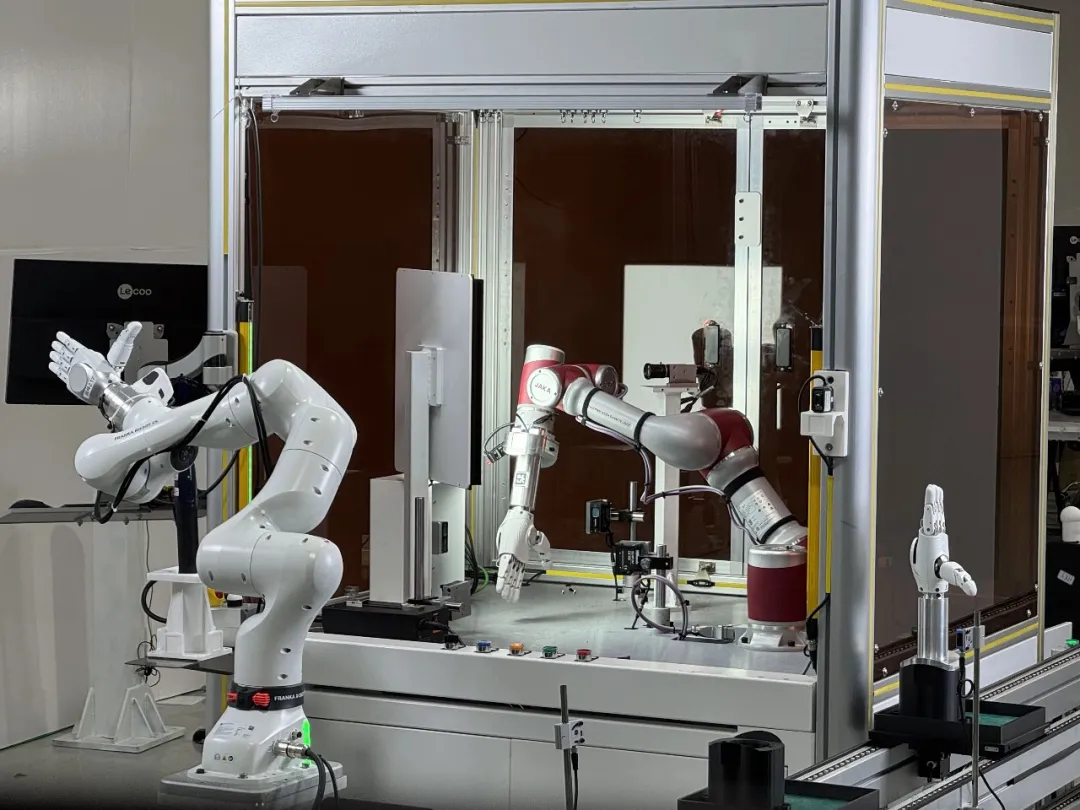
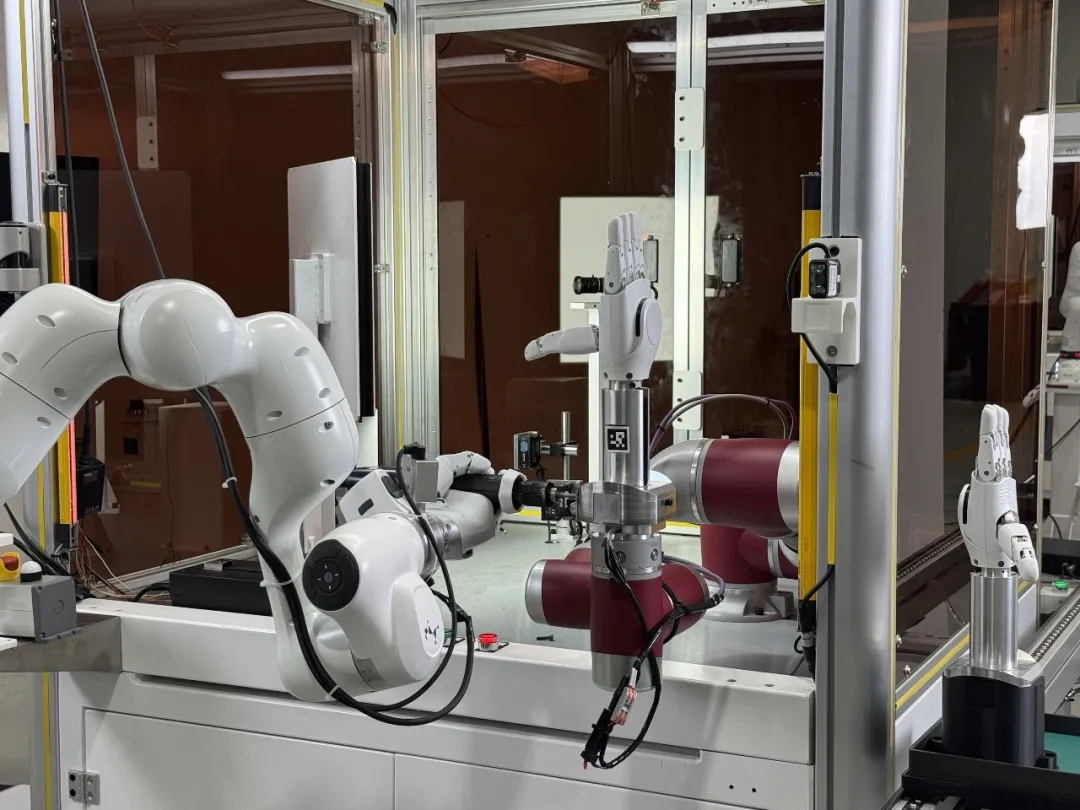
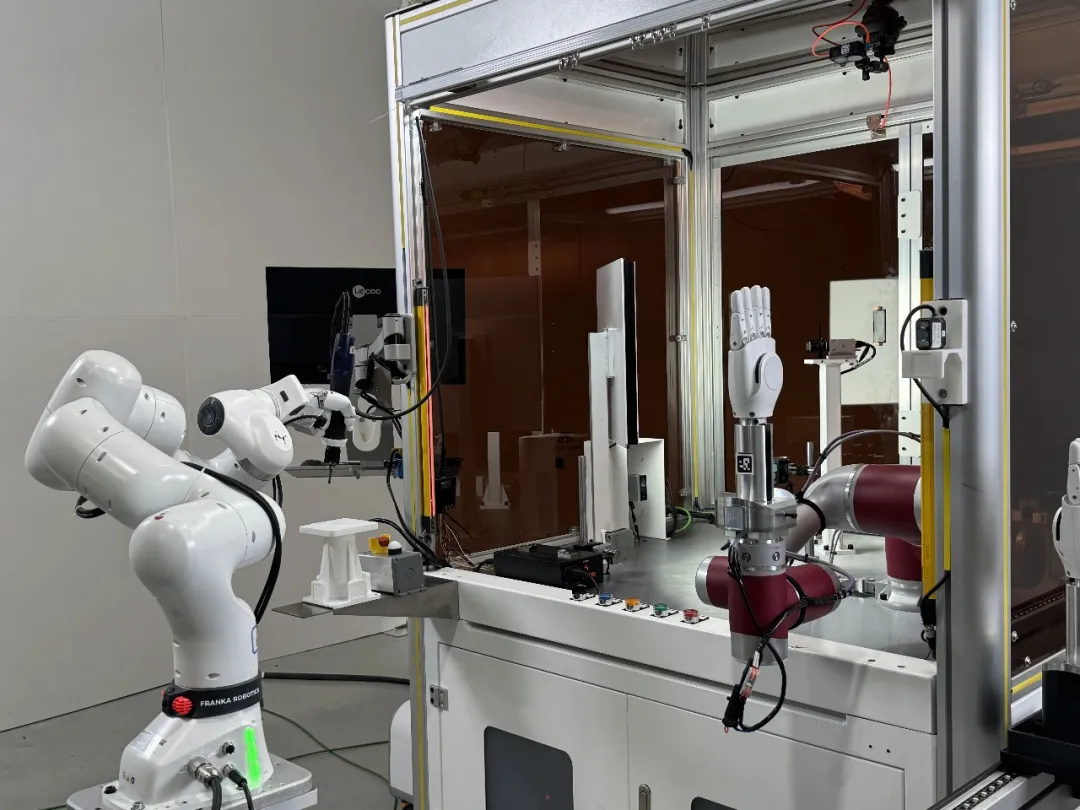
The critical point at the Waggonhill workplace was the ability of the shrewd hand to operate continuously at 72 steps. Its published data shows a success rate of 98%, the shrewd hand fully autonomous about 8.5 minutes (about 8 minutes, a tempo of almost 1:1), uninterrupted work up to 8 hours or more, for the shrewd hand. More importantly, these results were achieved by machine-reinforcing tactics, more stable, faster, and 2-3 times faster on average than remote operation to the critical point.
This group of figures, which traces the caliber of a skilled person's assessment from the qualification of a steam operation to the qualification of a steam process, put it on a real industry assessment scale that can be compared to the workplace on the same table.
Of course, these data are just the starting point of observable, attributable, and optimization engineering. The actual threshold consensus in the industry for the introduction of humanoid robots is more than 99% success rate, the rhythm can not drag the back of the production line. 98% of a job, not equal to a scale deployment pass.
This deployment is both a real-world test of the industrial adaptation of the program and allows critical points to push through the boundaries and optimise the ability to operate continuously over long processes. After all, in the industrial landscape, certainty is the only product.

At the same time, Critical Point OmniHand 3 has been running for a month at Long Long Park, from beans, building blocks to ping-pong, ice hockey, fencing, and torchballs, and the task list is growing.
02.
Why a pair of gloves is harder to define than a hand
All inquiries about deployment are ultimately sent to this upstream data.
The current structural embarrassment of physical data supply is that remote operation of the most accurate virtual machine is limited to equipment and manpower, and the capability of the ceiling is clearly visible; the lowest cost of first-person data scaling is the greatest potential, but space errors on a centimetre scale allow it to be locked for a long time in the pre-training phase, and post-training still requires virtual machine or UMI supplemental accuracy.
There is a critical middle ground between the two: there is no data that has the extraction efficiency of close to human natural operations and can directly support training and even machine reproduction after accuracy and modular completeness.
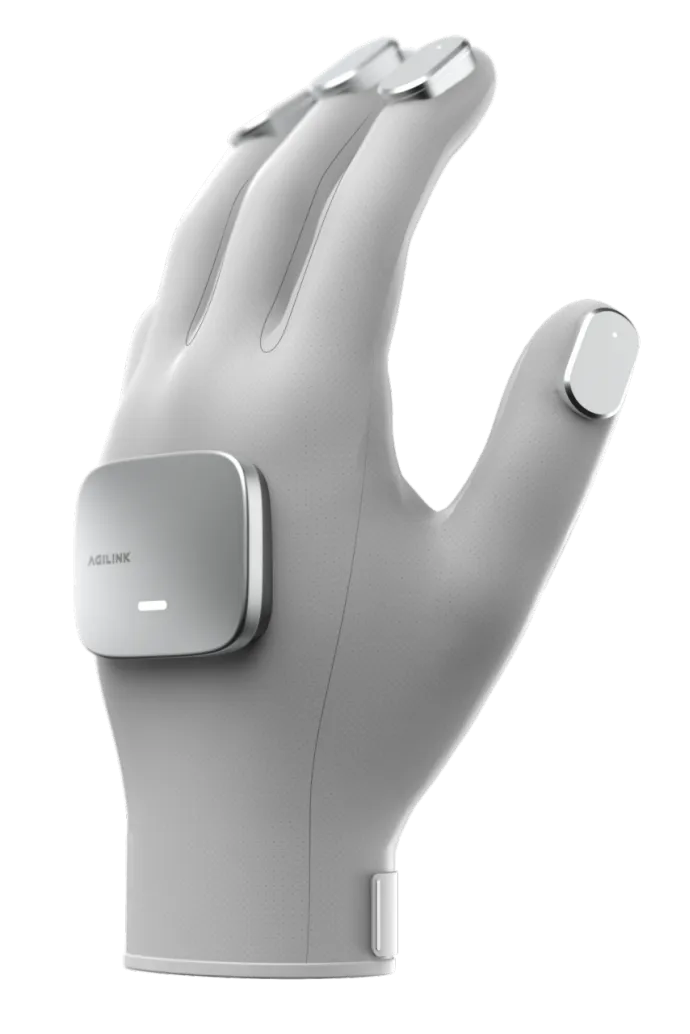
EMF magnetic field positioning with IMU integration brings the typical precision of hand positioning to less than 1 millimeter, gestural precision to less than 1.5 degrees, and anti-magnetic optimization in real industrial environments such as metal tools and metal workstations; 746 touch points, 17 regions, covering the fingers, thumb and forefinger, measurement range 0 to 20N, resolution 0.1N, strictly aligned with gestural data.
These parameters are superimposed on the direction of the data, which is a pre-set idea. The same source clock, anti-magnetic algorithms, deflection avoidance, sliding detection of these engineering details are incorporated into the sensor design, so that the data collected back is trainable at the source, rather than leaving the burden of cleaning, alignment, and noise reduction downstream.
Thanks to high-precision positioning and high-quality touch of the whole hand, the data collected by the gloves carries accurate hand gestures, human-grabbed touch intent, and a real sense of hand in the operation process.
The critical point is to emphasize that this is the real Ready Ego data: reliant on high-precision EMF positioning and full-hand touch, which can quickly generate high-precision alignment data between human hands and real machines. That is, the task of human demonstration, repeated directly on the robot, can accomplish the same operation.This high-precision aligned crawler hand-to-reel data pair is valued for its extremely strong downward compatibility: upwards, it can be directly matched to a pre-trained base model, with human-accumulated physical precedents, and the generalization starting point of a tall model; downwards, it can be directly cut into post-training and do targeted development for specific processes. More importantly, it doesn't have to move the real machine to the site to operate the data with great difficulty, saving huge deployment costs.
More importantly, the gloves are compatible with the OmniHand line of smart hands, with touch technology from the same source, and open boxes can be built with remote control links. This design directly compresses the embodied gap. The gap between mobile phones and mobile phones that allows data to migrate at high costs has been blended in advance during the hardware design phase.
The industry's common complaint about glove-like products is that data mining requires a lot of effort to align across the body, and the difficulty of aligning across the body depends on whether the two ends are adopted and used by the same person at the beginning of the design.
The 2026 multi-player multi-purpose multi-purpose multi-purpose multi-purpose multi-purpose multi-purpose multi-purpose multi-purpose multi-purpose multi-purpose multi-purpose multi-purpose multi-purpose multi-purpose multi-purpose multi-purpose multi-purpose multi-purpose multi-purpose multi-purpose multi-purpose multi-purpose multi-purpose multi-purpose multi-purpose multi-purpose multi-purpose multi-purpose multi-purpose multi-purpose multi-purpose multi-purpose multi-purpose multi-purpose multi-purpose multi-purpose multi-purpose multi-purpose multi-purpose multi-purpose multi-purpose multi-purpose multi-purpose multi-purpose multi-purpose multi-purpose multi-purpose multi-purpose multi-purpose multi-purpose multi-purpose multi-purpose multi-purpose multi-purpose multi-purpose multi-purpose multi-purpose multi-purpose multi-purpose multi-purpose multi-purpose multi-purpose multi-purpose multi-purpose multi-purpose multi-purpose multi-purpose multi-purpose multi-purpose multi-purpose multi-purpose multi-purpose multi-purpose multi-purpose multi-purpose multi-purpose multi-purpose multi-purpose multi-purpose multi-purpose multi-purpose multi-purpose multi-purpose multi-purpose multi-purpose multi-purpose multi-purpose multi-purpose multi-purpose multi-purpose multi-purpose multi-purpose multi-purpose multi-purpose multi-purpose multi-purpose multi-purpose multi-purpose multi-purpose multi-purpose multi-purpose multi-purpose multi-purpose multi-purpose multi-purpose multi-purpose multi-purpose multi-purpose multi-purpose multi-purpose multi-purpose multi-purpose multi-pur-purpose multi-pur-pur-pur-pur-pur-pur-pur-pur-pur-pur-pur-pur-pur-pur-pur-pur-pur-pur-pur-pur-pur-pur-pur-pur-
03.
DUET 2.0 is a combination, not all tasks are worth combining.
The data defines the upper limit of the model, but the architectural determining model is unable to reproduce this upper limit in real contact.
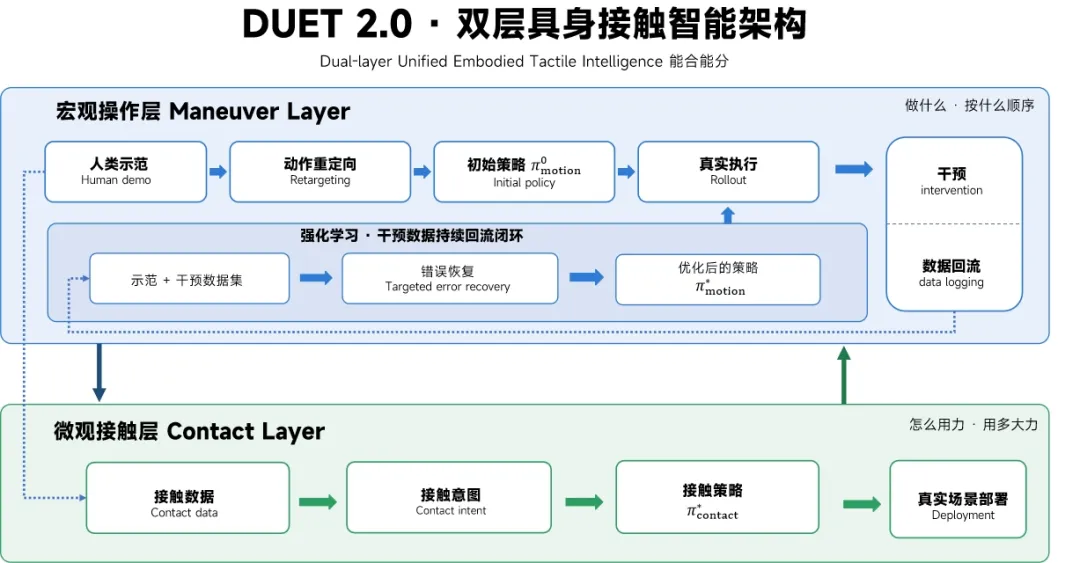
Its core is a two-tier solution. The upper macro-operating layer is responsible for where the chip goes, in what order the chip is made, solving task-level action generation and overall decision-making; the lower micro-contact layer is based on real touch, responsible for how the chip is used, how the chip is tuned in the contact process, and for fine-tuning force control.
When the two layers are joined, the macroscopic intent is transmitted downwards, the micro-touch feedback upwards, and the decision-making and execution are synchronously optimized; when the two layers are separated, the upper layer can independently support the generation of motion of different hand types, and the lower layer can rely on the tactile self-closing loop, even if the particles of the upper layer instructions are rough, and the lower layer can make mistakes and corrections during the contact phase.
This architecture responds to a long-standing structural contradiction in the field of sophisticated operations. Higher-level task planning models and lower-level force control strategies often work on different time scales and data distributions. Forcing the two into an end-to-end model can cover up the problem of data fit in a demonstration scenario, but in long-flow industrial tasks, a rough particle resolution of the upper layer can cause the lower layer to fall into a state of contact that cannot be remedied visually.
DUET 2.0 opts for hydrogen energy combined with thermal energy, which is essentially recognizing that agility is not a single strategic problem, but rather a multi-level, multi-time scale control problem, and then using architectural flexibility to replace engineering's faulty space.
04.
Bet on all the links, not at the conference
If you put the critical point of this release together, the systemic logic is clear.
The main end is a gradient matrix made up of OmniHand 3, 3 Lite, 3 Ultra, and OmniPicker's sleek range of products, which prevents customers from paying for unnecessary performance; the data end is an OmniGlove glove matrix, with base version coverage position acquisition and remote control; the Pro version covers in the wild multi-module adoption; the algorithm end is DUET 2.0; the deployment end is two verification samples for the long-term industrial jobs and long-term commercial landscape.
Look at these four links separately, and each of them is being done by an enterprise. But with the demonstration of a hydrogen algorithm trained in the real deployment of hydrogen data backflow, this aircraft can be turned in a closed loop in a system.
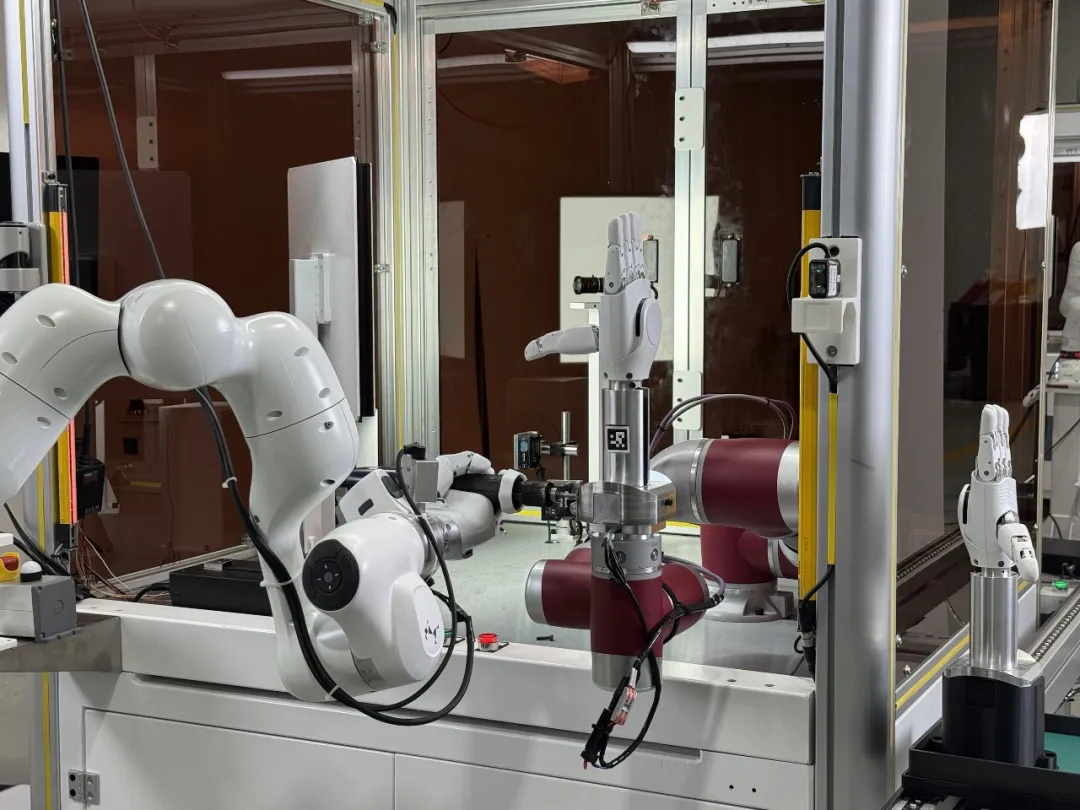
The gloves use controllable cost to produce real-machine-ready touch positioning data, data into the pre-training upgrade base model's operational precedent, post-training task-oriented adaptation; deployment mode continues to run in real-world workplaces, reverse-flow failure trajectory and intervention data in turn exposes the model's contact blinds; the intrinsic gradient matrix uses different degrees of freedom and cost ranges, matching multiple scenarios from scientific research to industrial, allowing the aircraft not to be trapped in a single hardware mode.
Hardware does not replace algorithmic manipulation of data sources, algorithms do not replace the deployment of manipulation of hardware adaptations, and deployments do not replace physical manipulation.
In the first half of the agile runway, everyone rolls the hardware, rolls the parameters, rolls the conference; in the second half, the entry ticket is deployment, delivery and orders.
One hand may win the next conference, but only one system can win the next job.