Brushing your teeth, bleeding, tooth decay, mouth odor... if you have these symptoms, it's likely to be toothache.
How common is tooth decay? More than 50% of adults worldwide suffer from it. In China, up to 80% of adults over the age of 30 are at risk of tooth decay. What is more troublesome is that it is also associated with diabetes, cardiovascular disease and even Alzheimer's disease, and the pathogenic bacteria and inflammatory media in toothpastes spread throughout the body through blood.
Current treatments, whether ultrasound or deep tooth brushing, face an embarrassing reality: insufficient, unclean, hard-to-reach medication.
Recently, a study published in the leading international academic journal Science Advances offered a whole new idea: using a group of magnetically controlled nanoparticles to actively drill in, physically clean, and then accurately administer drugs.
The team of authors came from the Harbin University of Industry (Shenzhen) and the Guangzhou University of Oral Medicine.
01.
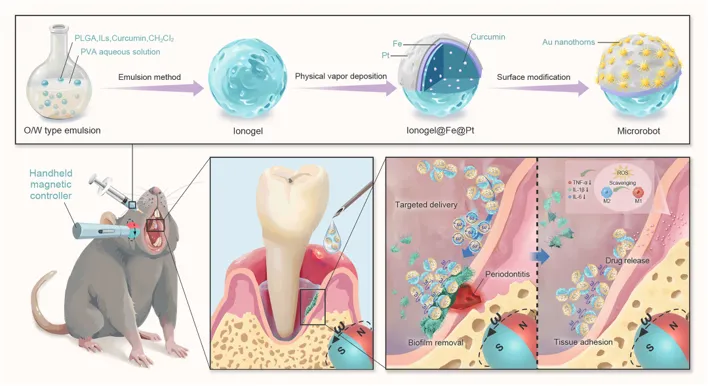
What does it look like? A thinner-than-haired nanospin ball.
This tiny robot is about 10 micrometers in diameter, equivalent to one seventh of the diameter of a strand of hair, and is completely invisible to the naked eye.
Its core structure consists of three subtle parts:
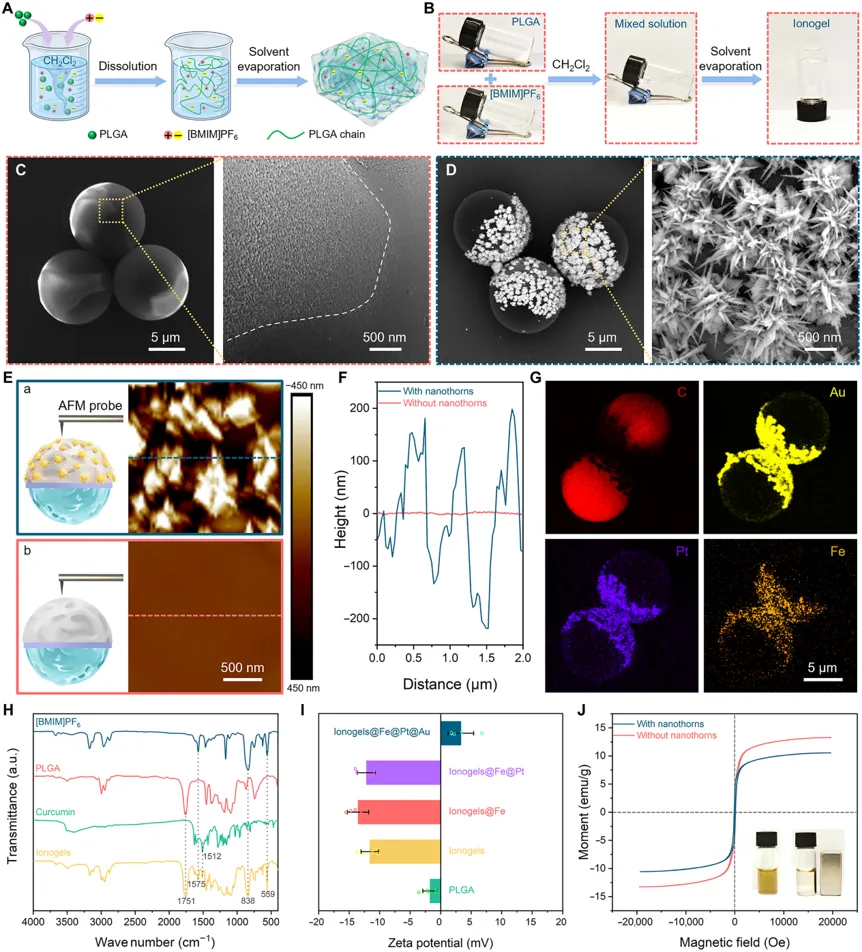
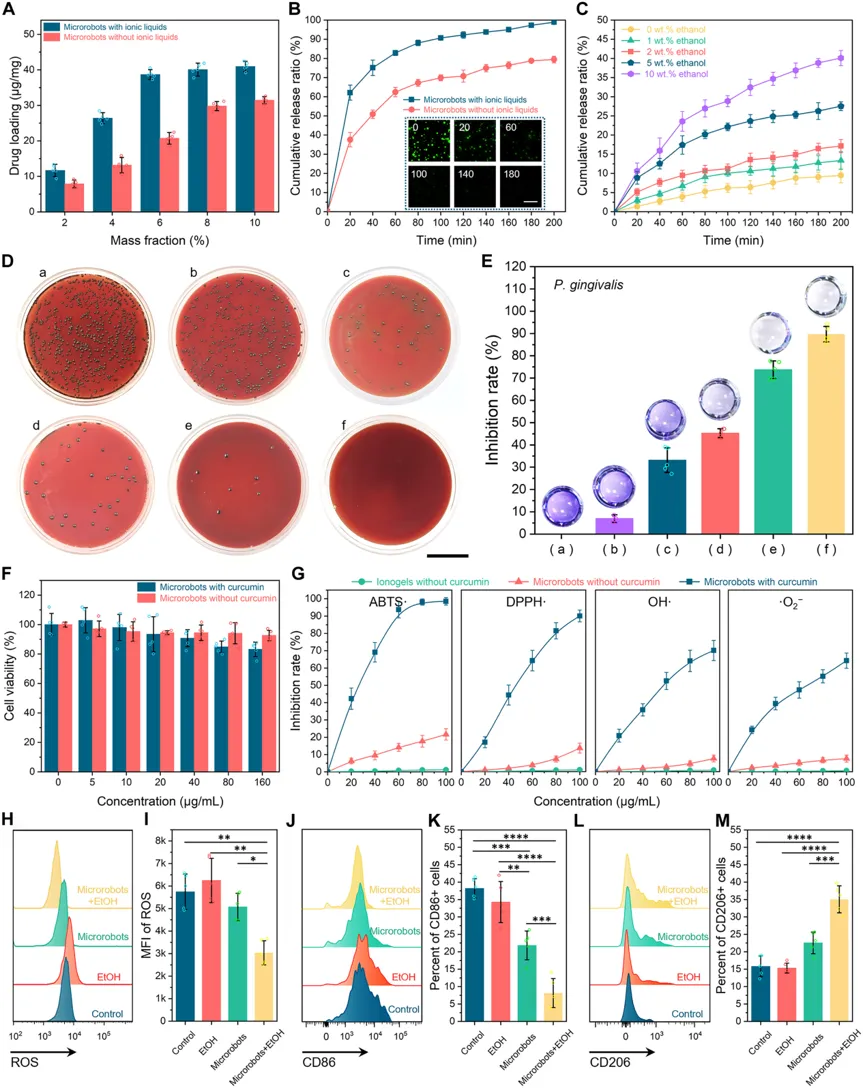
Ion-gel nucleotide is based on PLGA and ionic liquid, and is equipped with the Chinese pharmaceutical sulfide as an ammunition pump. This design significantly increases the load of the drug, which is 1.76 times higher than the version without ionic liquid. More importantly, it has ethanol-responsive release properties, which trigger the exact, continuous release of the drug in the dental microbial environment after reaching the placenta.
An asymmetrical magnetic coating of zinc deposits iron and zinc on one side of the surface, making it like a microscopic reference needle that responds quickly to an external magnetic field.
Gold nanoparticles are one of the finest designs of the entire project. Researchers have used catalytic growth to extract sharp gold nanoparticles, with a bottom diameter of only about 60 nanometers, from the surface of the tiny robot. This layer of sharp-pointed armor gives the robot two core capabilities: mechanical removal of bioluminescence and reinforcement of membrane sealing.
But the structure is a premise, and the real question is: Will it be able to successfully complete this whole set of moves in the humid, fluid, bacteria-filled environment of the tooth?
02.
How does it work? Three steps to break down tooth inflammation
The research team answered this question with a series of experiments. The whole treatment process can be broken down into three steps.
Step 1: Physical cleaning, tearing up the biosphere with a nanoparticle
Tooth inflammation is difficult to treat because the bacteria are not loosely attached to the tooth's surface, but are hidden in a stronghold known as the membrane wall. The extracellular polymers secreted by the bacteria, such as steel cement, envelop themselves, and ordinary antibiotics and drugs cannot penetrate.
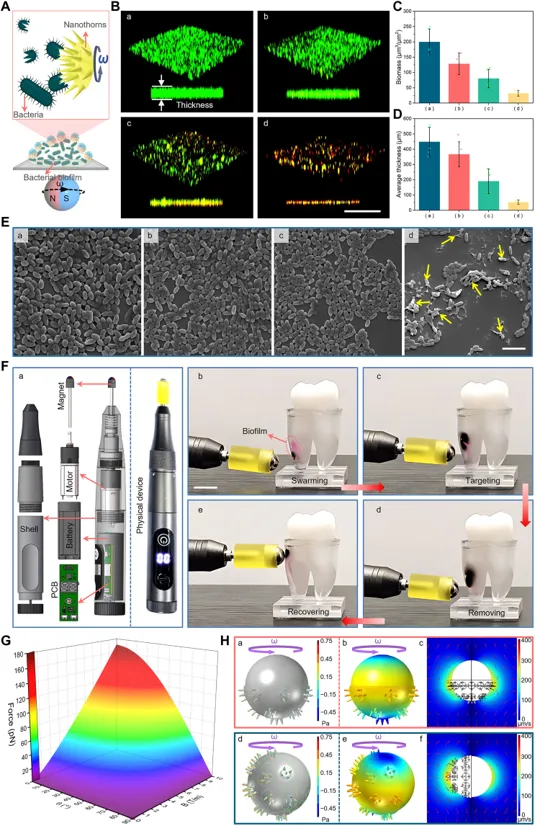
While the robot's nanoparticles can produce a high cutting stress when magnetically driven in rotation, they can mechanically tear apart extracellular polymers like a microchip, directly breaking down the structure of the membrane.
Experimental data are the most convincing. Following the processing of magnetically driven nanoparticles, the bacteria in the biosphere were reduced by 74.1%, and the thickness of the biosphere itself was reduced by 88.2%.
The researchers also conducted experiments in bioluminescence regeneration. In areas treated by nanoparticles, the remaining bacteria are unable to regenerate the bioluminescence, indicating that this is not only cleansing, but also eradicating.
Step 2: Penetrate stagnation, overcome the fluid barrier and spray with saliva
Oral urine and esophageal fluid are another natural barrier, with a viscosity of 5-10 times that of water. Traditional medicines are often sprayed or blocked outside before reaching the mouthpiece.
The research team simulated the dental fluid environment for testing. Micro robots with nanoparticles, with a maximum penetration depth of about 487.4 μm under magnetic drive (about 0.5 mm, the thickness of a bank card), are 1.49 times the penetration depth of robots without nanoparticles, while purely passively propagated penetration depths are almost negligible.
The researchers designed an injectable hydrophobic gel as a carrier that wrapped micro-robots like fruit jellies, both to prevent saliva from leaking and to naturally decompose under the action of salivary polyanase.

Step 3: Precise administration of medication, precise placement of medication in inflammatory areas
Physical cleansing is just a cure. Tooth inflammation is rooted in a sustained inflammatory response, and although the bacteria have been removed, the tissue has become inflamed.
So the last thing the robot has to do is get the anti-inflammatory drugs to the point where they arrive.
The inner core of the robot is pre-loaded with hydrogen sulfide (the natural active ingredient in the Chinese medicine hydrogen sulfide, which has excellent anti-inflammatory effects). However, hydrogen sulfide has a well-known short plate, which is insoluble in water, and most of it is directly metabolized after oral administration.
The robot circumvented this dilemma. It carried the fluoxetine directly to the bottom of the dental pouch, continuously releasing it at the infirmary, the equivalent of placing precise medication on the wound.
After Huang's arrival, three things happened at the same time:
One is to extinguish fires. The inflammatory site produces a large amount of harmful substances, which are rapidly cleared by chlorophyll to prevent further damage.
Second, mediation. Inflammation is essentially an over-reaction of the immune system, and sulfuric sulfide is used to modify the cell membrane to repair the cell membrane, causing the body to switch from the attack mode to the repair mode.
The most terrible consequence of tooth decay is the erosion of the cartilage. It suppresses fractured bone cells, protects the base of the teeth, and leaves space for tissue regeneration.
03.
How do doctors use it? From lab equipment to handheld controllers
While studying robotic motion in the lab, the team used a complex, large-scale magnetic control device. This type of device is suitable for experimentation, but obviously impossible to move to a dental clinic.
So, after verifying the robot's body, the team continued to take the control end a step further into the actual use scene, making the magnetic control system a handheld device and developing a handheld magnetic controller.
The design of the device was inspired by an electric toothbrush, the core of which was a silicon magnet with a surface magnetic field of about 100 mT, which was rotated by a 0 to 100 Hz DC motor and adjusted the magnetic field direction and rotation frequency by controlling the circuit.
With this set of devices, the team built an experimental environment that was closer to the actual structure of the gums. They 3D printed a model of the dental gums from the human tooth, cultivated and chromatized bacterial bioluminescence in the dental gums in a simulated bag, and then manipulated a small group of robots using a handheld controller.
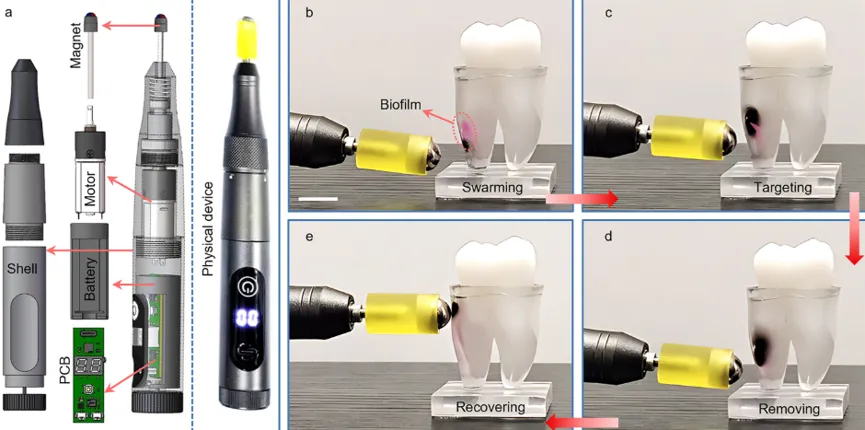
The results of the experiments showed that the robot was able to move the cluster within the model, oriented towards the biosphere, complete the spin clearance in the target area, and finally recycle through the magnetic field. The entire process formed a complete treatment loop: move→oriented→clear→recycle.
The significance of this step is clear. Micro-medical robots are getting smaller, moving faster, and if they can only rely on sophisticated experimental equipment to control, clinical transformation is still an empty word. The study has begun to consider both ends, one of which is micro-robots that work in dental bags, and the other is that the operator can directly carry a magnetic control device in his hand.
04.
What is the effect of the treatment?
All previous experiments have answered the same question: Can robots perform the prescribed actions in a simulated environment?
But the really crucial question is, does the system work after it's been used to treat inflammation of the gums?
The team tested in mice. They used a wire thread to grind the teeth on the mice, inducing tooth inflammation, and then injected a tiny robot every two days, guided by a magnetic controller for 30 minutes, for two weeks.
The result is intuitive.
Microscopic CT scans show that the group receiving magnetic field-guided treatment significantly reduced the absorption of cartilage, significantly increased bone volume and number of bone beams, and retained the base of the tooth.
Inflammation: Tissue staining and immune testing confirmed a significant reduction in the inflammatory cells in the dental tissue of the treatment group and a complete decrease in the inflammatory factors. Local fire was extinguished.
Sequential analysis found that the structure of the oral microbiome in the treatment group changed positively, shifting from tooth inflammation to a healthy direction. That is, fewer bad bacteria and more good bacteria.
After the end of the treatment, the main organs did not see metal accumulation, tissue slices did not see pathological damage, indicating that the robot did not leave any noticeable side effects after completing the task.
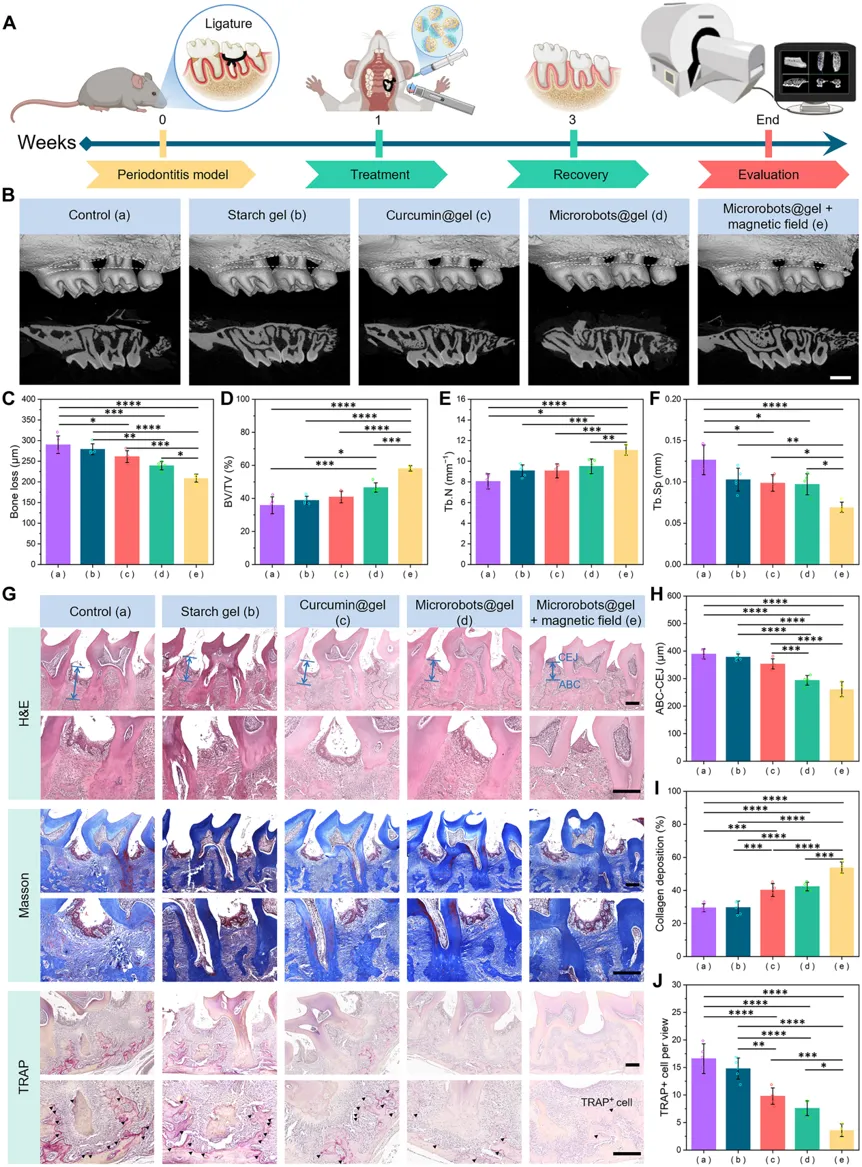
Of course, this is just a mouse experiment. There is still a long way to go for large animal testing and clinical trials. But the whole logic is running, the magnetic field is responsible for sending, the nanoparticles are responsible for cleaning, the hydrogen sulfide is responsible for suppressing inflammation, and the three have worked together to upgrade from passive cleaning to active treatment.
Perhaps one day, patients with toothache will no longer have to endure acute pain and fear of tooth decay, but will be in the clinic with a handheld controller operated by a doctor who will command a group of robots invisible to the naked eye to clean every corner of the tooth.