Every person who makes an AI system has gone through this phase: it doesn't work, it doesn't know where to turn, it doesn't know where to turn, it doesn't know where to turn, it doesn't know where to turn, it doesn't know where to turn, it doesn't know where to turn, it doesn't know where to turn, it doesn't know where to turn.
Can we give this thing, "optimizing AI systems", to AI itself?
For this purpose, the team of the Penguin Model Application Platform has opened up AntOmniEvo, a framework for automated optimization of AI systems.
The AntOmniEvo framework code is:https://github.com/ant-research/AntOmniEvo
Mara Chain's paper on the core algorithm:
All you need to do is provide a "modifiable part" in the system, a "prompt", a rule, a script, a configuration, organize a real file into a directory, a mapping of the system to be optimized, that's the artifact to the left of the diagram, evaluate the data, score standards, system definitions, how the system works; the rest is done automatically by a framework-driven AI prompt, change the rules, change the configuration, change the script, and 7x24 continuously in the "convert file → score cycle until the change is done".
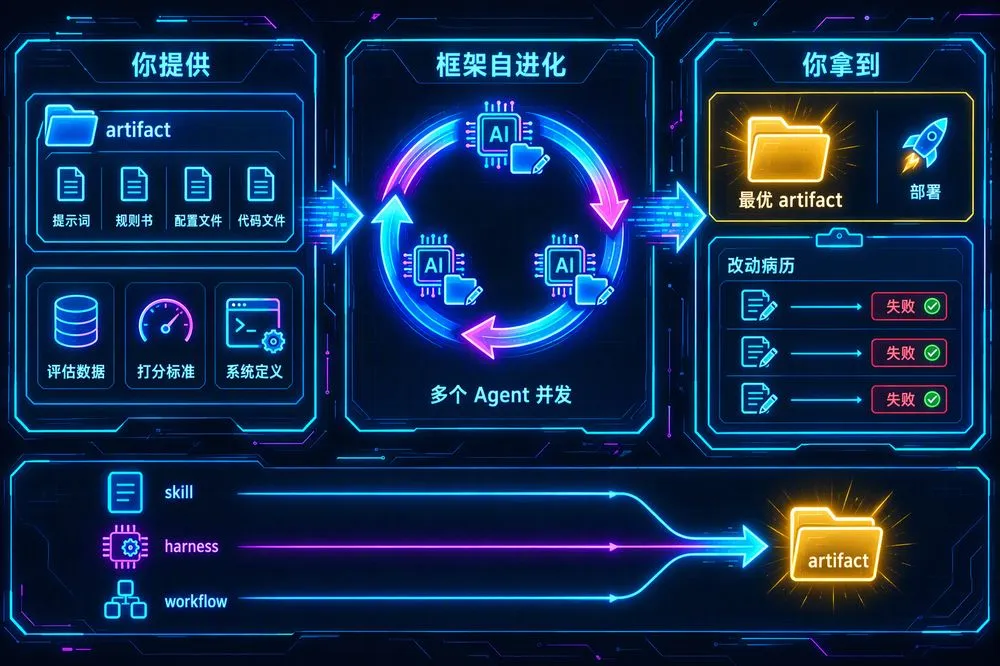
This diagram is the full picture of the value: on the left you have four things, in the middle it runs 7×24, on the right it delivers the best artifact that can be directly deployed and every disease history that has been modified.
Four core values:
Savings: Set a budget, start, and then you don't have to. You work it overtime, and all you have to do is collect the final product.
Deliveries can be uploaded directly: the optimized product is a directory of real files (prompts, rule documents, scripts, configurations) that are loaded when the system is running.
The full white box of the process: each candidate version, each run track, each score is on a complete disc, and there is also a "Lonning Gym" visualizer (see below) showing who progressed, who retreated, which version fixed which problems, the whole process can be viewed.
One framework: Agent's skill, agent harness, retrieval line configuration and node script, three shapes, one set of optimization cycles, and our goal is to optimize anything.
How did it do that?
Two layers: how to organize the system, how to improve the algorithms.
The system layer: tunable artifacts - optimization = changing files. In the system, "the parts that can be changed" (prompt, rules, scripts, configurations) are mapped into a real file directory, which is the tunable artifacts; these are the files that are loaded when the system runs, so changing files = changing system behavior, optimizing the system = allowing the coding agent to evolve this directory into a cycle of "changing files → running evaluation → viewing scores".
There's also a statement that goes along with the directory -- what the directory tree looks like, what each file is about, what changes are allowed.