In 2026, input law, a tool that has been around for generations and is often considered "enough to do", suddenly became one of the busiest racetracks in the AI industry, with voice input being the focus of the competition.
In May of this year, thousands of people asked about AI voice input methods online, and the WeChat input method hit the top of the App Store's free list with "gap forwarding"; in June, Ali announced the introduction of CosyVoice voice input methods, and the search dog input method announced a comprehensive AI. Today, the accuracy of identification in advertising ranges from 97% to 98%, and the focus of competition has shifted to "complete text".
In a press conference at the 16th edition of the press conference, Shenzhen Fujian, Director of Product Products at Fujian Fujian Fujian 16.0, asked a question: "If the text has come out so quickly, why do it still take a few minutes to respond to a message?
To unravel a real expression, the user must first organize the content, then enter the text, and finally color, order, and correction. The next two steps are becoming industry standards, but the first step is still left to the user.
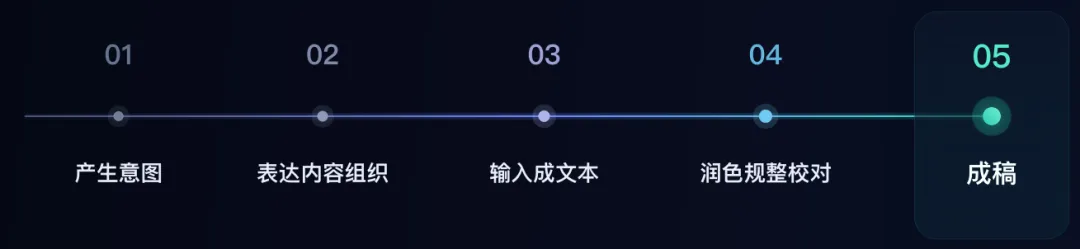
On October 22, the Intelligent Input Law 16.0, which was released at the 1024 Developers' Day of Kodak Flight Global, proposed the "intent to draft" as a core proposition for the new version.
The so-called "intent draft" means that users can only express their intentions to the input code if they have a content that is suitable for the user's actual scenarios of expression and is directly available. For example, if the user only provides the relevant material and then says the phrase "help me back to lead the progress inquiry", the input code will understand the material and organize the content on its own, and the user can only read the confirmation and send it.
At the conference, Tenerife also gave an explicit three-generation voice input: faithful recording, expressing and expressing intentions, and listening, writing and understanding intentions respectively.
The reason why "intent writing" is the next direction of voice input is because the previous two generations of users have already decided by default what they want to say, and the most complicated part of the actual expression actually happens before the opening.
Speech allows people to express themselves in the most natural way, and for the first time, large models allow machines to understand a vague intention and process scattered material.
Similar judgments were made by Tenerife 16 years ago. In 2010, Tenerife decided that voice would be the next stage of the mobile Internet era's input laws, introducing the world's first Chinese voice input laws.
In order to answer these two questions, Machine Heart interviewed Weng Soo, Director of Voice Recognition Research and Development at Koda.
Why is the third generation intending to write?
The three generations are divided according to one criterion: "to see how much preparation the user needs to do for this expression before opening it". Faithful recording and expression of the manuscript reduces the work of input and editing, provided that the user already has a good idea of what to say; the intent of the manuscript begins to share the work of organizing content. The three coexist for a long time, the user wants to keep a faithful record of the original language, and get help when needed to organize.
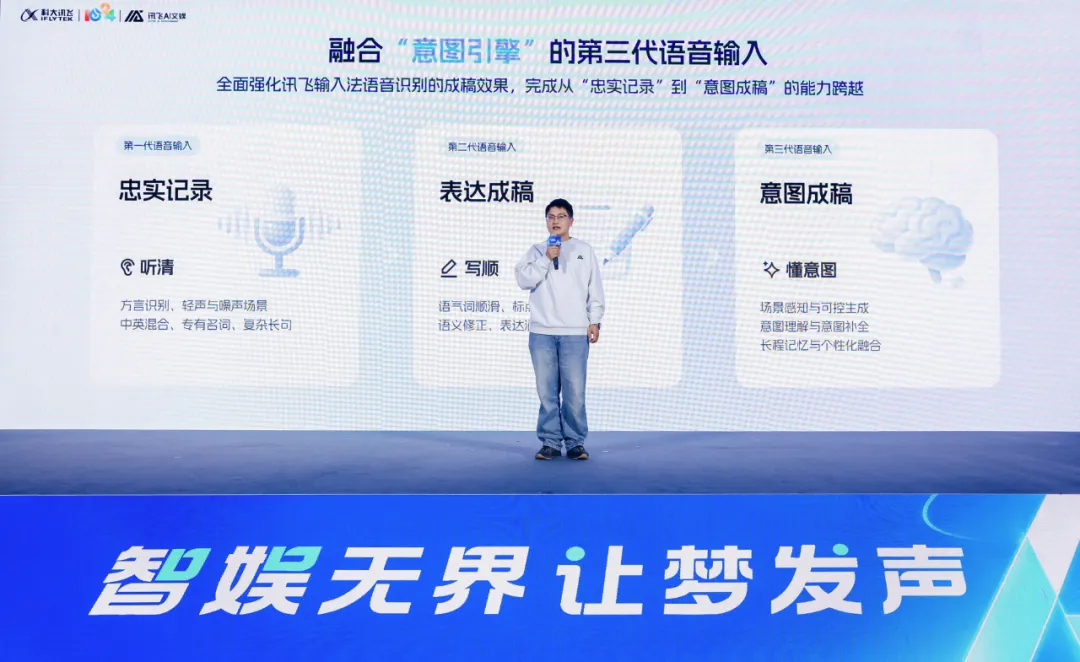
Wang Chen, Director of Voice Recognition and Development at the KodaFee Research Institute, is presenting three generations of voice input at the 1024 developers section of KodaFee Global.
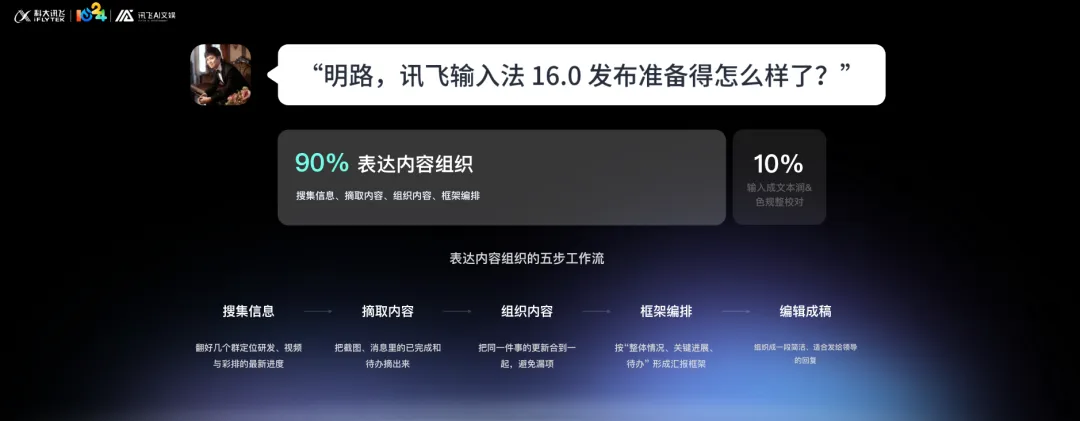
Tenerife's judgment is that in complex expressions, content organization accounts for ninety percent of the workload. This does not mean that all inputs and simple inputs can be completed at once; but in cross-application, contextual tasks that need to be combined, time is often spent finding materials, focusing, judging relationships, pinching the tone. "Inputing text is just one step in the entire process of expression".
One category is time-consuming: the materials are scattered in several places, and every time AI seeks help, they have to be copied over and over again, and backgrounds are switched over and over again.
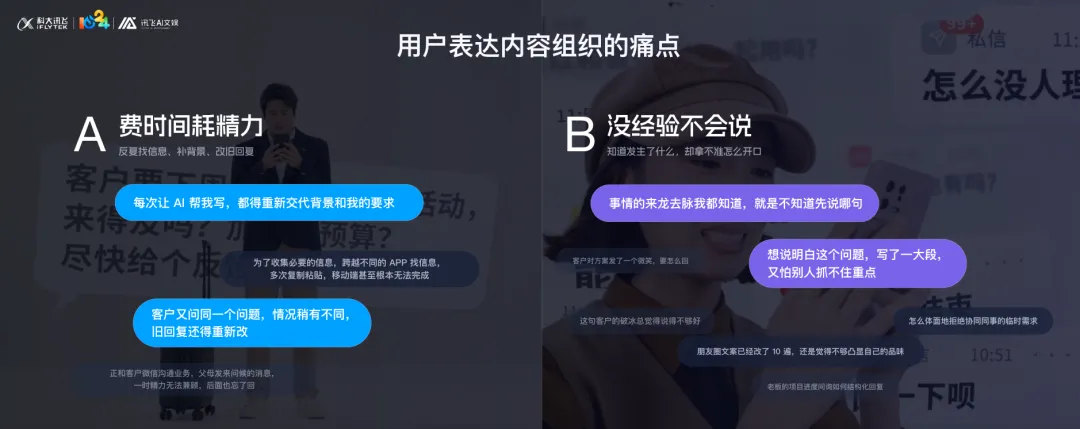
If Shong further explains, the former is central to the completeness and accuracy of the information, the system must extract the scattered content, combine similar issues, and preserve key facts; the latter "what is missing is not the information, but the communication strategy", the system must understand the objects, scenarios and risks, give the right tone and multiple candidates.
This is not a new requirement, it is different now that technology is finally able to accommodate it.
But early schemes were based on rules, the same needs, different user statements, and the more rules, the more statements that could not be covered. By the way, the task of expressing itself could not be written into rules or templates, different scenarios, different objects, organizational methods, and key information.
The big model is complemented by an understanding of natural expression and complex contexts. Users say, "It's too hard, please, but don't take his time", and the system needs to understand both the changing objectives, the tone requirements and the unchangeable content. Changes in technology have also changed users' expectations: in the past, users used to think of words as whole and then give input; when they found that AI could draft responses based on the material, they would naturally give out "organized expressions".
The user's long-standing ability to express pain points and the big model's just-maturing ability form the most valuable intersection here. This is why Intel defines intent writing as third-generation voice input: it does not add an orange button after "talking about the writing", but instead advances the input method from recording a sentence to completing an expression.
Complete expression is often required across multiple applications and involves multiple tasks: information is scattered in chat logs, documents, and screenshots, and the system must first extract, merge, and then decide whether it needs to retrieve information, read memory, and call on which expression skills, before finally delivering a piece of text that is available. This means that the intent is to be solved, essentially a collaboration between a set of tools and capabilities.
Sentinel entry method 16.0
How to turn an intention into a draft?
Returning to the example of a leader asking for progress. In the Sentinel Input Law 16.0, the user can first provide the relevant chat screenshots, copies of messages and documents to the input law, forming the task information; when necessary, directly say a request, such as "help me organize a progress response to the leader". According to Shenzhen Road, the system will first determine which points need to be switched based on the workplace reporting scenario, then place the existing progress, data and time in the corresponding position, then adjust the pronunciation and wording according to the user's expression habits, and finally put the draft back into the input box, which is sent after the user has confirmed.
The material is written as "video preview has been released, pending review", and cannot be summarized as "video finished". The user still has to make a final judgment: the add-on system cannot confirm the facts, decides how to express the risk, does not make a commitment. After creation, it can also continue to ask for "compressed into three words" "put the risk in front".
This process is supported by a number of links: a multi-modal context compiler converts snippets, voices, and documents into structured context; an intent to understand what tasks users want to complete; a scenario understanding to determine the appropriate expression strategies for communicating objects; a task planner decides whether to retrieve information; read memory; and finally, a candidate document is organized by the generator to be submitted to the user for review and confirmation. The user's modification results are also recorded under the condition of active authorization for subsequent memory consolidation and personalization conversion.
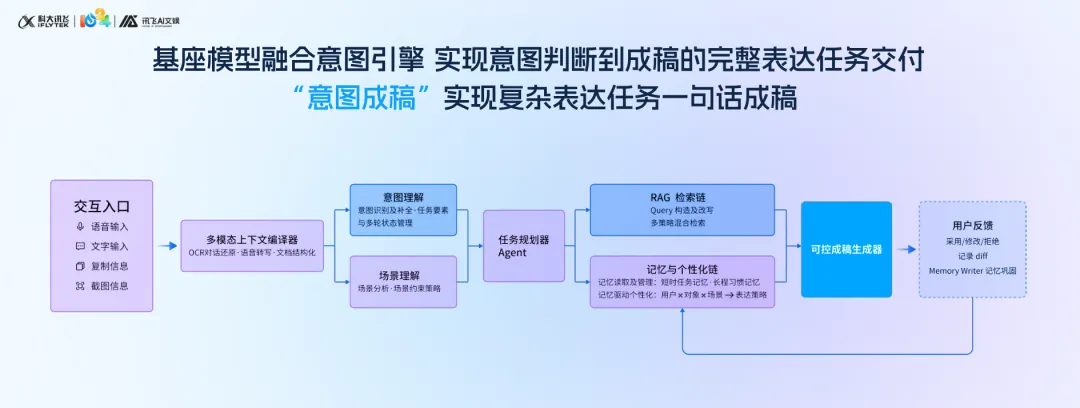
Wang believes that the difficulty lies in the synergy of the entire chain, the two most critical of which are the intentional understanding and memory modules: the first decides "what to do this time" and the second decides "how to do it to be more like a user" to avoid "making others see it at first glance that it was created by AI". He also reminds: "The model generates a text, just a starting point for expression.
So the Intelligent Input System 16.0 put these capabilities into the keyboard. "The user responds to a message, and the whole process often takes only a few seconds", says Liu Mingrou, "The input is not easy to find, the writing is not easy to change, and it affects whether the user is willing to use AI". Personalized AI keyboards provide the task information, express the skills of calling and modifying the writing, and integrate it into the same keyboard experience.
Among them, task-level information cards refine time, place, person and constraint from the text, content copied and uploaded by the user from the user's active input, which is automatically brought into the background when the next entry is made; long-range memory is used when users make requests such as "Work responses as short as possible, don't be casual" to ask if they remember, create memories that can be viewed, deleted or closed after authorization.
The technical dimension
First listen, then write it down so you can understand your intentions.
The intention to write the script is on the shoulders of the first two generations. At the conference, Kim Jin-woo gave an example: "The name, time or amount of a person on a mission is wrong, and even if it is written fluently, it can be said wrong".
In September of this year, Intel released the voice recognition supermodel Spark-ASR-2.0 and the on-line sensor input method. It is based on the nationally produced Starfire voice base model SparkAudio, where voice coding has been trained for 10 million hours.
Architecturally, Spark-ASR-2.0 allows for two paradigm synergies between non-self-return and self-return: the non-self-return module produces a complete "draft" quickly, encounters complex environments, long-tail expressions or needs to be understood in context, and is modified by LLM-enhanced self-return module intervention.
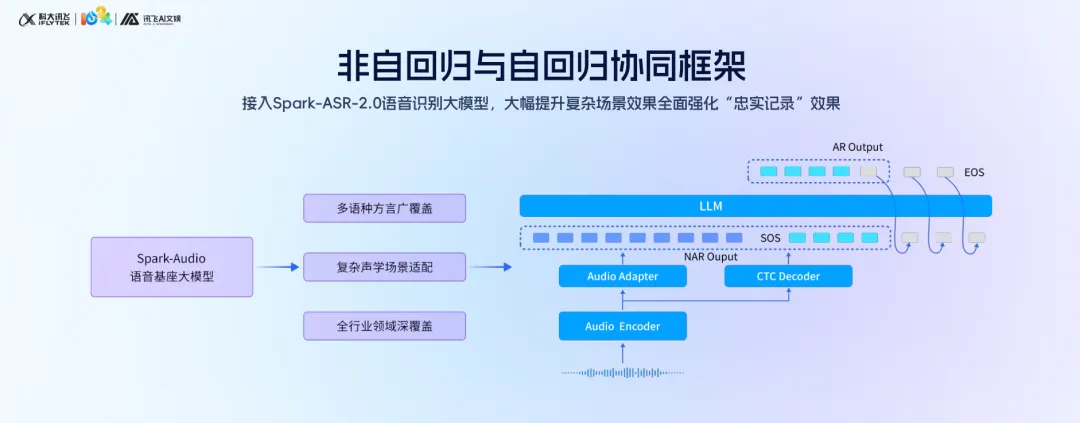
So how do you decide not to intervene, from where to intervene?
For example, if a user says, "Today's weather is good, let's go for a city walk", the draft mistakenly identifies "walk" as "work". When the LLM parallel verification, the previous content is consistent with the draft, and there is a discrepancy in the "walk", the system introduces the regression code from here.
These capabilities fall into real-world scenarios on mobile devices: in subways, buses, or movie theaters where it's not easy to talk out loud, where people don't want to be heard, where users often press low-pitched inputs, and environmental noise is constant.
The accuracy of language recognition in Spark-ASR-2.0 has increased from 85% to 91%, from 86% to 90% for small vowels, and from 33% to 80% for mixed-language words.
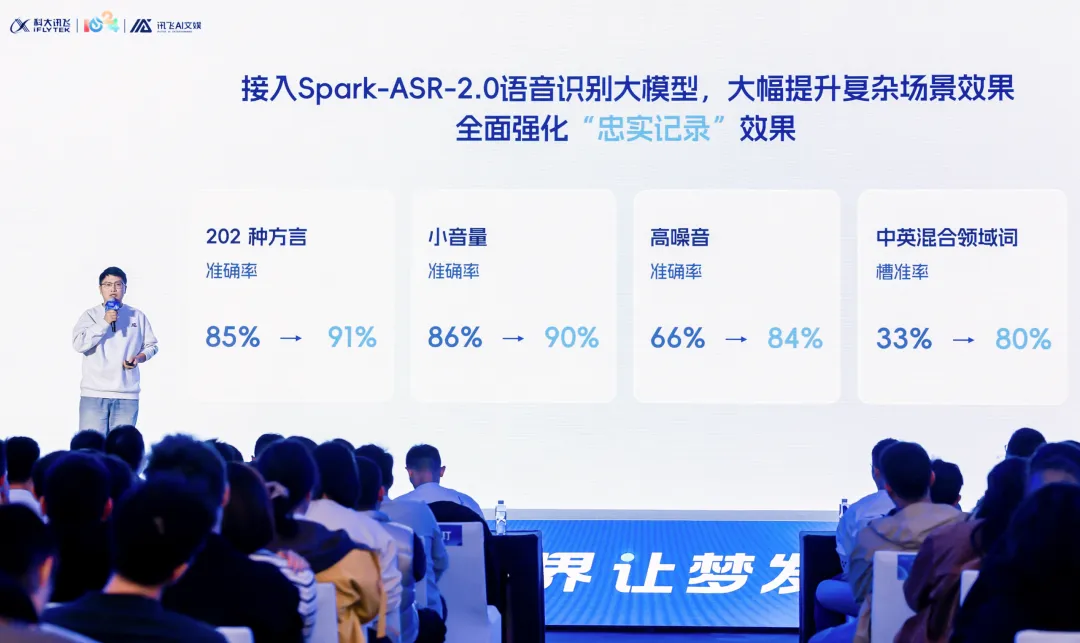
New phrases such as "Meta released an open source model Muse Glimmer", which were often overlooked, can now be preserved in their entirety.
The user receives the result of identification, before sending, they delete the spoken word, change the size of the spelling, modify the digital format. "The voice input saves time, and the user spends on subsequent editing. "By the way". After 2024, Intel began to explore the expression of the text. He emphasized that processing the spoken word cannot be "one-sided", such as "I think the "yes" in the bar is deleted, the tone has changed; the purpose of the expression of the text is "to reduce the editing cost of the user as a whole, on the premise that the user wants to express facts, attitudes and tone".
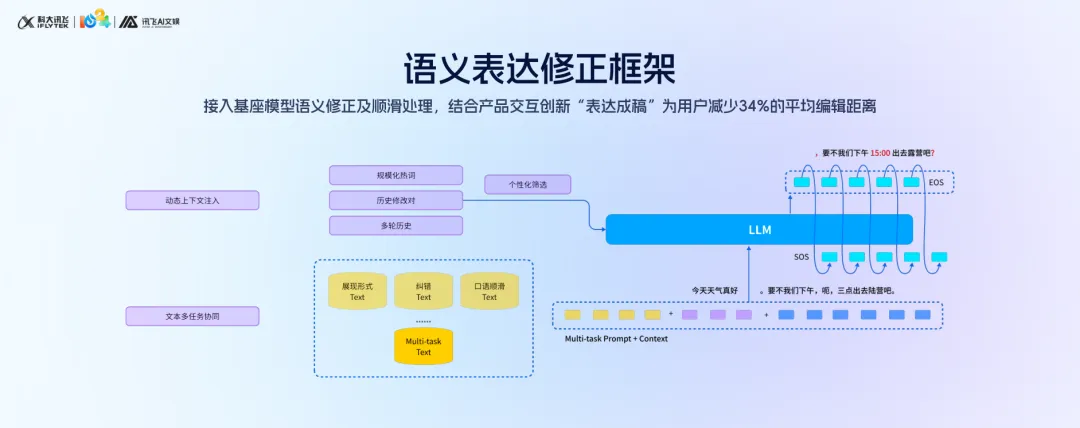
For example, the initial recognition result of a sentence is "Today's weather is good. If we don't go camping in the afternoon, oh, three o'clock", and output "Today's weather is good, if we don't go camping in the afternoon at 15:00 o'clock?" after correcting the error, word processing, timing and markup adjustments. According to the data published by Flickr, the expression document allows the average editing distance of users to be reduced by 34%, the direct adoption rate of sentences longer than 30 words increased by 40% and the text specification relatively improved by 48%.
The Sentinel Input Code 16.0 can also adjust the expression according to communication objects and scenarios, and supports the sidebar: users say "Saturday at 3:00 p.m. in Shenzhen City. No, it's too early to change to 4:00 p.m....................
It's the hardest part to copy in the big model era.
"For simple general scenarios, the basic speech recognition capabilities of everyone are not very different", Wang said, "but there is a gap in these scenarios, high-noise, and mixed Chinese-English". These capabilities come from years of accumulated dialect data, deep acoustical experience in real environments, and continuous modeling methods.
Product dimensions
Know what users need when they need it
If the technology determines whether the intended draft can be made, the product determines whether it can be used.
The first is the judgement of "when AI should intervene, how much to intervene". By the way, many of the problems in the input method seem small and occur very frequently: generating more results for a moment will disrupt the pace of conversation; the content changed by the user cannot be easily accessed by the system; AI is recommended too often and will interfere with normal input.
These judgments are based on 16 years of product experience of service users, which today serves more than 150 million monthly users.
The second is user-created expressive skills. At the conference, Kim Jong-il mentioned that in previous AI assistants and smart platforms, users and creators could define the way AI helps them communicate, express themselves and create, making specific requirements into skills that can be used repeatedly.
The platform now has more than 300,000 expressive skills, 150,000 creators of skills covering more than 10,000 expressive scenarios. According to Shen Road, "These accumulations are the core of what we are confident about going to write". Users embody task goals, style preferences, and fixed rules into skills that don't have to change over and over again; product patterns can be imitated, but the understanding of these scenarios that users embody doesn't take away.
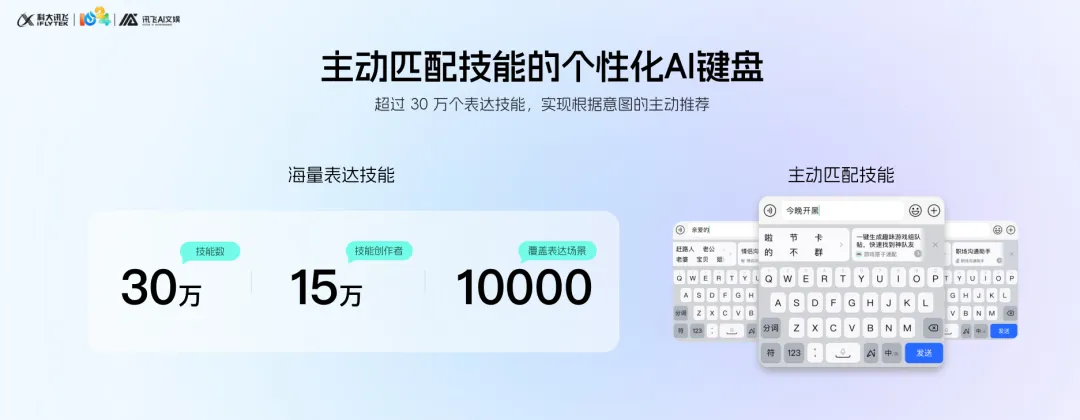
The third is to turn skills into a part of the keyboard. The core of the personalized AI keyboard is not the appearance, but the ability to organize the scene around the expression: workplace reporting with large factory workplace skills groups, game community corresponding community skills groups, workplace reporting with love warrior skill groups; users can also arrange their most commonly used skills in skill brackets.
According to reports, over 60% of AI keyboard users have shaped their own exclusive keyboards.

The simultaneous introduction of the "keyboard packer" by Sentinel 16.0 allows the input method to test emotional values beyond convenient expressions: it responds to typing rhythms, accompanying each user's input.

The bottom line: the verdict of 16 years ago
The answer goes back to 16 years ago.
On October 28, 2010, the Android version was released, the world's first Chinese-language voice input. At the time, smartphones were just beginning to gain popularity, with an accuracy of about 70% in Mandarin.
According to Shan Shan, there is still a barrier to entering text on a small screen for people who are not familiar with spelling or typing slowly, and speaking is a human ability; at the same time, many problems can only be discovered in the real world. "Speech is one of the most natural ways of expression for humans; the method of entering can transform this natural expression into truly usable text in the digital world".
Since then, the accuracy of identification has increased to 80% in 2012, 95% in 2014 and to 97% in 2016 and 98% in 2017 under the DFCNN programme.
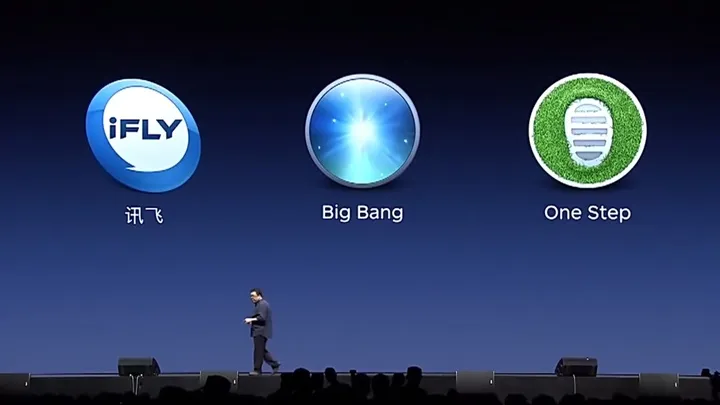
In October 2016, Ro Yong-yeon presented a live demonstration at the M1 event in Ningbo, China, and the first free app in the App Store with more than 100,000 daily active users.
This shows that voice input has transcended the threshold from being technically feasible to being available to the product: "It's gone from feeling like a new feature to being a way users are willing to try and possibly actually start replacing keyboard input". It is understood that the penetration rate of voice users using Centauri input will be about 40% at the end of 2016 and 75% by 2022".
The coverage has also expanded somewhat. Dialogues have been introduced in 2012 with the introduction of a language-by-city landline, where 202 dialects were integrated into a single model to achieve switching-free identification; offline, light-sound, noise-resistant, and optimisation for elderly, children and visually impaired users, enabling more people to use voice input on their own terms. In 2020, the Sentphay Input Law became the first entry law to be certified by the Chinese Association of the Blind.
Looking back, two judgments in 2010 and 2026 follow the same logic: first look at where the user card is and then, at a time of technological maturity, take the lead in making it a product.
Let's focus on what we want to express.
Next, Tenerife focuses on three areas of speech recognition:
Unrelated speakers refuse to recognise, and target speakers are locked in crowded conversations and noisy environments;
editing the voice content and making uniform changes to the entire content using voice commands;
Emotional results are displayed so that markers and phrases reflect the tone of the user.
If, by the way, voice content editors are the first to land, emotionalization will push the boundaries of emotional judgment more cautiously.
In the far future, in devices such as AI glasses, users may be more likely to express their intentions through voice, vision and gestures. "The focus of future change is not on how the input method is no longer present, but what form it will be".
The ideal state he describes is that the user speaks at a natural rhythm, without having to think of the sentences as complete; it requires faithful recording when the original is spoken, and it requires clarity when the manuscript is written. In his words, it is to allow the user "not to focus on how to enter, but to be able to focus on what they really want to express and complete".
In this sense, intent writing is the result of sixteen years of voice input that extends into more complex expression pain points in the age of the big model. The big model makes this step possible, while making it really useful for details that come from a long-term understanding of the user and the scene, and a real problem-solving expression skills.
© THE