It's the first time in the history of the world.
To tell you the truth, the history of human science is completely rewritten tonight!
Just as OpenAI's breath of fresh air puts three bullets into it, the official announcement is that AI has independently completed three "milestone" new discoveries.
Mathematics: Proving a full-dimensional "local smooth guess" that completely ends a hundred-year-old "hanging valley guess" that has plagued the mathematical community;
Computer science: falsifying the "index time hypothesis" (ETH) that has dominated the scientific community for nearly 30 years;
Theoretical Physics: Given a strict mathematical proof of the existence of four-dimensional quantum color dynamics (QCD) with pure hydrogen-Mills theory.
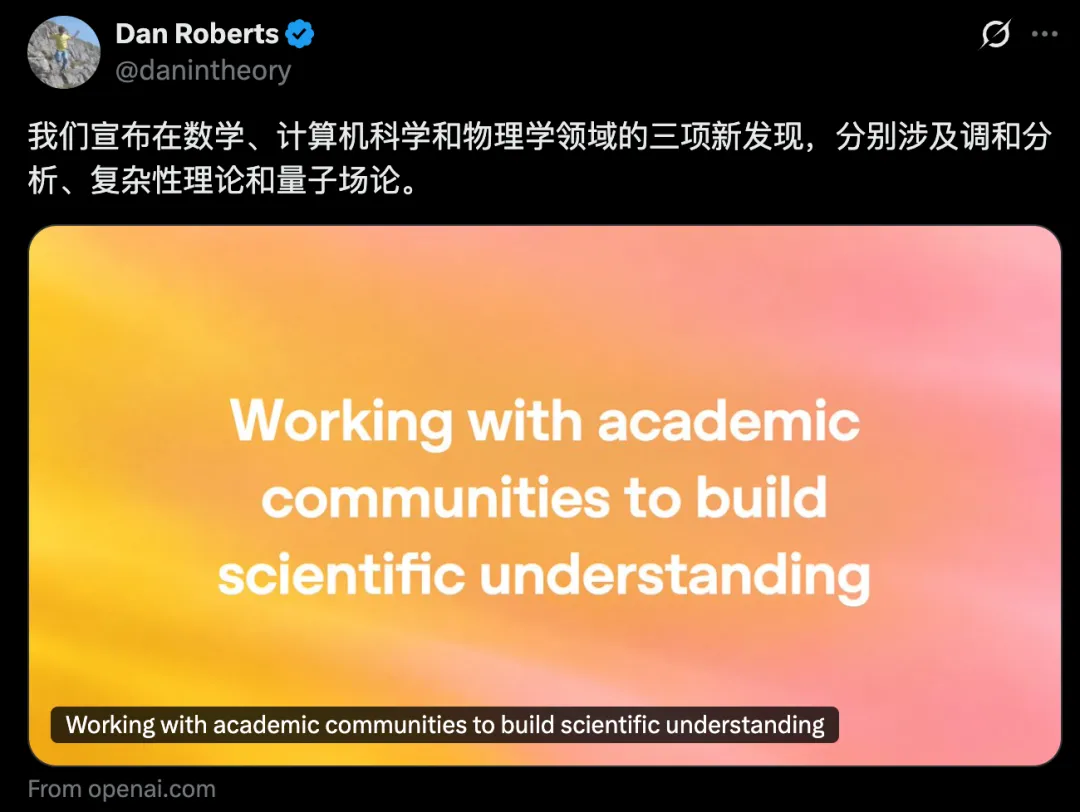
When the news broke, the entire Silicon Valley and academic circles were devastated.
The Hanging Valley conjecture has plagued mathematicians for a century and is the main field of study for the Nobel Prize-winning King Neon.
But in the third wave, the one thing that really breathes a breath of fresh air in the circle is the "index time hypothesis" (ETH). Over the past three decades, the global computer science community has agreed that ETH is correct.
This hypothesis, which computer scientists call the Iron Law, and hundreds of papers have been built on it, has now been directly overturned by AI overnight.
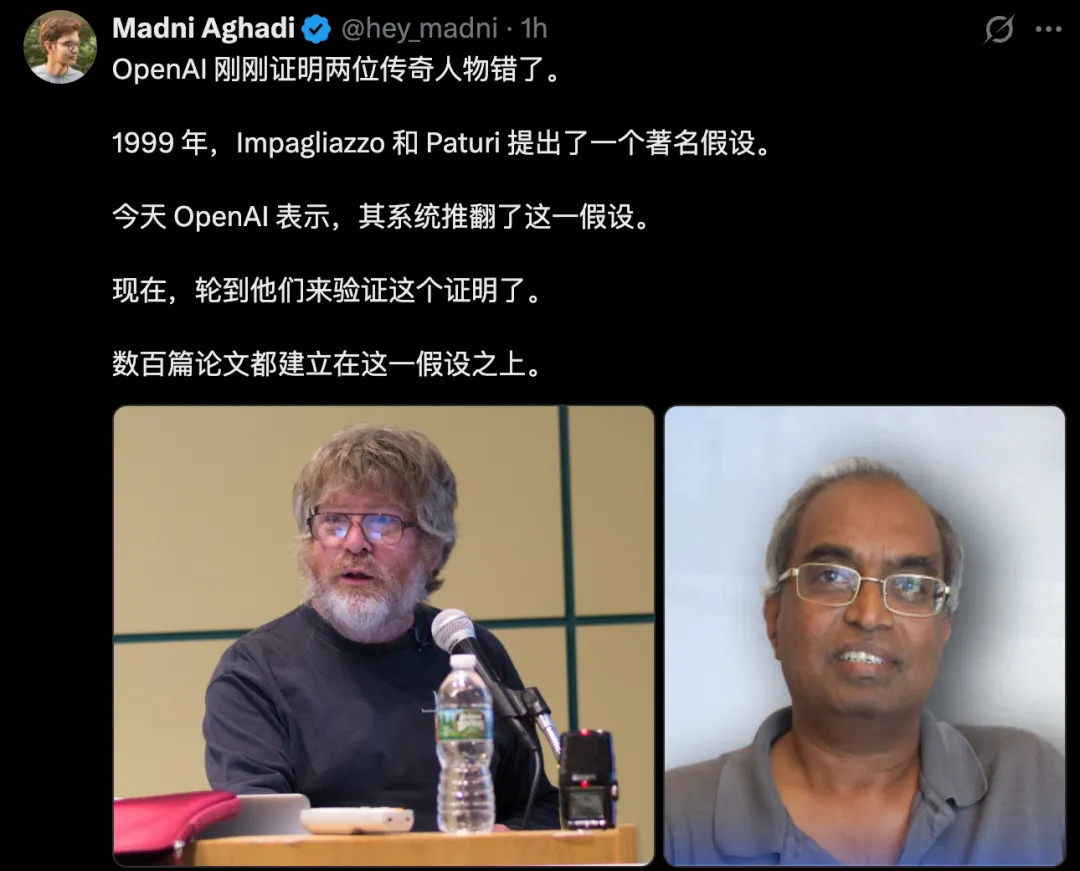
The most disconcerting is the speed, from getting proof, to completing the machine-by-machine verification, which took only one day.
In addition, the person responsible for examining the AI responses was the person who asked the question personally that year, and the winner of the award personally led the team to the test.
Nobel laureate David Gross exclaims, "For those who don't understand, the hypothesis of ETH is so surprisingly falsified that it has far-reaching implications".
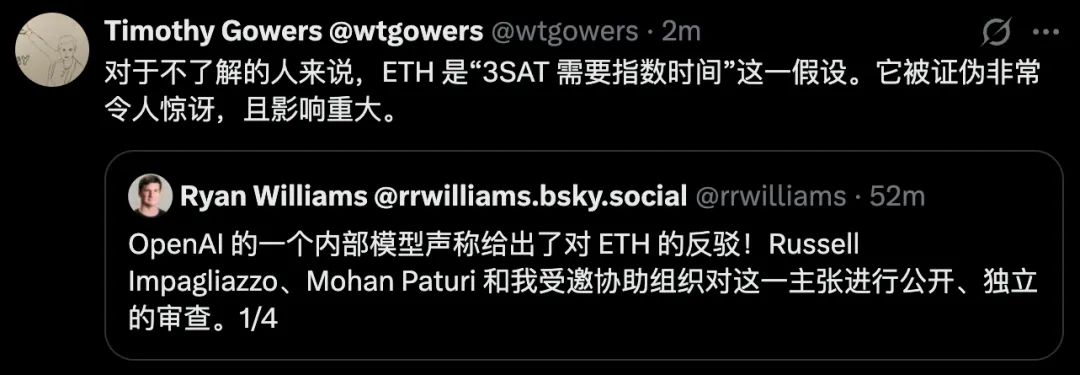
Chen Li Jie, a Chinese alumnus, couldn't help feeling that the index time was wrong!
 30 years of railroad collapseHundreds of computer papers
First, let's talk about a problem that all programmers have to deal with: satisfactory sexuality (SAT).
Given a set of logical conditions, the question of whether a set of valuations can allow them to be formed simultaneously. It is the ancestor of the NP-complete problem, and is connected to the "P and NP" millennial puzzle bloodline.

In the late 1990s, Russell Impagliazzo and Ramamohan Paturi proposed the "index time hypothesis":3-SAT problems cannot be solved in "sub-index time" and must be quantified as quickly as possible by a 2cn quadratic scale.
This hypothesis has not been proven, but almost everyone believes it.
Over the past 30 years, researchers have been linking other problems to it. Hundreds of papers in graph theory, databases, computational geometry, and computational biology have shown how quickly ETH algorithms can define boundaries.
As a result, today, AI has directly proven that this is all wrong.
OpenAI's open-source computer paper, titled "Only One Unambiguous Conclusion", concludes that the timing of the hash index is incorrect.
The algorithm proposed in this 67-page manuscript is even more precise in calculating how many sets of 3-SAT formulas meet the assigned conditions. As long as this number is greater than zero, the formula can be solved together.
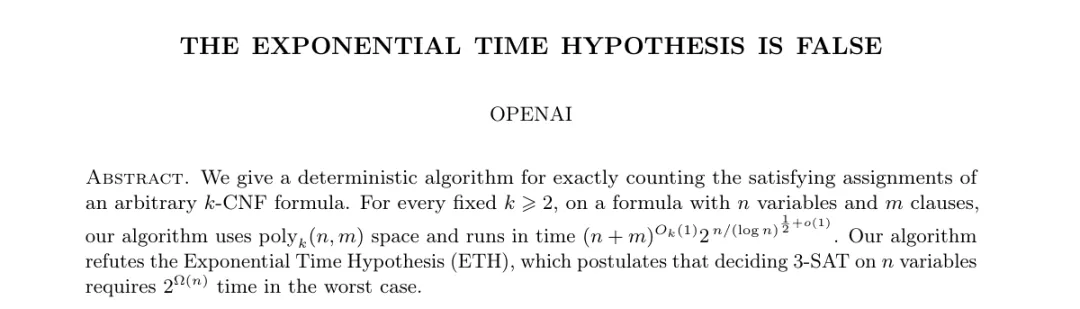
3-SAT can be understood as a set of interlocking switching rules: each rule involves three values that are either true or false, and the task is to find a value that makes all the rules work together.
The problem is that as many variables as possible, the combinations will explode. ETH believes that, in the worst case scenario, solving time does not revolve around the exponential cost of increasing the number of variables.
The paper proposes to reduce the rate of growth to a sub-index level, and there is still a gap in multi-disciplinary time, soRejecting ETH is not the same as proving P=NPIt is not possible to directly translate all of the problems into seconds, which can be counted tomorrow.

OpenAI is equally clear that a lot of follow-up research is needed to turn theory into practical acceleration.
In order to verify this astonishing conclusion, OpenAI even directly invited the grandfather who proposed ETH to the mountain himself!
Impagliazzo and Paturi, as well as MIT's renowned complexity theorist Ryan Williams, were personally linked. Earlier this morning, Williams publicly provided a link to the paper and argued for its time complexity.
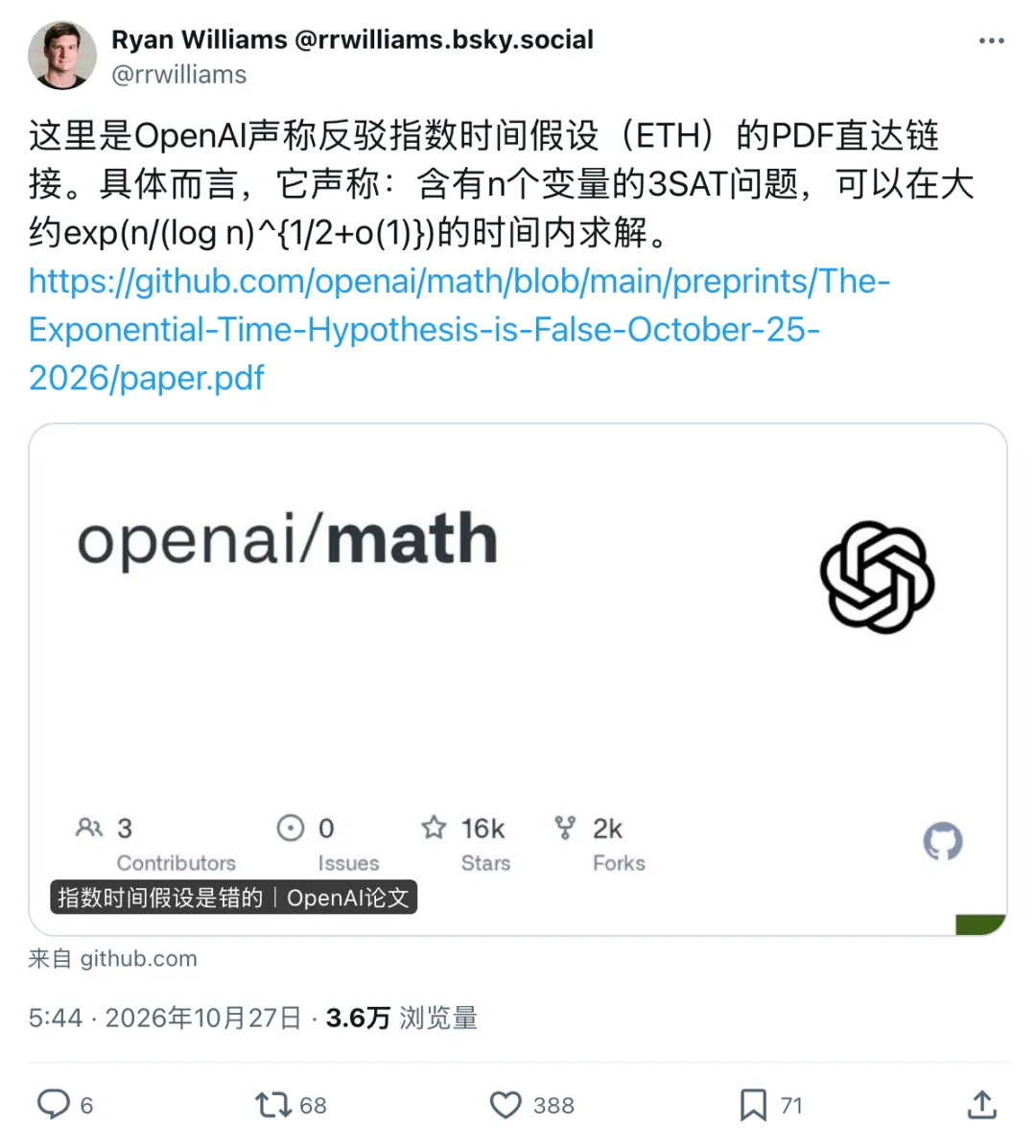
They have spent nearly 30 years researching a computational limit that has now been established.AII'm not sure what I'm saying.
Similarly, the internal AI of OpenAI completed proof in just one day. It received natural language rebuttal on October 16 and completed Lean formalization on October 17.
A day here is the conversion interval between two forms of proof; the public review of whether the results will stand is now being handled by these experts.
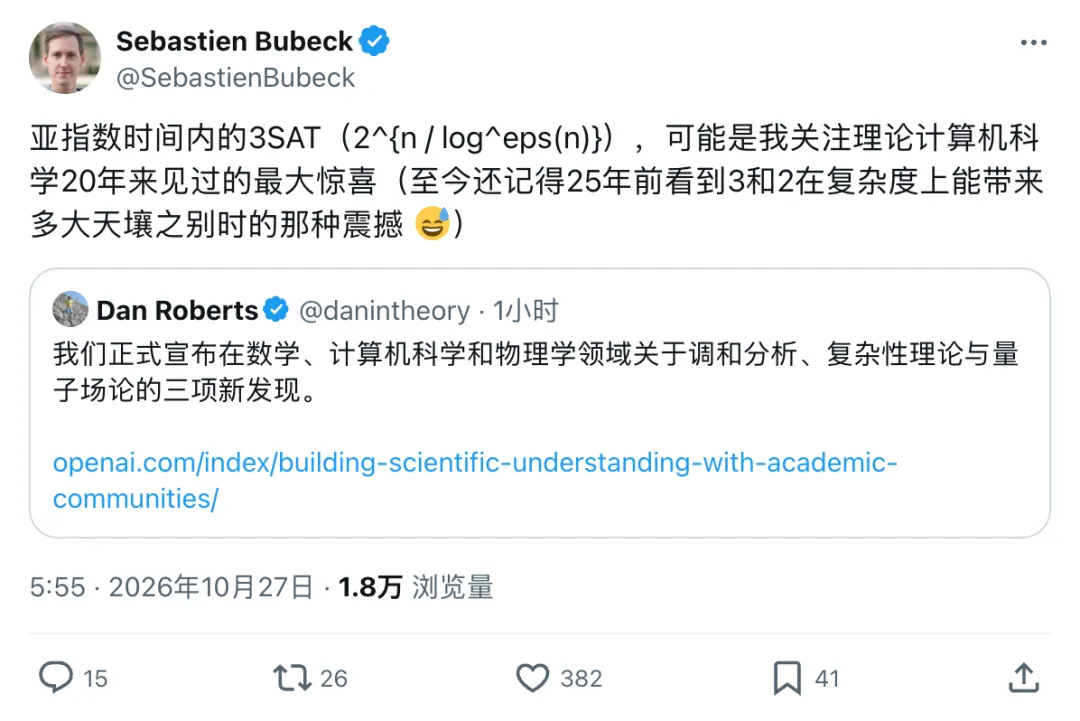
OpenAI theoretical computer and mathematician Sebastian Bubeck exclaimed that 3SAT in sub-index time was the biggest surprise he had seen in 20 years of focusing on theoretical computer science.
He still remembers the shock of 25 years ago when he saw how complex 3 and 2 could be.
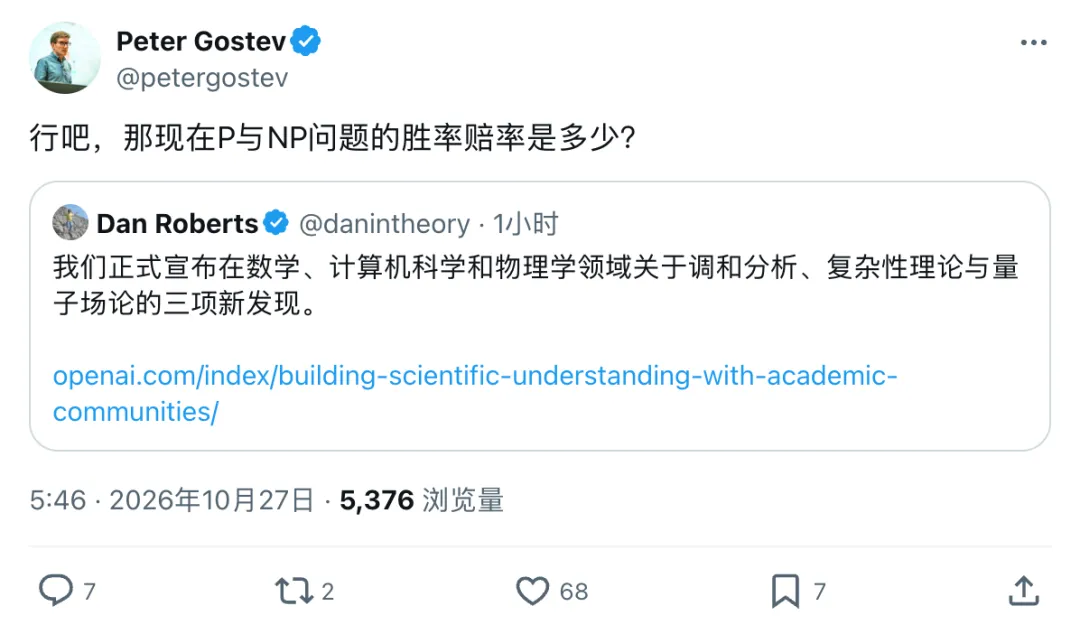
Networker Peter Gostev said, "Well, what's the odds of winning P vs. NP right now?"
 Full-dimensional shutdown!The century's hanging valley speculation has been overshadowed by AI.
Let's take a look at OpenAI's first major discovery, which lies at the heart of pure mathematics, the harmonic analysis.
In mathematics, there is a famous hundred-year-old conjecture called the "hanging valley conjecture" (Kakeya conjecture).
In 1917, the Japanese mathematician Hang Kuan Yew posed a question: How much area at least needs to be swept if a needle with a length of 1 turns 180 degrees on the plane?
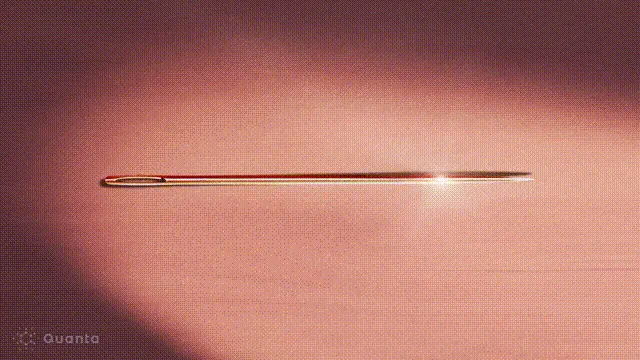
Intuition tells you to draw a circle.
But in 1928, mathematician Besi Ković gave a counterintuitive answer: an area can be arbitrarily small, small to close to zero.
Mathematicians turn to the question: a set containing all line segments in all directions, whose area can be zero, but its "dimension" can also be compressed?
This is the Hanging Valley conjecture, which asserts that in n-dimensional space, such a set must be full-dimensional.
This seemingly childlike problem was later shown to be linked to coordination and analysis, partial differential equations, numerology, and combinatorics.
Everyone knows that in 2019, Guth, Rainbow, Zhang Ruqiang demonstrated two-dimensional local smooth speculation; in 2025, Rainbow and Joshua Zahl invaded the three-dimensional hanging valley speculation, which shocked the entire mathematical community.
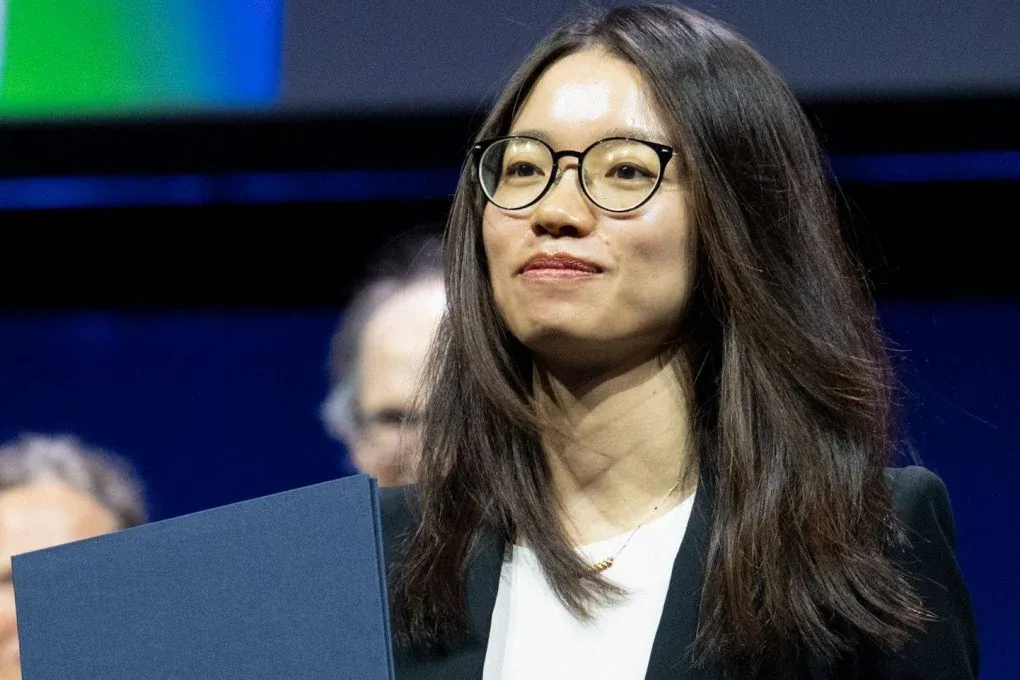
This time, the OpenAI model directly pushes "local smooth guesswork" to all dimensions.
This hypothesis was put forward by Sogge in 1991, which imagines waves of different directions coming together at the same time, and local intensity suddenly hitting high.
The rule of thumb is that this most extreme focus doesn't last long; if you put a period of time together, the average post-concentration level will be much milder than the worst moment.
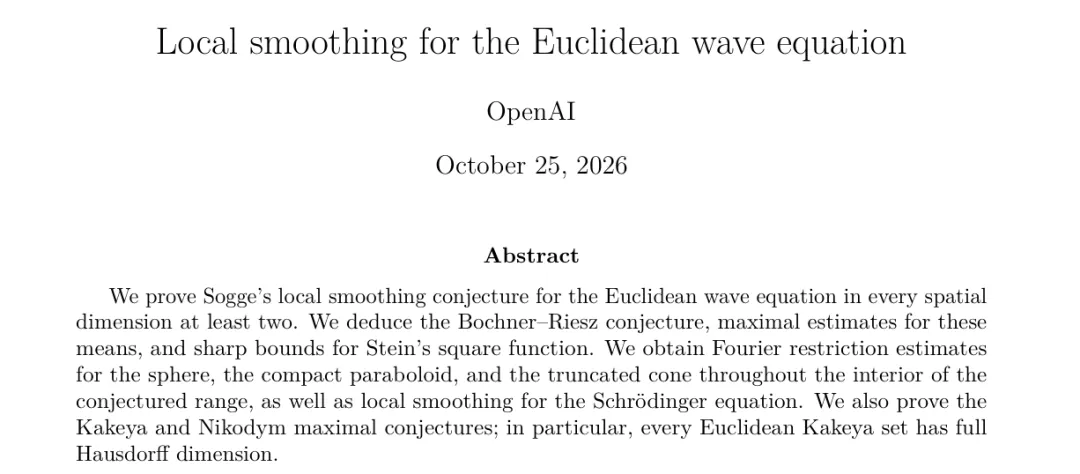
OpenAI says that the model uses a new auxiliary partial differential equation to prove that all dimensions of space are n ≥ 2.
It's a "mother conjecture" that once established, hanging valley conjecture and Stein limit conjecture will all fall apart just like Domino's skeleton.
The latter studied how estimates can be maintained, how waves spread, and how they are closely related to concentration, when the conversion of the ciliary leaves is limited to certain curves.
From receiving a natural language proof on October 18 to completing Lean's formal verification the next day, AI took only one day.
The result is that, with a more upstream analytical tool, a whole set of long-term problems are solved.
The Nobel Prize winning teamThe Holy Grail of the Millennium is ripped apartThe Working Group on Theoretical Physics, led by David Gross.
In 1973, he participated in the discovery of near-freedom: the weakening of strong interactions at extremely short distances and extremely high energies. This discovery helped establish quantum color dynamics and led him to share the 2004 Nobel Prize in Physics with two other scientists.
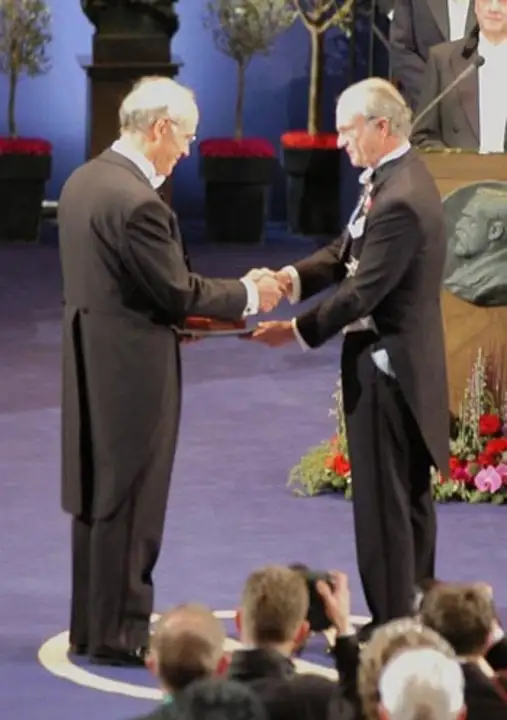
Today, he is involved in understanding and reviewing the proof of AI for this set of theoretical mathematical foundations.
Quantum colour dynamics, abbreviated as QCD, describes the strong interactions between quarks and quarks. The pure Miller's theory eliminates the field of matter such as quarks and retains the normative interactions of such quarks.
Physicists have long used quantum field theory to explain and calculate a large number of phenomena, but to rigorously construct these interactions into mathematical objects in four-dimensional space is still a difficult fundamental problem.
According to OpenAI, the model follows Balaban's approach in constructive quantum field theory and provides proof of the existence of certain four-dimensional specification fields with Fermi's theory, a range that includes QCD, and a general unified complement containing standard model specification fields and Fermi's.
The existence of pure Mills theory is part of the Millennium Grand Prix puzzle.The full answer to Clay's demand also includes a positive mass gap, i.e., that non-vacuum-excited energy cannot be infinitely close to a vacuum; this part of the announcement does not address this.

Along with Gross, Michael Douglas, Arthur Jaffe, Igor Klebanov, and Nikita Nekrasov also joined the group.
This list is divided by the fact that someone has laid down a physical theory, someone has personally defined the reward problem, and now they are facing new arguments put forward by machines together.
The model was given a proof of existence by Tom Mills on 9 September and a proof by QCD on 18 September.
Due to the length and complexity of the work, OpenAI did not advance the collaboration until October 16 after completing the formalization of Lean, where Mills was present.
Scientists who helped humanity understand strong interactions half a century ago are now taking over the world.AIThe answer to this question continues to question the underlying mathematical structure of the physical world.It is enough to make people feel the weight of the history of science.
OpenAI withdraws its signature and earns $5 millionBecause the results are too large, OpenAI has ranked the three manuscripts as "raw research data".
In order to translate it into scientific understanding, it first experimented with three models of pastoral collaboration in the external sciences.
Mathematical results reveal AI manuscripts with Lean codes; computer science results reveal the manuscripts with Lean codes and form a team of experts; and the Physical Society decides not to reveal the original products of AI for the time being, with five masters studying and personally writing the elaborate papers.
The four principles of collaboration are clearly written.
First, it is transparent and does not require signing any confidentiality agreements.
Second, OpenAI does not seek academic signature for original discoveries produced by internal models.
Third, the accreditation of explanations, the academic accreditation of working groups for their scientific understanding of what they have developed, their written explanatory papers and their accurate tracing of pre-human thought.
Fourthly, independent, free, voluntary and unpaid participation, which scholars conclude entirely independently.

OpenAI has donated $5 million to the Simons Foundation, and Simons Foundation, together with OpenAI and Anthropic, has invested a total of $15 million in computational resources to fund seminars, conferences, and special projects to help scientists independently review, understand, and expand AI-generated scientific findings.
Currently, there are 721 manuscripts produced by OpenAI's unpublished internal model, which are classified into 373 result families. The models are evaluated on about 4,000 open research questions, each of which consumes an average of about 3 hours of deep thinking computing at the ChatGPT Pro level.
Prophecy of three years agoAI will not replace disciplines, it will reshape disciplinesOpenAI researcher, Bing D. Wharton School of Business and professor of computer/mathematics Suzie J. has unveiled his speech PPT three years ago on X.
Page 4 of the PPT states that complete information work (intake, output, clarity of boundaries) is most vulnerable to AI shock, except for programmers, accountants, and in particular, "perhaps theoretical computer scientists, theoretical physicists and pure mathematicians".
Suzanne was shocked that almost no one in the audience believed him when he spoke.
In retrospect, the term "replacement" is not entirely accurate. AI will not replace any discipline.
Rather, it will fundamentally reshape and is already reshaping disciplines by rewarding research that builds deep connections with real-world challenges and other disciplines.
Greg Brockman, President of OpenAI, wrote in a statement that AI has begun to help us deepen our understanding of the universe.
AI is moving from research-assisted tools to the original discoverers of basic science.
Once the results are validated, human research will enter a new phase of "AI-first discovery, human verification understanding". The pace of scientific breakthroughs and the academic evaluation system will be reshaped.