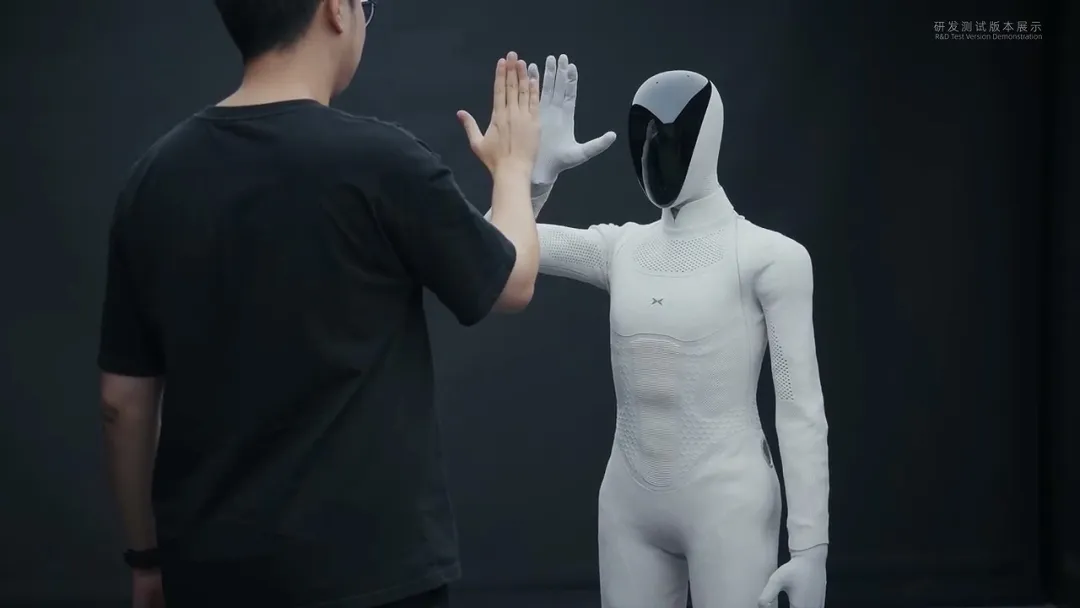
“ If people don't step out at a robot's pace and shake hands until they're half-changing their fists, they can't keep up, and robots can't keep up, maybe in less than 0.2 seconds.
Recently, Chevrolet released an interactive demonstration video of the IRON humanoid robot, the second-generation VLA model completes the time-series understanding and future behavior prediction upgrades and deployment on the side of the machine, with the official range of every 0.2 seconds re-reasoning based on the image, which can predict the changes in human movements in the next 6 seconds.
01.
Why is it harder to shake hands than to roll over?
The test in the presentation has no script. The tester first reaches out for a handshake, and the hand reaches halfway to a sudden fist-shake, the IRON closes the handshake and turns it into a punch; the tester also temporarily raises the control position, beyond the reach of the left hand, and it switches the handshake to the right hand.

In the past, it was the other way around: the robot recognizes a complete gesture, triggers a set of pre-set movements from start to finish, people go along with its rhythm, and once people change their minds in the middle, it stops and triggers the next time.
The difficulty of two things is different for the opponent. This type of head-over-head action faces gravity and the ground: the gravity trajectory before the jump, the speed of rotation in the air, the position of landing can be calculated in advance, and the robot can repeatedly train off-line to close, actually executing that moment, with few variables from outside the body. It is difficult to control the explosive force and accuracy, and the entire process is written by the robot itself.
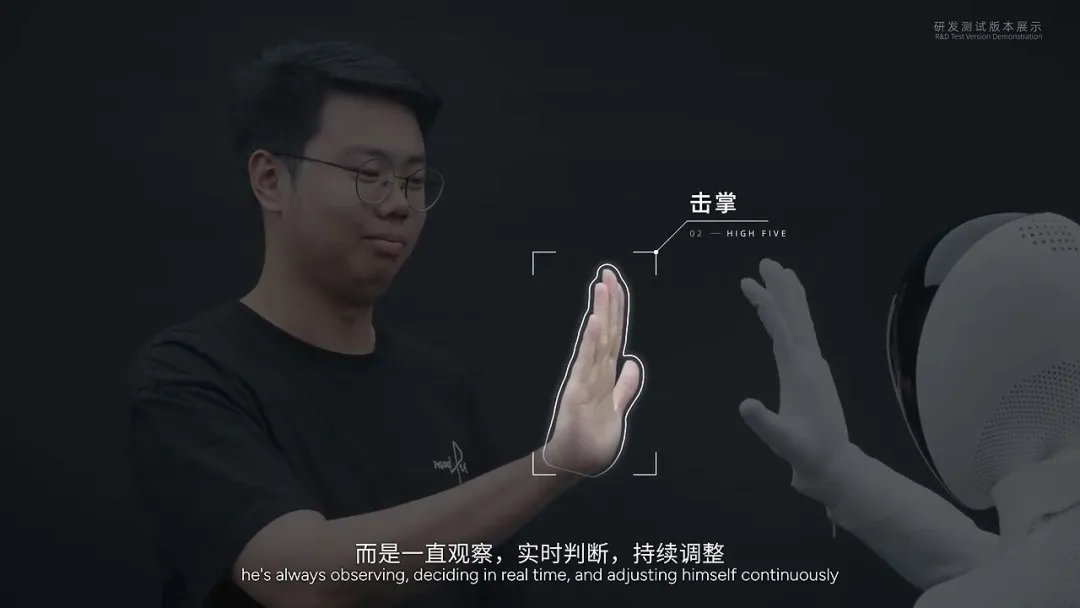
Handshake, in turn, the script is in the opposite person's hand: when the handshake comes in, from which angle, with how much force, do not turn it into a punch in the middle, robots are not in control. Wherever the lost hand goes, it is not the same as falling over the head of the robot itself, the handshake falls directly on the other person, struggling to pinch the other person, slowly half the other person has grabbed the hand, the positioning error is a fall.
Rhythm attributes are equally different. The rhythm of tasks such as surveying and transportation is determined by the machine itself, slowly, stopping does not affect the result; the rhythm of interaction is held in human hands, the robot is delayed half a second, and the entire interaction is interrupted.
So this kind of contact cannot be judged only once at the start. According to the official caliber, IRON is rethinking it every 0.2 seconds based on the image and predicting the change in movement over the next 6 seconds, with a handshake lasting less than a few seconds, and with this frequency, the robot has the opportunity to modify itself dozens of times in this contact.
Based on the body of the robot, these requirements have turned into several hard indicators: IRON is designed in a 1:1 human ratio, is 178 cm tall, weighs 70 kg, has a human spine, simulated muscles and a fully covered soft skin, and the arm uses what is officially called the smallest wavelength wavelength joint in the rubber industry to reach the size of a 1:1 human hand, serving the same position of the hand reaching the target, and the force of contact falls within the range of human habit.
02.
Why can't it be done in the cloud at such a high frequency?
In the industry, human-shaped robots are commonly used to combine end-to-end cloud computing with cloud computing: their own computing capabilities are limited, and they are re-delivered to the cloud. This program runs round-the-clock, run tasks are fine, run interactions are fast-paced once the cloud moves back and forth to experience the upward, reasoning, and downward three phases, with each phase of the dynamics superimposed on the same time delay budget, and interaction scenes do not come back.
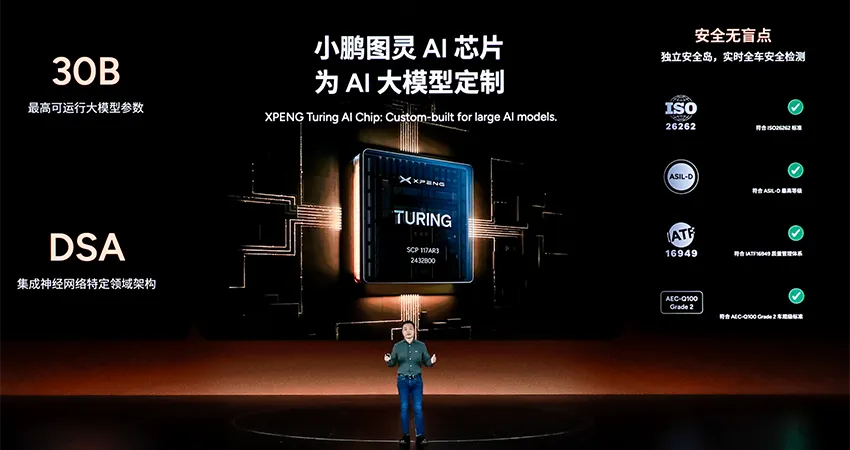
Small's practice is to put logic in the body: IRON is equipped with three self-developed Turing AI chips with an effective calculation capacity of 2250 TOPS. Turing chips were successfully released in August 2024. In the third quarter of 2025, a single calculation capacity of about 750 TOPS, roughly equivalent to three Great Britain Orin-Xs; while IRON is equipped with three, the specific purpose of which is to keep the whole set of logic in the body, two of which are the second generation full-blooded VLA.
The key is that day. The chip button is designed to run simultaneously on self-driving cars, robots and flying cars, and the company's positioning has been upgraded to Silicon Physics AI 15 months earlier. The first-generation of IRON mass-produced products with this arithmetic reserve downline, end-to-end reasoning doesn't have to compromise due to insufficient arithmetic.
There are two side-effects of computing in the machine: the perception that data is not real, the question of entering the store, the park, the commercial equipment in the factory, which the purchaser will ask; the reason for not eating the network fluctuations, the underground shopping malls, the weak network areas deep in the factory also function normally.
03.
Why did this model last nine months on the car?
The answer is on the scale. IRON's VLA is synonymous with intelligent driving, and the car is currently the only carrier with a mass-produced fleet: cars on the road are returning their models to real-world conditions every day, and robots do not yet have such a fleet available.
Set the timeline: In March this year, the second-generation VLA Turing AI was officially launched, with first-month assisted-driving miles accounting for more than 50%.
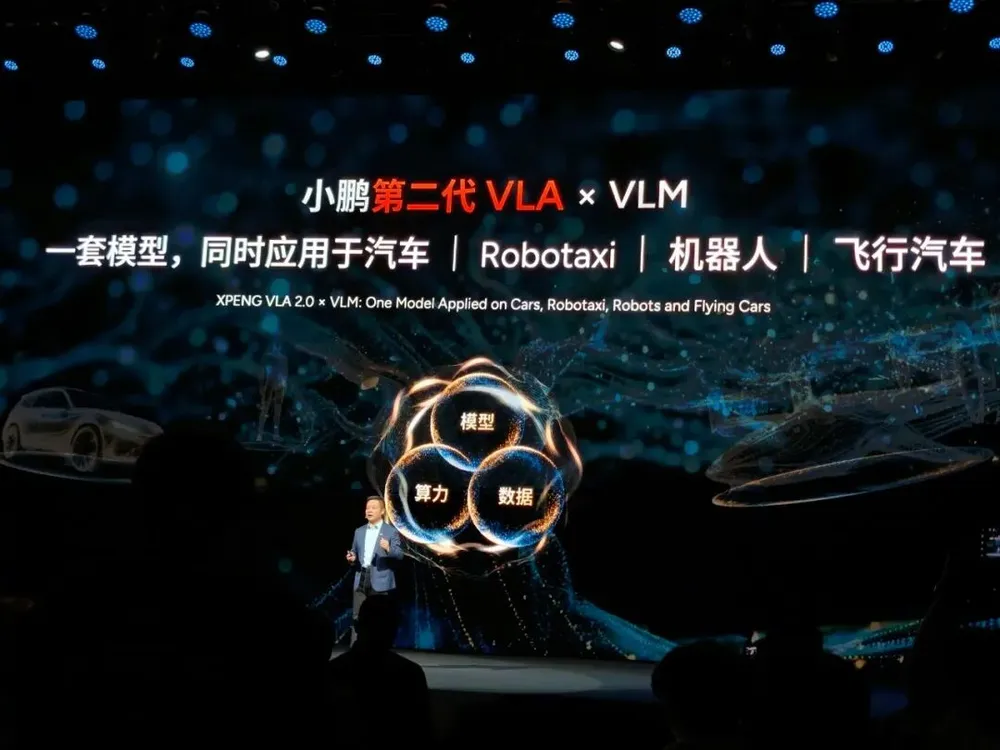
In August, the second-generation VLA completed a critical upgrade, expanding the edge-side model parameters by 3.5 times, from a static 3D space understanding of the physical world to a dynamic 4D space understanding; the other two indicators given by Chevrolet at the second-quarter performance conference call were a 300% improvement in sensitivity and achievement of the VLA+VLM cockpit.
4D space and time is one thing: 3D understanding what it's like to answer in front of a mirror, 4D understanding what it's like to answer in front of a mirror in the next second.
The number of assisted driving miles in January was more than 50%, the hardest in the timeline: after a month, drivers delivered more than half of the assisted driving miles to models, data flows, problem feedback, version iterations were all running on a mass-produced scale. By the time robots took over the model in October, it had been on the road for nine months, and IRON got the version that had been repeatedly checked by the vehicle regulations scene.
The two categories share this set of pipes, which are not equal to the same demand. The car side runs VLA, the robot side runs more than one layer of VLT as defined by the official definition, the VLT faces robotic tasks for reasoning and decision-making, the VLA is responsible for converting understanding into action, the VLM processes language and visual understanding.
The pipeline also includes infrastructure beyond the model. The company officially describes the self-building system as covering data, training, simulation, evaluation, deployment and computing AI Infra, automated driving is its first large-scale application scenario, and robots are a new class of the pipeline.
04.
What is the production line of interaction?
On September 8th, the first generation line was inaugurated in Guangzhou, with the first production line to complete the automated assembly of IRON autonomously down the production line. It is officially called the world's first high-end humanoid robot automated production line, designed by the group autonomously, with a core system automation rate of more than 80%, to introduce the quality system of the automotive industry to robotic precision manufacturing, to establish a standard product quality system for vehicle standard consistency.
Vehicle level consistency can be understood as follows: in the same batch of downline robots, the difference in assembly accuracy and movement performance should be controlled to a very small extent. Human robots have been stopped for a long time in small batches, semi-manual assembly stages, part standardization, assembly accuracy, overall consistency, production rhythm, each of which directly determines the accuracy of movement after mass production.
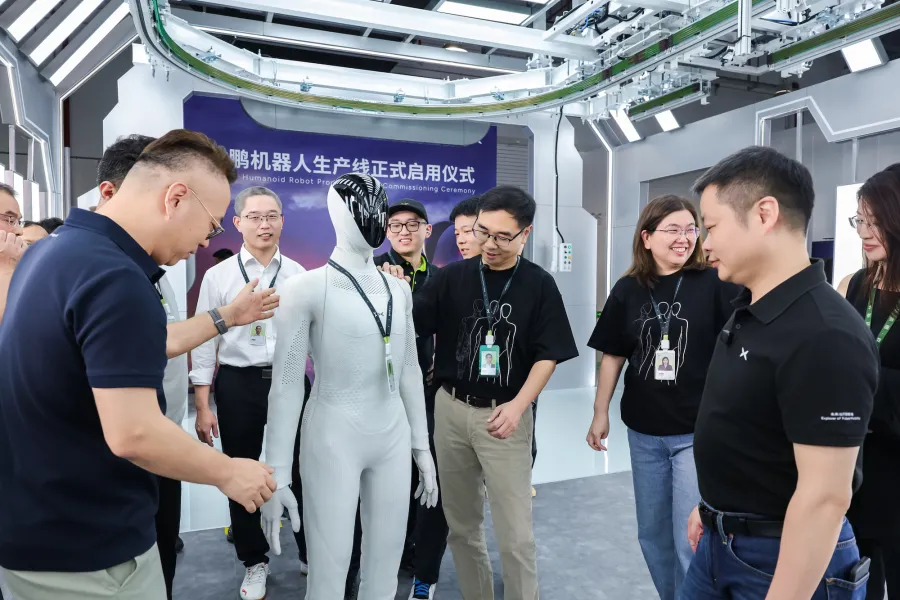
In the opening ceremony, he said that the production line of the machine is from zero creation, without precedent, and the next step is to continue to increase the production pace and manufacturing scale.
On August 24, the robotics business completed its first round of equity financing in excess of $900 million, with an after-tax valuation of over $6.3 billion, IDG Capital Holdings, High-Level Investments, Tencent, and Alibaba entered two strategic investors. According to the company's disclosure, fundraising invested in software hardware research and development, physical AI model training, high-quality data collection, full-chain production base construction and global commercialisation expansion.
The deadline also set for MIRON to enter mass production by the end of 2026, and to be delivered to Chinese and overseas markets in 2027.
He also revealed that more than 85 percent of the supply chain companies that work with the robotics company are overlapping with the small car, which is why the production line is able to directly move the vehicle-level process.
05.
All the shops and steel factories are in line, why did IRON go to the shops first?
According to official plans, IRON's first retail stores and parks are hosting, guiding and shopping. The company's published quarterly results show that as of June 30, 2026, the company's physical sales network comprises a total of 740 stores, covering 257 cities.
The use of the 0.2-second capability in this scenario is straightforward: when the customer turns his hand towards the robot in a certain direction, the robot does not have to wait for the whole set of gestures to be re-judged.
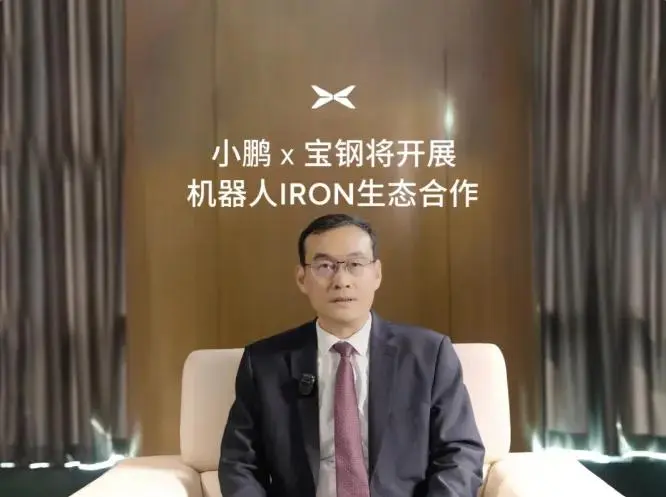
The second line of examination is in the industrial field. Iron Steel has been signed as an ecological partner of the IRON project, and the official statement is that IRON will be located in Iron Steel, exploring the application scenarios and transforming evolution in complex industrial fields such as inspections.
The two roles in the official calibre are different, and the previous sequence follows: on the other side of the store is a landing strip, IRON enters to take on the role of welcoming, guiding, importing the three positions already listed; on the other side of Baoh Steel is a strip entering the peninsula to explore the strip, belonging to both sides to verify the border.
The technical difficulty of making a robot is at least 20 times greater than that of making a car, and he lists design and shaping, hardware and chips, software and AI, data and control, quality and manufacturing.
He believes that this upgrade changes the evaluation unit of interaction: from being unable to complete a set of pre-set movements to being able to keep up the pace in the process of contact with people.....................