In September 2026, the Chinese-controlled FUS-Neuro closed-loop ultrasonic brain-machine neural control system passed a medical device-like test, accelerating the entry into the clinical stages of multiple adaptations.
If you just look at the news, you might think: "Oh, another machine company has passed a type test".
But what really matters is more than that.
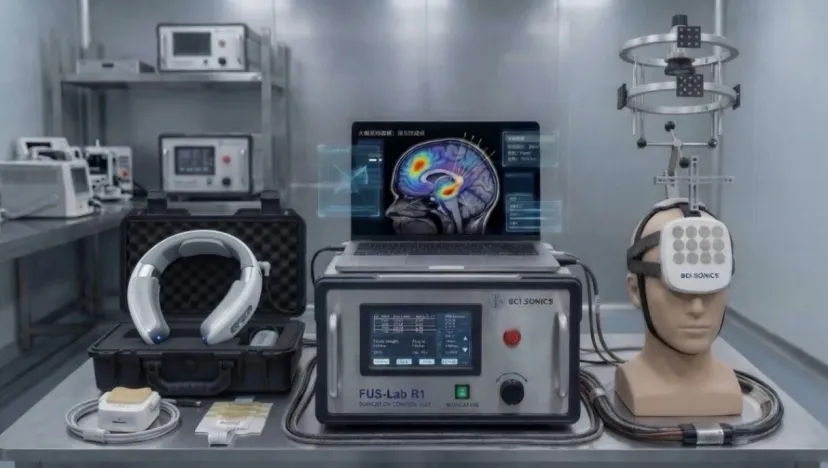
The company has never defined itself as a maker of ultrasonic brain-machine devices. Founder Li Yi's motto was: "The silicon device is just its current body, and NeuroAI is its soul".
NeuroAI is a Chinese supernatural-controlled intelligent technology system built on top of non-invasive ultrasonic brain machine systems that is responsible for reading, decoding, writing, and encoding brain cells into a customizable, iterative closed-loop platform.
It's not a brand slogan. It's behind a team that spent years, years and years, anticipating cross-disciplinary layouts, and that's the real reason that Huawei Superauthor has been able to build NeuroAI.
Why is this company doing this?
Non-invasive ultrasonic brains are a typical interdisciplinary project: you need to understand both acoustics, neuroscience, closed-loop control, AI algorithms, and medical device compliance.

The founding team of the Chinese supersonic control is not common in the industry. Founder Li Li, a co-educational Ph.D. from the Faculty of Medicine and the Fraunhoff Institute in Germany, and former head of the China division of GE Medical Global Research and Development Center, has long accumulated experience in the research and industrialization of medical imaging, ultrasound, AI and brain machine interfaces. The core team comes from Tsinghua University, Imperial Institute of Technology, Shanghai Transportation University, Zhejiang University, and others, covering neuroscience, acoustical engineering, intelligence, medical device engineering and commercialization, with complete experience in the transformation from principle sampling, engineering samples to clinical testing and registration.
Their choice was: not to build a narrative and recruit a complement, but to place interdisciplinary capabilities first and let the product emerge from the team.
NeuroAI is the product of this team. It's not a concept that was conceived in vain, but an engineering consensus that has been reached by acoustical engineers, neuroscientists and AI researchers after years of working together at the same table.
Platform vs. Equipment: What is the Difference
Traditional medical device logic: selling a device, the transaction ends.
The logic behind supernatural control is quite the opposite.
Each FUS-Neuro device is delivered not as an end point but as a new starting point. It carries not just a set of hardware, but a smart platform that can be continuously upgraded and evolved.
The value of a single device is a one-time delivery, but the value of the NeuroAI platform is continuous evolution.
Currently, the FUSLab research platform is open to universities to provide standardized ultrasonic brain machine experimentation tools for neuroscience laboratories. At the same time, the multi-center IIT is also cooperating in communication to further explore safety and potential adaptations.
NeuroAI's three-tiered capabilities
Level one: Acoustic computing engine. Input your cranial CT and focal coordinates, and NeuroAI calculates the optimal ultrasound input angles and parameter parameters. In the past, acoustic engineers computed offline for several hours and now compressed to the minute level.
Second layer: brain state recognition. Fusing fUS blood flow signals and EEG electrical signals to determine whether the current brain area is still, activated or abnormal.
Third layer: Parameter adaptive optimization. At the end of a stimulus, it automatically adjusts the next parameter to the expected effect and the actual effect. It forms a closed loop of read-resolve-write-review-modulation.
Every experiment is smarter than the last one.
True long-term difference: NeuroAI's own ability to evolve
Hardware can be tracked. Power switches with the same specifications, navigation with the same precision, and competing hands can always do it.
But one thing is hard to replicate: NeuroAI has accumulated experience in repeated interactions with real-life research scenarios.
Every co-creation with a doctor, every parametric optimization based on feedback, every engineering verification under real skeletal conditions - these are not things that can be replicated overnight. They come from the accumulation of hundreds of experiments, from the blending of the engineering team and the clinical team.
This accumulated experience of repeated verification in real-world scenarios is the hardest part of NeuroAI to replicate.
Maintaining restraint: Platform narratives also need boundaries
NeuroAI is currently the main service of the scientific research scene, and its role in clinical assistance decision-making is still in the early stages of exploration. Adaptation has not yet been locked in, and its effectiveness requires rigorous clinical trials to be verified.
The Chinese super-god is very clear about this. Li Feng often says: Well, we're just going to grow NeuroAI, and the rest, we're going to give it to ourselves.
It's not romanticism, it's engineering pragmatism - build the platform, validate the technology, turn the steering wheel, and time will tell what shape it will eventually take.
The end.
There's no shortage of beautiful hardware parameters in the brain interface industry. But there's a more difficult question that few people seriously answer: What happens after connecting to the brain?
Huawei has chosen a slower route: first building a cross-disciplinary team, then building a hardware base, and then continuing to refine the technology in collaboration with doctors and researchers to allow NeuroAI to continue to evolve in the process.
Type testing is just a milestone on this path. The real turning point is to wait until NeuroAI has spoken to enough brains.
By then, what we are discussing will no longer be a device, but an intelligent platform that is studying the human brain.
© THE