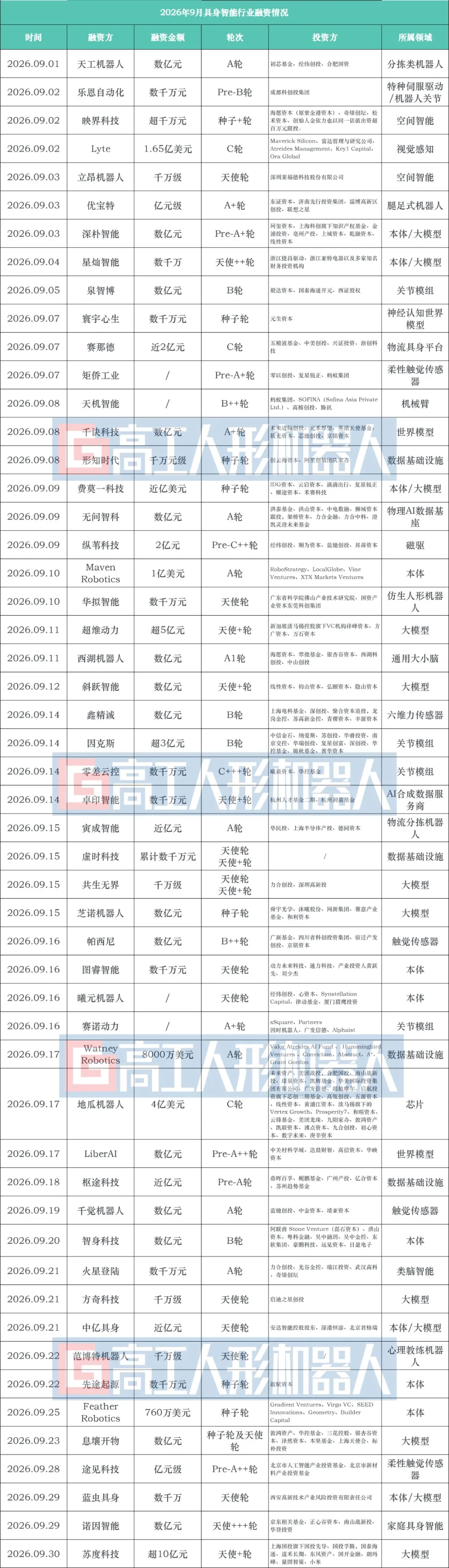
Of these, four came from overseas enterprises, totaling about $352.6 billion (about 2.4 billion yuan); the remaining 48 came from domestic China, totaling about 11 billion yuan.
If the timeline is extended, in the first nine months of 2026, there were 437 accumulated financing events in the smart industry, totalling about 2032 billion yuan. Compared to the same period in 2025, the number of financing events increased by 146.07% and the cumulative amount increased by 317.39% respectively.
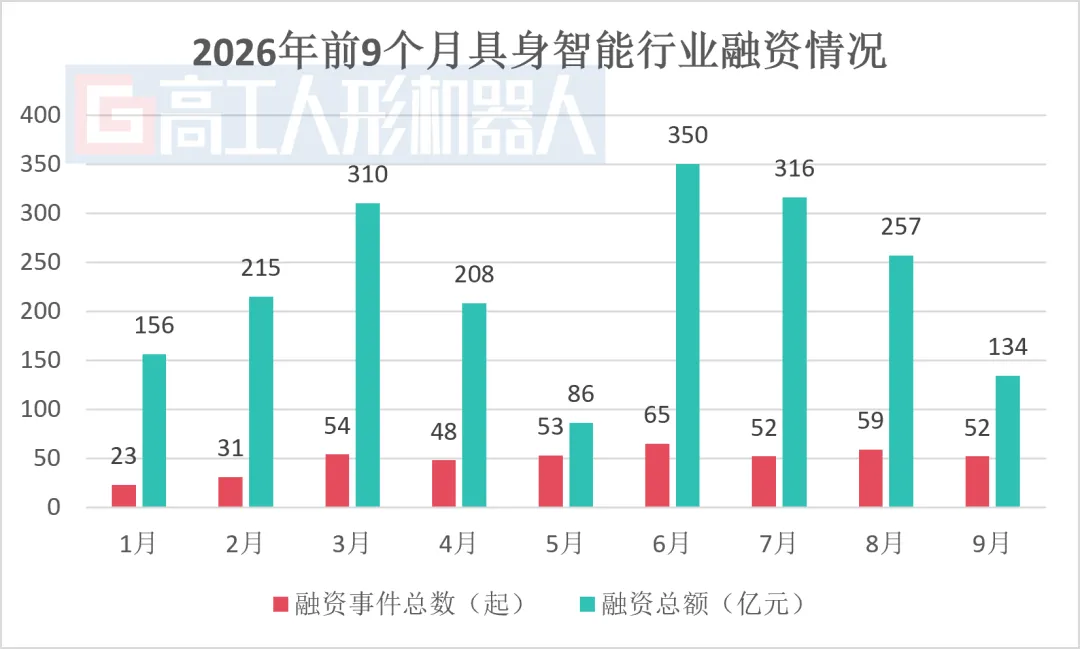
From the standpoint of the pillar chart, the number of monthly financing events after March this year varies little, but the amount fluctuates significantly. The reason may be that the main enterprises will concentrate on releasing large amounts of financing abroad at some point in time to seize market volume.
Who gets the most money?
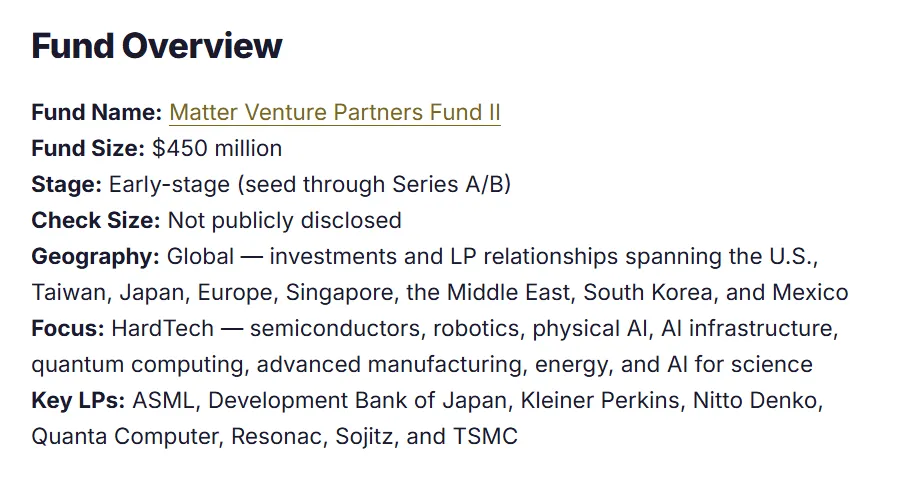
The semiconductor, robotics, physical AI and AI infrastructures covered by the Matter Venture Partners II Fund have been directly reflected in recent corporate intelligence industry financing.
Especially in upstream semiconductor connections, not only is capital in favour of underlying computing and motion control chips, but terminal manufacturers have also begun to lay out chip connections.
Just yesterday, China-based RISC-V chip enterprise Core Unlimited announced the completion of its Pre-A round of financing.
This round of financing is being jointly invested by the China Robotics Joint Automotive Innovation Center in Anhui Province, state-owned shareholding, Hubei Baocheng River Investments and other institutions.
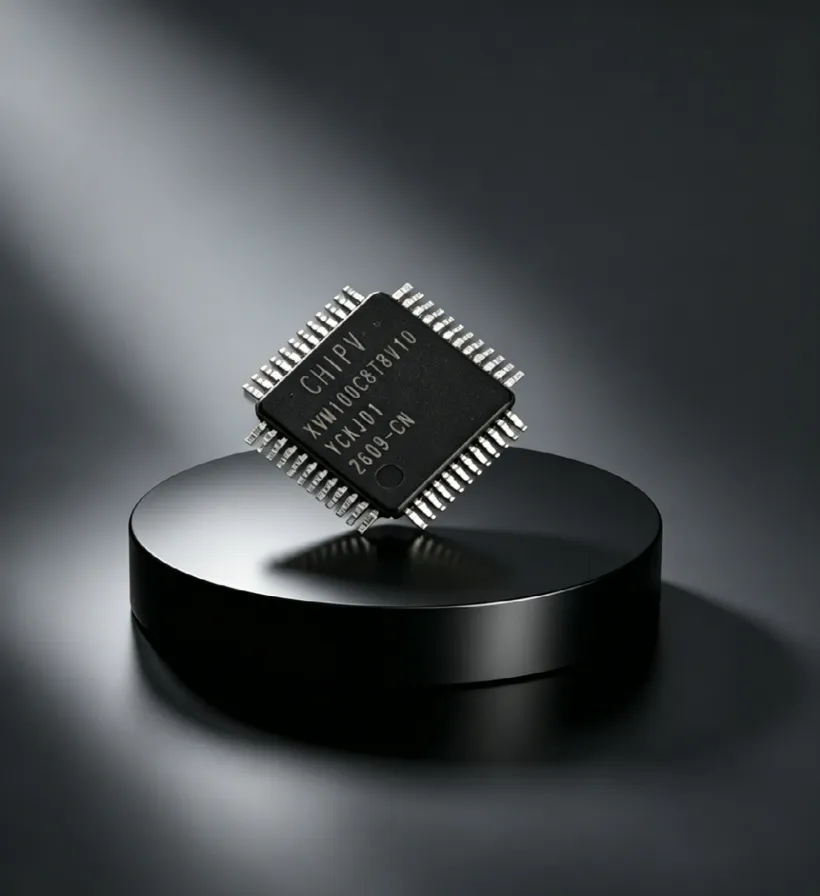
Source: Unlimited between the cores
A month ago, two chip companies completed two financing projects totaling 3.6 billion yuan, and Guwahati Robot was the largest company to do so in September.
On September 17, Giveaway Robot announced the completion of its $400 million (approximately RMB2.67 billion) C round of financing. This round of financing is aimed at strengthening the full-calculation product line-up of the chip, building a full-chain software platform that integrates data collection, model training, simulation verification, and rational deployment to meet the needs of the full-scenario development of robots from mature models to general-purpose humanoid robots, enabling robot models to explode.
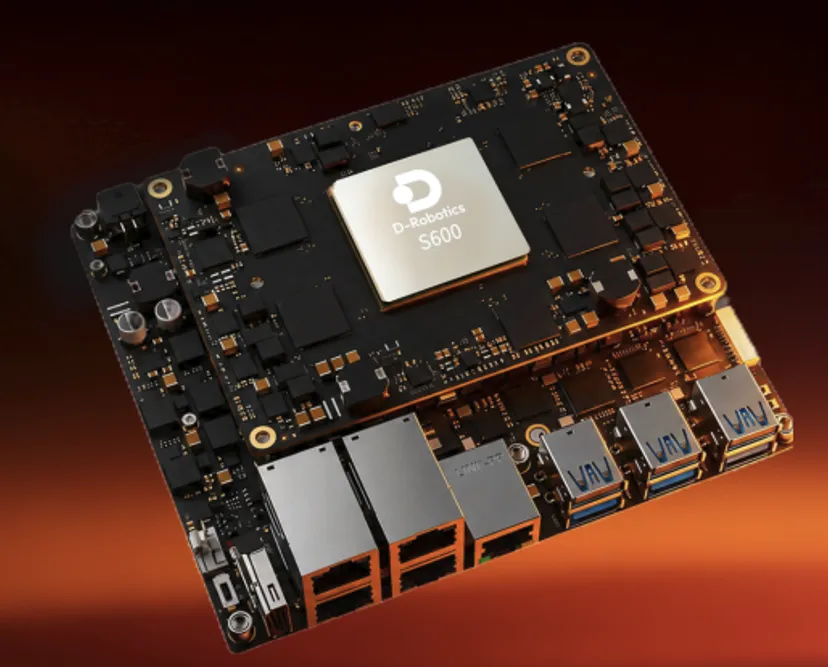
It's the first time I've ever heard of this.
On September 21, CoreX Technologies announced the completion of the C+ and C++ rounds of financing, which will be completed in 2026, at a cost of about 1 billion yuan.
The purpose of this round of funding is to accelerate the expansion of vehicle-specific product capabilities to smart terminal scenarios such as physical intelligence, and to deepen the cross-scenario technology layout.
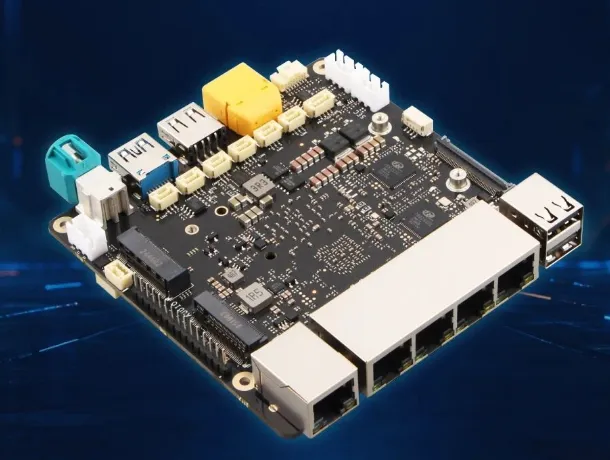
Source: Chernobyl technology
Clearly, the intersection of semiconductors and Physical AI is one of the real landmarks of the market's move upstream to the industrial chain on the trajectory of physical intelligence. Chip demand is not tied to the success of a single parent manufacturer, but to the process by which the entire physical intelligence industry moves from samples to mass production.
The certainty of mass production is far greater than the certainty of a particular brand's victory.
If the key to financial capital is the cross-cyclical certainty of a win-win chip chain, then as the maker of the system, the investment chip is paying in advance for its own computational card points on its quantitative output path, supply chain security and product definition rights, upgrading experimental cooperation to capital-level deep binding, moving from passive procurement to actively locking supply.
It can be said that the most interesting aspect of the September smart finance reset is not the ups and downs of the funding amount, but that the chip link is being added.
In terms of products, media statistics show that the UK's Jetson Thor, Qualcomm's Dragonwing IQ10, the S600, the R1 chip, the Black Sesame Intelligent SesameX, the Ideal Mach M100, and the Small Turing chip are all approaching physical intelligence from different directions.
Currently, the volume of shipments of robotic chips is rising, not specifically tailored robotic chips, but a general scheme derived from the migration of consumer electronics, automotive electronics.
The mainstream input path for computing chips is the conversion and reuse of self-driving chips, both of which are highly interconnected in underlying technology, and can be directly migrated through multiple-sensor convergence, asymmetric NPU reasoning, and real-time operating systems.
The High Artificial Robot Editor believes that it is not the best time for chip companies to launch robot-specific chips because the industry is small, the path of technology is not unified, there are no recognized optimal standards, and the adaptability of general chips is better suited to address the uncertainty of the next generation of algorithms.
An all-new dedicated AI chip can be adapted from architectural design to tool chains, and the full cycle can last up to two to three years at the earliest, while smart-scale deployments take only two to three years.
Overall, the capital betting chips, in an uncertain but irreversible window period of industrialization direction, chose a more definite cutting path.
The demand for physically intelligent chips is not enough in the general-purpose chipset, the special-purpose chipset is not mature enough in the middle of the chipset, replication is the current reality, customization is an ongoing trend, but the scale-down of special-purpose chips still needs to wait for a rapid increase in the volume of machine deliveries.
16 start-ups have completed financing in the last two months
At the same time, a total of seven startups founded in 2026 completed their financing in September, accounting for about 13.5 percent of the total number of financing events that month - mapping technology, FEMO technology, leaping intelligence, hybrid robots, fancy technology, half a billion pieces of furniture and landfills.
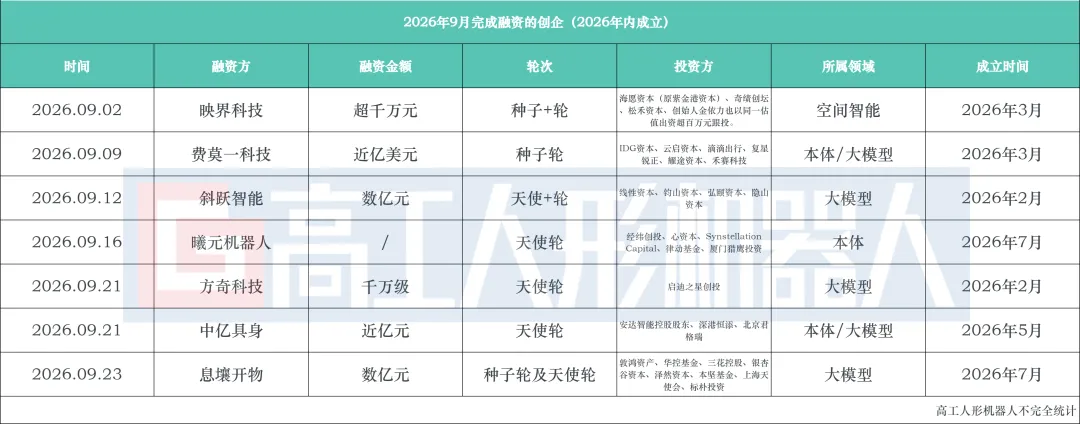
Although these new ventures are not growing at the moment, they are not small in size.
Among them, the founding team of FEMO One Technology, Sliding Intelligence is mainly made up of intelligent executives, and FEMO One Technology plans to make humanoid robots into large models, its founder started as a technical partner, vice president, and director in Marche; Sliding Intelligence is more focused on the field of large models, and was founded jointly by former AI chief scientist Chen Wei and former product line president Zhang Liu.
Li Li graduated from Tsinghua University, served as CTO of Huawei Cloud Models, Minister of Big Models Development in the Huawei Cloud Industry, was a core member of Huawei Big Models from 0 to 1, and has led many of the country's smart innovation centers in the local industry.
In September, the company announced that it would sell its robotics related business and assets to the company. After the transaction, the company will become one of the parts suppliers to the company, and the robotics business will become independent.
MLM is a newly established subsidiary of the MLM Group, which has not yet disclosed details about its business focus.
The other two companies, founded by Ph.D. student Qinghua, focus on the field of big models; the latter three are from the Mila Institute in Montreal, focusing on the field of space intelligence.
A total of nine startups completed the financing in August, accounting for about 13.5% of the total.
On the one hand, the majority of startups founded this year in August and September were officially announced to have achieved great results, officially competing in the smart industry; on the other hand, these enterprises are spread across different branches of the industrial chain, human robots themselves are no longer the focus of competition, and new entrants tend to cut into fewer branches from competitors, or take a place on less common technological routes.
In other words, this year's startups need to make their first appearance as soon as possible, and public financing is not a pass, but a rare opportunity to speak out, to let the outside world know who they are, where they stand in the industry chain, which technological path they are on, and why they will be remembered by the players.
Written at the end
The year 2026 is entering the final quarter, and this article is also the ninth edition of this year's smart industry finance document. So far, perhaps it's time to ask: Will capital logic change by 2027?