Whether an end-to-end VLA (Vision-Language-Action) program can be the best answer is up for debate. But as AI's large-scale modeling capabilities increase, AI's ultimate move is becoming a possible pathway for Anthropic's newly released MHS protocol, which is a reflection of this trend.
The idea was first put into practice by Naikkai Microelectronics: by taking a few simple steps, large models can identify devices and make adaptive crawling.
01.
Using AI to complete device recognition and control
Traditional industrial and scientific coding requires that engineers are familiar with proprietary communication protocols, manually match string parameters, repeat coding instruction formats, and spend a lot of time at the interface adaptation level rather than the core crawling functionality verification.
The tri-dimensional tactile sensing capability of the TG-9801 controls the deep fusion of the three-dimensional touch sensing capability with the big model dialogue, and after connecting the claw, the instructions can be sent directly to the AI through natural language, whether it is to query the state of the device, control the claw opening, or start the adaptive clawing process.
This model significantly reduces the usage threshold for end-user implementers, freeing researchers and systems integration engineers from the burdens of interfacing debugging, and focusing on capturing scenario verification and algorithmic iteration, significantly shortening the R&D and project integration cycle.
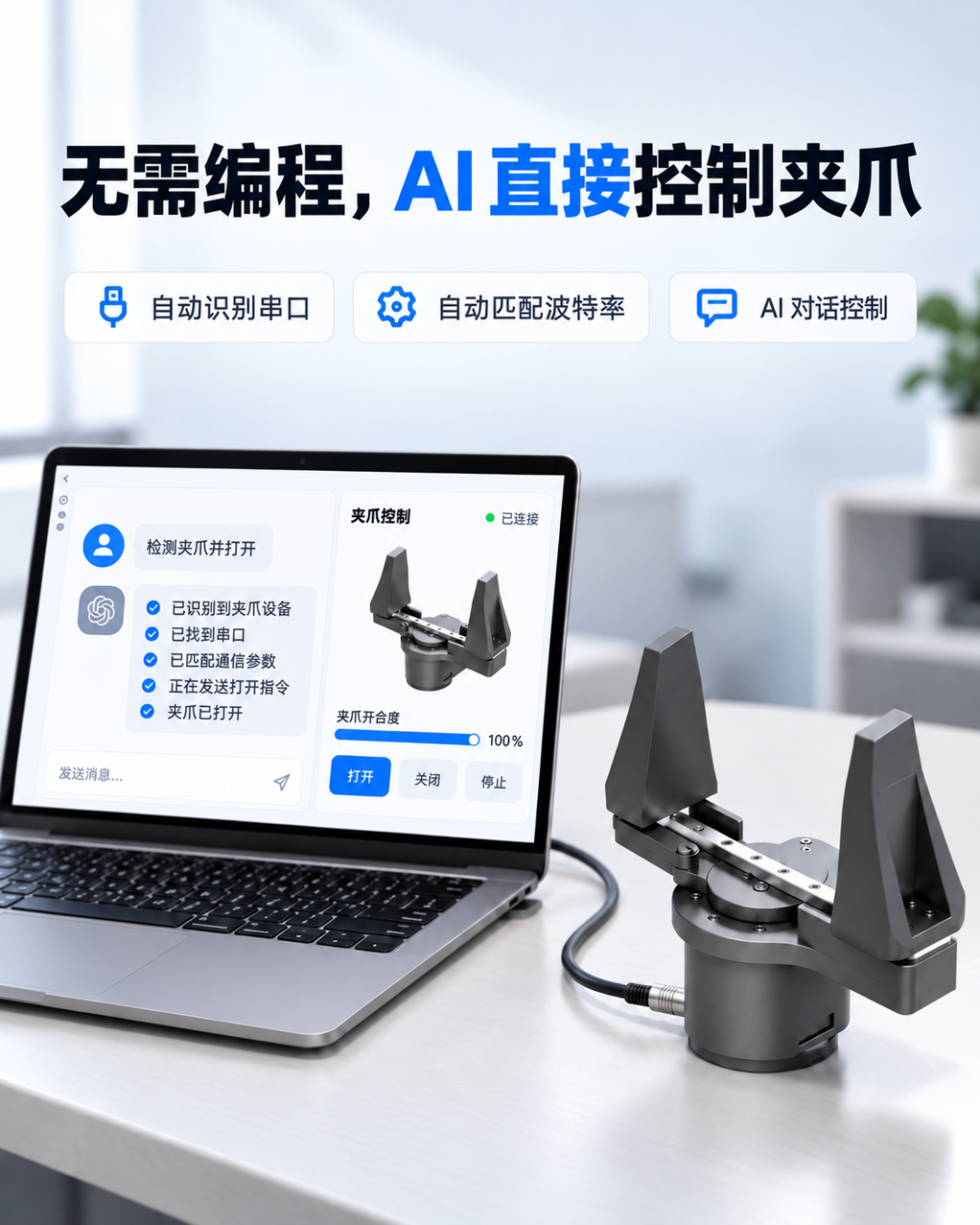
Device recognition and dialogue control signals
02.
Connecting and controlling with dialogue
After completing the physical connection of the claw to the communication adapter and accessing the device tools, the user can complete the entire process operation from device detection to execution of instructions only through natural language dialogue, the core of which can be divided into three typical application scenarios:
1 Find the equipment
A.I. Calling device tools to search for strings, detect port rates according to supported configurations, read device information and confirm connections, and minimize manual screening of communication parameters.
2 Read the status
AI reads online status, communication parameters, motion status, control mode and current location, and the data returned by the interface is organized into text for checking and debugging.
3 Follow the instructions
The input valve opens the valve valve, or valve with lower grip strength and speed, to adapt to grab the object valve. The AI will require the parameters and movements to be converted into the interface support, performed by the valve controller. The specific force values and speed can be set according to the requirements of the workpiece.
The dialog is responsible for expressing the operational intention, and the device controller is responsible for the execution of movements and the adjustment of tactile feedback.
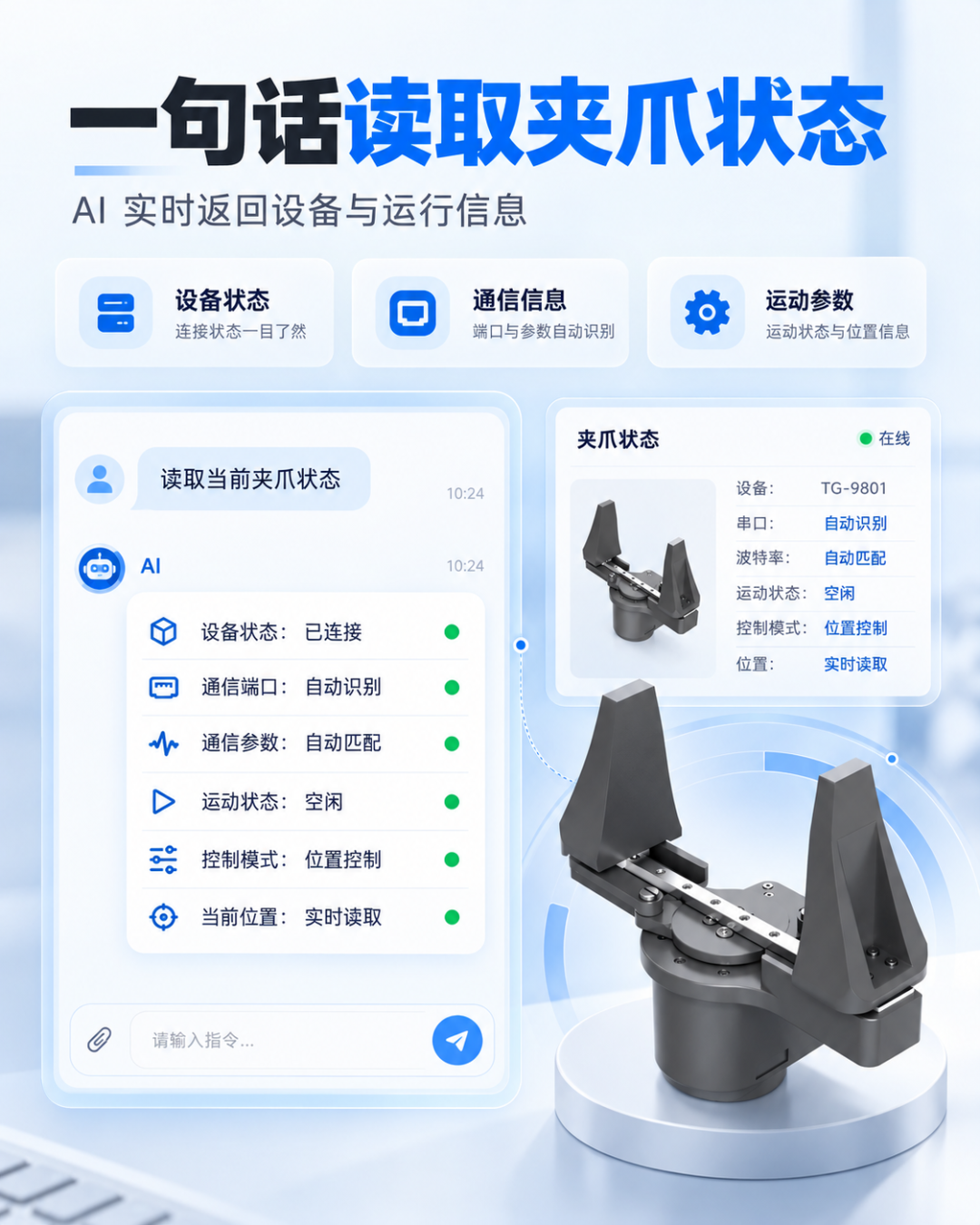
Talk about the status of your claws
03.
Visual Capture Provides Calling Ends
Currently, the Visual Language Action Model (VLA) has the ability to convert images and language instructions into robotic actions, and the large model calls hardware devices; the technical path to coordinate multi-module tasks is also in high-speed maturity. Gemini Robotics 2 uses both physical reasoning and action models, while Anthropic's MHS explores unified device access, hoping to become the MCP of the physical world.[2][3]
The communication control logic of the TG-9801 is designed along the lines of the call-to-call model tool. In a complete visual grappling scheme, the product can serve as a standardized touch execution end, forming a modular division with the visual system and the mechanical arm: the visual system is responsible for target identification and spatial positioning, the mechanical arm is responsible for route planning and movement, and the claw is responsible for final grappling execution, and by tactile feedback real-time regulation. This module architecture not only facilitates step-by-step regulation, but also supports flexible replacement and upgrading of each node.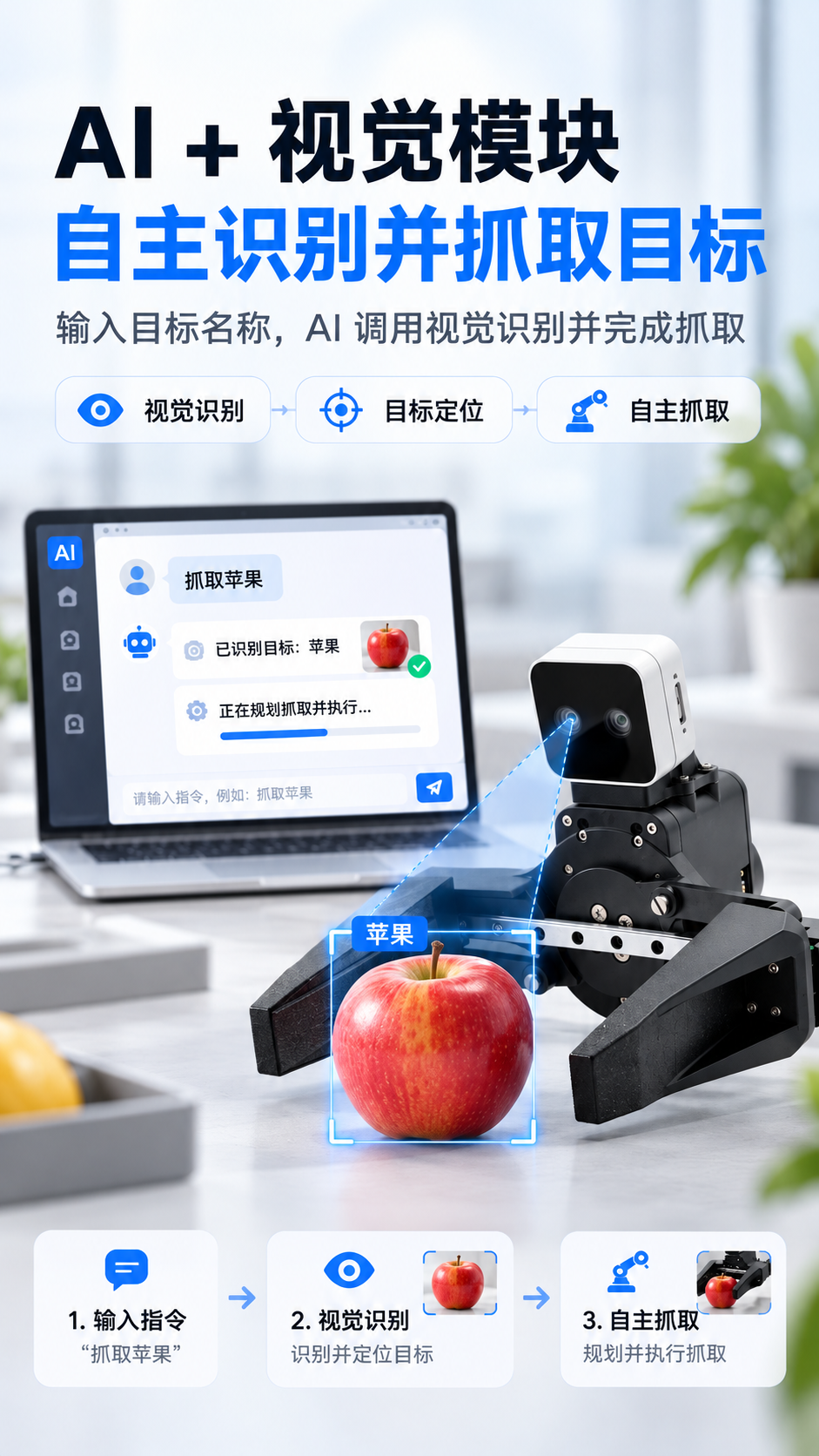
Application concepts for connecting vision and mechanical arms to complete system integration and verification
From the perspective of industry development, one of the key bottlenecks of robotic generalization is the barrier to the cost of adaptation and interaction of the end-user. The AI-Ready design of the TG-9801 is essentially to inject the natural language interaction capabilities of large models into the end-user hardware, providing a rapidly verifiable touch carrier for the deployment of the VLA program.
Sources of information
[1] Product information for the HKVR-TG 9801 series of aircraft
Google DeepMind Gemini Robotics 2 is scheduled for release on July 30, 2026.
[3] Anthropic Model Hardware Standard research preview is scheduled for August 27, 2026.