Just let the AI fix a bug, and it might go through the cracks, find a whole bunch of problems behind it, and even actively ask you: Shouldn't we work together?
This kind of AI could be coming soon.
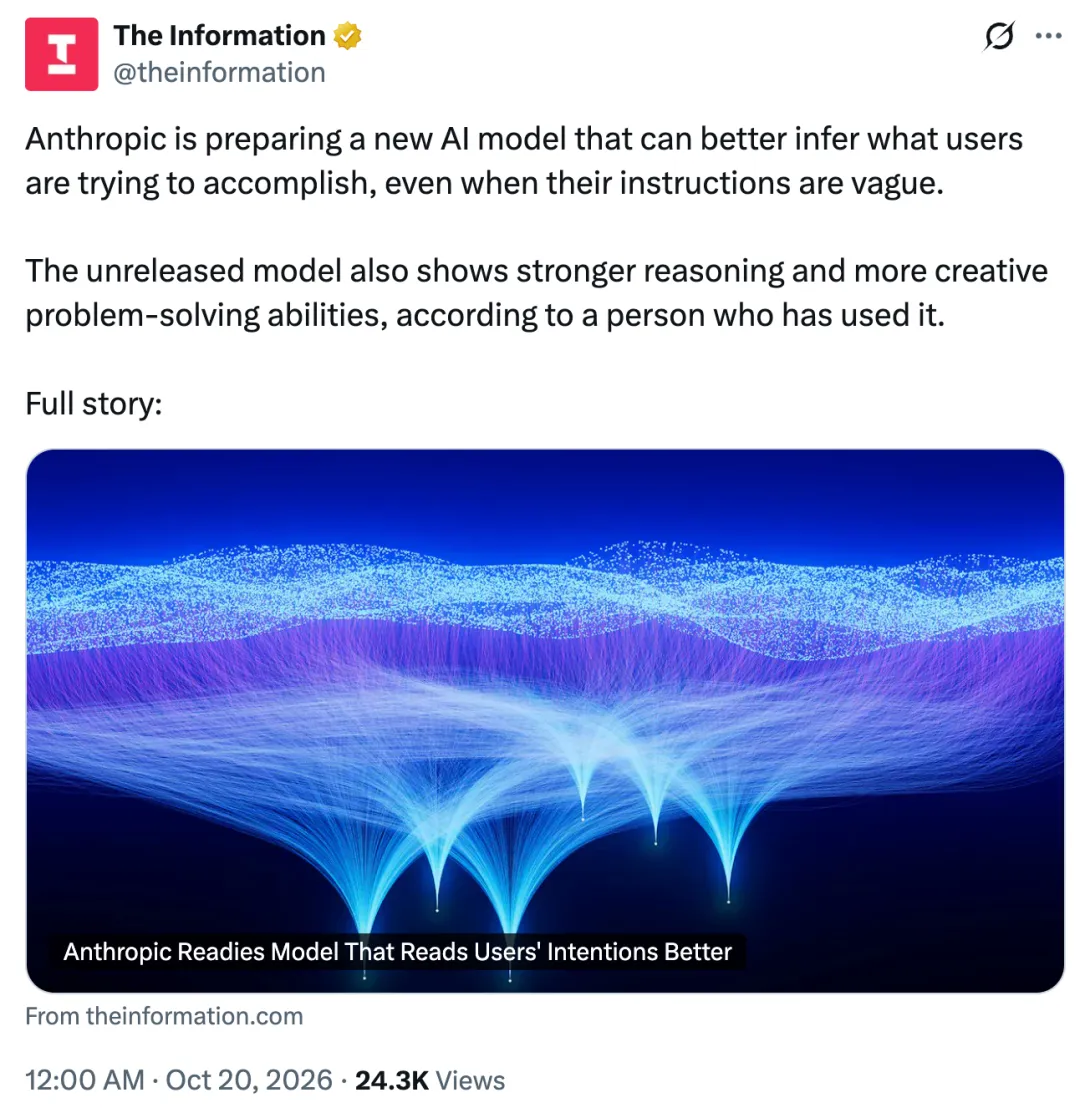
According to The Information's latest rumours, Anthropic is preparing to launch a new model with reasoning and intuitive judgment that is said to surpass all commercially available Anthropic models.
Some speculate that it is Claude Fable 5.5 or Opus 5.6.
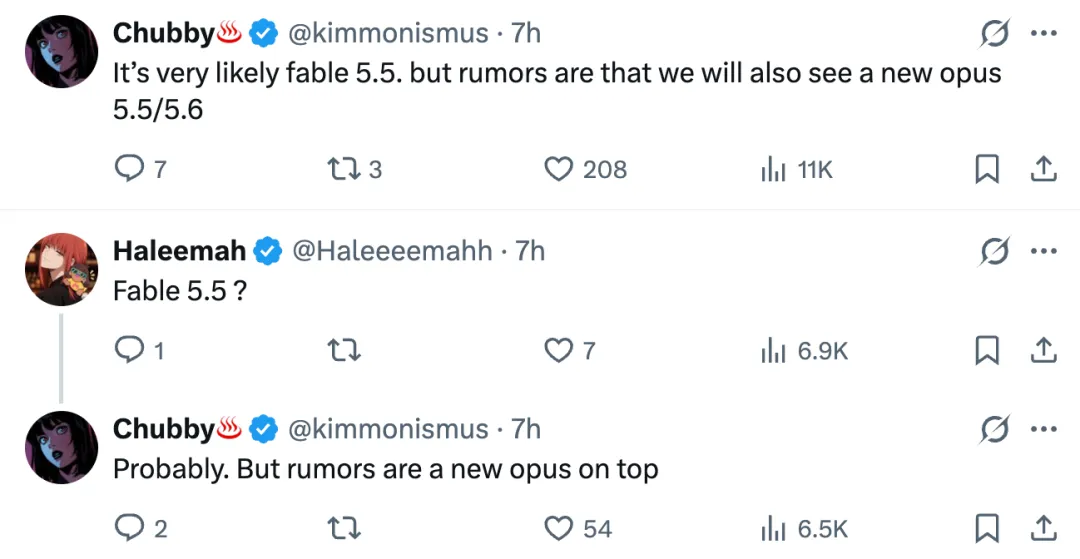
More interestingly, the model seems particularly good at understanding the user's intention to export without explicitly stating that the user only gives limited information, without switching the end goal, and the new model may also infer what the user really wants to accomplish and come up with a more in-depth solution.
The above information comes from a person who has already tried the model. Currently, the model has not been officially released by Anthropic and its specific name, release date and evaluation results remain unknown.
At the same time, The Information also revealed two other news: Google is developing a new model, code-named Gemini 4 Carbon, and OpenAI plans to launch a new product that could be part of the Terra series in the coming weeks.
Anthropic New model
Starting to actively understand user intentions
According to The Information, one experimenter believes that the new model that Anthropic is about to launch is already outperforming the company's current commercial models in terms of reasoning and intuitive judgement. One of the highlights is its ability to infer deeper goals from simple user instructions.
A programming scene was reported.
If a user requests a model to fix a bug, the new model may, in the process of checking the code, further identify an entire underlying problem that causes the bug. After the problem is discovered, it may also actively ask the user whether it is necessary to fix the same problem together.
It is worth noting that this is a hypothetical scenario where the experimenter is used to explain the model's capabilities, and the report does not reveal the actual test results accordingly. But this example is indeed interesting. Currently, when using AI programming tools, developers often need to repeatedly add instructions. For example, first let the model fix an error, then ask to check if other files have similar problems, and finally arrange a return test.
If the model is able to actively detect the correlations between problems, developers have the opportunity to reduce these back-and-forth communications. Especially in large code libraries, the same underlying problems may occur repeatedly in different modules. If the model only corrects the immediate reporting, similar failures are likely to occur again. Of course, finding similar problems is only the first step. It also requires accurate judgement of the scope to avoid modifying the normally running code.
Another example comes from stock investing.
According to the experimenters, if users ask how to invest in stocks, traditional models may give common indicators such as market interest rates, as well as some more general suggestions. New models may jump out of conventional thinking and come up with more creative algorithms on their own to try to predict the future performance of stocks.
Both examples point to the same characteristic: in the face of user questions, the new model may further analyze the goals behind the problem and attempt to find a more complete solution.
This ability is particularly important for AI programming and Agent tasks. In complex tasks, users often only describe the results they want to achieve, without listing all the execution steps in advance. Models need to check the environment, locate problems themselves, and follow-up actions based on information they find in the middle. If they can more accurately grasp the user's intentions, the model has the opportunity to reduce repetitive test errors in the execution process.
However, at present, these capabilities are described mainly by a tester. The performance of the new model in real projects, and how much it has improved compared to the existing Claude model, have not been publicly verified.
Google, OpenAI, and new models are on the way.
While Anthropic is preparing to update the model, neither Google nor OpenAI are staring.
On October 14, Google officially expanded the open range of its flagship model, the Gemini 4 Argon, to be available to developers, businesses, and consumers worldwide. The model has previously been open to some cybersecurity defenders. Argon primarily focuses on complex tasks such as programming, finance, law, cybersecurity, and scientific research.
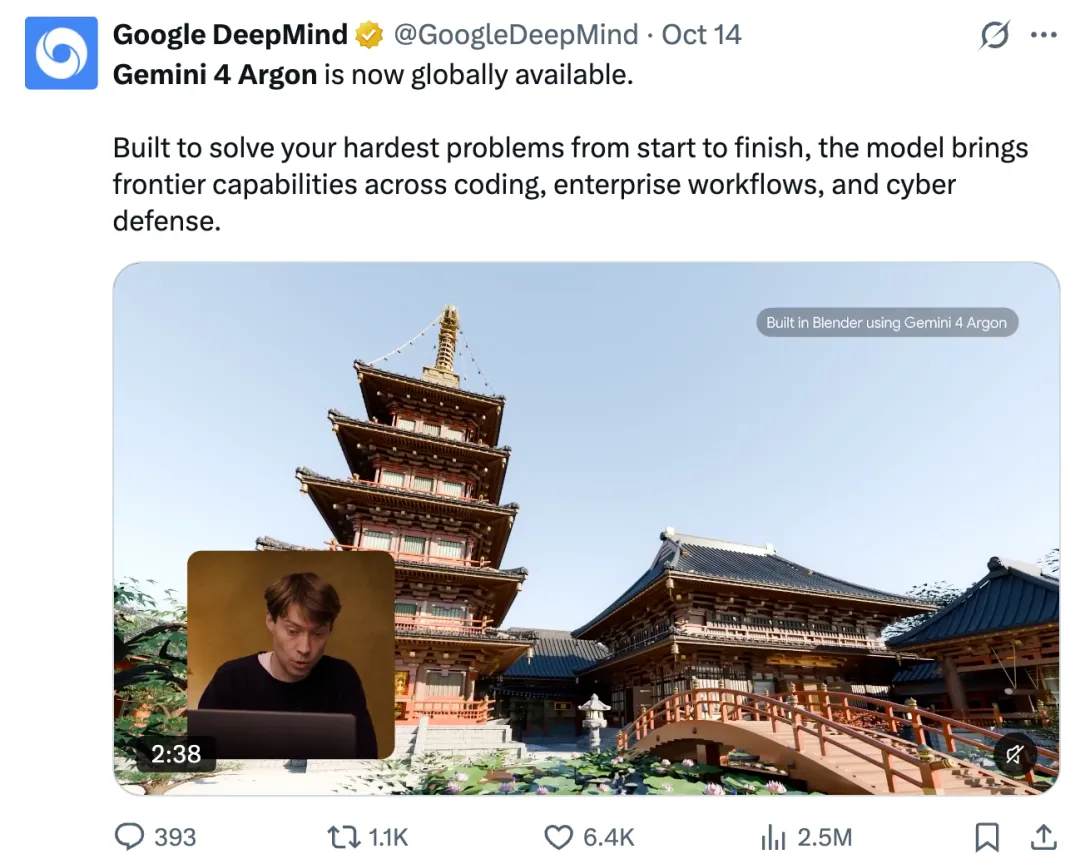
According to sources familiar with The Information, Google is working on the next model, the Gemini 4 Carbon. Carbon is said to be even more advanced than Argon, but no performance data has yet been released.
The report also mentions an advantage of Gemini. Argon does not appear to have surpassed the top models of Anthropic and OpenAI in its overall capabilities. However, some developers have told the media that Gemini still performs well in tasks that require visual understanding, such as analyzing video content, or checking for website functionality.
The Information also speculates that Google has large amounts of YouTube video data that may help with this capability. However, the report does not prove a direct causal relationship between the two.
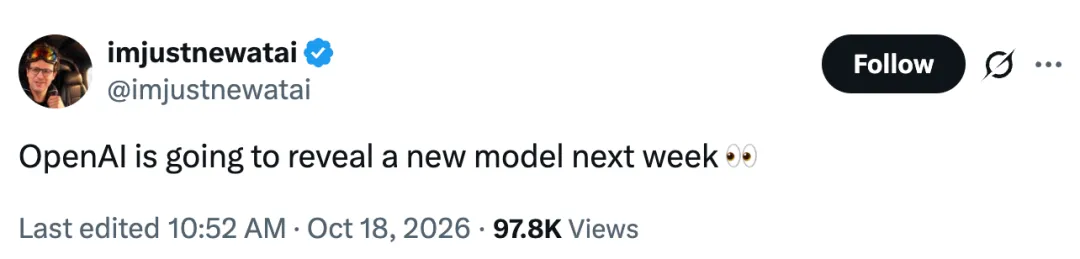
On the other hand, OpenAI is also preparing to continue updating the product line. According to sources, OpenAI is expected to launch a new model in the coming weeks, most likely a new version of the Terra series. Terra is located between Sol and Luna and belongs to the mid-range product line of OpenAI. This new model is expected to have further enhanced capabilities, while the price will be lower than the previously released GPT-6.1 Sol.
From a product positioning perspective, OpenAI is still trying to cover more development needs with different performance models, at different prices. For applications that require a large number of call models, the cost of reasoning often directly affects whether a product can scale. Even if a model does not achieve flagship performance, it is equally attractive as long as it can complete enough tasks at a lower price.
It is also worth noting that another heavyweight model is in the works for OpenAI. The Information previously reported that the unreleased model involves technology related to the Circular Transformer, and the team is still dealing with safety and security risks to avoid major problems after the model's release.
According to these reports, several leading manufacturers are preparing for the next round of model updates. There is still a lot of uncertainty about the exact release date, performance improvement and final product placement.
When AI started "thinking step by step"
Returning to Anthropic, the most notable of these outbursts is the potential change in the way the model handles tasks.
Using programming as an example. The developer allows the AI to fix a bug, which appears to be a very clear task. But the real goal is usually to restore the program to normal operation and prevent similar errors from occurring again.
In the past, developers often had to introduce these requirements gradually to the model by adding hints. If Anthropic's new model did, as described by the experimenter, actively detect similar problems and ask whether to extend the scope of repair, it would be able to handle more of the screening work that originally required the developer to do personally.
This change can make more sense in a more complex Agent scenario. When a user asks AI to analyze the reasons for a decline in a business indicator, the model may need to first examine the data and then phase out the relevant factors. If it is able to actively detect the link between the abnormalities, it has the opportunity to continue analyzing along new leads, reducing the number of repetitive user hints.
But there's also a real-world problem here: the model's inferred targets aren't necessarily what the user really wants. Developers may only want to fix an emergency fault on the line and don't intend to modify the entire project immediately. Even if the model finds a broader problem, they need to first confirm whether the user is willing to take the risk of additional modification. Similarly, in situations like investing, finance, the model requires the user to confirm its targets, constraints and risk preferences even when it presents a more complex analysis.
Whether or not accurate inference of user intent, and under what circumstances actively seeking user feedback, will directly affect the actual value of such a capability.
There is currently no evidence that the new model of Anthropic has solved these problems. However, from the example provided by the experimenters, it shows at least one desirable direction: after receiving the mission, attempts to further determine whether the problems ahead are related to a deeper goal.
For developers who increasingly rely on AI Agent to complete complex tasks, this could lead to quite an intuitive change in the experience. To what extent Anthropic will ultimately be able to accomplish this capability, we'll have to wait until the new model is officially released to see how it performs in real-world tasks.
The link is as follows:

© THE