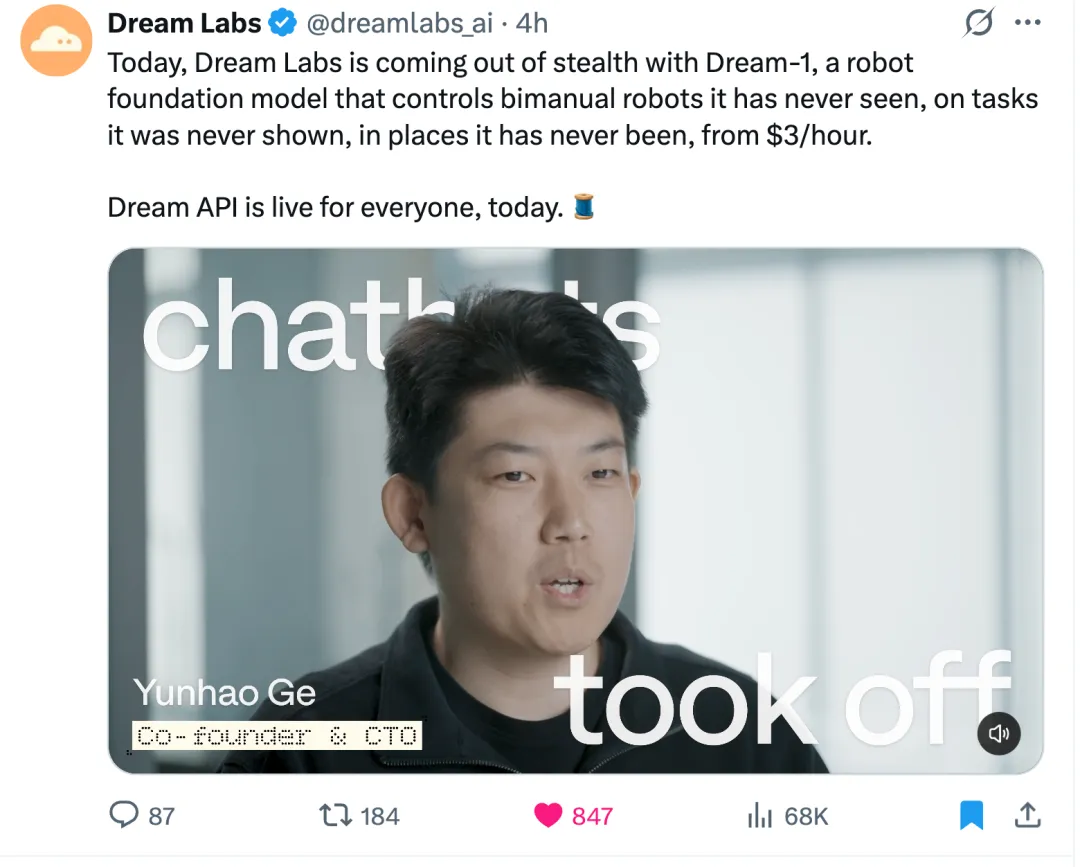
Today, Dream Labs, founded by the DreamZero team, officially closed its secrecy, announcing the completion of a $90 million seed round of financing, while launching the Dream API: the world's first open-source robotic brain API.
This means that anyone can access the Dream API to their own robot, providing only natural language instructions, and the Dream API can generate the corresponding motor control instructions to enable the robot to perform tasks. More importantly, it can also adapt to robots never seen before in training.
More than 20 hardware manufacturers have joined the partnership.
In February this year, a team from Ingrid presented the World Action Model (WAM), which is now one of the hottest routes for physical intelligence.
The Dream API is backed by Dream Labs' first model, Dream-1, which can control robots in real time, in a closed loop. Developers can access this capability to their own robots without a machine learning background, for just $3 per hour. Anyone can go to dreamlabs.ai and try it out.
The Dream-1 campaign
It's the first time that I've ever been in a dream lab.
This round of funding was led by B Capital, Kindred Ventures, A Capital, Unusual Ventures, SV Angel, Wing VC, Scribble VC and Adrian Aoun.
Robots lack a common brain
There are a record 5 million industrial robots operating in factories around the world, but almost all of them are programmed for a single task, and what they learn cannot be transferred to another machine.
At the same time, robotic hardware is rapidly becoming cheaper: a set of two-armed mechanical arms costs around $2,000, and semi-automatic robots under $15,000 are becoming more and more common. But these robots have almost no "brains" when they come out of the factory.
The rapid adoption of chatbots is driven by a general model that anyone can use on a computer or a mobile phone.Combined with zero-sample generalized models, we can turn the data wheel: robots will be useful sooner, more people will use them, more data will be generated, and models will be better.
Dream API: Open to the brains of all robots
In the past, people who wanted robots to use a basic model often had to train themselves or work in-depth with manufacturers. The Dream API was the world's first open-source robot model API: developers can connect robots to the API after registration. The model is deployed in multiple data centers around the world and robots can respond quickly anywhere.
There are two other supporting services around the Dream API:
FaaS: Encounters with unsupported hardware or new tasks, developers and robot manufacturers submit a small amount of demo data and can get customized models in a matter of hours. For a new robot, a five-minute trajectory is enough to complete the adaptation.There are 10 Language following scoresHe's been promoted.
Robot Playground: Without having to buy a robot, you can open the browser and follow the instructions of the real robot in the San Francisco office of Dream Labs and watch its reactions in real time without completely clicking it.
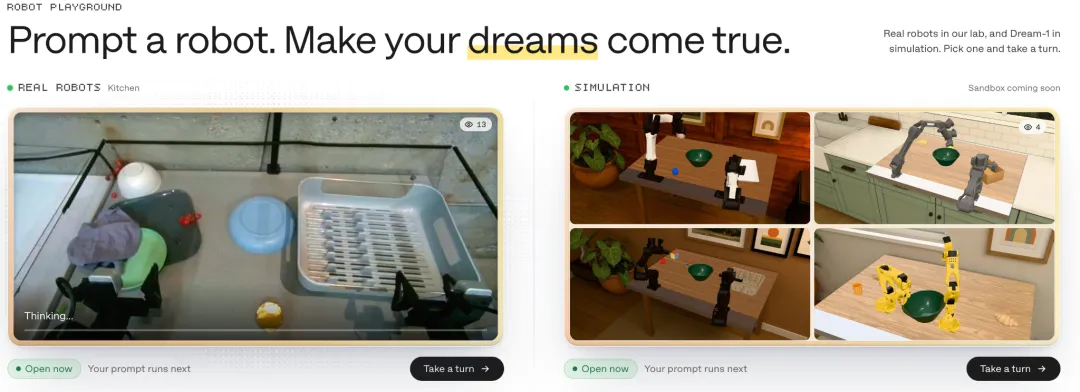
In terms of price, in addition to the Dream-1, which costs $3 per hour, there is also the faster and lighter Dream-1-flash, which costs $2 per hour.
"Just like the first public release of ChatGPT, robots have finally come up with the first general-brain API open to the public. It may not be perfect, but someone always needs to take the first step", said Green, co-founder and CTO of Dream Labs.
Dream-1: Learning from the video
Dream-1 can work on robots from different manufacturers. It is trained on videos of people completing their daily tasks, learning to predict what will happen next, and then deciding what the robot should do accordingly. Because it learns from video rather than from a machine, the ability to learn can be transferred between different hardware.
Joel Jang, co-founder and CEO of Dream Labs, gives an example: "You get into a rented car, you don't have to re-learn to drive, you don't have to find a controller, and your past driving experience will do the rest.
He told the machine's heart: "The world's action model learns to predict both video and action at the same time, so 'control a robot' and 'imagine what this robot will do next' become the same problem. And in the head camera's view, any robot is just a shape that moves in the image, and video is a representation that all robots share. As long as the model can predict how a new robot will perform a task, it can generate the movements that will get the robot there".
Robots that haven't been seen before, tasks that haven't been taught before, can do zero-sampling.
In the simulation, the team evaluated 27 previously unseen Dream-1 robots, including the U-tree R1, the Baxter, the two-armed UR5e, and the ALOHA, each running 300 rollouts. The YAM performance was 100%, with 24 reaching more than half, and the highest-armed PiPER reaching 91.2%.
On the real machine, Dream-1 also controls Metal Arm and Maker Arm from MakerMods, reBot B601-DM from Seeed Studio, OpenYAM from Anvil Robotics, and partner robots like Vega from Dexmate, without any specific intrinsic data, with instructions such as folding a towel, closing a drawer, hanging a headset to the neck, and "putting cherries in a basket".
Dream-1 Zero sample controls the new robot
It is also capable of performing unprecedented tasks in unprecedented environments. Beta test partners run Dream-1 autonomously at nine sites around the world, including AGIBOT in Shanghai, BitRobot in Shenzhen, KAIST in Seoul, Hugging Face in Paris, Scale AI in San Francisco, with tasks ranging from putting screwdrivers in boxes, folding boxes, and sorting tools into containers.
Dream API
Currently, Dream-1 primarily handles desktop tasks, such as grabbing and placing objects, folding clothes. Two-armed parallel claw robots do not require additional data; for more than 20 hardware partners, Dream Labs will also further optimize models for each robot, which cost between $2,000 and $10,000.
Can a big model directly control a robot, or does it need a robot brain?
Recently, large generic models such as the GPT-6 Astra have been directly connected to the mechanical arm, controlling robotic activity, and many people are beginning to worry: will specially trained robotic base models be replaced by large models?
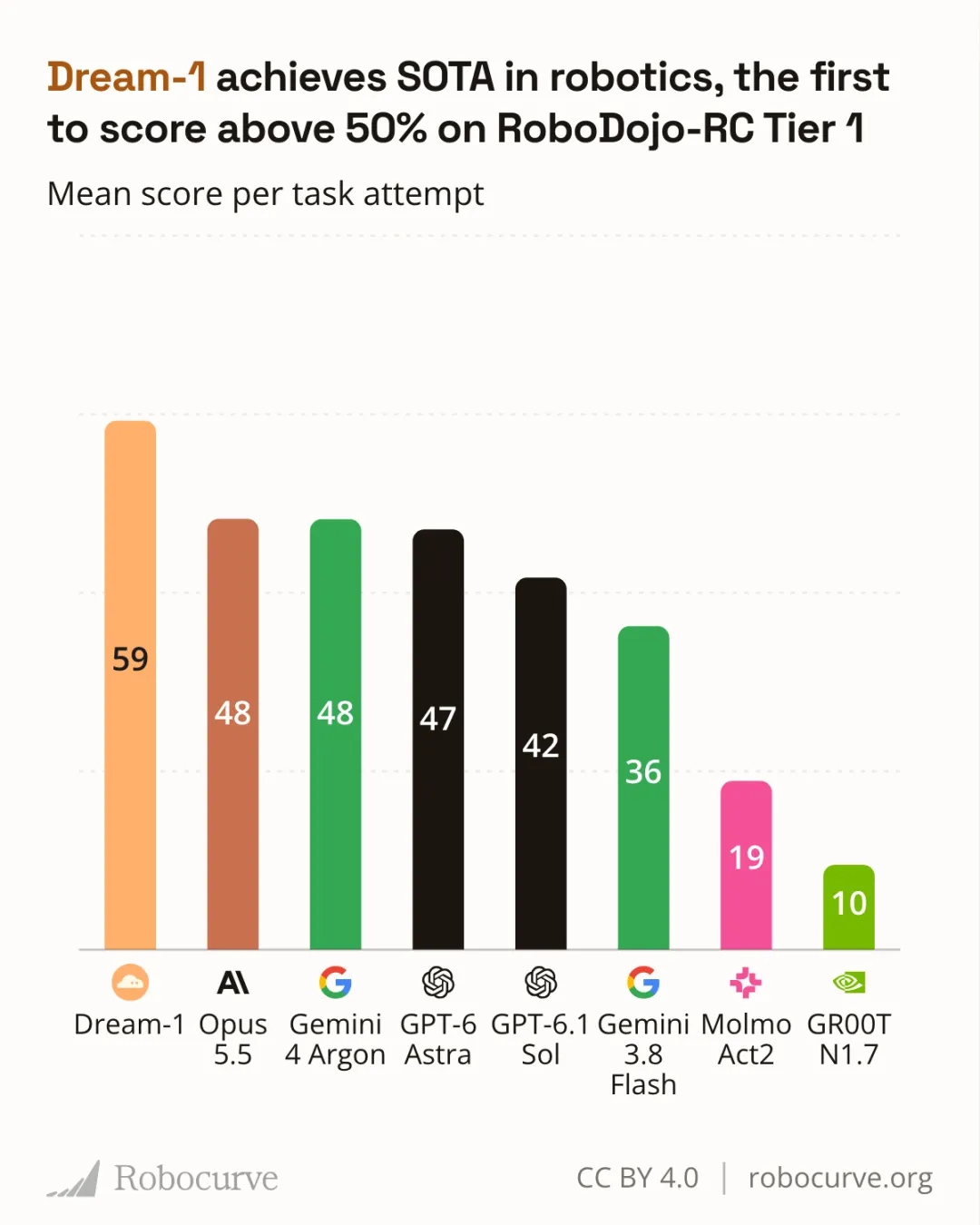
In the RoboDojo-RC Tier 1 rating released by independent third-party rating agency Robocurve, Dream-1 scored an average score of 59 percent per mission attempt, the first model to exceed 50 percent, higher than the latest major models such as Claude Opus 5.5, 48 percent, Gemini 4 Argon 48 percent, GPT-6 Astra 47 percent, GPT-6.1 Sol 42 percent, and higher than MolmoAct 2 19 percent and GR00T N1.7 percent.
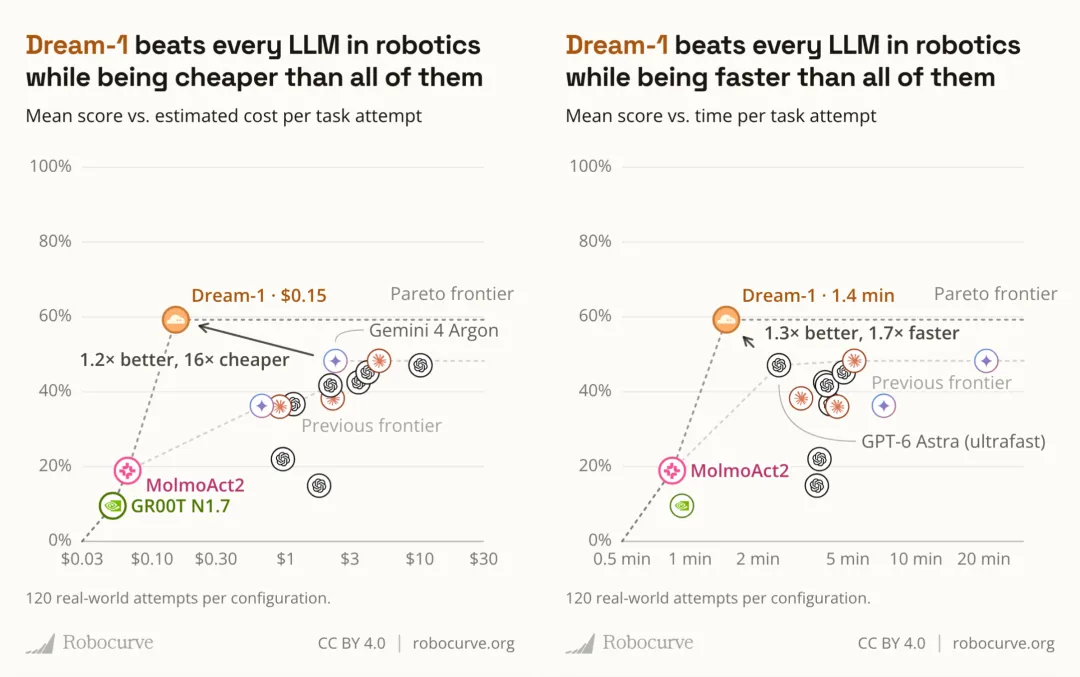
Not only is the score higher, but Dream-1 is also cheaper, faster: it costs about $0.15 per mission attempt, and scores 1.2 times higher and costs about 16 times less than the Gemini 4 Argon with the highest scores. The average running time is 1.4 minutes, and it scores 1.3 times higher and 1.7 times faster than the fastest GPT-6 Astra. Each model configuration is tested 120 times in the real world.
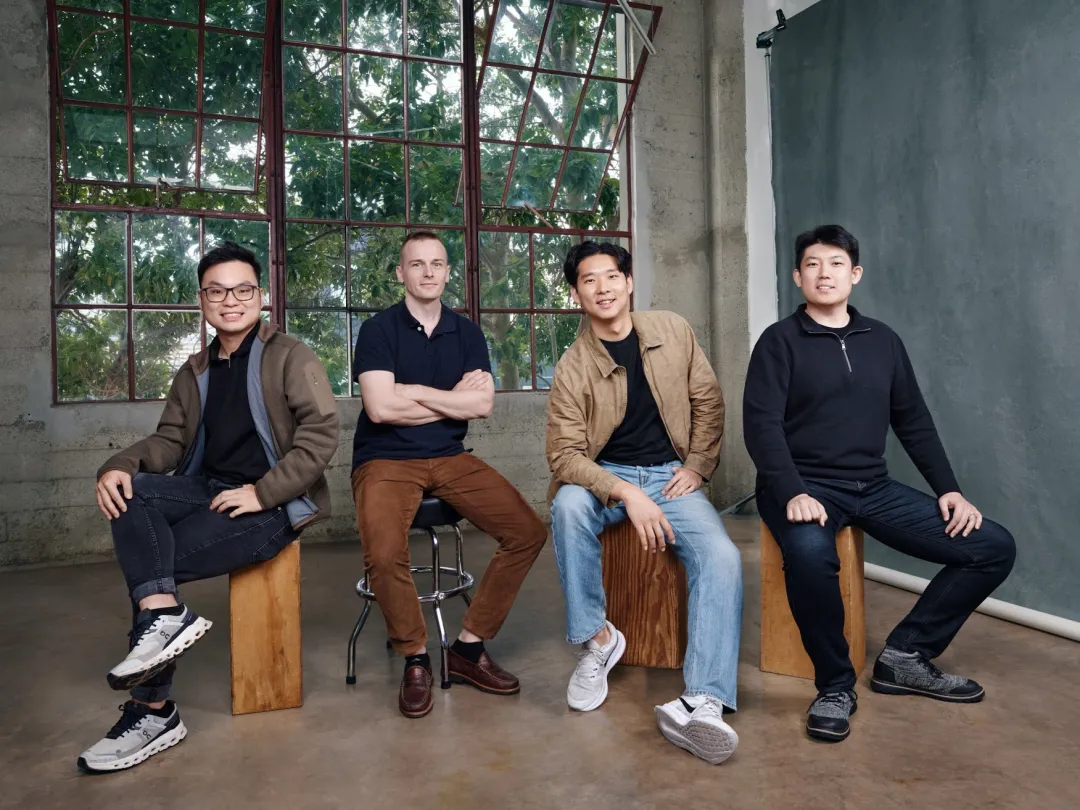
The four core members of the INVIDA GR00T
The four co-founders are from the GR00T robotics team:
Joel Jang (co-founder and CEO): Head of Global Modeling at GR00T, where he leads LAPA, DreamGen, DreamDojo and DreamZero;
Co-founder and CTO: Head of Video Modeling at GR00T, who was involved in the creation of the Predict, Transfer, Policy, Cosmos World Based Modeling series, which spanned Stanford, the University of Southern California, Google, and Microsoft;
Scott Reed (co-founder and chief scientist): Founding member of GEAR Laboratory in Engadget, where he led the GR00T N1 to N1.7 series of models; prior to his eight years at DeepMind, he created Gato and Genie, cited more than 158,000 times by Google Scholar;
You Liang Tan(Co-founder and Chief Robot Officer): Head of the GR00T open source at UKDA, involved in the construction of ROS 2, Octo, SERL, EgoScale.
In February this year, the team also launched DreamZero at Invidia, which for the first time explicitly introduced the World Action Model, WAM. In the next six months, WAM quickly became one of the hottest routes for physical intelligence.
The most surprising thing for the team at the time was that DreamZero, after training with only 30 minutes of YAM robot data, generated zero samples for unprecedented tasks, which in the past often required hundreds or even thousands of hours of specific intrinsic data. If 30 minutes were enough, the robot's "no data, no data, no data" death cycle could be broken. The team decided to start. Six months later, Dream-1 was born.
Daisy Cai, B Capital's general partner, said: "A functional mechanical arm that has gone from luxury cars to high-end laptops is what's lacking now is smart. This team has done some groundbreaking work in the field of robot learning at Intel, and now anyone with the Dream API can build on it".
Limitations and the Next Step
Dream-1 is currently in beta, and the team has written down its limitations:
Performance depends on the quality of each robot's IK solver;
Only decide where the clavicle ends up, without controlling how the arm reaches, and there may be problems near the obstacle or at the boundary of the joints;
Faced with a vastly different body than robots that have been seen, it is possible to predict impossible moves.
Joel Jang says, "We're not showing you a demo that's been cut, but we're giving you a model that you can test for yourself, that really works, along with its mistakes".
There is still a gap between zero samples and one adaptation. "What we really want is not to need even these five minutes. " The gap between zero samples and one adaptation is our next main task. "
Next, Dream-1 will support wheeled mobile robots and agile hands. This round of funding will mainly be used for computing to expand the tasks and robot categories that Dream-1 can handle and support more users.
In a world of robots where hardware is getting cheaper but still lacks "brains", how far can a model that can directly take over a strange robot go?
In the end, an egg is added:
The link is as follows:

© THE