
It's the first time in the history of the world.
Today's large models, which want to pursue performance, often have to spend a lot of money. Front-end models like Claude Opus or GPT are very useful and expensive.
But if I tell you now:There is a system that not only takes first place in nine benchmark tests that include scientific reasoning, business automation, tool calling, agent capability, but also has an average cost of 0.06 yuan per call, or less than 2 percent of an opponent's.Do you think it's incredible?
It was only recently that this breaking of the law really happened.
SinapisAI.com, an AI infrastructure company, has released a highly disruptive technology report.
The launch of the Mio 1.0 Lite, like a "Wolverine ally", brought together a number of high-priced domestic models that might have had some "prejudice".
They may not be all-powerful when they fight alone, butAfter the scheduling collaboration, the phenomenal combat power of the much more expensive single-body model exploded.
In an evaluation covering nine public benchmarks,Mio 1.0 Lite has an average score of 77.15, ranking first among 13 reviewed models.The average cost per request is about 0.062 yuan, the lowest in the review program.
A technical report, related code and assessment data set, titled "Toward Collective Model Intelligence: Characterizing and Coordinating Models", has been released on GitHub.https://github.com/SinapisAI/collective-model-intelligence)。
For the first time in the industry, this report systematically proposes a new direction of tremendous potential."Collective Model Intelligence" is a term used to describe the collective intelligence of a group of people.。
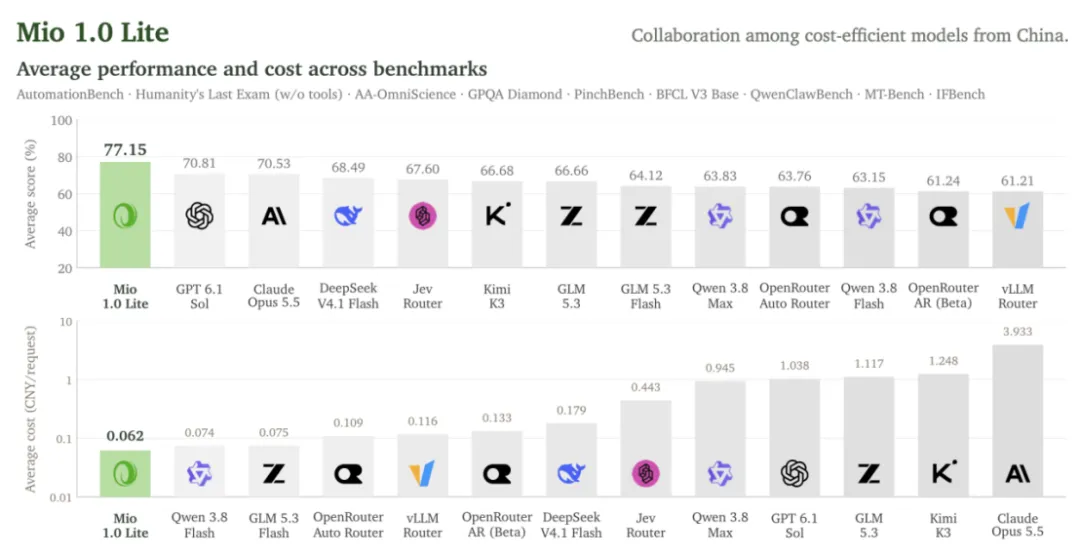
This round evaluated a so-called "war of the gods" and compared eight single-body models and four routing products. In the international model, the mainstream models GPT-6.1 Sol and Claude Opus 5.5 participated in the comparison.
The most powerful models from major model manufacturers in the country are also in the list, including quantity models such as the Kimi K3, GLM 5.3, Qwen 3.8 Max, DeepSeek V4.1 Flash.
In addition, mainstream routing products such as OpenRouter Auto Router and its Beta versions, Jeff Router and vLLM Router also participated in the same competition.
Evaluation: Reduce the cost of sexual assaultThe nine benchmarks cover tasks such as intelligent body automation, function calls, multi-round conversations, instruction-following, expert-level scientific questionnaires and knowledge questionnaires. Based on the nine average scores, the single-body model scored the highest on GPT-6.1 Sol, but not only did Mio 1.0 Lite score 6.35 points higher than it did, but the average cost dropped 94.0%!
The lowest cost in the review was Qwen 3.8 Flash, with the Mio 1.0 Lite scoring 14 points higher than its predecessor, at a cost of 16.4% lower. In comparison, Claude Opus 5.5 costs an average of $3.93 per request, about sixty times the cost of Mio 1.0 Lite.
Mio 1.0 Lite scored the highest on the five benchmarks of AutomationBench, PinchBench, BFCL V3, IFBench and GPQA Diamond. In these five benchmarks, its cost was 73.7% to 97.5% lower than the highest scores in the other programs.
In some projects, this leading edge presents a "break-in" level. For example, the BFCL V3 for examining function call capabilities, Mio 1.0 Lite scored 77.50, the Claude Opus 5.5 in second place scored 66.00, and the former's single-request cost is about one-quarter of the latter.
On the instruction-following IFBench test, the Mio 1.0 Lite scored 92.00, and the second-ranked program scored 82.80.
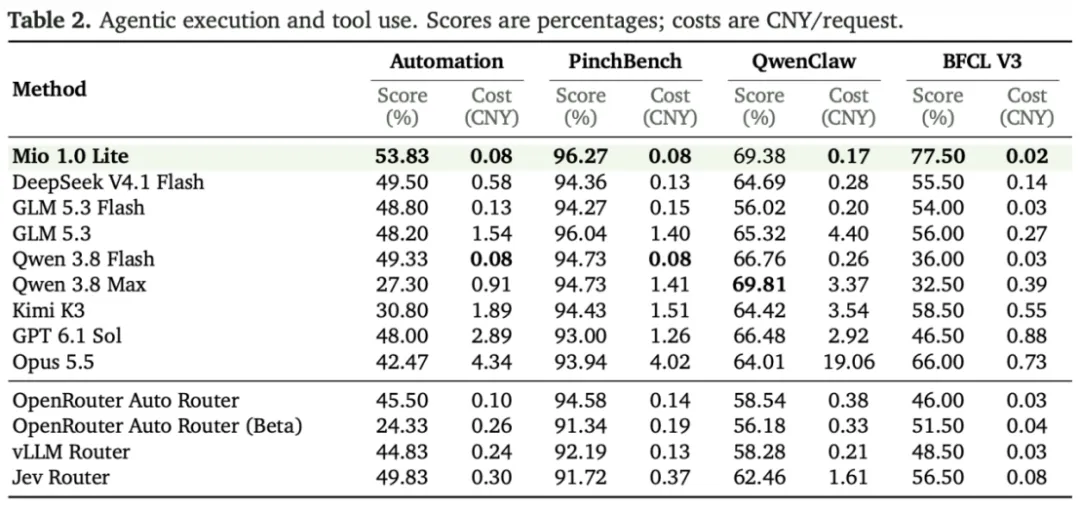
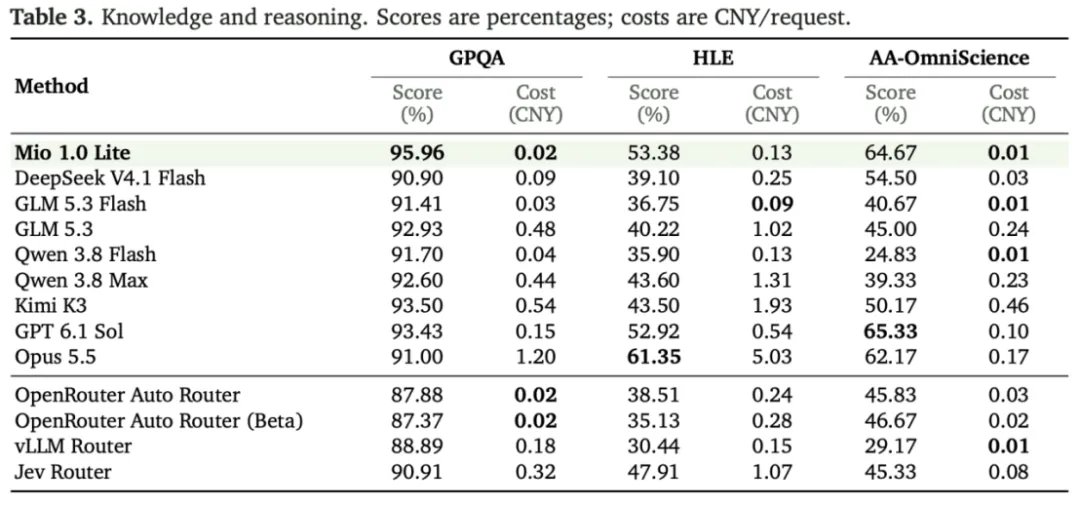
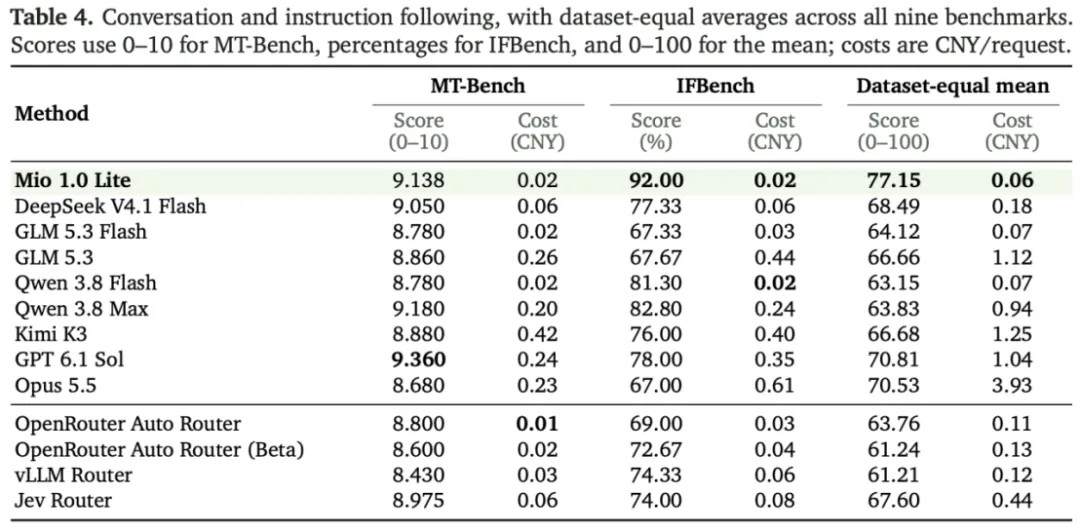
On the other four benchmarks, Mio 1.0 Lite scored well: QwenClawBench and AA-OmniScience both were less than 1 percentage point behind first place, but cost less than 95.1% and 85.3% respectively.
One of the biggest gaps is the non-tool "Humanity's Last Exam", where Mio 1.0 Lite scores 7.97 percentage points lower than the highest and costs 97.5% lower.In each of the nine benchmarks, none of the reviews outperformed the Mio 1.0 Lite in both scoring and cost.
Interestingly, the participating homegrown models were not ranked first in the tests when they were evaluated separately.
But once they are "organized" together, their combined performance directly transcends that of front-end models that cost tens of times more. This is the intuitive manifestation of "model group intelligence".
What is group model intelligence?The report's starting point comes from observations of the ratings data. Average scores on the rankings often mask the differences between models. Comprehensive ranking-based models often answer questions about the errors of the ranking-based models.
A complex task typically involves connections such as understanding input, reasoning, and calling tools, each of which often performs best with a different model. Many conventional steps can be used to meet quality requirements with a lower-cost model, and the saved budget can be used for higher-difficulty connections.
According to the report, model group intelligence is the accumulated ability to understand, replicate and coordinate models trained independently by different developers to improve the quality and resource utilization efficiency of tasks. Under this framework, a model is evaluated both at its own level and to see what capabilities it can add to the group and how many resources it needs to call on these capabilities.
As an example of a programming intelligence body, a repair task typically involves steps such as diagnosing defects, generating patches, running tests, and modifying improvements. According to the model group intelligence, each step can be given to the model that is currently best suited for completion, and the results of the previous step and the budget that has been spent will affect which model to choose next.
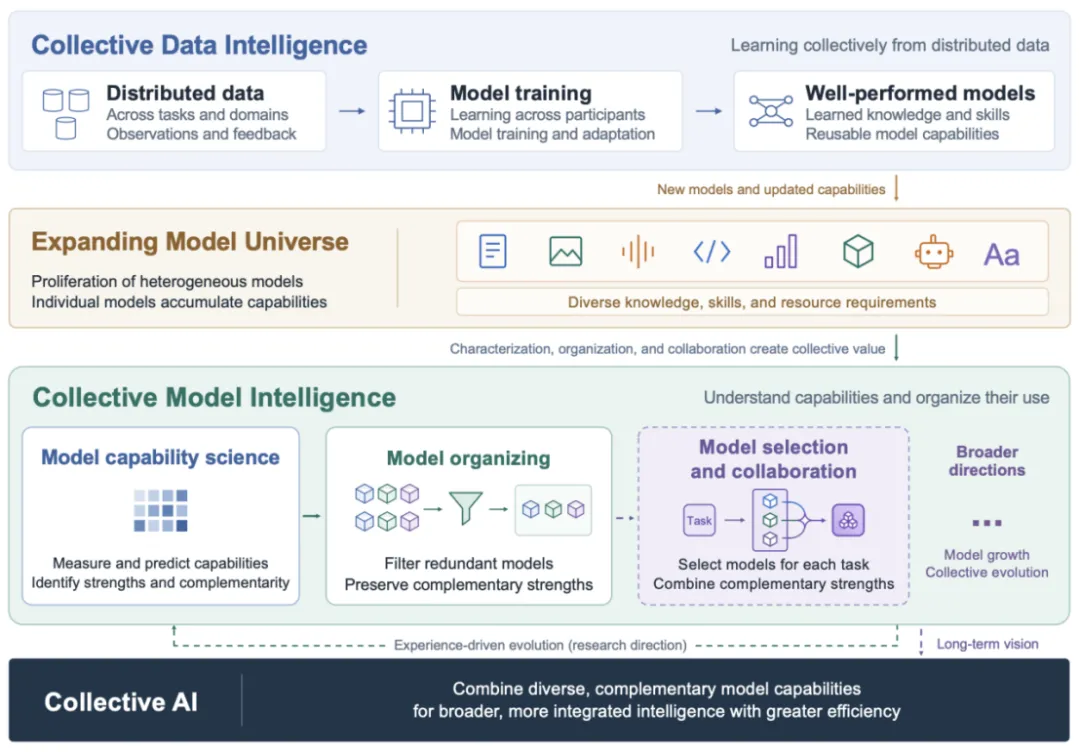
From individual models to group intelligence. Models trained by different developers each accumulate knowledge and skills. The ability to measure and predict systems, identify complementary relationships between them, and organize models for selection and collaboration to form a more integrated and efficient intelligent system.
Three components of support group collaborationIn order for multiple models to work together effectively, there are three things that need to be done. First, to master the characteristics of each model's capabilities, second, to arrange the work reasonably, and finally, to ensure that the selected model can operate efficiently.
The report carefully designed the three core components to allow them to work together perfectly.
Model Eval is responsible for evaluating model capabilities.
Model Eval first estimates the model's scores in one field based on a small number of subjects, and then uses the model's association with the field to infer the model's performance in other fields. In an experiment involving 25 models, 18 benchmarks, and more than 25,000 subjects, each target model tested only 5 to 40 subjects.
Mio ((Models in One) is responsible for organizing and scheduling models。
It maintains a streamlined pool of candidate models, complementing capabilities, and choosing the right model for each step based on task progress and residual costs and time budgets. To test the robustness of model selection, the team constructed the RobustRouteBench dataset. The dataset contains 35,278 instances, covering general text, multi-models, and three scenarios in Chinese, with candidate models using 63, 45 and 10 data sources, respectively.
Mos (Model Serving OS) is responsible for running and scheduling the model.
It unified the management of external model interfaces and autonomously deployed models, and improved the distribution efficiency of model files by sharing caches. In experiments, 10 instances simultaneously loaded a model of 18.84 GB. Reading directly from object storage took more than an hour and could be completed in about three minutes with preheated shared caches.
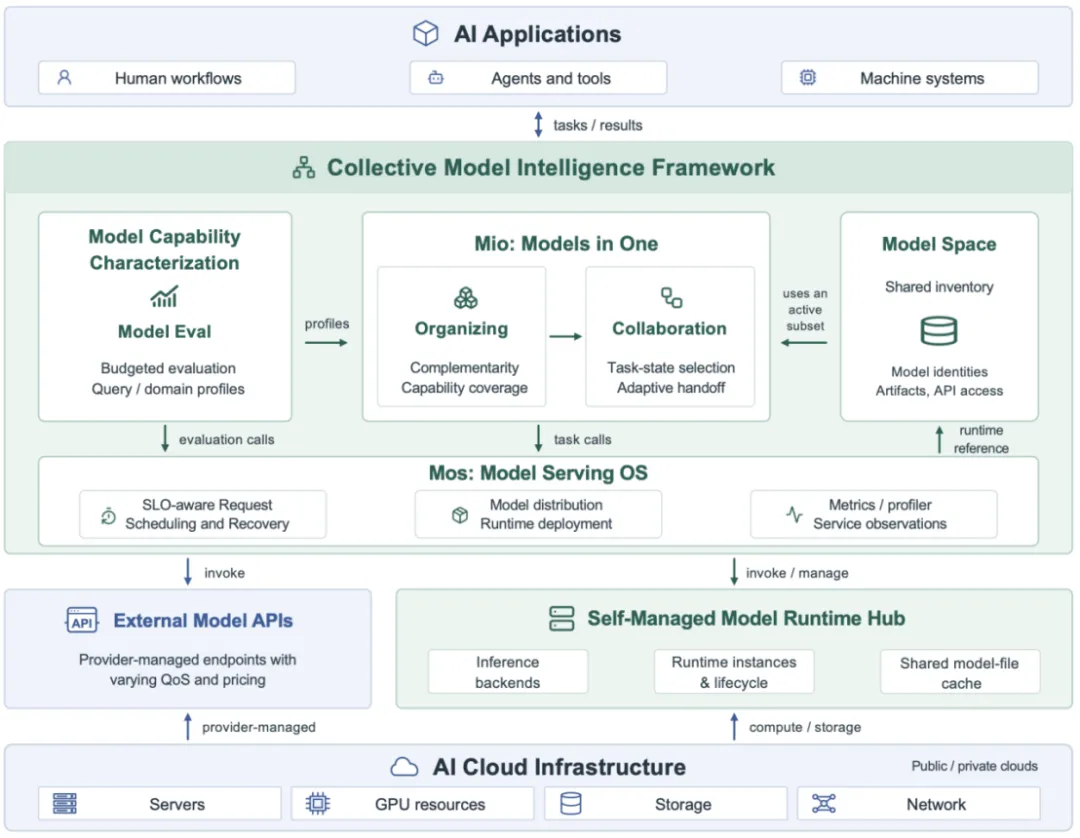
Model Eval is responsible for capability assessment, MIO is responsible for model organization and collaboration, Model Space is responsible for unified registration and management of model resources, Mos is responsible for scheduling external model interfaces and autonomous deployments of models, supported at the bottom by public cloud or private cloud infrastructure.
The idea of "learning lessons" was born a decade ago.The theoretical basis for model group intelligence can be traced back to the "Learnware" paradigm.Ten years ago, Professor Zhou Zhihua of Nanjing University proposed the concept of a curriculum. He proposed that each well-trained model be equipped with a "rule" describing the model's capabilities and scope of application.
In this way, users can find suitable models directly from existing models when faced with new tasks, without having to train from scratch.
In the technical report, Nanchang Intelligent applied this idea to large models, creating a "capacity image" for each model, recording its empirical performance and predictive performance in various fields and topics. The role of the capability image is similar to that of the regulation in the subject. In streamlining the candidate model pool, the system draws on a method of screening based on capability coverage in the subject study.
The system only removes the model when a preserved model is able to replace the work of the removed model, and performance losses are within the permissible range. Some models do not stand out on average, but have unique advantages over specific problems, which allows them to remain in groups.
There will be more and more models in the future.Data, models, field knowledge and computing power are dispersed among different institutions, restricted by factors such as privacy protection, data ownership and communication conditions, and are often difficult to concentrate. The same basic model can also form their own advantages through the adaptation of different teams.
Open source models continue to be released, and specialized models in various industries continue to appear, and the same manufacturer will launch several versions of the flagship and lightweight versions for different scenarios. More than 20,000 open source models and datasets have been assembled in China alone. It is predicted that the number of models will continue to grow and the differences between models will grow.
In my opinion, the growth in the number of models will gradually change the way people view the model. In the past, people were more concerned about which model is strongest. When more models are available, which models combine the best, cost the most, will become just as important questions.
This change is significant for model developers. Teams focused on a particular industry, or small teams with limited resources, find it difficult to compete positively with leading manufacturers on a comprehensive list.
As long as their models excel in a particular type of problem, there is an opportunity to play a role in the group and get rewarded. This contributes to the formation of a model ecosystem of multi-coexistence and collaborative collaboration, allowing more teams to use R&D results.
New dimensions of the Law of ScaleOver the past few years, the improvement in the capacity of large models has largely followed the scaling law. Model parameters, training data, and computing quantities have increased in a certain proportion, and model performance has improved in a predictable manner. This law has driven the rapid progress of large models.
Model group intelligence can be seen as a new dimension of the law of scale.In addition to the parameters, data and calculations of individual models, the number of participating collaborative models, the differences in capabilities between models, and the level of organization of the collaboration can also affect the ceiling of overall capabilities. The results of the Mio 1.0 Lite provide a preliminary example. Participation in collaboration are both domestically produced high-priced models, and the cost of individual models is significantly lower than the international front-end models evaluated.
This new dimension can be mutually promoted with several of the original dimensions. With the emergence of stronger single-body models, the lower bound of group capabilities increases. With the addition of models that excel in specific areas, the range of group capabilities expands.
It should be pointed out that the laws of scale on the group dimension are currently a directional judgment. How much benefit the growth of group size and diversity will bring, and how the expenses of collaboration itself will grow, require more systematic experiments to illustrate. This is why this direction is worth investing in the long term.
It's a cost-cutting move that makes "impossible" business landings "possible".The cost has a huge impact on the popularity of large-scale model applications. To complete a task, a smart body often needs to call the model dozens or even hundreds of times in a row. The total cost of a task may exceed the affordability of many enterprises if it costs only a few cents per call. Many applications that were not economically budgeted are likely to land.
The way in which model group intelligence reduces costs is to give the simple linkage to the low-cost model, leaving the budget to the really difficult linkage, without reducing the requirements for the quality of the task. The more task steps, the more obvious the advantage of this on-demand allocation.
Working with Open Source China to evaluate entry-level sitesRecently,Nanchang Intel and China's Open Source AI Infrastructure Platform MoMoArk have worked together to evaluate models and data setsThe first review covers 40 models and 50 datasets, and details of some of the resources have been uploaded online.
With tens of thousands of models and datasets available on the modular arc, developers must first look at the strengths and shortcuts of the model before they can do so, and it is difficult to tell the differences between the models on different tasks with a single sum. The online evaluation of this collaboration allows developers to view the performance of the multi-dimensional capabilities of the model, the results of the same topic comparison and the sample difficulty of the data set, first narrowing the scope of the candidates, and then combining the actual validation of their tasks.
These images and difficulty distributions do not rely on having each model run bulk data repeatedly to obtain it, which is a costly and time-consuming calculation to do. The approach of NANC is to evaluate the data using the model while evaluating the data using the model. One question is if all models are wrong, a common shortcut can be exposed, but it is difficult to help developers choose between the models.
Some models can answer questions that are easily mistaken and provide clues to their ability to distinguish. On the one hand, the team identifies the advantages and limitations of the model and, on the other hand, analyzes the difficulty and differentiation of each sample based on the response performance of multiple models.
This approach is supported by corresponding research. One of the papers the team participated in was accepted by CIKM 2026, where the papers created images for each question based on historical answers recorded, and the new model only completed a limited number of questions to estimate the complete assessment results.
Another paper, accepted by EMNLP 2026, uses the same question to be asked multiple times in different questionnaires, using the ability distribution instead of single-to-error, to make model routing judgments more stable. The results of sample analysis are also reflected in the selected question, using higher-difference data engraving models, and then using new model performance to improve the selected question, thus forming an evaluation cycle that promotes the model and the data.
The new model answers each question, and the system selects the next question accordingly, ultimately combining the answers and predictions to estimate the overall results.
This process is backed by the self-developed evaluation system of Nanchang Intelligent. The system has covered hundreds of domestic and international models, accumulated tens of thousands of evaluations from hundreds of public evaluation sets, and relies on the continuous operation and dynamic updating of automated flow lines. In accordance with the cooperation arrangements, the two sides will continue to enrich the content of the evaluation, expand the coverage, and make model capabilities measurable, comparable and traceable.
The more the model ecosystem thrives, the more the need for a link to understand and organize models. From ability to evaluate to group collaboration, the infrastructure is being built at this location.
Questions to be answeredThe report clarifies the scope of the research. The results of the current experiments are subject to component-level verification, dissolution experiments by candidate model pool organizations, multi-step collaboration, online real-time scheduling and overall system benefits, among others, need further evaluation.
He believes that this is a step in the right direction and that several key issues need to be addressed. Models are updated quickly, and capacity assessments need to be followed up in a timely manner, otherwise the capacity image will be gradually lost. Collaborative links will increase certain time expenses and need to be controlled within the range acceptable to the user. In multi-step tasks, more mature mechanisms are needed to communicate context between models and ensure consistency of results.
The team will continue to work in two directions. One is to extend the system to larger model groups and access more industry models for specific areas and tasks. The second is to explore the mechanisms of experience-driven group evolution, enabling the system to use the group's capabilities to discover its own inadequacies, improve operating mechanisms and verify improvement effects, and improve continuously through continuous evolution.
As can be seen from the name, the Mio 1.0 Lite is a lightweight version. Its candidate models are both high-priced domestic models, mainly for higher performance at lower costs. From the perspective of the new dimensions of the scale law, the models in the candidate pool are stronger, more stylish, the assessment and scheduling mechanisms are improved, and the overall capabilities of the group are further enhanced.
In the future, it may no longer be about "who has the best model and who is going to die", but rather "who can combine the best models and laugh until the end".
When a new model is released, people will no longer just look at its ranking, but ask: What new superpowers will it bring to our AI, the League of Avengers?