
“ Using a single camera and an IMU, the drone ran 100 km/h on the track in Abu Dhabi, eliminating three consecutive human world champions.
The study was carried out by the MAVLab team at TU Delft in the Netherlands. Recently, the results were published under the title MonoRace: Robust monocular AI for champion-level drone racing.Published in leading global journals《Science RoOn the cover of Botics。Their system captured the grand prize of the 2025 Abu Dhabi Autonomous Unmanned Aerial Racing (A2RL x DCL) and defeated three FPV World Racing Champions in a man-made draw.The fastest single-step finish time16.56 seconds.
The organising committee set a tough rule this time around:The IMU can only be loaded with a single shutter speed camera, and no external positioning system or hardware modification is allowed.This setup raises the difficulty by a fraction compared to the previous "champion-level" program with dual-eye cameras and an action-capture system.
01.
A single-camera race to win the human title
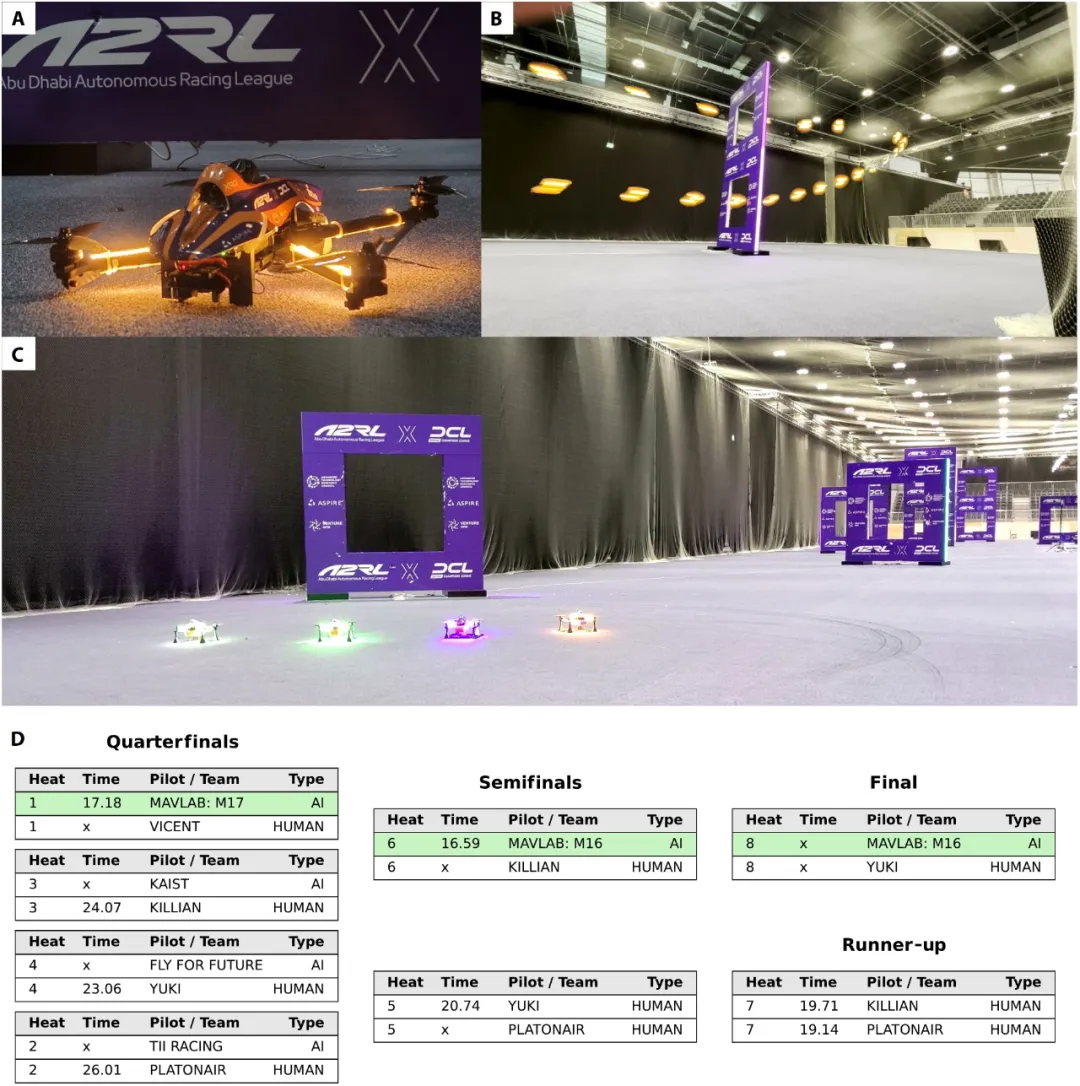
The tournament will be held in Abu Dhabi from 11 to 12 April 2025. The venue is a 100m x 30m indoor hall, set on the track.11 square doors with a diameter of 1.5 metersThese included two sets of double-decker doors and a split-S propeller-driven drones that went through the upper door and plunged directly into the reverse through the lower door. The goal was to complete the two laps as quickly as possible.
The event featured four events: a Grand Prix with 15 minutes of individual time for each team, a three-round elimination contest for AI against human FPV pilots, four AI-powered multirole races, and an 83-meter straight-four straight-race MonoRace.He won three Grand Prix titles, a manned match and a straight race.It only finished third in the multi-race because it was not able to avoid obstacles and hit other unmanned aircraft when it needed to fold.
At this speed, the motion blur is severe, the shutter speed can cause additional image distortion, the camera cable can be interfered with by electromagnetic interference, and the IMU can operate at high speeds.
The entire drone is a carbon-fiber shell.It weighs 966 g.The main processor, equipped with an IMX219 single-lens revolving high-speed camera (155° horizontal x 115° vertical, 90Hz) and a built-in IMU (accelerator 1000Hz, gyrometer 2000Hz), was the British Jetson Orin NX. During the race, the team trained a series of reinforcement learning control networks, named after the fastest completed time, such as the M16, M17, M23.M16。
02.
3×64 small network, 500Hz direct control motor
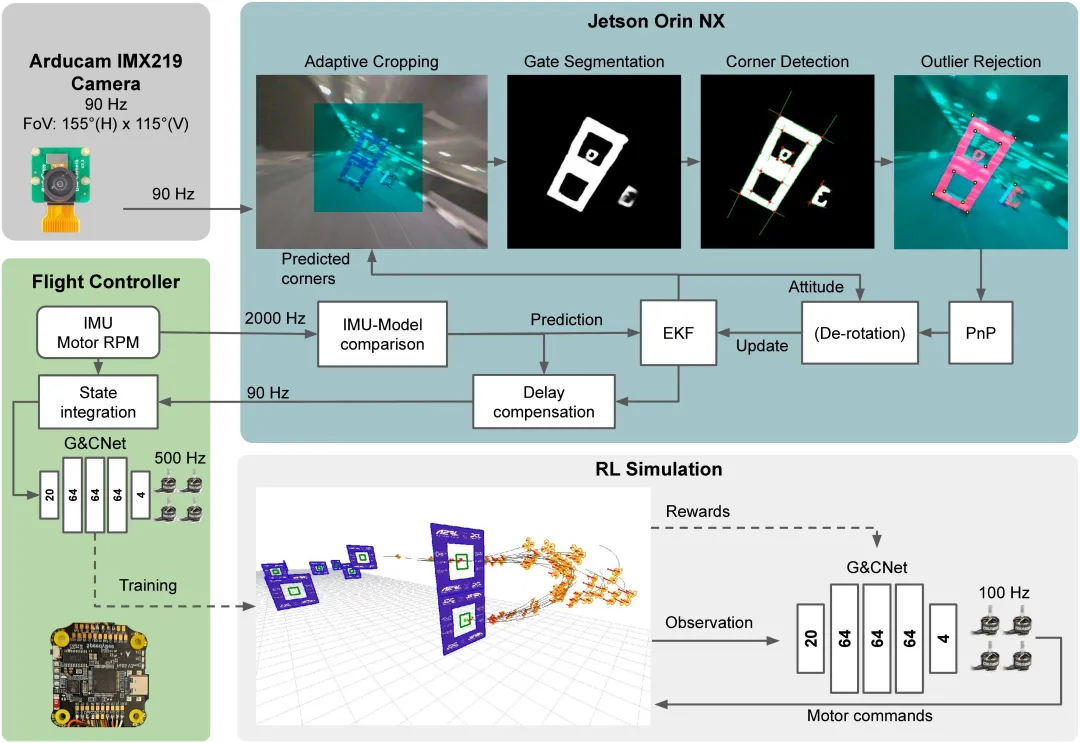
At the heart of MonoRace is a small network called G&CNet (directional and control network), which maps the estimated state out directly into motor instructions, completely replacing traditional in-loop controllers.
The network was initially developed for real-time optimal landing of spacecraft and was later used by the team for high-speed quad.There are only three layers, 64 neurons per layer.It can run directly on a flight control chip (STM32H743, 480MHz ARM processor) to500Hz frequency output motor instructionsBecause the central control link is bypassed and the end-to-end delay is extremely low, the motor instructions can be pulled from 0 to 100% in 2 milliseconds.
The training was based on reinforcement learning (PPO algorithm) and simulation. The team trained in a simplified simulation of the dynamics, dynamics, and momentum of the main actuators, and then passed on the training strategy.Large-scale domain randomizationMoving to reality, the random range of some parameters reaches up to 50% of the rated value. Flight data for the fastest lap can be seen that most of the test power, torque and engine speed fall within a 30% randomized envelope, some of the time beyond the boundary, but the controller is still stable in flight. This indicates that full randomization allows the unmanned aerial vehicle to capture the dynamics that have not been modeled.
03.
It's half gone, and it can fly at full speed.
Control is reinforced as long as the state estimate is accurate.Neural network gates dividedandDrone modelIt's hard to believe that we've been able to do this for a long time.Can run at full speed with 50% image damageIt can also cope with accelerometers and meters.
The entire link is: the image is first custom-cut, intercepting the 384×384 area with the most information based on the predicted door location, and handing it over to the door dividing network.GateNet(U-Net structure) After splitting the mask, the team developed an angle point detector.QuAdGateBy detecting the edge line of the gate, the point of intersection is determined precisely, so that the angle coordinates are no longer affected by the circumference of the membrane or lack of damage. After RANSAC-based isolation is removed, PnP decomposition positions are used, and high-frequency IMU data is finally integrated into the expansion of the Kalman wave EKF.
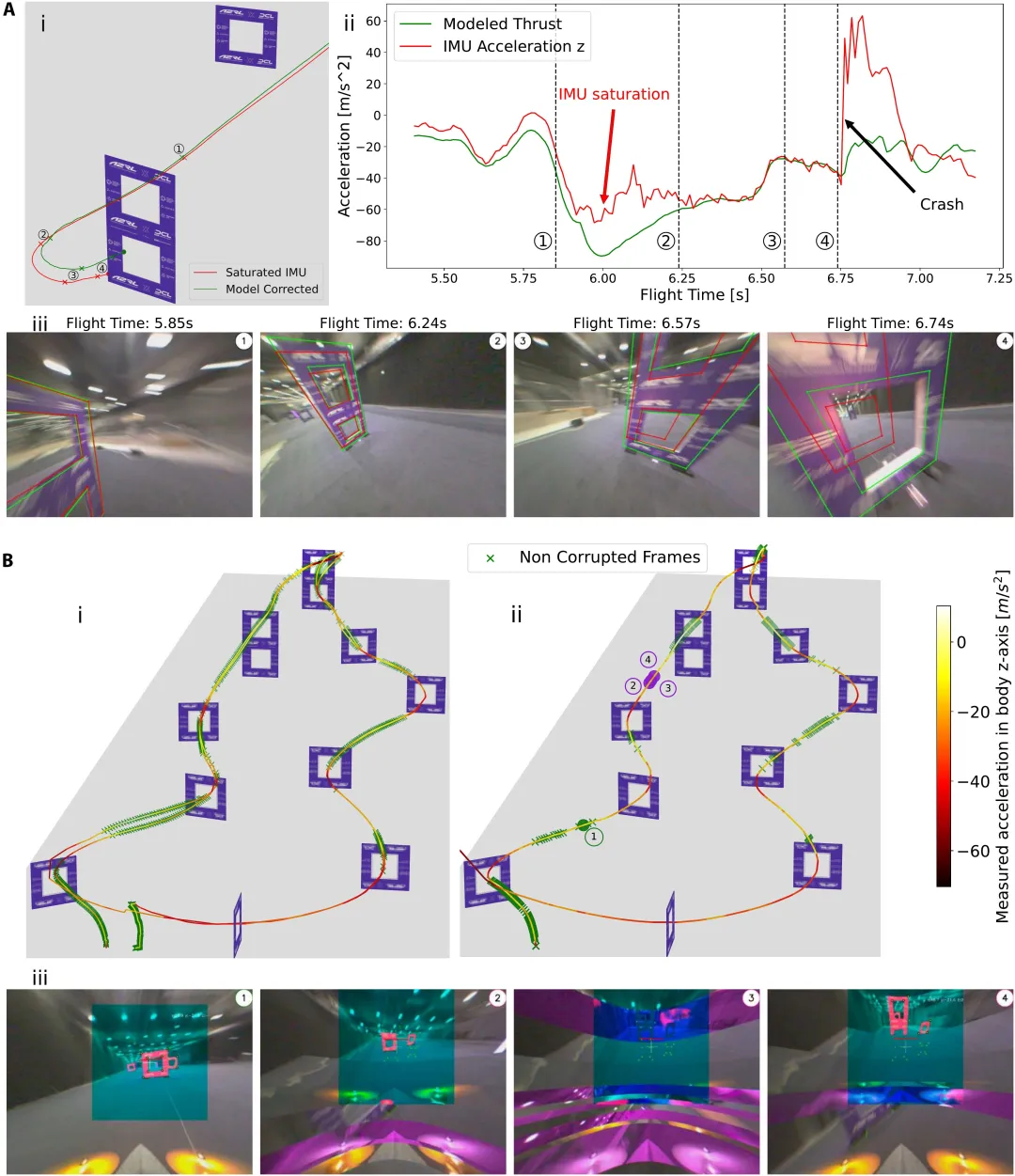
Two of the most representative of these details are that the RL controller can produce a thrust of up to 7g, combined with structural vibration and noise, and the accelerometer frequently hits the 16g measurement range, causing large data errors, causing the EKF to disperse, leading to explosions. The team's method is to predict the acceleration in real time using dynamic models, and once the measurement values and model predictions are too bad (the OZ spectrum exceeds 22 m/s2), modify the model predictions in the EKF, and increase the uncertainty of position and gesture, increasingly relying on vision. The M17 of the next Grand Prix was used twice for the IMU crash and explosion, and after successfully deploying this modification, the remaining three races flew entirely.The second is to combat camera interference. The original drone's camera alignment is easy to twist under high thrust, bending to solid-state hard drives, and triggering electromagnetic interference. Eight to 75 percent of the images are damaged during 10 flights. MonoRace uses multi-level isolation to remove the image: no angular points are created when the damaged area is not separated from the door; the angular position is distorted by RANSAC 2D imaging matching; the faulty position of the leakage is rejected by the EKF deviation. In a 75 percent damaged flight, the drone still successfully passes through a door at over 25 meters without an effective image.
Because the game forbids any external positioning, the team has no real value. Their solution is to use the gate itself as a gauge: combine a state estimate with a known gate map, re-project the gate cover back to the image, and calculate the actual split results.It's a lot more expensive than IoU.The higher the IOU, the more accurate the state estimates. This method is mainly used to calibrate the camera's outboard cameras using flexible 3D printing brackets, which change angles after each impact or repair. After the bomber or repair, the team uses the most stable M23 strategy to fly through the race track to collect data, then use Bayes optimization to run 40 optimization cameras in three angles. In simulation verification, this method reduces the outdoor input error from about 2° to within 1°, and the EKF position error decreases by about 50%.