It's the first time in the history of the world.
Let the robot pick up one and put it in the pot.
The real difficulty may be not to identify the claw, or to find the claw, but to grasp the moment when the claw is closed: early in the morning, the claw will fall; late in the evening, the claw may have been pushed away. After the claw, the mechanical arm must continuously adjust the force, direction and speed.
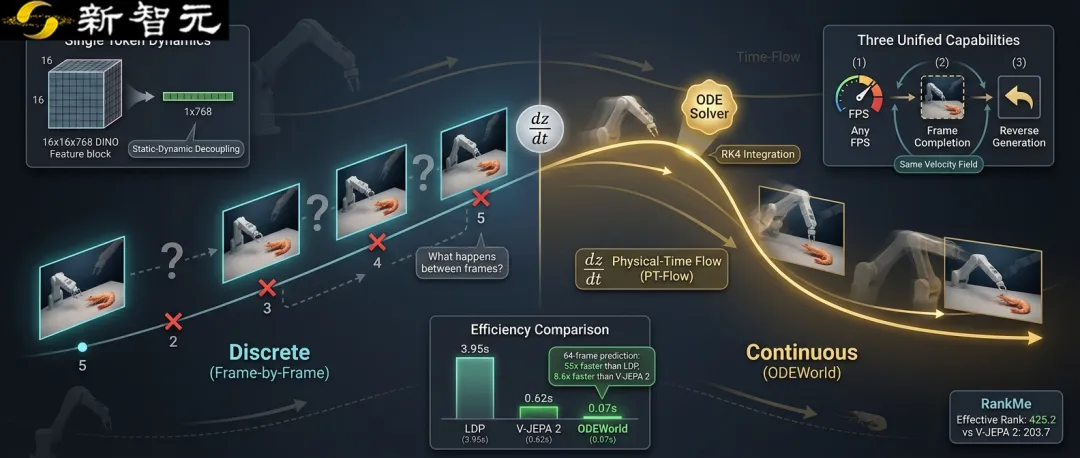
But many models of the visual world know time precisely from these images taken by the camera. They see the 1st, 2nd, 3rd, and learn how to jump from one chart to the next. As for what happens between the two charts, how to predict a different rate of torque, and even how to recover from a critical moment of absence, the model usually does not have a continuous trajectory that can be directly queried.
It also makes the question more specific:
If a robot's understanding of the world exists only in one grid image, how can it capture the moment between the two?
A research team from the Institute of Intelligent Industrial Research (AIR) at the University of China and UC Berkeley's BAIR have proposed the world's first continuous time-capable model of ODEWorld. It does not just ask "what's next?" but it directly learns what direction the world is going at each moment, how fast it is changing, and thereby restores a subspace trajectory that continues to evolve in real physical time.

Link to the paper:https://arxiv.org/abs/2607.27924
The main page of the project:https://dstate.github.io/odeworld_website/
The key to this work is not to add a "supplementary" function alone. As long as the model has a continuous change trajectory, it can read the state at any time: when it needs a higher torque rate, it adds sampling points from the trajectory; when observations are missing, it queries the middle time; and when it needs to look back at the source of the change, it solves backwards along the trajectory.
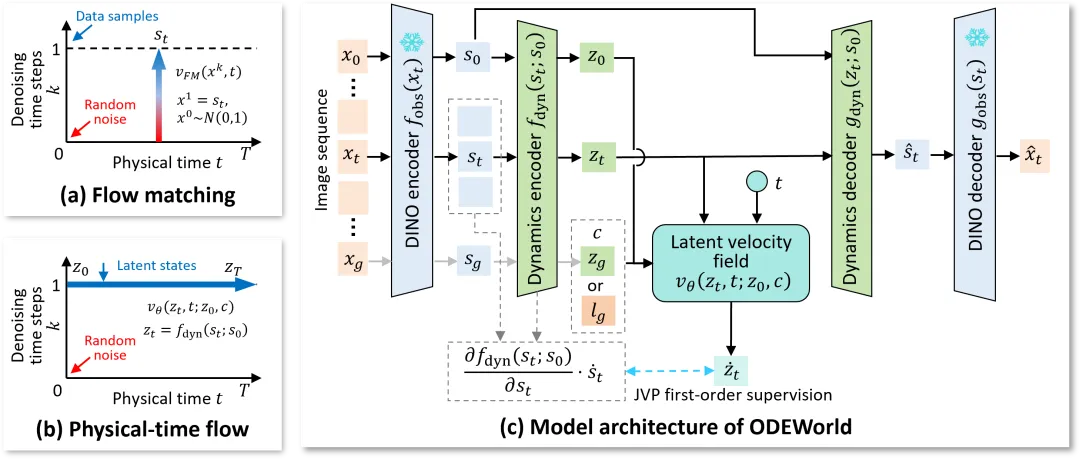
The team called the prediction paradigm Physical-Time Flow, abbreviated PT-Flow; the continuous time-subspace world model based on PT-Flow was named ODEWorld.
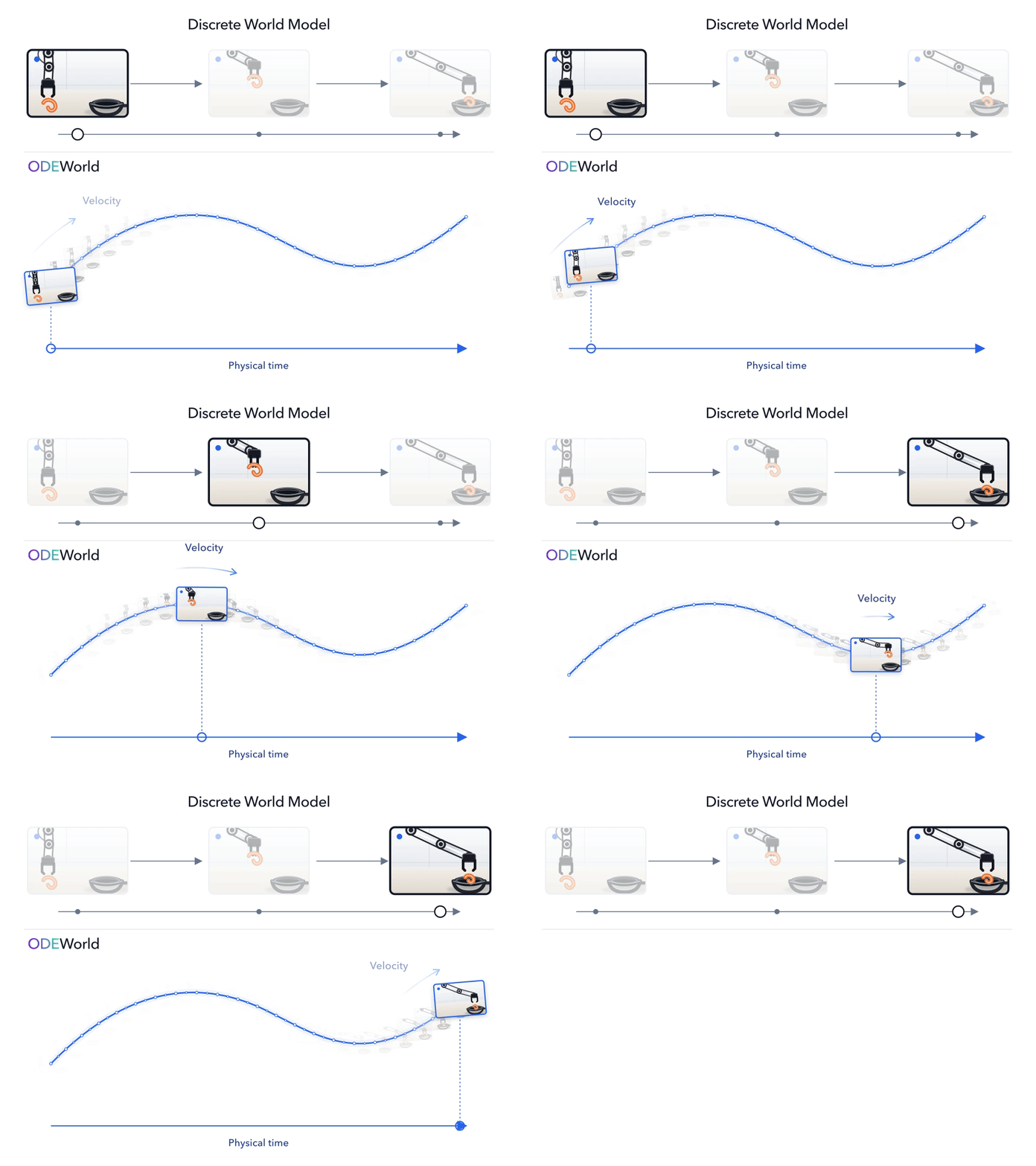
Different predicted time boundaries
The state of the robot at the moment t is represented as Traditional discrete models typically study a state-transfer function:

C can be either a target image or a task instruction.
This modeling method is not ineffective, but it binds the predictive capability to a predetermined time progression. Training videos jump between adjacent sampling points according to fixed frequency sampling, and model learning also jumps between adjacent sampling points. When the query time falls between two training holes, or when the input sequence lacks partial observations, the discrete model itself does not have an explicit continuous trajectory for querying.
PT-Flow is converted to a conductor for real physical time in the learning sub-state:
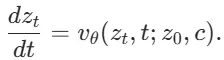
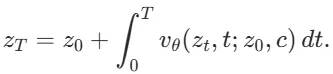
Right here. is a sub-space velocity field where the output current state changes direction and velocity at the next instant. After a given reference state z0, the future state can be scored by a constant differential equation solver:

Static dynamic decompositionConstruction of clean underground space for speed skates
To convert video into a continuous equation, you first need to find a state space that fits the description of the ODE.
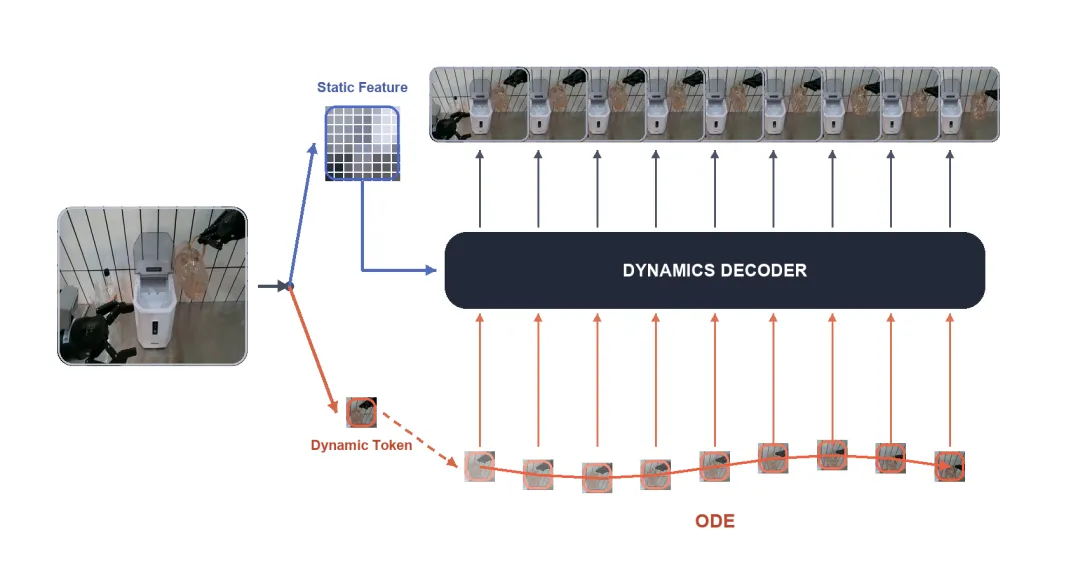
In robotic video, a large amount of visual content is unchanged. Desktop, wall, and object textures may remain stationary for several seconds, with only mechanical arms, claws, target objects and contact relationships really driving the mission process. If the speed network is simultaneously adapted to a static background with a small amount of movement, dynamic signals are overwhelmed by a large number of zero changes or noise characteristics.
ODEWorld therefore does not establish a speed field directly in the pixel space. It first uses a frozen DINOv2 encoder to compress images as visual characteristics. Then, using a set of dynamic encoders and decoders in the initial state, extract the potential variables that are really responsible for describing the change:
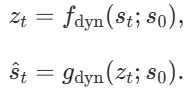
Both encoders and encoders can see s0 directly. Static scene information can therefore be obtained from the reference state, and there is no need to re-save the background, only to generalize what changes have occurred relative to the current state of s0.
This solution resulted in a very radical compression: the original DINO characteristic was 16×16×768, while the ODEWorld dynamic sub-variable used only one 1×768 token. Based on this single token, the speed field was only parameterized by a light three-layer MLP, with time information injected through the FiLM;zt, z0 and target condition c together determine the output of the speed network.
Direct monitoring of the "state of change".
Having compact subspace does not necessarily mean that the model can learn steady continuum dynamics. One of the long-standing problems facing the subspace world model is the depiction of shrinkage: if the encoder maps all the different images to similar vectors, the predictor is less likely to lose, but these vectors no longer contain enough state information.
The key design of ODEWorld is not only to compare the predicted state to the target state, but to directly monitor the underlying state as a one-step time guideline.
Because dynamic encoders are satisfied According to the law of chains:
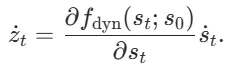
S0 remains unchanged during a forecast process, so it has zero time orientation. Training data can be used to estimate adjacent characteristics, although it only provides discrete time. 。
By using the Jacobian-vector product (JVP), the model can project the speed of change in visual characteristic space to dynamic sub-space without explicitly constructing a massive Jacobian matrix. 。
The speed network's training objectives are as follows:

In this case, the slope represents the stop gradient, which is used for steady-state speed field optimization. Further experiments in the paper show that even if the stop gradient is removed, the model can still be effectively trained, indicating that the one-stage speed constraint itself has already provided a stronger structural constraint to the subspace.
This differs significantly from typical JEPA training, which typically requires predicting the potential variables produced near the target encoder, and relies on EMA, stop gradients, or additional differential-coordinate constraints to avoid contraction.
ODEWorld writes "how states move through time" directly into the monitoring goal: if all states shrink to the same representation, the model cannot explain the real velocity of non-zero change.
Under the same sampling protocol, the average validity of the 768-dimensional dynamic sub-variables of ODEWorld is 425.2; the DINOv2 CLS characteristic is 376.1; the 1024-dimensional representation of V-JEPA 2 is 203.7.
Higher effective ranking means that subspace retains more dimensions of variation independent of each other, and that single tokens do not equate to information scarcity.
Savitzky and Golay
In theory, the simplest state velocity can be obtained by a neighboring cube differential:
However, ODEWorld uses a frozen DINOv2 image encoder. DINOv2 is primarily designed for single-channel visual representation, and does not specifically guarantee timing consistency in continuous video. Even if the pixel changes only slightly, adjacent features may also contain high frequency vibration; directly using these differences as physical speeds, the visual encoded noise is passed to the speed field.
The team therefore used the Savitzky and Golay conductor filter to estimate.
It performs multiple smoothing and guiding operations within the local window, while suppressing high-frequency noise, while maintaining key changes such as contact, grab and object movement. The paper's subtractive trajectory visualization shows that the trajectory generated by ODEWorld is smoother than the original DINO characteristics and the discrete next-step prediction baseline, while retaining the main geometry of the original character space.
This also reveals an important boundary of PT-Flow: Model learning is not about solving known physical equations, but about finding a subspace dynamic system in the data that is suitable for continuous scores and can preserve the mission's meaning. It pursues continuous representations that can be used for future predictions, rather than recovering the only real control equation from video.
A speedwayUnified three types of generating capacity
Upon completion of the training, future predictions will no longer depend on repeatedly calling fixed step lengths for the next model, but will use existing ODE solvers such as RK4 to score along the speed field.
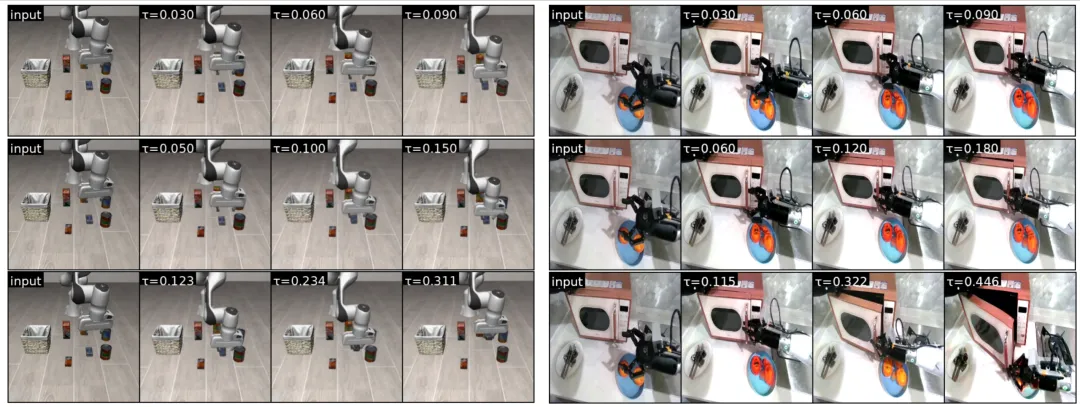
The first is to generate arbitrary time resolution. Hoping for slower movements, more and more intensive moments on the trajectory; hoping for faster progress, less sampling points. Models do not need to train separately for different play speeds.
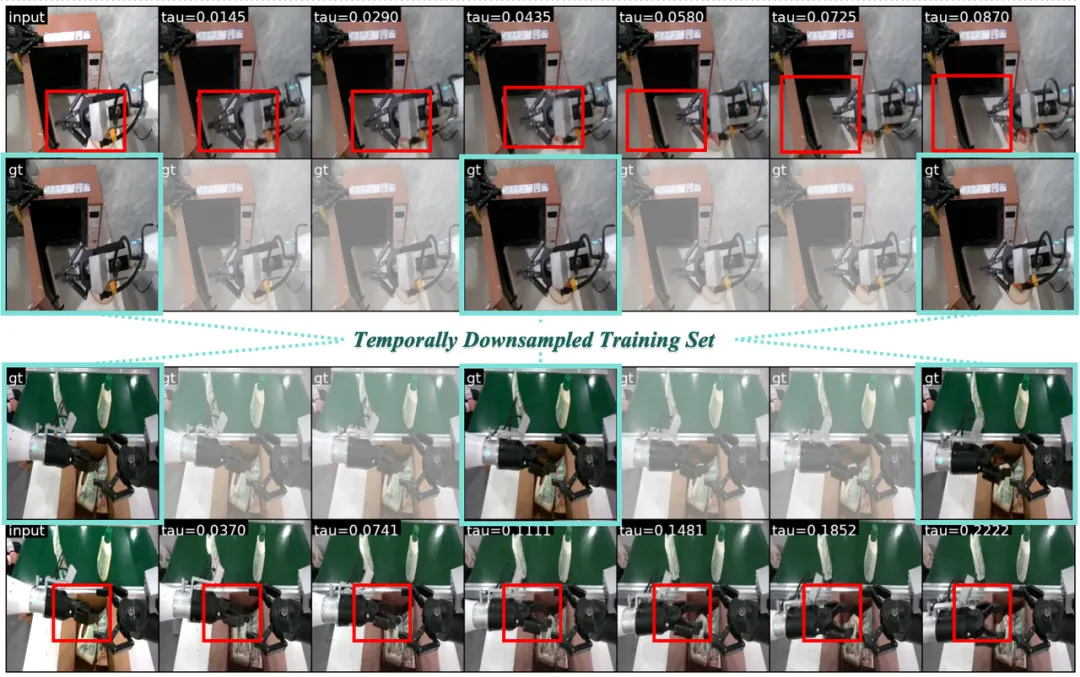
The second is time-completion. The paper reduces the training sequence to one-third of the original torque rate, and ODEWorld is still able to query the intermediate moments that are not provided by the training data and generate a coherence state. The "completion" here is not a simple pixel insertion, but decoding the corresponding moments from the learned sub-space dynamics trajectory.
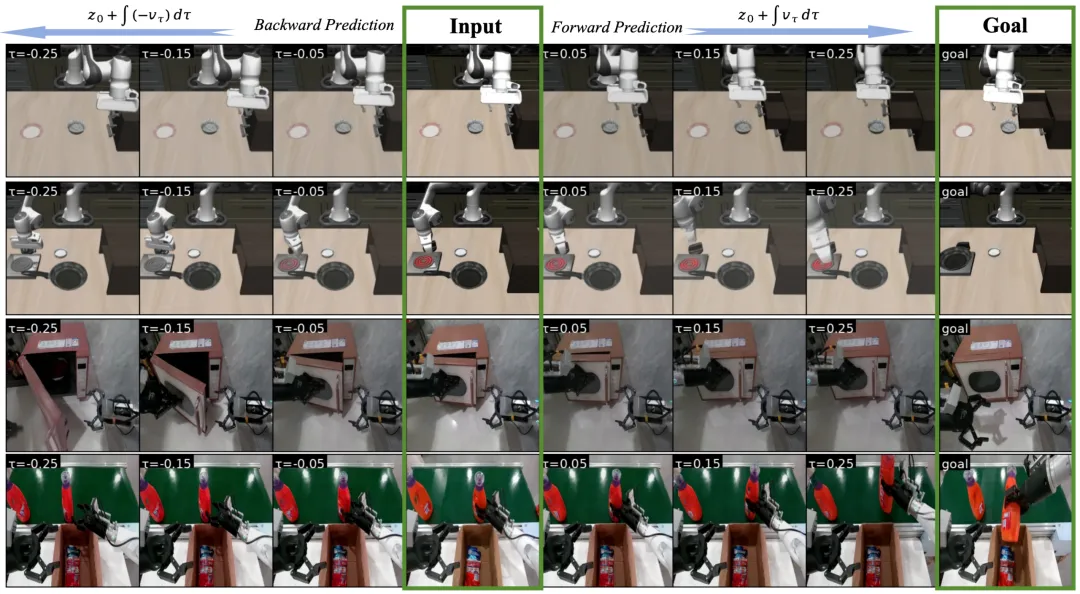
The third is reverse generation. Reversing the point direction means that the same speed field can generate a physically reasonable reverse sequence. This does not mean that the model can restore any system's unique, real history, nor does it mean that all real-world processes are strictly reversible; it indicates that the sub-space flows studied by the model can perform stable numerical points in the opposite direction.
64 tonnes predicted fasterLong-range images are also more stable.
The efficiency of ODEWorld comes first from the compression of representational space.
It does not repeatedly predict on high-dimensional or full-vision features, but instead concentrates motion-related information in a dynamic token that resolves state changes over time in this compact subterranean space. Large amounts of background and external information remain essentially unchanged in the adjacent mirror, so there is no need to recalculate each step of the prediction.
The second layer of efficiency comes from the speed field itself.
Because the dynamic state has been compressed, the network responsible for describing the rate of change of the sub-state requires only a three-layer MLP, without having to rely on a huge step-by-step generating network. The ODE solver completes the entire trajectory in the low-dimensional sub-space, only when a specific image is required to be output, and the model restores visual results through the dynamic decoder and image decoder.
In other words, ODEWorld primarily uses computation to "how the world changes" rather than recreating the entire world at every point in time.
In the LIBERO video prediction experiment, the short-term and long-term prediction results of the various methods are as follows. PSNR measures the proximity of the predicted image to the real image at the pixel level, the higher the numerical value; LPIPS focuses more on the structural and semantic differences perceived by the human eye, the lower the numerical value.
In the short-lived 16-tonne forecast, ODEWorld reached 20.53 PSNR and 0.109 LPIPS; when the forecast range was extended to 64 tonnes, the two indicators remained at 19.46 and 0.134, both better than LDP and V-JEPA 2.
When 64 tonnes are produced, the delay for LDP is 3.953 seconds, V-JEPA2 is 0.619 seconds, and ODEWorld takes only 0.072 seconds to produce about 1/55 of LDP, 1/8.6 of V-JEPA2 and 1/8.6 of LDP.
Compressing dynamic representations to single tokens and completing sequential scores with light-speed fields not only reduces the representation scale within the model, but also translates into end-to-end predictive efficiency.
From the forecast of the next waveTo the modeling of change itself
The most important significance of ODEWorld is not just the performance hints of extreme compression, but the shifting of the study objects of the world model from "mapping between discrete states" to "rate of change of state with physical time".
Static dynamic decomposition clears representational spaces for continuous dynamics; JVP projects the changing speeds in discrete video as observable subspace guides; single-token and light-speed networks allow ODE scores to run at low cost.
In terms of physical intelligence, this change is perhaps more worthy of attention than "a few more predictions". What robots really need to understand is not what pixels the static world is made of, but how the world is changing as it approaches, touches and moves an object, and where this change will take it next.
When the world model begins to directly study these changes, it is only when the future is predicted that it will be possible to gradually emulate and move further towards a continuous dynamic evolution.