For most people, wrapping is simple: one hand is topped, one hand is topped, one hand is topped, one hand is topped, one hand is topped, one hand is topped, one hand is topped. Few people realize that in this process, the hand always carries a deforming sheet of leather, the fingers constantly feel the feedback of the material and the leather, and the two hands must be joined at the right time.
This kind of daily human-made action is very difficult for robots. But now, these difficulties are being overcome. Now, in a 1 minute, 12 seconds video, a pair of robots have successfully completed the process.
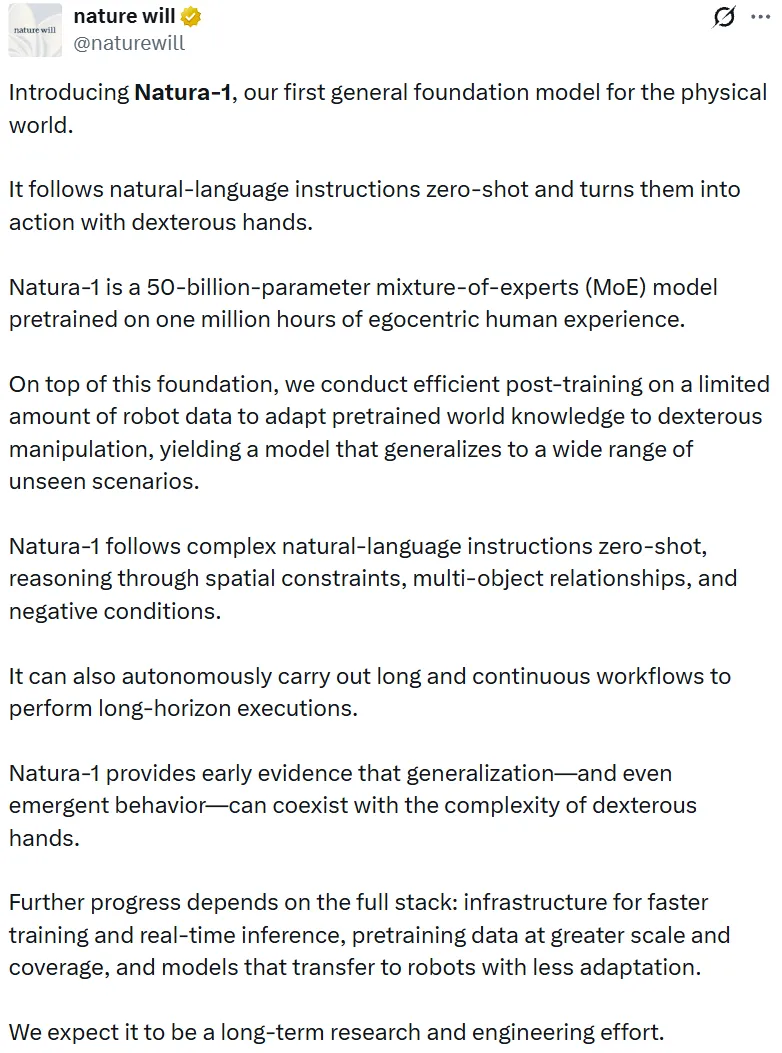
The two hands are powered by the newly-released Natura-1 by Beijing-based Intelligent Will, a 50B-parameters hybrid MoE model, which has completed preliminary training on 1 million hours of first-person perspective human experience data, with language and visual input to drive 20 degrees of freedom in control circuits of 100 milliseconds.
The answer is "can't do it right". Natura-1 wants to answer another, more difficult question: can it do it directly instead of a task that has never been practiced?
Flexible and general, difficult to reconcile
The human hands have more than twenty degrees of freedom, everyday objects are often soft, easily deformed, bounce back, each touch changes the state of the object, robots can only do marginal tuning; but the difficulty is also obvious: the complexity increases with the degrees of freedom.

The freedoms and combinations of parallel claws and clever hands, created by AI
According to the Nature Will team, much of the work done in the past has been on the same side: either as a general strategy aimed at clawing clawing or as a flexible operating system designed for a single task.
At this end of generalization, there have been some important advances, such as π0.7, but to achieve this universality with the finer hand, the first thing to do is to rely on data.
The Nature Will team also pointed to a more fundamental cycle: a robot can only collect data where it will already be working, and it can only work where it already has data. To break this cycle, data must come from outside the robot.
As a result, more and more teams are focusing on an existing data source: humans themselves.
In February this year, EgoScale, published by agencies such as Invidia, used 20,854 hours of first-person view human-operated video pre-training of the VLA model to observe the linear relationship between data size and verification losses; the average success rate was 54% higher after deployment of the 22 degrees of freedom on the agile hand than the baseline without human data pre-training.
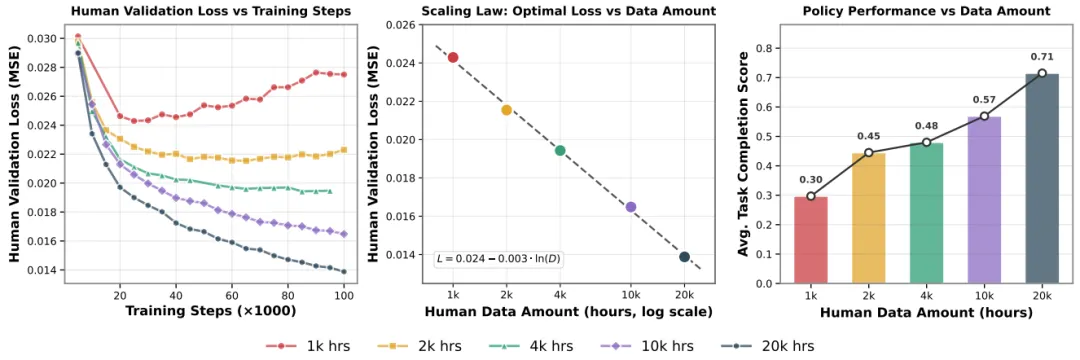
Human pre-trained Scaling behaviour, which best verifies the functional relationship of loss at convergence with changes in the size of human data, reveals the near-perfect linear Scaling Law, arXiv:2602.16710.
Half a year later, this scale was increased by about 50 times. On August 10, American robotics company Dyna Robotics released the world's first-person shooter model DYNA-2, which used more than 1 million hours of first-person human video in pre-training, with no robot data at the pre-training stage; according to Dyna, the data gradually grew from 1000 hours to 1 million hours, with the average convergence score on 14 robot missions rising from 20% to 53%.
The Scaling Law of the Dyna-2 world-action model is based on human video data ladders ranging from 1,000 hours to 1 million hours.
Nevertheless, the two projects did not bypass the same link: putting human experience into specific tasks still required additional adaptation. EgoScale relies on a small number of people to coordinate data for intermediate training, and DYNA-2 used up to 10 hours of robot data for each assessment mission.
The human experience has been shown to be scalable to robots, and the next question is: Can these experiences, in a handful of hands with a high degree of freedom, be adapted to the task without moving directly to the new task?
Natura-1
One model, two capabilities
Natural Will was founded in January 2026 by Dingning, an assistant professor in the Department of Electronic Engineering at Tsinghua University, a research-based company that focuses on a basic model of the physical world. It set itself the goal of General Physical Intelligence (Physical AGI): training to complete general basic models of perception, prediction, reasoning and movement in the real world.
The Nature Will team tells the machine's heart, which comes from two judgments:
It is possible to create a general basic model of the physical world;
Human first-person perspective data is already being collected on a large scale.
The methodology behind these two judgments extends from the LLM study that models, data, and infrastructure need to evolve together. The Nature Will team tells the machine heart: "We've followed the idea of model scale and data scale combined growth in big-language model research.
Natura-1 is the first general-purpose model of the physical world of the natural will. Its training is divided into two stages: pre-training on 1 million hours of human experience data, followed by an efficient post-training with limited robotic data to adapt the world knowledge learned in pre-training to agile operations.
Unlike many systems that break down "understanding instructions", "predicting the world", and "generating action" into different modules, Natura-1 is a single MoE Transformer that combines language, image, video, and action training. It targets two capabilities:
Flexible handling, using hands to accomplish multi-finger synchronization, object gesture adjustment and complex touch;
The zero-sample instruction follows, faces unseen scenarios and tasks, completing operations directly based on natural language instruction, including handling space constraints, multi-object relationships, and negation conditions.
What can Natura-1 do?
The Nature Will team tested Natura-1 from three levels:
How thorough and durable can long-term mission exploration be after a skill has been trained?
Can a zero-sample test-examination model be effective in dealing with untrained tasks?
In the latter part of the record, what is known as emerging capability, is that when a task goes wrong, can the model come up with a solution on its own?
Here's how to do it: A six-piece, one-piece long-distance mission
In addition to the packaging, the Nature Will team released five other demos: brewing tea, making yogurt bowls, packaging for delivery, sticking cell phones and writing pencils, the longest of which lasted more than three minutes, all at the original speed, a mirror at the end, without artificial intervention. Each episode contained multiple subtasks, with robots continuously processing liquids, particles, soft tools and soft materials in the same process.
For example, the three-minute adhesive film of the phone, Natura-1, first wipes the screen, then puts the pre-installed protective film on the counter-frame handle, with both hands tightly pressed; then one hand reaches the phone and counter-frame on the screwdriver, the other hand continuously pulls out the isolation film, and finally pushes the finger along the edge corner to push away the bubble.
When packing for delivery, it switches between crawling between lafferty, furry toys and laptops, with one hand pressing against the rebounding case cover, and the other hand pushing the casing, and finally labeling and scanning the barcode.
While these actions are performed, while changing the shape and contact conditions of objects, the model must be constantly modified based on real-time feedback rather than following a fixed trajectory.
It should be emphasized that these six demonstrations show the depth of operation of the task after fine tuning. To see if the ability can be brought to untrained tasks, see zero sample testing.
Zero samples: Untrained tasks
The Nature Will team told the machine's heart: "What we're talking about here is Zero-shot, which means that after the model completes pre-training and post-training, it no longer collects data specifically for testing tasks, adds training, and receives instructions and executes them directly".
The team built a set of benchmark tests covering 12 capability dimensions, and the test tasks and their scenarios and combinations of actions did not appear in the post-training data; alongside each test video, they also released the closest demonstration of the training focus to the outside world to judge the difference. For example, one task required putting an apple in a bowl, putting a bottle on a tray, and then moving the tray, while the training set only included "picking up fruit and "starting a ready tray". Natura-1 combined them and the tray did not touch the other tray next to it.
On this benchmark, π0.5 and OpenAI's GPT-6 Astra (which serves as a control strategy in writing code) failed to score on the agile platform; they received 13.5 and 16.7 points respectively, while Natura-1 scored 53.4 points on the agile base and 59.1 points on the agentic platform.
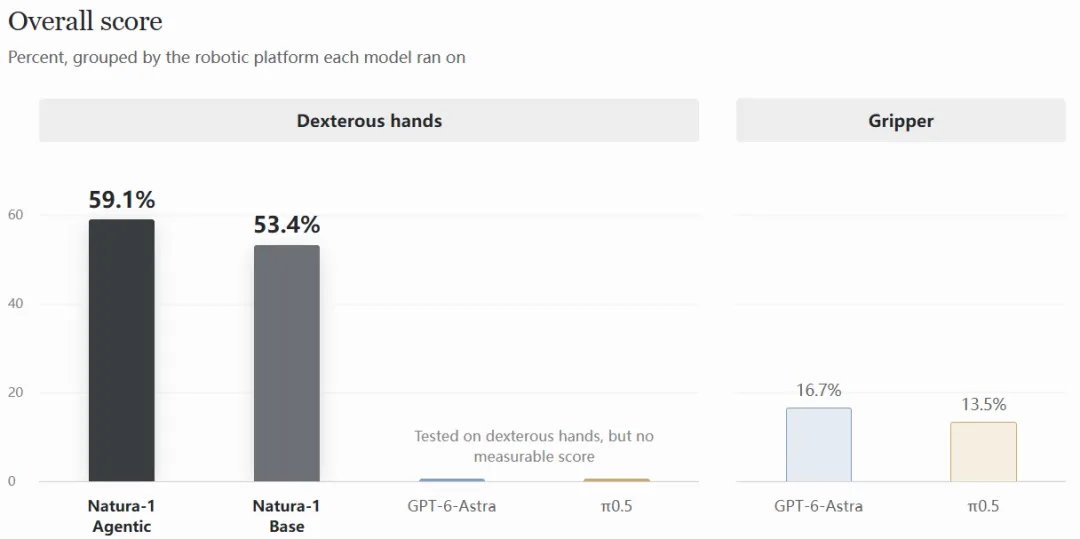
Not only that, but the advantage of Natura-1 is also evident in its execution time.
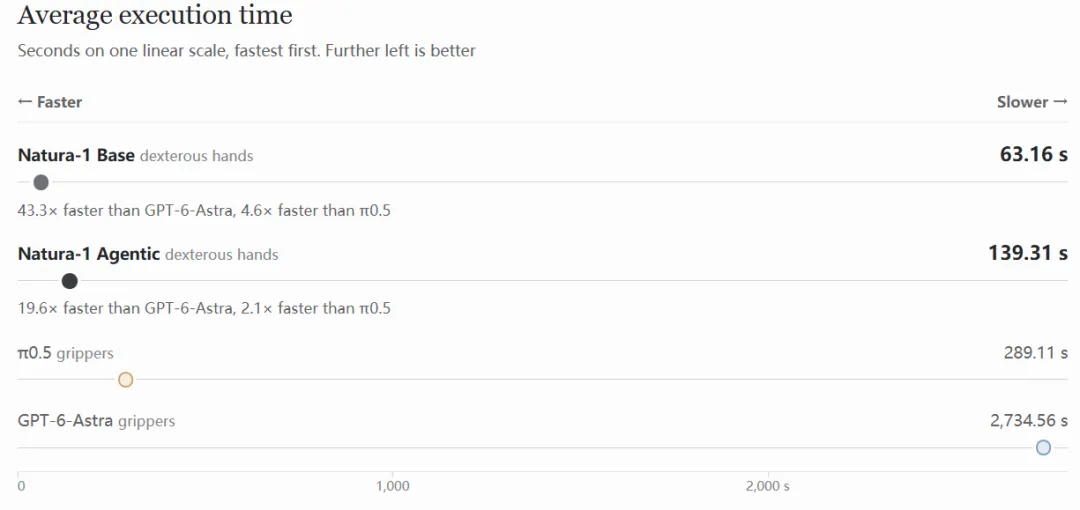
The team also tested using the researchers' daily temporarily conceived opening instructions, and many of the subjects were deliberately drilled. For example, putting a toothbrush box and a water bottle in the tub, the instructions requiring both hands to be placed at the same time, first left and then right and then left, first right and then left, were executed as requested by Natura-1.
For "not seen", the team gave a limitation: "Pre-training data coverage is wide, which may already contain relevant items and operating experience, so 'not seen' here is mainly relative to post-training". Their example is pressing the blank key on a laptop: post-training data does not have this task, but similar actions may have occurred in human videos.
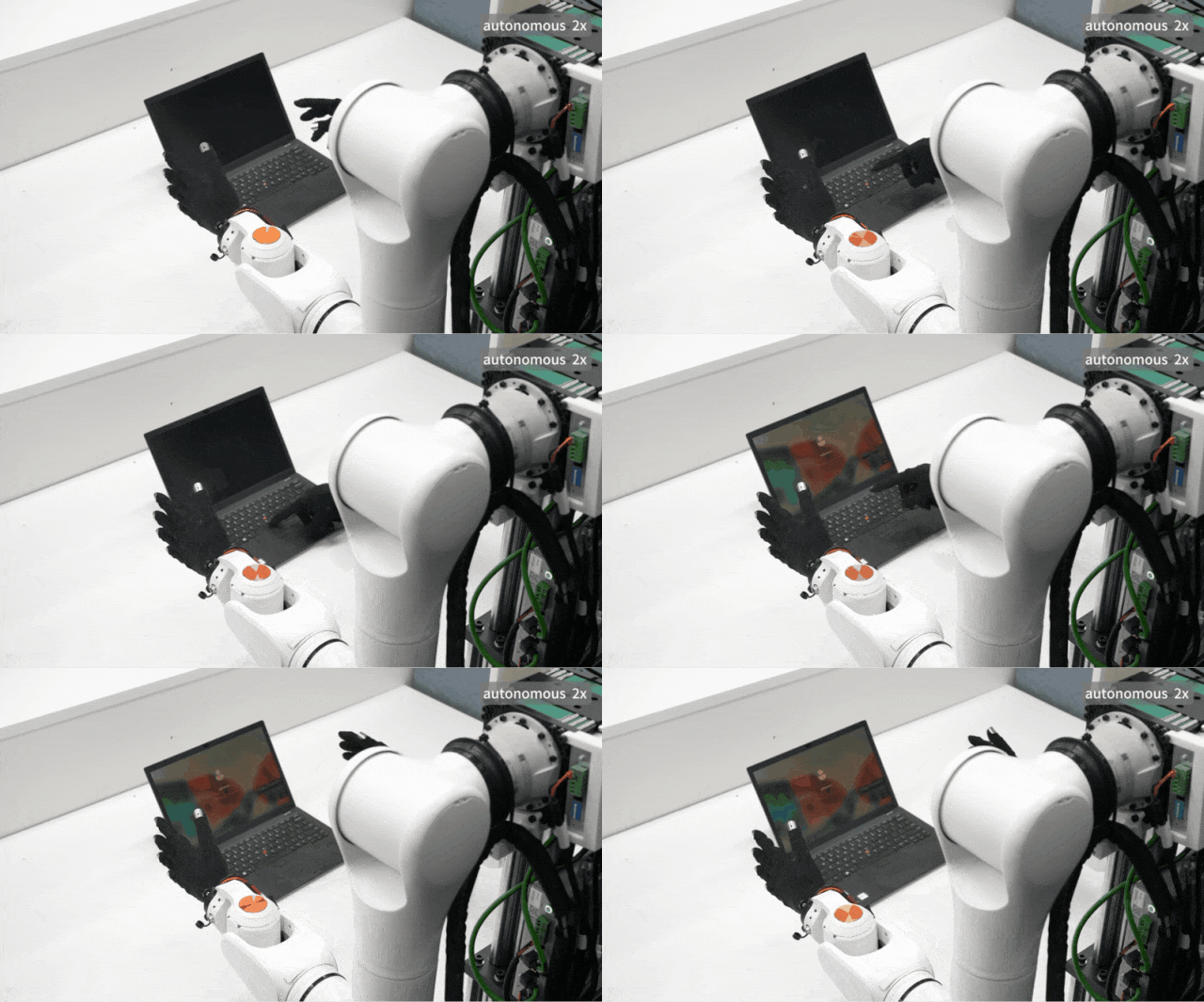
This is zero-sample on the meaning of this route: the experience in human video can be directly summoned to the real machine when there is no corresponding robot data. In the team's words: "What we are concerned about is not only changing an object that can't be grabbed, but also whether we can organize and complete tasks that are already capable in the face of untrained task requirements".
Unforeseen emergencies
The team also observed some behaviour that was not part of the testing plan.
In one deliberate setting, a basket with yarn was placed on a staircase that could not be reached with a long rod in its hand, with only one instruction: "Try to grasp the yarn". Natura-1 grabbed the basket with a long rod and pulled it closer, with one hand holding the long rod and the other hand pulling out the yarn.


The team recalled that the data was smaller in size, the model didn't catch up, but the hand continued to move as planned; after the scale was expanded, it began to adjust in time, to try again. The Nature Will team told the machine's heart: "We didn't intentionally collect this kind of failure recovery demonstration in post-training, but the model still showed recovery capabilities. Our judgement was that large-scale human pre-training data contained a wealth of adjustment and retesting experiences from which the model learned how to respond to changes in operation".
The team also admitted: "This is a phenomenon that we observe as we scale up training; specific capability sources and mechanisms need further research".
Where did the ability come from?
In the view of the Nature Will team, long-range agility and zero-sample generalization "doesn't happen by chance". Human experience is abundant, but only raw material, to turn it into a robot action that requires data, models and infrastructure to be designed together:
Data is responsible for monitoring the language and actions of each video
The model is responsible for learning as much as possible from each track.
Infrastructure needs both massive training and reasoning in 100 milliseconds.
The data
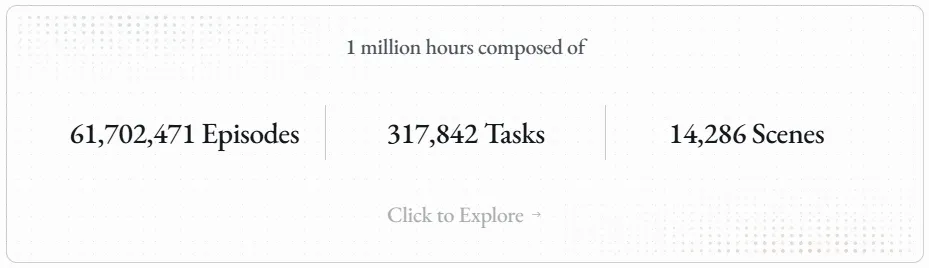
Natura-1's training data is 1 million hours of first-person human experience after being screened, and includes approximately 61.7 million clips, 31.8 million missions and 140,000 scenes, mainly for controlled collection, supplemented by Internet first-person video.
The team uses a structured task classification system and intelligent body workflow analysis to cover gaps and redirect the collection priorities to scarce areas. Original video can be transformed into a "video clipping language clipping" trajectory after cleaning, rebuilding, and layered language labeling. On an internal basis, its self-development to rebuild pipelines is 41% less than existing open-source methods.
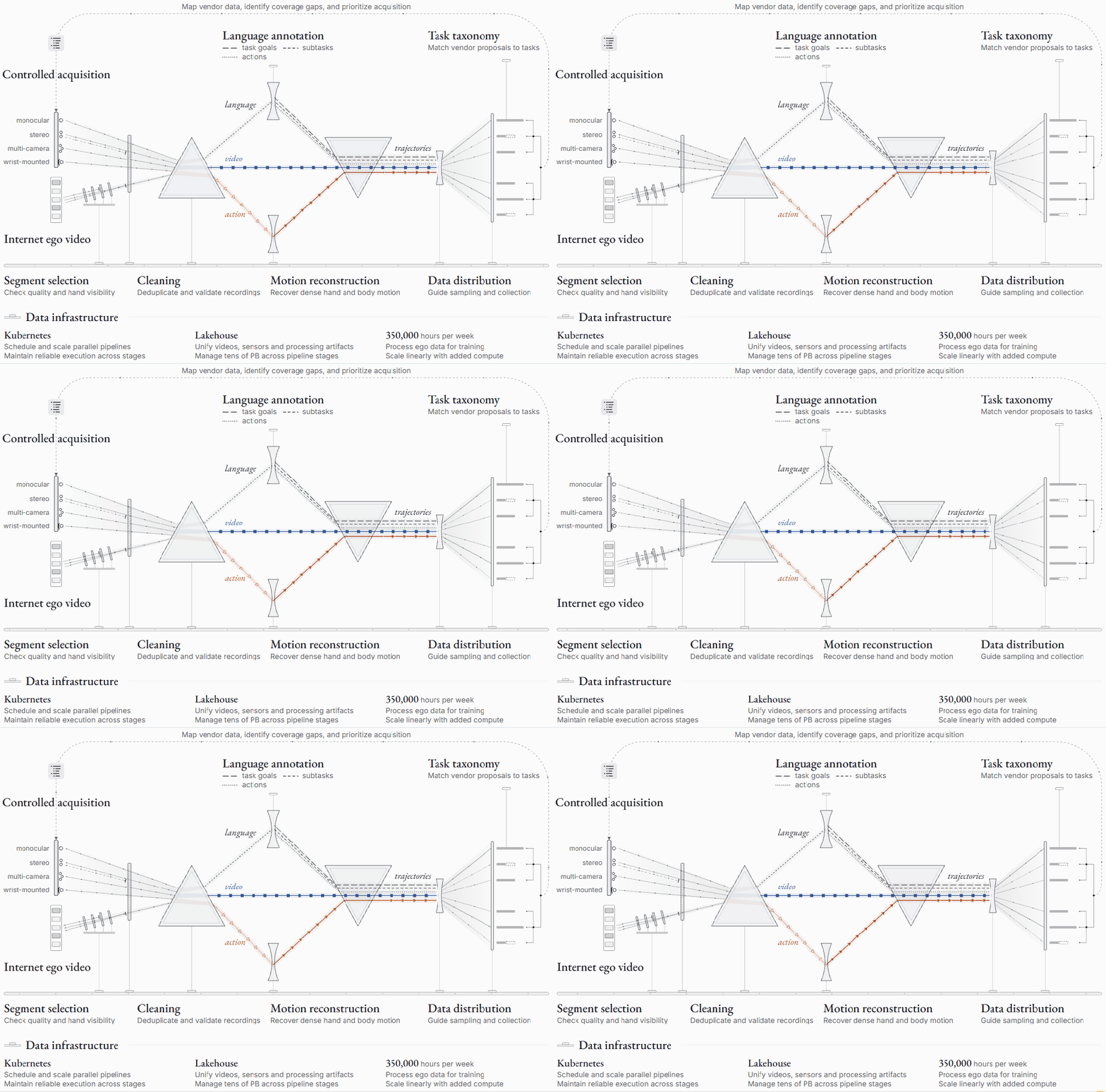
Natura 1 data system map
Choosing human data and choosing smart hands is the same decision. The Nature Will team tells the machine heart: "Many of the tools and operating methods in the home and industrial scenarios are designed around human hands, and we want robots to be able to adapt to these tools, rather than re-engineer tools and processes every time they enter a scene".
Infrastructure
"Make everything scalable" is the technical concept of the Nature Will team:
On the data side, the data warehouse manages dozens of PBs of data, producing 350,000 hours of parallel pipelines per week based on Kubernetes, consuming nearly linear growth with computational power. The team explains that the pipeline's design goal is: "When the amount of data increases tenfold, it can still be processed in close proximity to the original time by adding about ten times the resources accordingly, without having to rebuild the entire system".
On the training side, the self-development framework achieves more than 50% model computational utilization on hundreds of GPUs, and the self-development attention calculator's throughput is more than 6 times that of FlexAttention after optimization.
On the logical side, the Rust rewritten service framework presses end-to-end delay to 100 milliseconds to meet real-time control.

"The idea behind this is consistent with the infrastructure of big-language models: data and model scale will continue to grow, and systems need to be prepared in advance for that growth", says the Nature Will team.
Models
Natura-1 ranks the entire mission segment into a sequence of language, images, video, and action tokens, with the backbone modeled after the standard MoE Transformer.
Its core idea is to see video and action as two projections of the same physical state: action labels are scarce, but video is rich, models use past videos as memories, predict future videos, train video and action simultaneously with flow matches, and gain more control from each trajectory. In order to prevent models from looking only at images, ignoring instructions, pre-training also uses fine-grained descriptions to make the language "burdened, making different intentions fit different predictive outcomes".

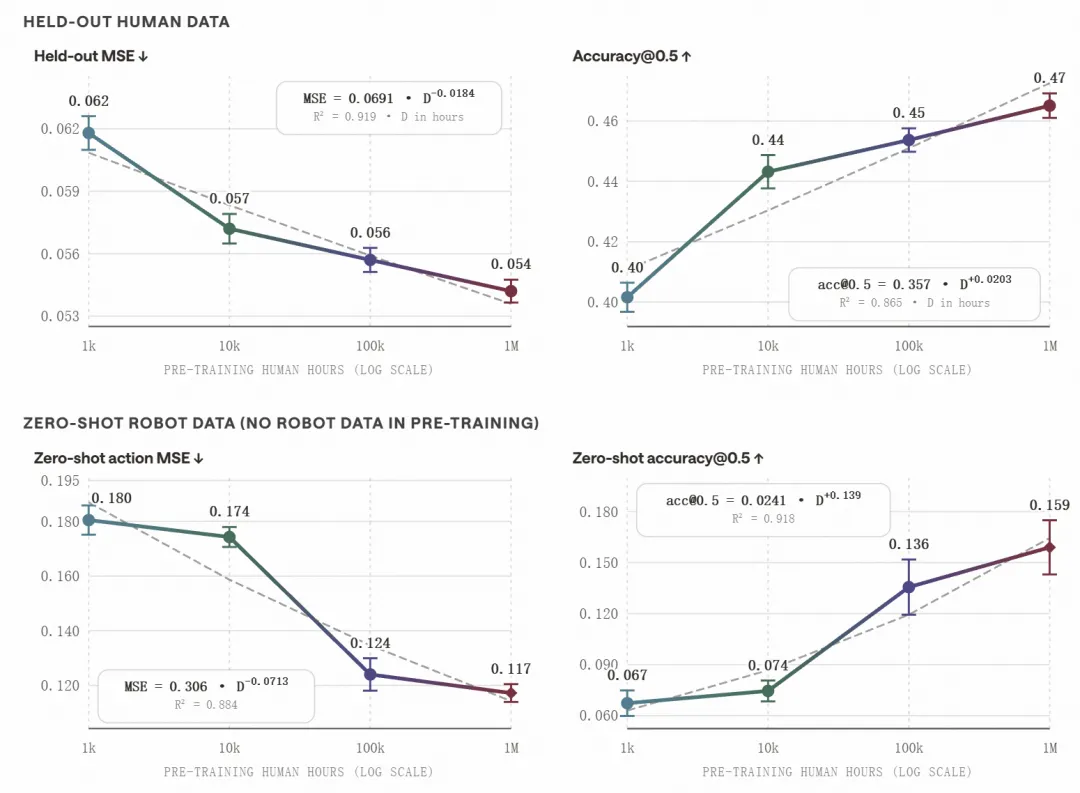
The Scaling Curve shows that the training experience increased from about 44,000 hours to 1 million hours, with a 47.7% decrease in the model's prediction error of movement on human data (MSE); and a 67.7% decrease in the same weight on machine data. Both are prediction errors under Teacher Forcing, not mission success rates, but show that the increase in human experience can indeed be transmitted to robots.
The Natura 1 Scaling Curve
What is the meaning of this verse?
Natura-1 has already provided early evidence of how subtle and universal coexistence can be achieved. As for the next stage, the Nature Will team tells the machine heart: "Our core goal is to continue to improve the model's ability to generalize across different tasks and scenarios, and to make it more reliable for complex tasks in the real world".
The team said the goal is to move from "being able to complete the partial steps" to "doing the whole thing steadily, efficiently". For this reason, they plan to incorporate tactile information into data and models, pre-train on larger data, reduce adaptation costs when migrating to robots, and allow models to run on cheaper hardware.
Looking at the larger industry context, this route in Natura-1 is becoming increasingly commonplace from the betting of a small number of teams. In June, a study called HumanScale compared two pre-training data at the same data scale and found that first-person human video can outperform remote-operated virtual data, with the most obvious advantages in distributed decentralization. Dyna Robotics, which released DYNA-2 in August, said the next step was to expand the training scale to 1,000,000 hours.
When millions of hours are no longer scarce, the focus of the puzzle is shifting: whether the same human video can be reconstructed into action, labelled into language more accurately; how much adaptation the model takes to fall on the robot; and what kind of entity to choose to take on these experiences. Natura-1 is betting on a combination of the most difficult to take on the human experience with a sophisticated pair of high-freedoms and allow the same model to face untrained tasks directly. This path can go far, both depending on the stability and cost of the sophisticated hand, and whether the Scaling curve of human experience can continue.
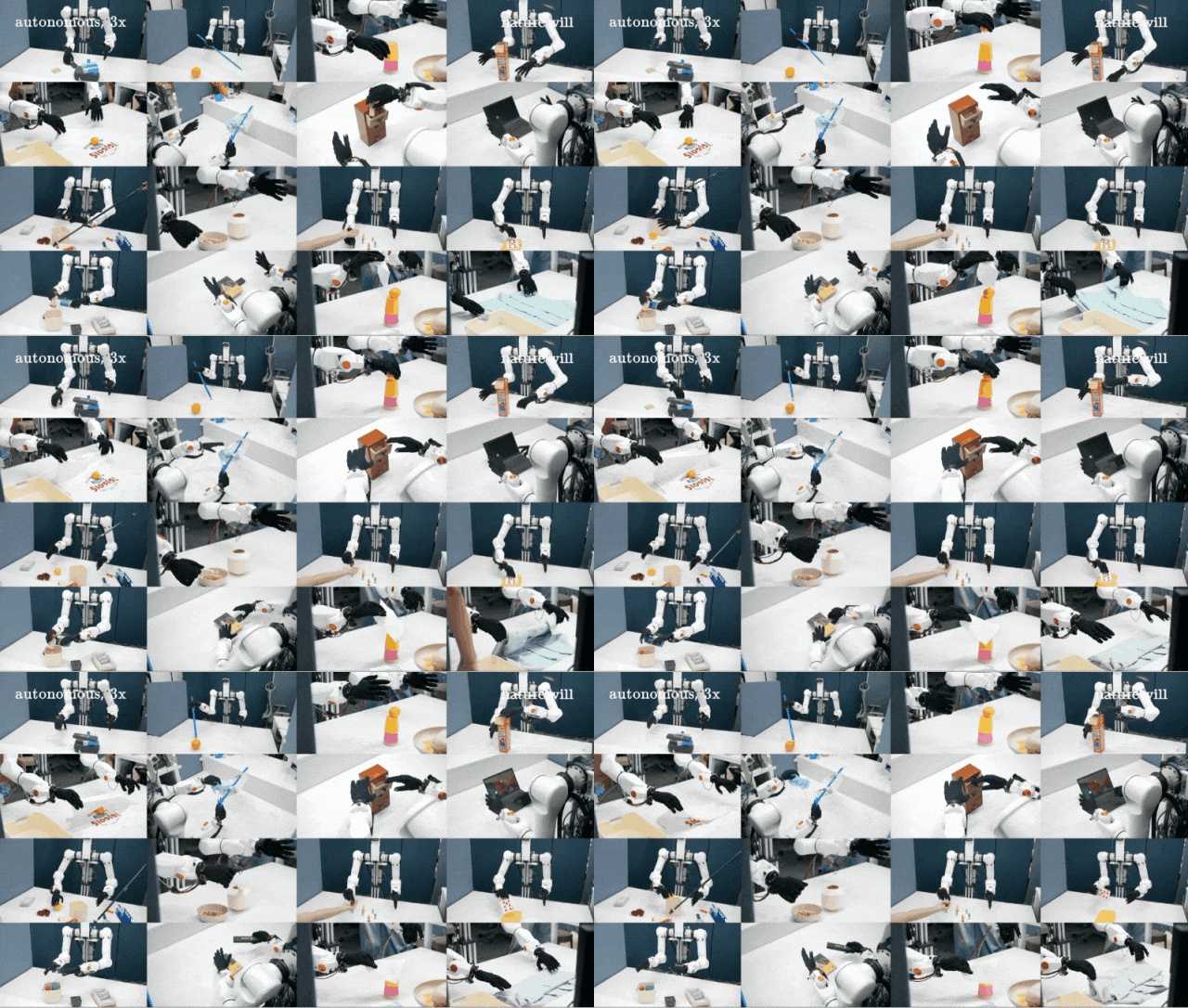
In a world that is hand-crafted and hand-held, how far can humans learn from their hands to make robots go?
Reference links
The official blog:
The official website:
The official tweet:
© THE