The task was simple: to put a heated cup in the cabinet. A smart body first put the cup in a microwave oven, then put it in the cabinet, and then fell into the loop of repeatedly checking the cabinet. This inefficiency was repeated 36 times until the operation budget was exhausted, and the task was still not completed.
This is a real case demonstrated in the paper in the ALFWorld simulation mission: the Raw Trajectory baseline, which uses a complete history of interaction, still fails after 50 steps, while the PoS completes the same task in 17 steps.
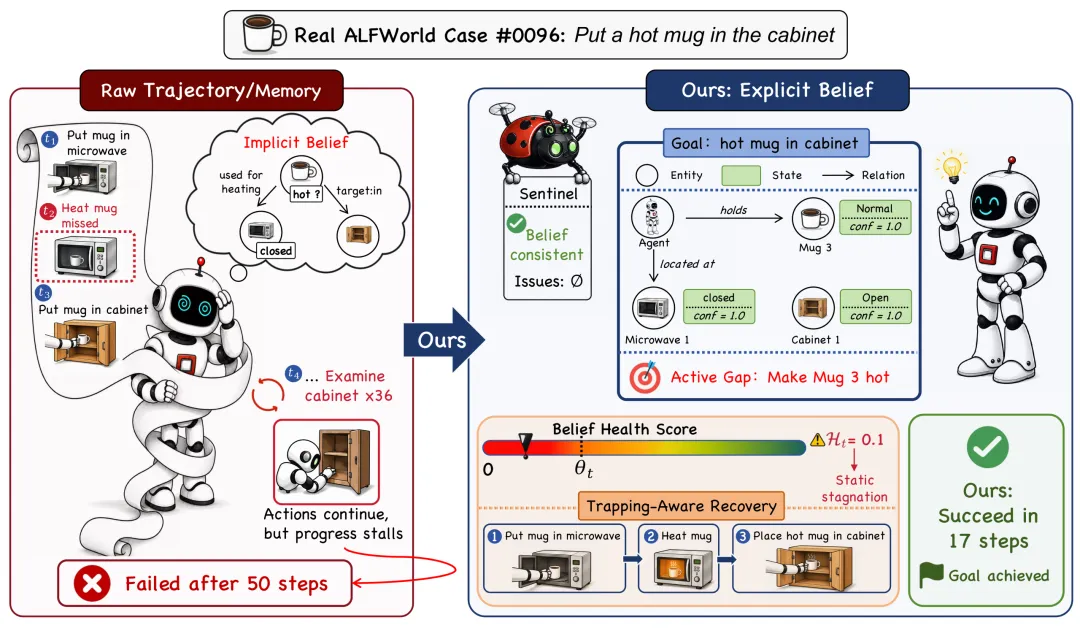
Figure 1 Two execution paths in the heating cup task. Continuous check of the cabinet after the original trajectory baseline leaks the heating link; PoS explicitly retains unfinished heating requirements and guides recovery when stagnant.
The smart body is still calling tools, receiving observations, generating next-step plans, seemingly always working, but the key requirement is not always being pushed forward. Similar difficulties occur in other interaction tasks: the GUI Agent repeatedly clicks and the interface stays in its original location; the Coding Agent reads the same files over and over and over again, with no valid modifications and verification. The operational records continue to increase and unresolved problems remain.
A team of researchers from institutions such as Nanking University's Unified Aliyuan University clarified the problem as Belief Trapping: the intelligent body continues to interact with the environment, but the evolution of beliefs related to goals has failed to bring meaningful mission progress. It can either manifest itself as native repetition, or it can be cycled between several states, or continually explored without touching on a truly unresolved problem.
To this end, the research team proposed PoS (Progression of States) which continues to maintain a state of clear belief, recording the current world and unresolved demands. On this basis, it uses Belief Health to measure mission progress and implement Trapping-Aware Recovery based on trapped patterns and gap types after detection.
In a set of 12 sets of experiments consisting of four benchmarks, three basic models, PoS's overall indicators were higher than other methods of comparison in the paper. The question behind this result was also specific: how to turn a long-time busy Agent into a computable, diagnostic, and intervening process?

Beyond Memory: Harnessing Long-Horizon Agents with Explicit Belief States
Research institutes: Yunnan University, Ali Yun, and Qinghai University
Address of the paper:https://arxiv.org/abs/2610.01415
The main page of the project:https://luoyu100.github.io/projects/progression-of-states/project/
Open source code:https://github.com/luoyu100/PoS
History is growing
The current state of affairs is not necessarily clearer.
Information on long-range missions will be outdated. The cups were just in the microwave and may have been removed, a tool call expresses what to do, a return observation shows what actually happened, previous rounds of judgments seem reasonable, and may be overturned by new evidence.
Complete trajectories preserve the order in which things happen, and memory and compression mechanisms help to filter and organize these records. They provide an important evidence base. However, each time a selection is made, the intelligent organism still needs to rewrite the dispersed information into an understanding of the current task to determine which conclusions continue to be drawn and which have failed.
PoS illustrates this step. Here, the hypothesis of the hypothesis is that the intelligent body is based on a current understanding that has already been established, with both direct observations and inferences still to be tested. It can be updated, checked, or it can be wrong. To judge whether a task is advanced, one must first have a current state that can be compared across time.
Putting the current world and the rest of the demands in the same state
The first step is to clarify what the current situation is. PoS uses entities, states, and relationships to organize the world related to the mission: cups, microwave ovens and cabinets are entities, whether the cup is hot, whether the microwave ovens are closed, where the cup is located, by whom it is held, is expressed through relationships. Status and relationships also retain sources, confidence, and available supporting evidence to facilitate further verification.
This indicates that only information is retained that affects the action, judgement of the outcome and the completion of the goal. For example, the task of the heating cup requires remembering the temperature and location, and simply recording that the cooker has ever operated a microwave oven is not enough.
The second step is to clarify what's wrong with the glass. PoS divides the unresolved requirements into two categories: information gaps (Epistemic Gap) are things that need to be clarified, achievement gaps (Achievement Gap) are things that need to be changed through action.
This classification is also applicable to diagnostics. When checking service failures occur, waiting for a database or processing within the JVM to cause a delay is an information gap. The next step should be to look for evidence that distinguishes between the two explanations, rather than continuing to collect logs unrelated to judging.
In the face of multiple unresolved requests, PoS selects an Active Gap that is currently prioritized. Smart entities can still see the full state of the task, but the action has a clear focus.
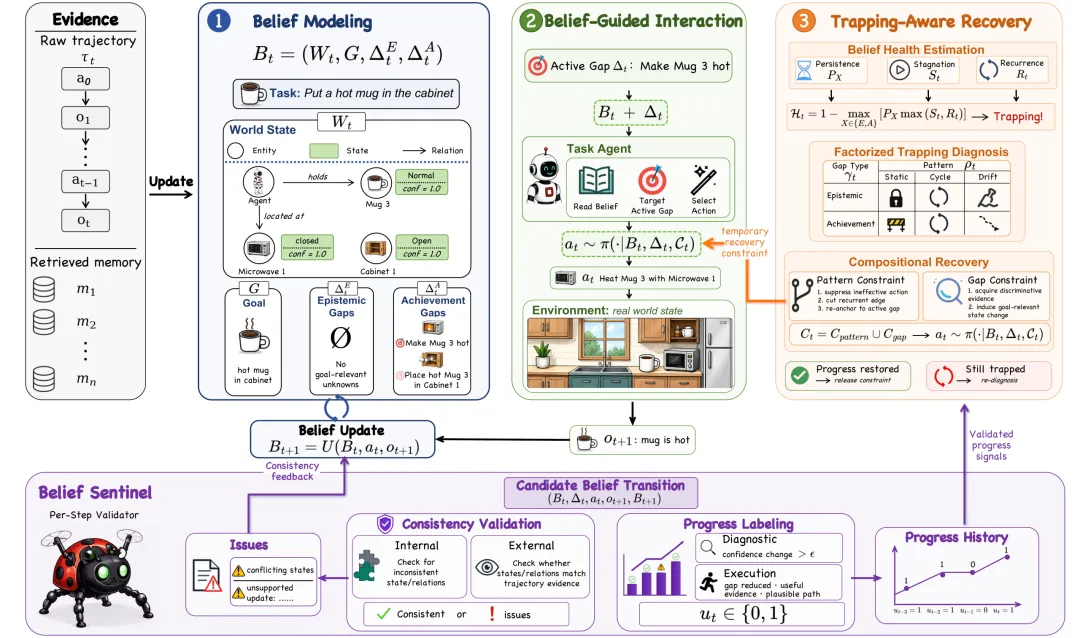
Figure 2 PoS's overall process. The left-hand side constructs the current world and unresolved requirements, the middle selects actions around the Active Gap, the bottom Belief Sentinel checks updates and records progress, and the right-hand side generates temporary recovery constraints when stuck.
The State of Writing
It is also necessary to verify the evidence.
After a state of explicit recording, a problem needs to be solved: the state itself is also generated by the model. If it writes in the wrong judgment, subsequent decisions may continue on the wrong premise.
Therefore, once the action returns to the new observation, PoS first generates the candidate update and then checks it to Belief Sentinel. It mainly checks for two things: whether the update is self-contained internally, and whether the update is supported by evidence of interaction. For example, the same microwave boiler cannot be marked as open and closed at the same time, only seeing the cups put into the microwave boiler is not enough to establish the fact that the boiler has already heated the boiler.
After the discovery of the problem, the intelligent organism combines the evidence to modify the update, and after the state of validation enters the follow-up decision. In public implementation, if the correction has not yet been approved, it retains the previously submitted state. This also provides a premise for the test in difficulty: first verify whether the state changes are credible, and then judge whether these changes constitute progress.
However, internal self-confidence, which is compatible with observation, does not mean that the task must be moving forward. The intelligent body can remember precisely that the cup is not yet hot, and then continue to look at the cabinet.
How Belief Trapping Became a Calculable Problem
Multiple calls to the same tool may be collecting different evidence and, in turn, changing tools at every step, and may have been bypassing key issues. PoS is therefore concerned about whether or not validated beliefs are still changing to help the task when the requirements are not resolved.
It first observes the progress of the marking of each state shift, followed by three signals on the most recent K-tested shift. It observes the single-step progress of the execution of the task, including reducing the current gap, obtaining the necessary information, or advancing a reasonable completion path.
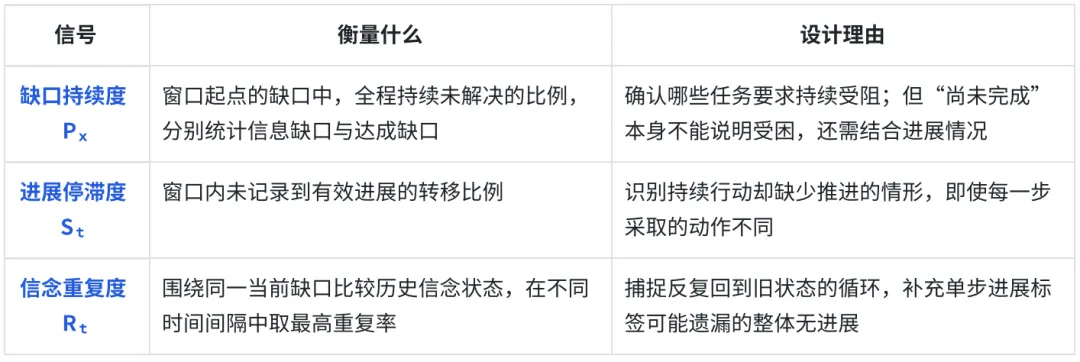
Based on these three complementary signals, PoS constructed an explanatory inspirational indicator called Belief Health:

Here, E, A, respectively, indicates that information gaps are associated with gaps being reached, the lower the health, the stronger the signal to be stuck. The principles followed by the combination are: continuous unresolved requests, which form a stronger signal to be stuck when progress stagnates or beliefs repeat together. The inner max maintains stagnation and stronger abnormalities in repetition, avoiding the dilution of one apparent sign by another weaker sign; multiplied by gap continuity, the abnormalities are associated with longer-term unresolved requests; the outer max focuses on the more apparent type of obstruction in the two types of gaps. Thus, tasks are not completed and do not trigger the stuck ones separately, while the individual sections are judged towards the progress labels, and cannot also mask the ongoing state cycle.
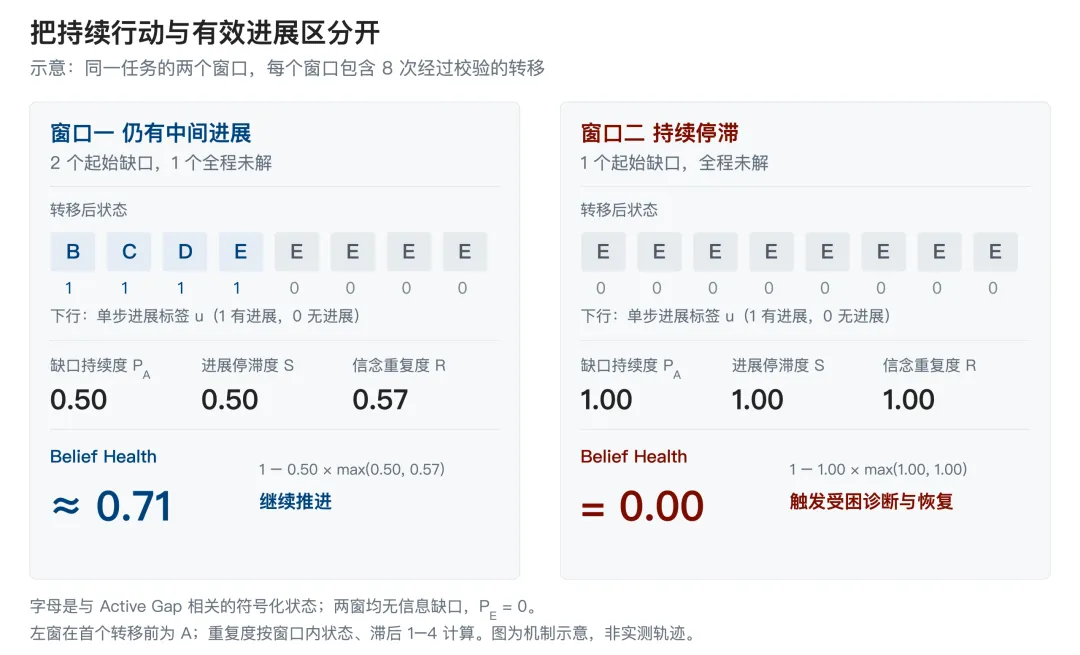
Figure 3 shows the health of the same task at different stages. The first window still has intermediate progress, and the second window only remains with ongoing unresolved requirements and repetitive states.
The paper is set to start testing after eight accumulated transfers of validated tests, entering a standoff diagnosis when belief health Ht is ≤ 0.25.
Trapping-Aware Recovery transforms trapped diagnoses into action constraints
PoS will break down the diagnosis into two dimensions: whether the patient needs intervention, the recovery mechanism, which behaviors should be changed, and what progress should be made towards recovery.
The first dimension is the behavioural pattern. Static indicates that the state of the world is unchanged locally, Cycle indicates a cyclic interstate loop that has occurred before, and Drift indicates that the state of the world, although changing, has not progressed with parts related to the current gap.
The second dimension is the blocked gap type. PoS compares non-empty information gaps to the continuity of the gaps reached, choosing a more rigid one: the former requires new evidence to be able to distinguish between interpretations, and the latter requires a real change in the status of the task.

In the formula, It's the default mode.
 The detection window indicates that X is the blocked gap type, and that Bt and Δt are the current belief and Active Gap respectively. The two groups of constraints have a common function: the pattern constraint is responsible for breaking invalid behaviour and the gap constraint is responsible for clarifying the progress that must be restored next.
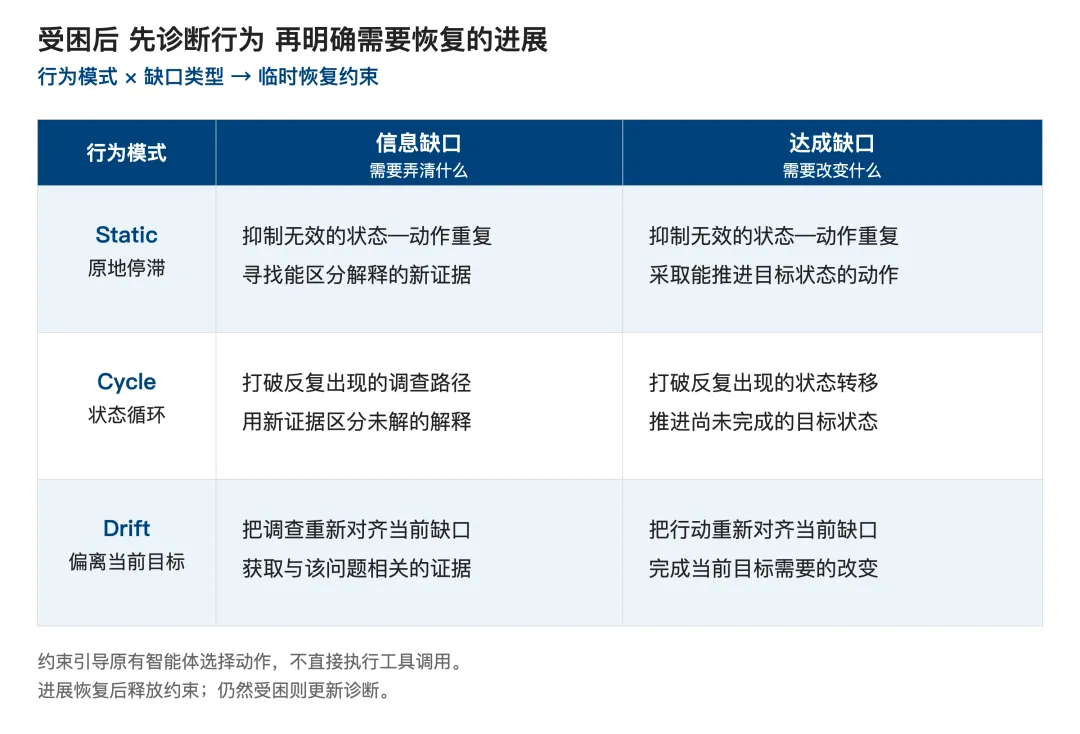
Figure 4 Trapped diagnoses simultaneously consider patterns of behaviour and types of gaps. How each grid combination matrix breaks the current pattern of behaviour matrix and matrix needs to restore which progression matrix to form a constraint on the next action.
Therefore, stagnation on the ground, constraints that suppress the ineffective state of the bowl movements, repetition on the loop, breaking the repetitive shift, deviation on the target, re-alignment of the Active Gap. They also have to be accompanied by another requirement: to obtain distinctive evidence, or to produce a change in the state related to the target. For example, in the cup task, it is not enough for the smart body to check the casing separately, and it is necessary to have subsequent movements to advance.

Restoration of constraints is given as an additional condition to the original intelligent body, by which it continues to choose movements, and the current Active Gap remains unchanged. After each new transfer and validation, the system recalculates the health of the system: above the threshold values, temporary constraints are released, while the remaining constraints update diagnosis and constraints.
The RCA-100 case t024 in the paper demonstrates this process. The Kimi-K3 smart body has found that inventory service slow requests occur at the same time as an increase in waste recycling activity, but is slowly unable to distinguish between the two explanations of database waiting and processing within the JVM. PoS identifies the stagnation + information gap at the origin, requests to stop ineffective repetition, and searches for evidence to distinguish between the two explanations.
The intelligent body then chose to inspect the CPU activity. Three low-progress movements occurred in the middle of the recovery process, after which the CPU evidence obtained together with observations of waste recycling contributed to the revision of beliefs. The operation carried out a total of 28 movements, with the final submitted inventory/memoryPressure simultaneously matching the fault entity and type of the benchmark label.
Four types of tasks, three models, improving the ability to reappear
The team evaluated PoS-ALFWorld and LOCA-Bench on two types of missions, requiring the intelligent body to complete the goal through multiple rounds of operation, while RCA-100 and ClinDiag required the intelligent body to continue to obtain evidence, complete a malfunction or medical diagnosis. The four benchmarks evaluated 134,525,103 and 604 cases, respectively, in which the overall results of LOCA-Bench summarized seven environmental description lengths.
The experiments used Qwen3.7-Plus, Kimi-K3 and GLM-5.3.[7] For each base model, the PoS execution, belief maintenance and test components used the same model to compare methods covering the entire trajectory, ACON, PACE, HiAgent, and LongHorizon-Harness, which explicitly maintains the task state. PoS did not need to update the base model parameters for these tasks.
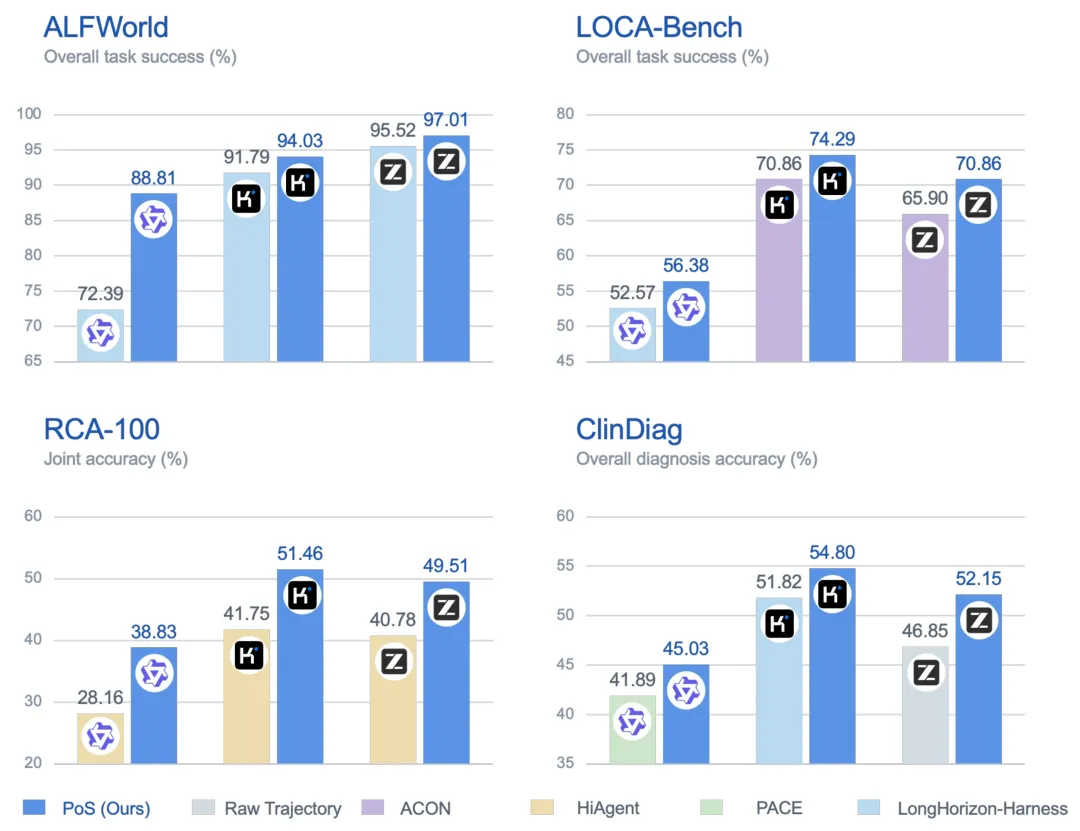
The four parameters on the left side of the paper teaser. Each group has the strongest contrast with PoS under the same base model; the icons correspond to Qwen3.7-Plus, Kimi-K3 and GLM-5.3 respectively. ALFWorld, LOCA-Bench for mission success rates, RCA-100 for fault type and entity combined accuracy, and Clindiag for diagnostic accuracy.
PoS achieved the highest overall indicator in the text comparison method in all 12 groups of metric parameters × model scales. In the example of Qwen 3.7-Plus, ALFWorld increased from 72.39% to 88.81% from the strongest controls, an increase of 16.42 percentage points, a relative improvement of 22.68%; the RCA-100 combined accuracy increased from 28.16% to 38.83%, an increase of 10.67 percentage points, a relative improvement of 37.89% respectively.
This group of results covers simultaneously the changes needed to make the world achieve its goals, and the use of evidence to gradually clarify the two mission structures. Further dilution and recovery controls are used to test: continuous calibration status, identification of trapped and imposition of targeted constraints, what each brings.
There are two components to maintaining the status quo:
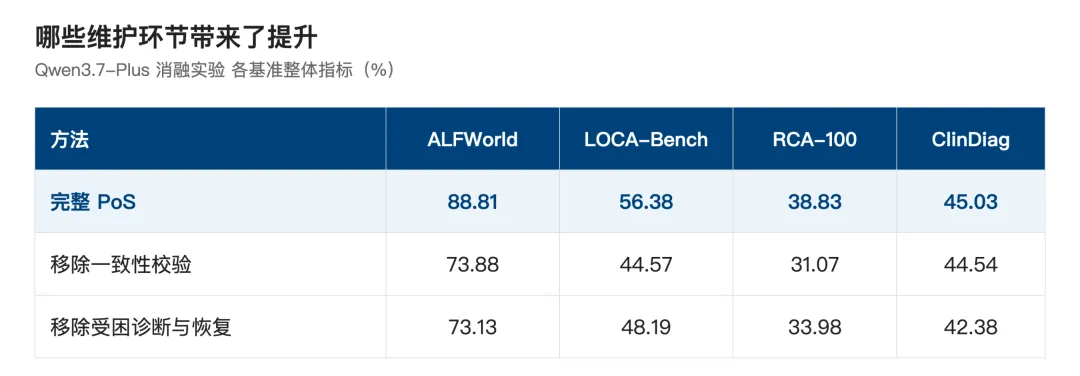
Following Table 1 Qwen 3.7-Plus, consistency testing and recovered diagnoses dissolve. The numerical values are for the overall indicators of each benchmark, as a percentage per unit. All four benchmarks decrease after the removal of consistency testing or the removal of the diagnostic and recovered ones.
On Qwen 3.7-Plus, ALFWorld dropped from 88.81% to 73.88%, and LOCA-Bench dropped from 56.38% to 44.57% following the removal of the consistency test.
After removing the trapped diagnosis and recovery, the combined RCA-100 accuracy of Qwen 3.7-Plus dropped from 38.83% to 33.98%, a decrease of 4.85 to 6.79 percentage points for three models on this benchmark.
The method of recovery itself is also different. The paper further preserves the trapped test, replacing the specific recovery constraints with generic ones. Please try to restore the tip, PoS's targeted recovery achieved a higher endpoint in the four benchmarks of Qwen 3.7-Plus.
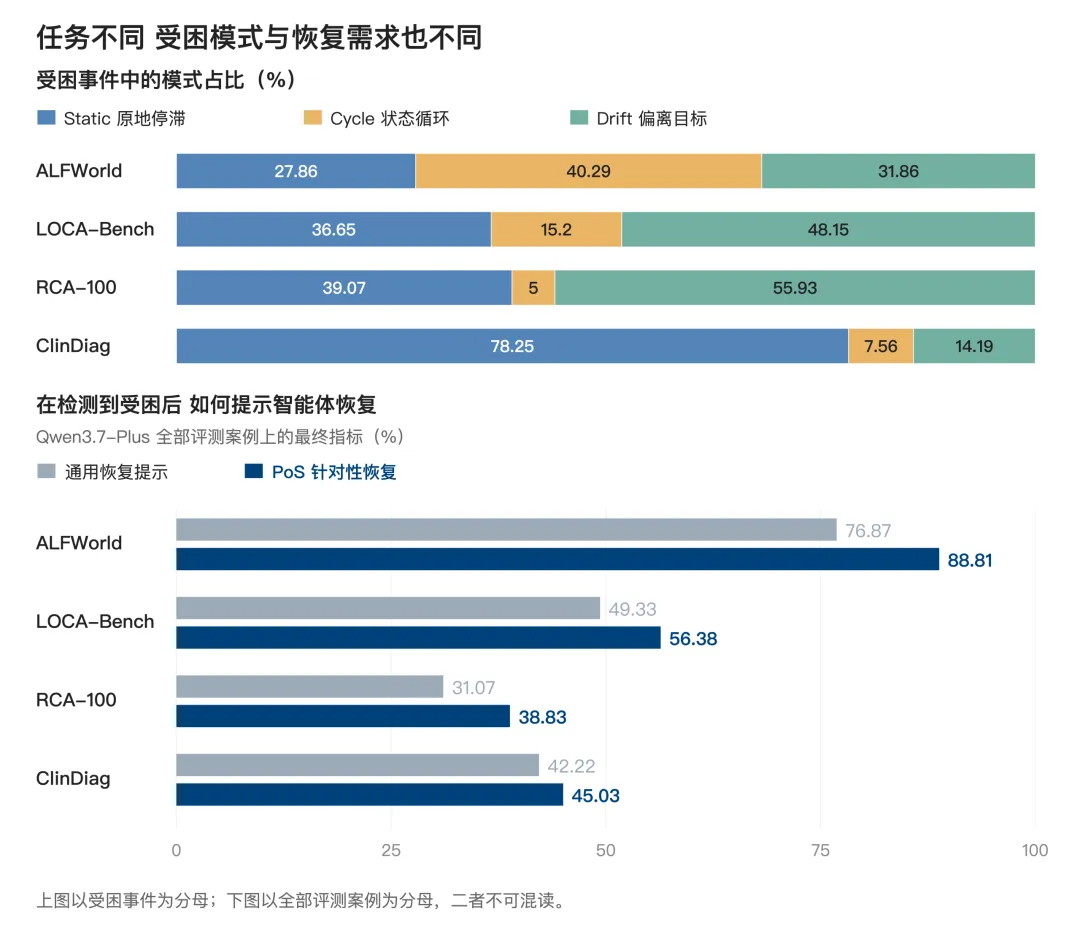
Figure 6 shows the proportion of patterns in the detected patterns of the different tasks and the recovery effects. The figure below compares Qwen 3.7-Plus to the final task indicator in all evaluation cases when using general recovery tips and PoS-targeted recovery.
This variation of targeting corresponds to the task: the most common cycling of ALFWorld's trapped events, with Drift deviating from the current target in the RCA-100 at 55.93%, and Static stalling at the ClinDiag core at 78.25%.
When the environment describes growth to 256K
LOCA-Bench also offers a pressure test: extend the environmental description from 8K to 256K tokens to see if the smart body can complete the task in a longer context. As the length increases, the overall performance of the methods decreases. PoS is relatively stable in the 96K to 256K range, with the three models being 10.67 to 16.00 percentage points higher than the strongest controls in the same setting, respectively.
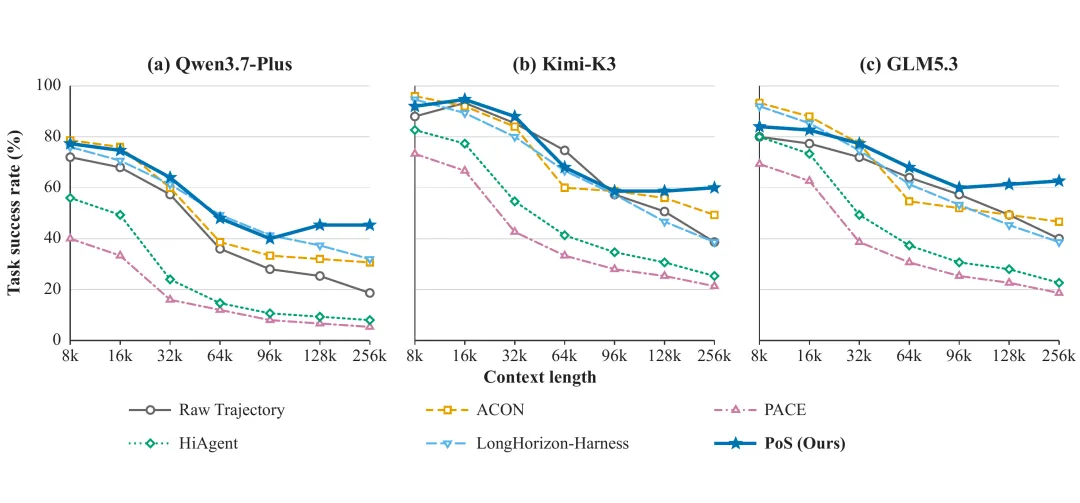
In Figure 7 of the LOCA-Bench, the environmental description has a success rate of 8K to 256K. The blue line is PoS and the horizontal axis represents the length of the environmental description (8K-256K).
This result is consistent with PoS's design thinking: whenever new observations are received, the status of an existing task is updated, and subsequent decisions can be made around the current conditions, reducing the need to repeatedly rebuild the status of the task over a long history.
More reliable state maintenance and computational costs
PoS uses additional reasoning to construct, update, and validate beliefs. The paper, set to RCA-100, Qwen 3.7-Plus, statistics the total average input and output tokens for each case, showing the actual cost of this input.
Average cost of 103 cases in Table 2 RCA-100. Execute the Intelligent Corresponding Task Agent; total methodology also includes belief building with Sentinel, where K represents a thousand tokens.
With the RCA-100 Qwen 3.7-Plus setup, PoS increased the combined accuracy from 24.27% of the original trajectory baseline to 38.83%, and the total method token consumption reached 5.06 times that of the original trajectory baseline. Among these, the token consumption of the execution of the smartphone itself decreased by about 20.9%, with additional expenses to maintain confidence and Sentinel. PoS demonstrated a trade-off between higher diagnostic accuracy and additional logical input and diagnostic accuracy in the experimental group.
PoS still relies on the ability of basic models to understand evidence. Faith health is used to identify stagnant progress and does not directly verify the final answer. Even if the state is consistent internally and consistent with observations already made, it may still contain erroneous judgments formed by a lack of knowledge in the field. The paper discusses two subsequent directions: reducing the expense of repeatedly generating text using a more compact underlying world state, and introducing field knowledge retrieval in state updates to help models interpret professional evidence.
Returning to the initial cup mission, 36 ineffective checks exposed the problem clearly: the system needed to be able to tell if progress had stopped while the intelligence body was still in operation. PoS clearly identified Belief Trapping as a state of need for detection and intervention, providing a basis for observation with explicit conviction, identifying stagnation with health, and allowing restored constraints to point to truly unresolved requirements.
The PoS code is open-source, providing a complete framework, original trajectory baseline, two dissolution configurations, and method explanations and replication guidelines. Project pages also provide interactive demonstrations of progress monitoring, difficult recovery and execution cases.
Author's note
His research focuses on long-range, belief states and dynamic reasoning in multi-cycle interactions, and the evolution of intelligent agents, combining big model reasoning, memory, detection enhancement and reinforcement learning to build collaborative multi-intelligent systems. He has published 10 papers in conferences and journals such as ICML, EMNLP, KDD,ASE, TOSEM, and has represented work including Graph of States (ICML 2026) and OpsAgentASE 2026.
Sun Yong-Jia, associate professor, Ph.D. student in the School of Software at Nanking University, has long been engaged in AIOS research, focusing on the failure mechanisms of cloud natives, data centers, supercomputers, and smart computing, while working in collaboration with multi-intelligent agents to optimize research on big model logic to drive smart decisions towards complex systems.
© THE