It's the first time in the history of the world.
No need to write it.
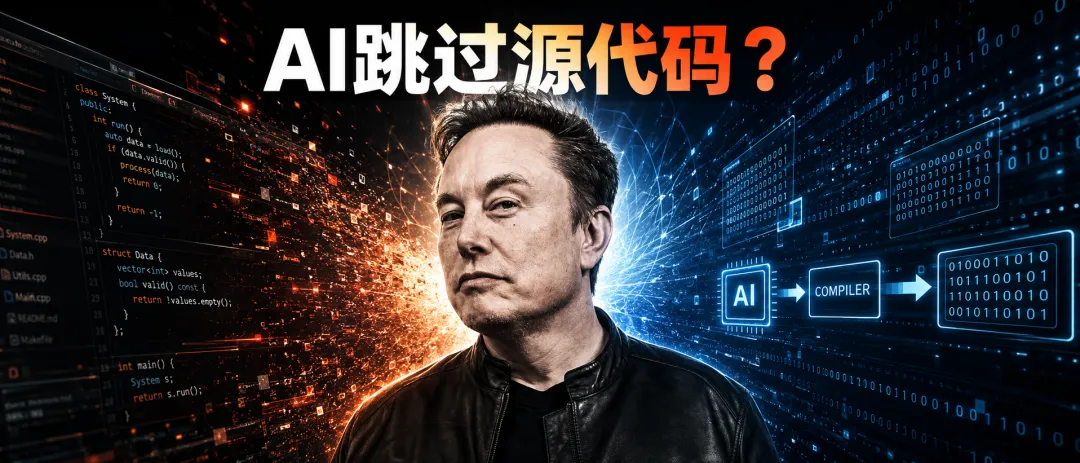
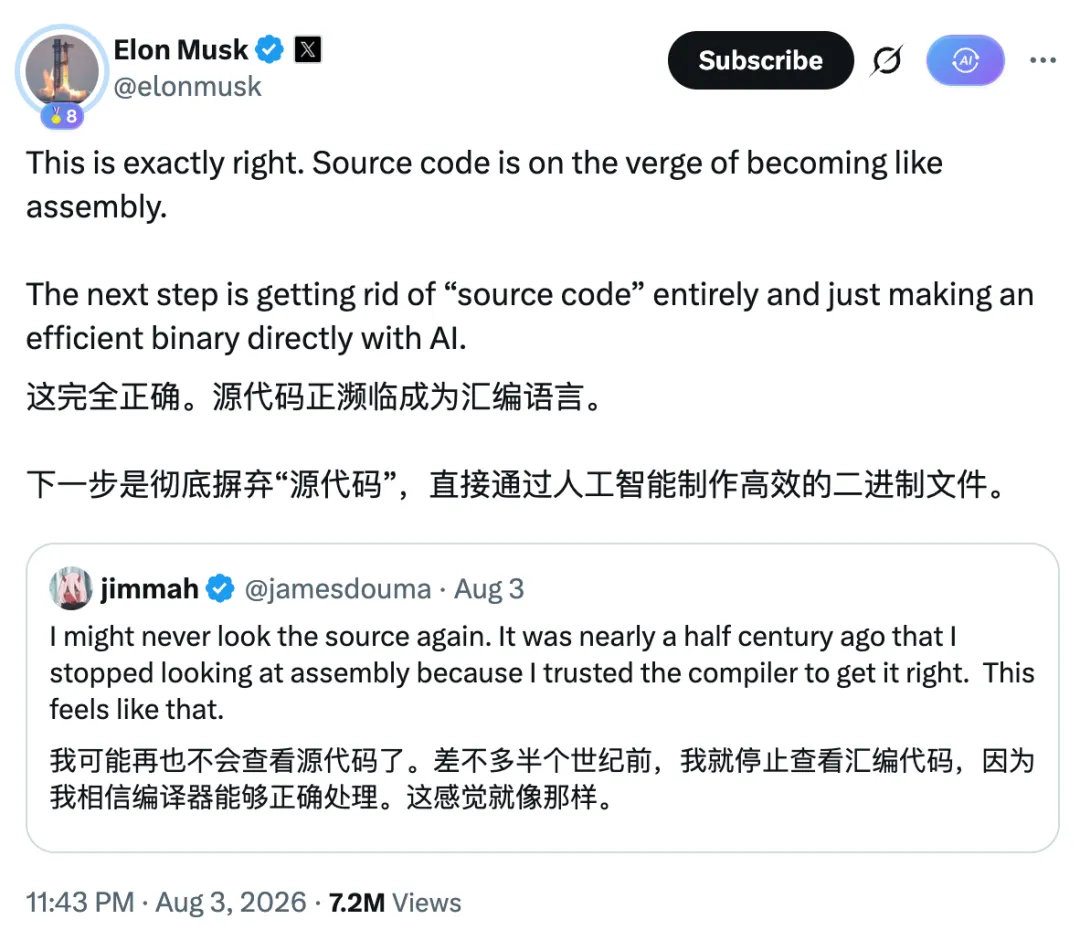
Just now, Musk has made an outrage on X: the code is becoming the next compilation, and the next step is to completely abandon it and let AI directly generate binaries!
Simply put, when you tell AI what you want, it spews out a series of binary files that the machine can run.
Python, Java, C++ are all middlemen, cut them off.
Once this outrage broke out, the circle instantly exploded. The father of UML, the author of The Way to Clean Codes, joined the scene, a father figure in the software engineering community who rarely stood opposite Musk.
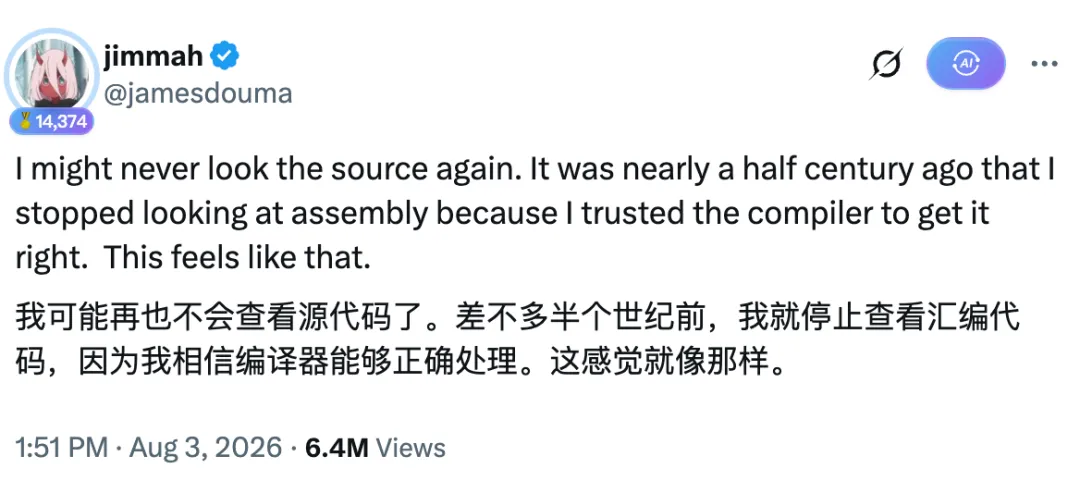
The man who started the fire is James Douma, a former Autopilot Deep Learning expert at Tesla.I might never look at the source code again. Like half a century ago, I stopped looking at compilation code because I trusted the compiler.AIThe generated code has the same trust.
After seeing the second turn, Musk made a more explosive statement:The source code is becoming the next collection. The next step is to completely abandon "source code" and use it directly.AIProduction of efficient binary documents.
He added a citation to "source code", which means that it is not a programming language that needs to be eliminated, but the link itself to "human code writing, reading code".
The adults can't sit down.
If ordinary people say that, everyone in the comments section will look the other way. But what Musk says is different.
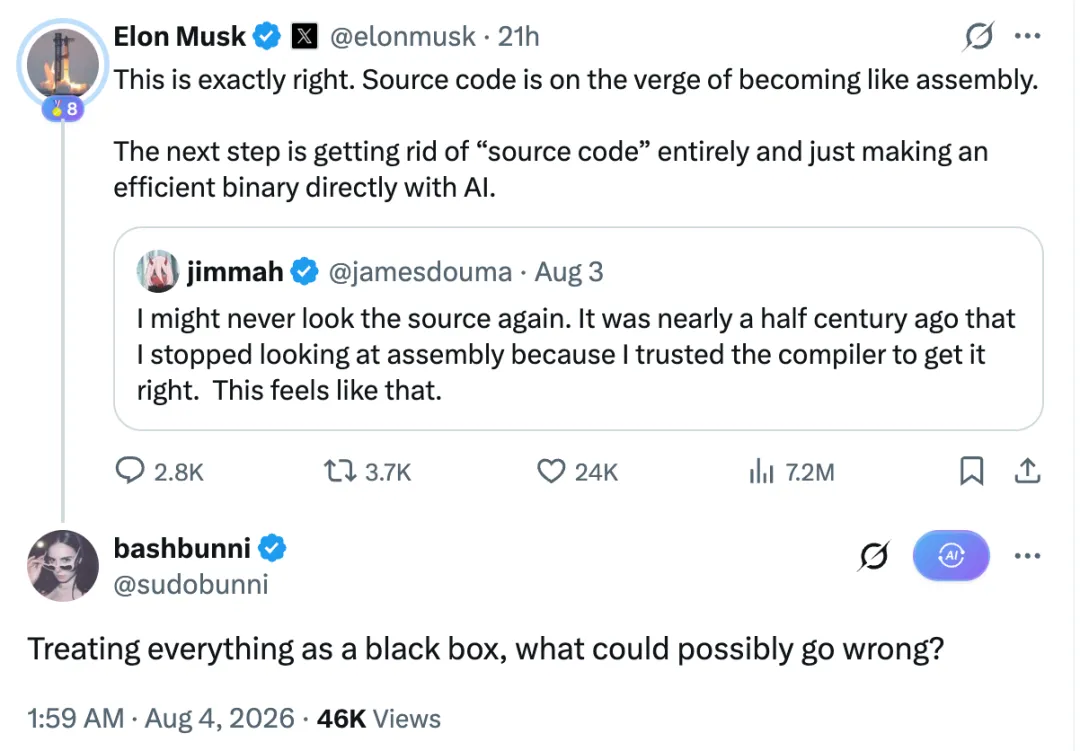
First, a well-known developer, Bashbunni, came up with a direct response:What's wrong with putting everything in a black box?
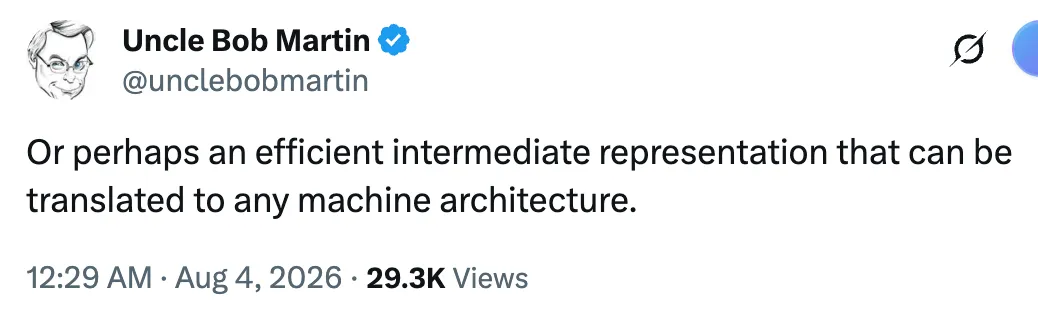
The real heavyweights then came out.Uncle Bob MartinThe author of "Clean Code", known in the industry as "Uncle Bob", offers a constructive solution: don't rush to throw out a direct binary system and let AI generate one.Human beings don't have to look at it, but machines can execute it consistently across platforms.。
It's like saying: You want to skip the source code, but leave a middle layer in the transition.
Grady BoochThe father of UML, a software architecture living fossil, refuted it more gracefully and gracefully.A language that is expressive enough, accurate enough, reproducible enough to produce executables, what do we call it?
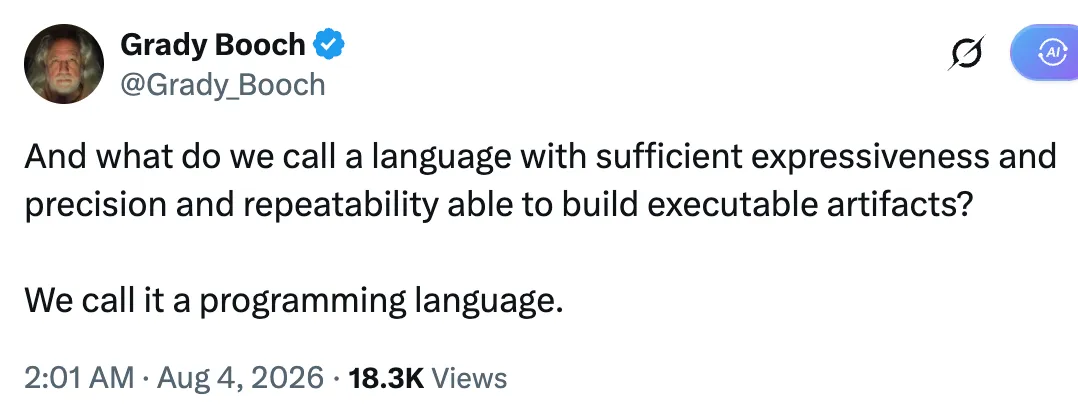
It sounds like a word of mouth, but it's actually a death sentence.
Musk wants to get rid of the "source code" product, but Booch tells you:As long as you need to describe intentions accurately, you need some kind of "programming language", and what's written in that language, by definition, is called source code.
In other words, whether you call it a cue word or a natural language, as long as it's accurate, reproducible, capable of version management, capable of censorship, it's a programming language, written in source code.
And it's going backwards, which is equivalent to yes.
There is also a distinction that has been repeatedly mentioned in the comments section:The compiler is a definitive translation.AIIt is a probability generation.
Trusted compilers are the same because they compile the same source code ten thousand times, but the code generated by AI may be completely different.
And this is where Douma's "half-century-old analogy" is weakest: one is a translator, faithful, accurate, zero-player; one is an improvised novelist, inspired to write anything, but you never know what comes next.
Is Musk wrong?It's not fair to say that Musk is completely dreaming, because reality is already racing towards him.
In April 2026, nearly 80% of Google's new code is AI-generated. Some small start-ups exaggerate that 95% of the code is AI-written.
This is not new. The entire history of programming can be described as a history of "continuous human retreat".
In the 1940s, programmers used 0s and 1s to write machine codes directly, punching holes in the paper tape, and running a whole machine blank. Later, there was a compilation language that replaced the numbers with MOVs and ADDs, which were slightly better, but still spoke to machines.
It wasn't until 1957 that Fortran first allowed programmers to write in a way that approached mathematical formulas, which was a revolutionary step. Later, every generation of C, C++, Java, Python languages were doing the same thing:It's freeing humans from the underlying details that keep you farther away from the machine and closer to the intention.
Each time the abstract layer moves upwards, it is accompanied by the same fear:"We are going to lose control!"But each time, the new tool chain establishes a new trust mechanism.
The compiler doesn't let you see the machine code, the type system doesn't let you track the memory, the garbage recycling doesn't let you release it manually.
And today's Cursor, Claude Code, Codex, is essentially the latest extension of that line.
But note:They still generate the source code.People can read, they can search, they can change.

According to Musk, "directly generating binaries, bypassing the source code", there are currently no products in the world.
The real problemAfter all, the debate is actually asking for something more fundamental:
Can humans build an engineering system that they don't understand but can still trust?
Every time an abstract layer has moved from machine code to compilation, from compilation to advanced language, humans have always kept a layer, while abandoning the underlying details.What you can read yourself.As a safety net.
The source code is the last layer of the web.
Musk said: "The net can also be torn down". We said: "It's torn down, who's coming to the bottom?"
Half a century ago, no one believed that programmers would not look at compilations. But the certainty of compilation tools proved to be trustworthy, and fear dissipated.
Today, when AI wants to replace source code, it has to answer the same question:Why would I trust you?