 * This article agrees 2559 Words, reading and completing 5 One minute.
In automotive assembly workshops, a mechanical arm can drop a gun thousands of times at the same point, with errors calculated using silk. This stability is true of industrial robots, but it also limits its boundaries. Once the position of the workpiece is deviated by several millimeters, or a temporary switching model is ordered, the production line often needs to be re-modulated.
In a medium-sized factory, the supplier of the mechanical arm may be A, the supplier of the AMR at the logistics link may be B, and the system for access to the three-dimensional warehouse may come from C. Different sets of devices have different back-end protocols, data are distributed and rarely interact with each other.
This is also the reason why physical intelligence is seen as a watershed in the industry. Robots want to learn how to understand factories, as long as the data from the device layer actually flows.
This change is also reshaping the way industrial robot enterprises compete. Over the past few years, the domestic industrial robot market has experienced domestic substitution and price warfare, and the gap between entities has become increasingly difficult to bridge, and the focus of competition has shifted to the software and data levels.
This is the first time I've ever heard of KAI.
Let the data of the devices go up, let the platform decisions go down
The open-air KAI platform launched this year focuses on integrating the capabilities of decentralized devices into a unified platform.
From the bottom up, the architecture of the open-air KAI platform is divided into five layers, from the L0 device layer to the L4 application layer. According to Zhang, Director of R&D and Development of Kuka China, the platform accesses Kuka robots and third-party devices, converts industrial data scattered across multiple systems, and opens up the digital lifecycle system. After the agents in the platform read the production tasks, they will call the corresponding tools and then drive the device to execute.
For example, after a new order has been placed, the Agent will order the corresponding process parameters according to the task and send them down to the relevant mechanical arm, while the platform can synchronize the running path of the AMR and the timing of the launch.
In a five-tiered architecture, the L0 equipment layer is the basis of the entire platform. From industrial robots to automated robots, all types of execution equipment in the factory are located in this layer. The upper model relies on data from the L0 layer, and the decisions generated by the model are also executed through the L0 equipment landing.
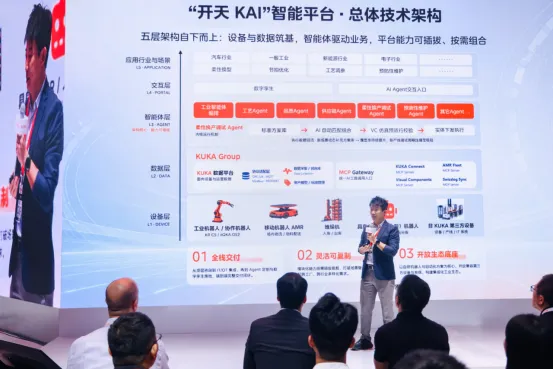
Coca-Cola launches the open-air KAI platform
Open KAI also supports access to third-party devices. Domestic factories generally adopt multi-brand equipment, and factories that have been in production for many years can access the original equipment directly to the platform, reducing both the cost and the risk of discontinuation of production.
Multi-scenes demonstration of the landing capability of the station
Modeling capabilities are only the first link to industrial AI entering the factory. After entering the workshop, the system also needs to be checked for production rhythm and long-term stable operation. On the stand, Kukka designed a multi-scenario demonstration of the factory station, showing the performance of the platform and equipment in close proximity to the actual production line.
In the warehouse-line collaboration scenario, the AMR takes the containers in the warehouse area, distributes them to the workplace at the production line pace, pairs them and then returns them to the empty tray. The multi-modal sensing system is responsible for identifying the containers and trays, and the route is planned by the platform. When the container's position or specifications change, the system can also rely on 3D vision and dynamic sensing to automatically adjust the tray. These are the most difficult links in the past.
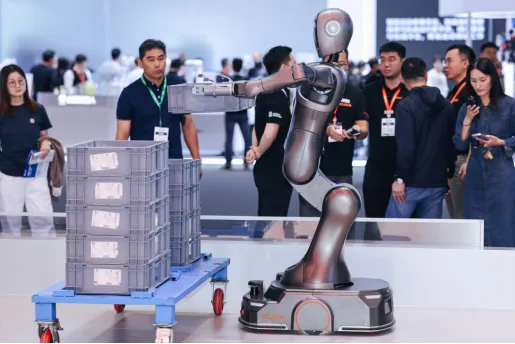
Kouka Fittings & AMR Warehouse collaboration solutions
The requirements for transport accuracy in semiconductor clean workshops are more stringent. KMR iisy complex robots demonstrate on-site FOUP wafer box transport, using industrial camera visual positioning and laser SLAM navigation double confirmation, positioning accuracy reaches ±0.05mm. Wafer machines are dense, rhythm tight, and the positioning accuracy of single unit equipment needs to be combined with global timing. After the transfer of transport status data to the platform, cross-zonal transfers can also be dynamically timed based on the rhythm of the production line.
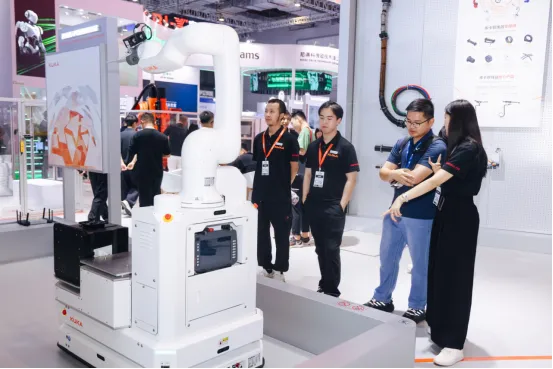
Combined robotic semiconductor transport solutions
The key product of this release is the KUKA LBR NEXUS collaboration robot. It uses a 6-axis structure, with a load covering 7 to 20 kg, and is geared towards a multitude of small-scale production scenarios. Its biggest upgrade is that human interaction chip engineers use natural language to describe tasks, and AI assistants can assist in completing system configurations. KUKA AI Vision can also achieve native integration, saving on-site industrial controllers.
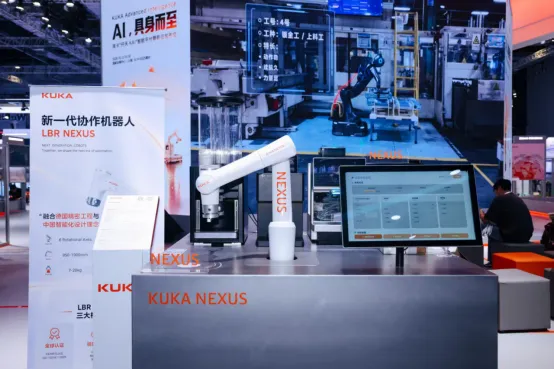
KUKA LBR NEXUS is a collaborative robot
The process link poses higher demands on AI. The long-term experience of grinding and welding depends on the technician's experience, there are differences in shape between the welds, and the traditional method requires one-by-one demonstration. Cook's intelligent random grinding solutions generate grinding trajectories in real time through 3D vision and physical information AI algorithms, allowing robots to autonomously plan paths after recognizing the workpiece, saving the previously programmed links.
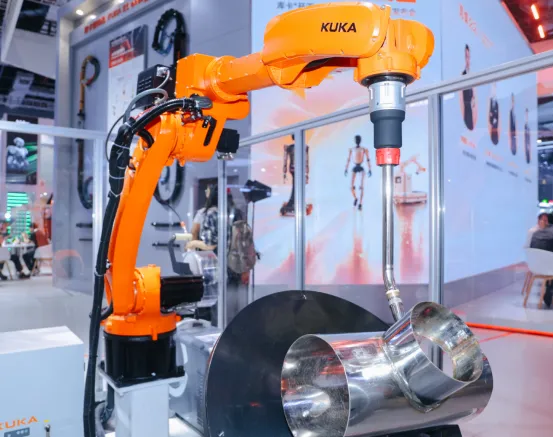
Cook's automated welding solutions
New Energy is one of the key industries covered by the exhibition. In the silicon-electric power generation linkage, the pace of the production line is fast, and the requirements for transport stability are also higher. The exhibition features a KR 40 SCARA-level multi-connect robot for this scenario, with a maximum load of 40 kg, mainly used for power transportation scenarios.
Outside the booth, several products and solutions that Kouka has launched are already in production.
At the Fukushima plant in the United States, 117 Fukushima robots have access to KUKA Connect, a system based on operating data for state-of-the-art monitoring and intelligent operation; and at a European TV manufacturing plant in the western Polish city of Górzów, 22 Fukushima AMRs are responsible for transporting materials between warehouses and 10 assembly lines and for air-packing re-shipment.
Rooted industrial landscape leading to a new era of autonomous intelligence
From a longer-term perspective, the competitive logic of the industrial robotics industry is changing. Over the past two decades, industry competition has largely revolved around intrinsic performance. As AI enters the industrial arena, competition is spreading to the scheduling and data levels. Who can build an industrial ecosystem at the data and smart levels will occupy a more favorable position in the next phase of smart manufacturing.
China is the world's largest market for industrial robots, with a complete manufacturing portfolio, complex production scenarios, and sufficient verification space for industrial intelligence platforms.
The 15th Five-Year Plan calls for the construction of a modern industrial system based on advanced manufacturing, which undoubtedly requires a deep integration of artificial intelligence and manufacturing systems.
—END—
 Recent Activities
 A week's worth of capital events, billions of dollars worth of smart money, from POC to real estate, from industrial smart money to real estate.