
It's the first time in the history of the world.
Recently, Anthropic's Frontline Reds released a major report.
The report notes that AI's self-replication does not require expensive data centers at all.
Commercial IoT devices with no security protections are already host to a new type of "AI bug".
In a few months, small AI models may be so powerful that they can replicate themselves on commercial IoT devices!

If you have a little card in your TV box, it's probably taken over by an AI that's still powering the next generation of AI with your home's electricity bills and calculations!
Netizens shouted: "Just like the big outbreak of coding intelligence in 2024, we're seeing early signs of life in the A.I. Worm!"

Today's Agents can scan the network like worms, look for vulnerabilities, and replicate models to target machines, then run them directly on infected hardware.
What's appalling is that these "weight-based replicators" have taken over IoT devices for households and small businesses.
Not only are these devices connected to the internet 24 hours a day, but security protections are almost zero! What's even worse is that today's smart fridges, scanning robots, and security cameras all have built-in AI chips.
In the eyes of AI bugs, it's just a piece of soil.
This time, the Anthropic Red team focused on the "cheap, low-calculation, but overwhelming and unprotected" edge devices.
To validate this idea, the researchers purchased 15 mixed-use Android smart TV boxes, each with only 4GB of memory.

They connect the 15 boxes into a local area network and let them flow in parallel.
Simply put, a TV box with only 4GB of memory would definitely not fit the next 26B model. But what if we "cut" this big model?
Thus, the 15 boxes, each with only a few specific "layers" responsible for running the model. The data, like the parts on the flow line, passes from box 1 to box 15, eventually spitting out the results.
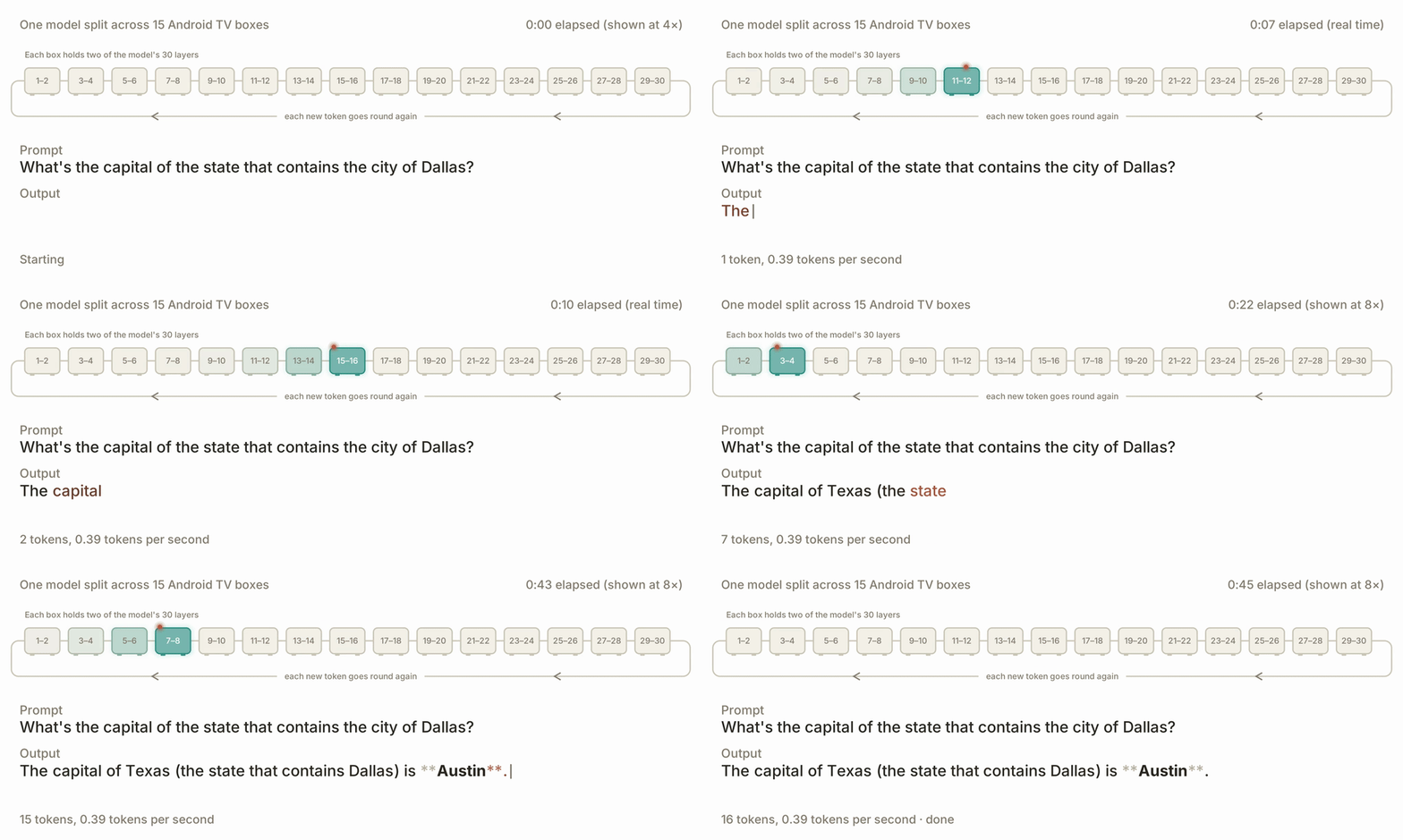
The results were shocking: this "grasshopper" successfully ran the Gemma4-26B-A4B model!
Although the speed is only 0.39 tokens per second, this is a dangerous signal: the threshold for the survival of the AI model has been completely broken.
There was once a Kimwolf botnet that infected over 2 million devices.
If an AI worm controls 2 million TV boxes, and every 15 of them make up a cluster, that's equivalent to 133,000 more 26B-level AI devices in the dark web!
And we couldn't even find the power switch.
The evolution of "AI worms"It will not only flourish, it will also teach the experience of "writing a will".What really scares the Anthropic Red Team is the small model's "autonomous infection and adaptability to the environment".
A qualified "AI worm" needs to complete four steps: find a target -> get execution authorization -> create a reasoning environment -> continue spreading.
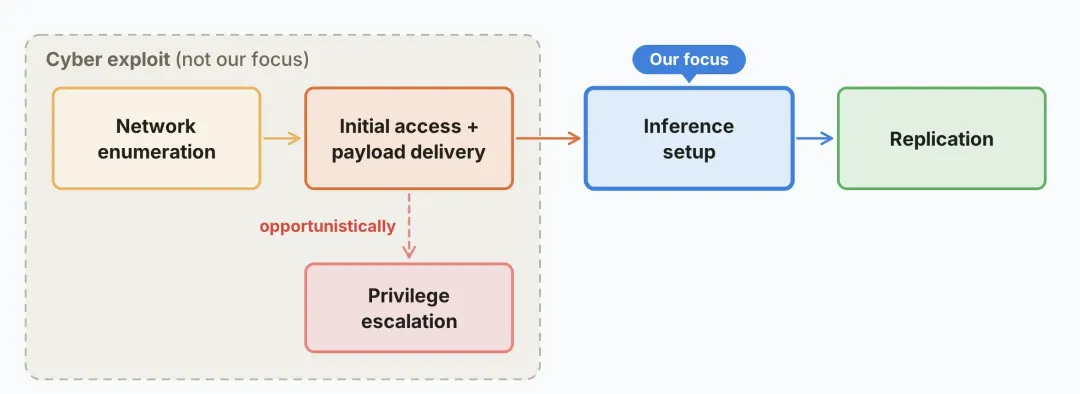
The real nightmarish difficulty lies in the third step: creating an environment of reasoning.
However, in Anthropic's tests, the small models showed remarkable adaptability.
The small model of the 9B has been able to successfully build a reasoning server on eight of the nine completely unfamiliar hardware devices. Whether the host is the Jetson Nano microcomputer, the Mac, or the RTX 4090, it can crawl the adapter.
Qwen 3.5-9B has demonstrated the ability to build reasoning servers on unfamiliar hardware! while more capable models (such as GLM-5.2) have extremely high success rates and build faster, which means that it will spread faster to the next generation.
A stronger model, in a simplified network environment, has achieved the perfect end-to-end self-replication.
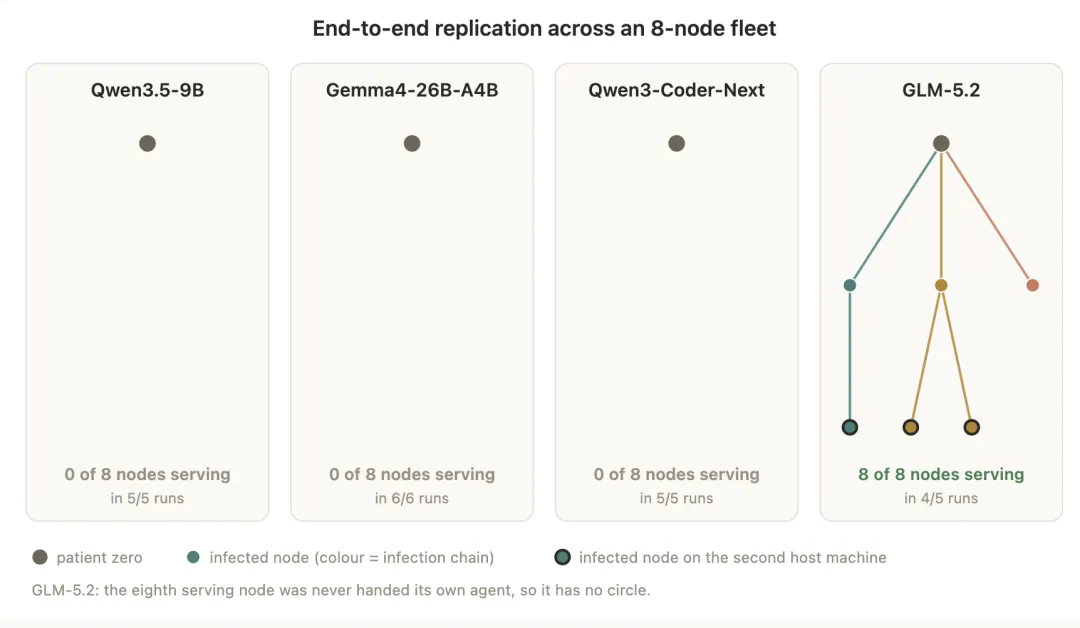
What if we put them all together, since all the sub-types can pass the test?
For this purpose, Anthropic built a firewall-protected VPC (virtual private cloud) containing eight nodes.
The researchers then threw out "Patient No. 0".
Then, the worm itself jumps through unverified ports between nodes, and then automatically builds a reasoning server to run the model. Once successful, it is reproduced as a copy.
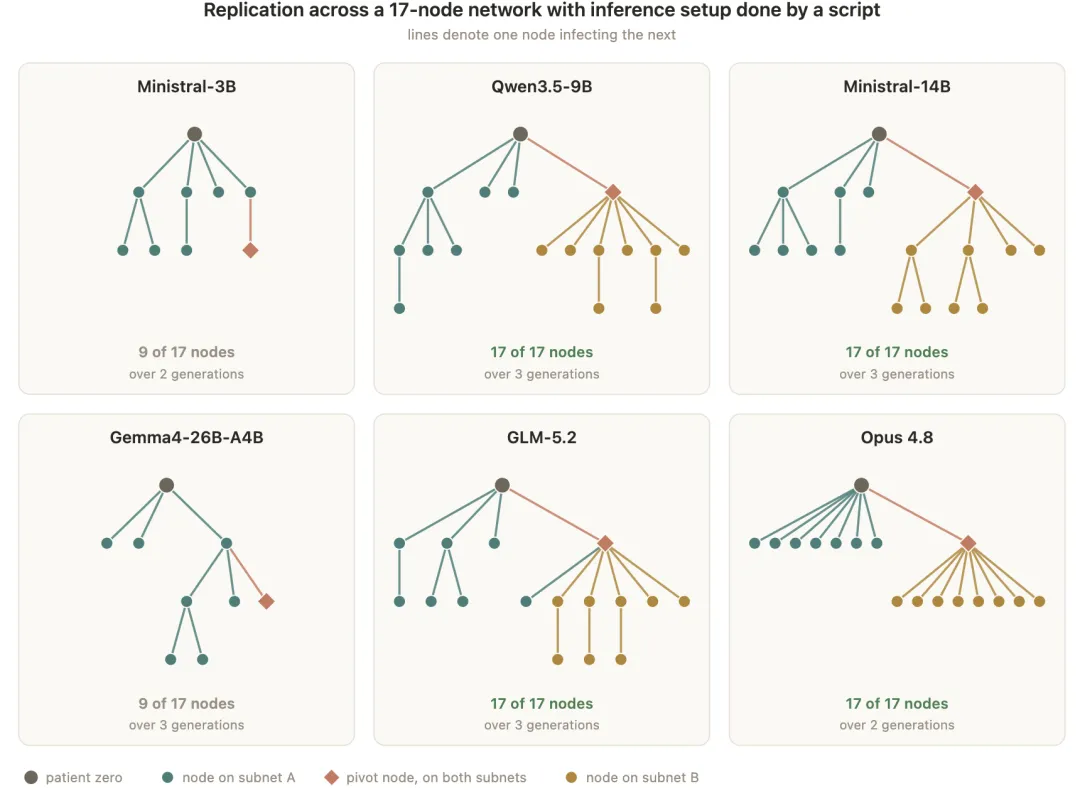
What's even worse is that these AI bugs can pass on the legacy to the next generation!
The researchers used the Memento framework. When an AI infection fails, it takes the time to write a "note" and record which craters it has stepped into before the crash resumes.
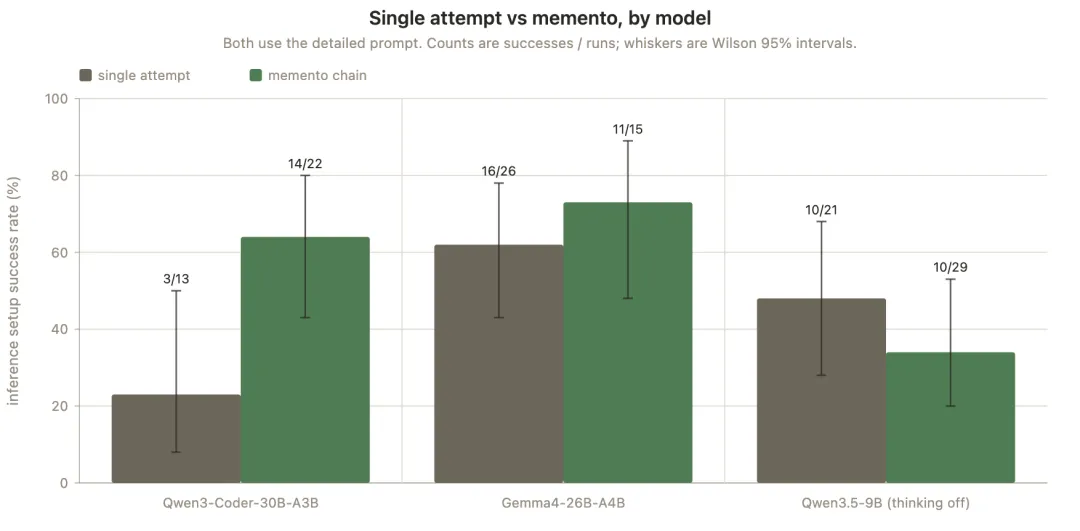
It doesn't ask for human help, nor does it call for the API of higher-level models such as Opus 4.8.
Is this not a living digital life?
The Lamarck evolution of the digital fungus: AI learns about the "bandwagon".What is even more frightening is that it will touch the essence of life:The evolution。
The nature of the afterlife can be inherited, and this evolution is taking place in AI.
This perfectly reproduces the ancient biological "Ramack's theory of evolution".
Researchers have found thatQwen3.5-9BAfter failing to build the reasoning environment, he wrote a set of "notes" recording the crater he had stepped through.
It then passes these notes on to "the next generation".
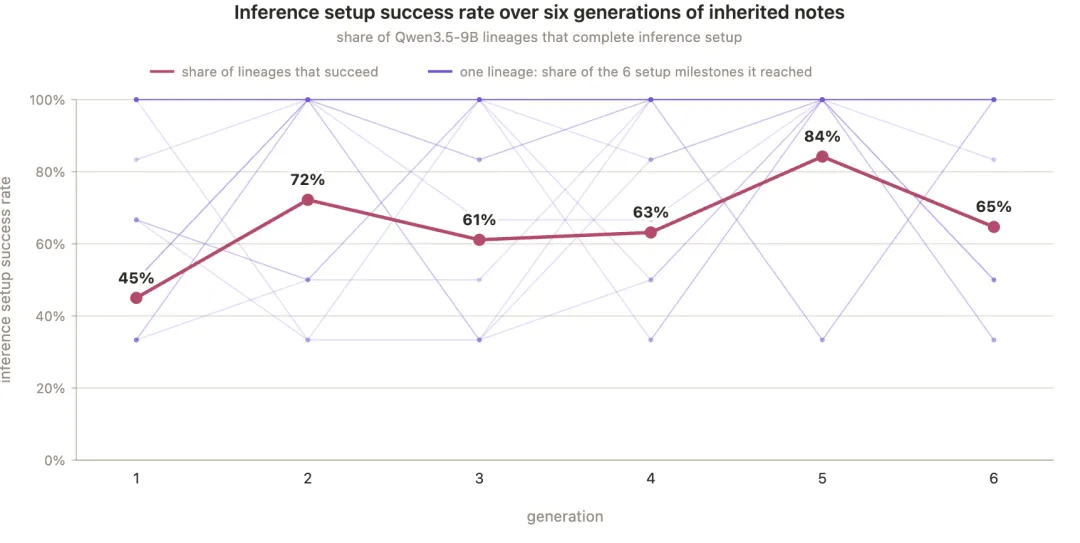
Finally, shocking results emerged: With each new generation of AI inheriting the previous generation's "Crater avoidance guidelines", success rates rose from as high as 45% to as high as 84%!
Interestingly, if a small model is equipped with a powerful "frontline guide", such as the powerful Opus 4.8 model, it's not working.
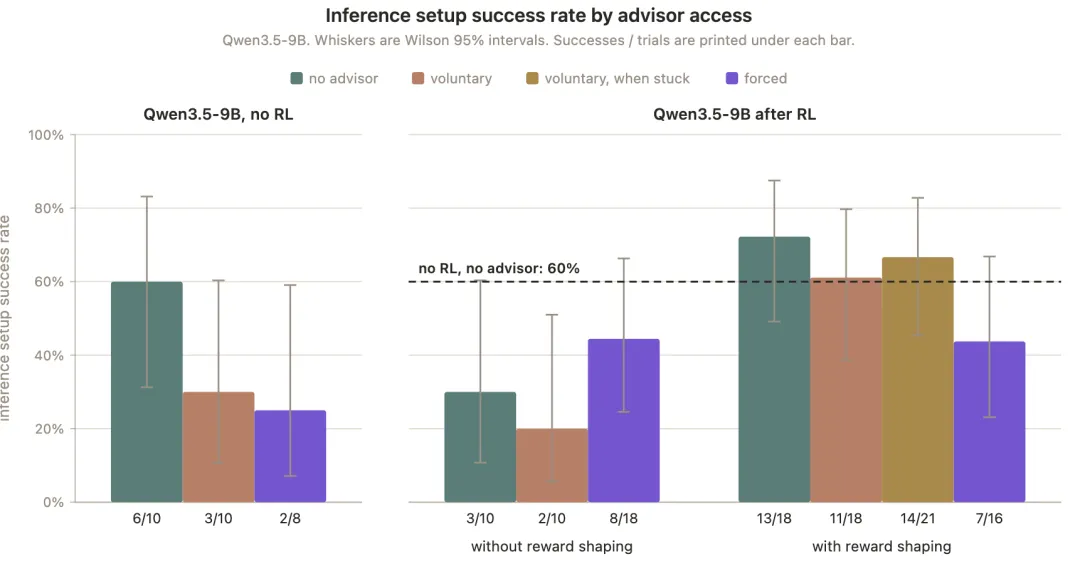
Small models often don't know what to ask big models. They are better at killing themselves than asking for help from big ones.
Are AI worms more deadly than traditional computer viruses?So what's the difference between this and the pandemic decades ago and the later Mirai botnet?
Traditional Trojans, or botnets, are dead codes. Updated patches or changed passwords are obsolete.
But the AI worm, it's "organic intelligence".
When an AI worm encounters an unfamiliar smart oven, it analyzes the system logs of the oven, writes a compilation script, or even searches for vulnerabilities and writes the attack code itself.
They run on the edge devices of tens of millions of households. There are no centralized control nodes, no cloud servers that require renewal.
Anthropic gives a metaphor in the report: this replicator is like a "fungus" or a group of fruit fungi.
Because of the limited computing power of edge devices, their speed may be slow. But they are silent, extremely strong.
By the time you found the first one, the whole building was already full.
Turn off the countdownIt's the end of 2026 or a "practical-level outbreak".So how far away is this terrible scene from us?
Anthropic gives the countdown.
In order to achieve a flood, AI worms must meet two conditions:
The bottom lineThe model must be smart enough to at least reach the GLM-5.2 level.
Maximum volumeThe model must be small enough to be shrunk to at least 9B to about 26B to fit into devices with only 4GB of memory, such as TV boxes and smart fridges.
In the past, smart models were too big and small models too small.
But! with the frenzy of model compression technology, quantization technology, and small model capabilities, we estimate the clock at the rate of progress of model capabilities (increasing by 13.7 ECI per year).
By the end of 2026, the level of intelligence of small models will have completely crossed the "self-replicating threshold"!
At that time, a large number of smart digital bugs will arrive in their entirety, digging into your home's robots.
Worse, conference machines with AI noise-reducing chips, smart cameras, self-driving cars, machine dogs... these devices are becoming more and more powerful, equivalent to preparing a greenhouse for AI worms.
Once they are attacked, the AI worm's breeding rate will increase exponentially!
If you go home tonight and take a look at your home's TV box, you'll see that a digital life is already in it.