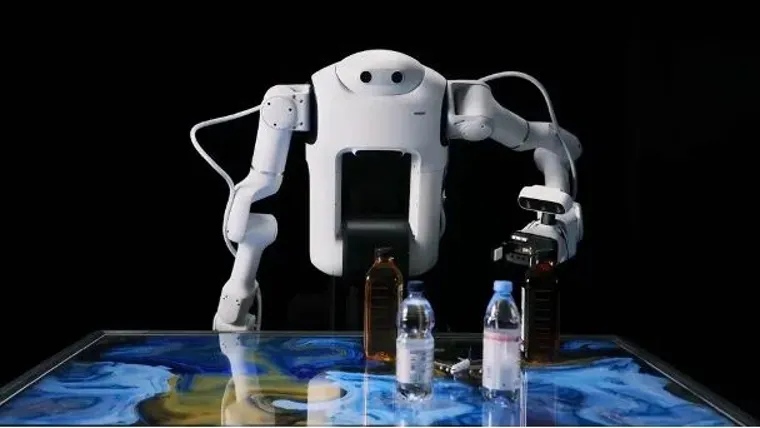
“ One of the highest-grossing and most intelligent bettors in the world.
In 2026, the total amount of financing for smart racetracks has exceeded 100 billion, but where the money went is being subtly diversified.
Some companies, with the pioneering advantages of the general large model, quickly build up the ability to migrate across scenarios and become platform players; others are deeply cultivating the know-how in the vertical field of processes, deeply linking algorithms with the logic of interaction with the specific physical world, building an industry that is difficult to replicate.
This differentiation suggests that a mere computational stack or parametric scale is no longer the only determining factor for achieving high reliability in real physical environments and is becoming the new benchmark for capital filtering.
Capital is re-voting with real gold and silver, and they say that the core barrier to this body-and-body intelligence is intelligence itself.
In this context, Sudoku Technologies recently announced the completion of a new round of over 1 billion yuan in financing, which will be led by Shanghai, Taipei, Taipei, Hong Kong, Hong Kong, Hong Kong, Hong Kong, Hong Kong, Hong Kong, Hong Kong, Hong Kong, Hong Kong, Hong Kong, Hong Kong, Hong Kong and Hong Kong.
This is the fifth round of financing since Sudoku Tech was founded 17 months ago. After completing the $500 million Pre-A round of financing in April, the company's valuation has surpassed RMB 20 billion.
In a 20-billion-strong club that has expanded to nearly a dozen racetracks, Sudur's financing pace is not the most radical, but its path of choice is becoming an industry-wide unavoidable issue.
01.
A list of shareholders is an industry map.
The dismantling of the shareholder structure of Sudoku Tech is more meaningful than reading any BP.
On the national side, Shanghai is pioneering investments, venture capital, state-owned finance, long-term investments, long-term venture capital; on the industrial side, Ningbo-era venture capital, Alibaba, Tencent, Baidu, and the number of millionaires are in the ranks; in the marketed institutions, high-value investments, IDG capital, long-term capital, and measurement strategies are all about you.
This is typical of China's capital+industrial+financial sandwiches structure. This combination of sophisticated technology to cope with the cycles of growth, heavy assets, and strong landfall characteristics, builds a layer of ramparts that is not easy to replicate.
The addition of a state-funded background not only implies long-term and patient capital support, but also implies the potential advantages of access to scenarios and policy synergies in key areas such as high-end manufacturing and infrastructure.
The entry of industry giants can help to open the entire industry chain from chip computing, cloud platforms to terminal hardware, providing a real testing ground and data feedback loop for algorithms.
The involvement of market institutions is both a backbone of the company's commercial value and ensures that it maintains a keen sense of smell and flexible mechanisms in technological change and market expansion.
The three forces join forces in their respective roles, jointly supporting Sudoku's ambition to explore the physical world in depth at the level of the brain.
02.
I've been working with robots in the virtual world for millions of years.
In order to understand the state of the art, we must first understand the technological path it chooses.
In the last two years, the high-frequency words in the narrative of corporate intelligence financing have not been excluded from the spectrum of spectroscopic spectroscopic spectroscopic spectroscopy.
But Sudoku tells a different story. Public information shows that the company chose to be entirely self-developed, from models, data, simulation technology to robotic body and control system automation. The core technology pathway is Sim2Real, which is based on large-scale high-quality simulation data, as well as authentication.
It is reported that the team broke down the basic capabilities of robots in the physical world into a set of atomic capabilities: precision placement, flexible object operation, hand-to-hand coordination, mobile clutching, autonomous navigation. Each ability is refined repeatedly in a simulated environment and then migrated to the real world.
In the face of the most scarce data problems in the industry, Sudoku TECHNOLOGY is also not going the usual way. It has not opted for long-term dominating real-machine remote-operation acquisition, but has established a data production system through simulation training. It is known that the system can generate millions of levels of training data every day.
Behind this is a cost-cutting effect. The data marginal cost reduction effect brought by the top-tier simulators makes the expansion of the data scale no longer subject to the human and device bottlenecks of the physical world. Real machines operate remotely although intuitive, data quality is high, but the cost is extremely high, and the scenery coverage is extremely limited.
The technical team at Sudoku Technologies, based on years of experience with the SAPIEN and ManiSkill platforms, has taken the ability of these simulation tools to new heights.
Suzuki, co-founder, chairman and CTO of Suzuki, has a simple metaphor: Suzuki lets robots practice for millions of years in the virtual world and comes back to help you bottle up.
The results were verified in April this year. In the demonstration, robots continuously grabbed hundreds of unprecedented objects, such as transparent glasses, reflective metals, soft fabrics, irregular toys, with a 98% success rate for the first time, and close to 100% in two attempts, without relying on real machine data.
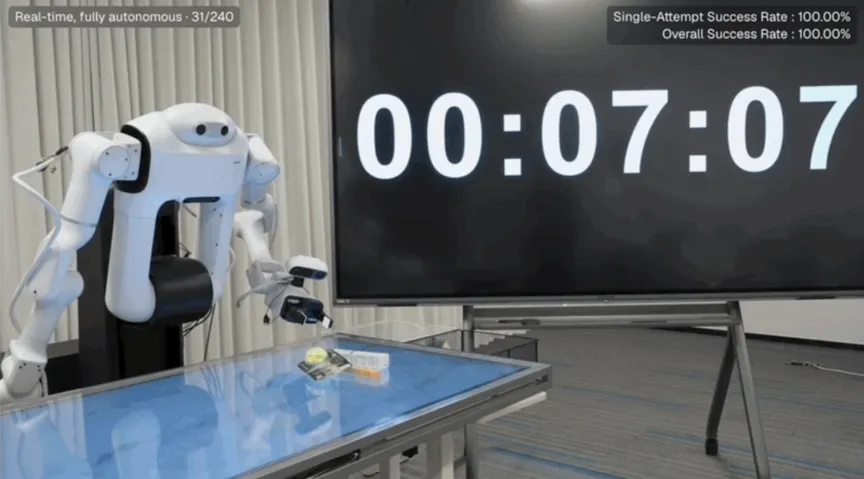
For integrators, this data means that in the future, a new production line, a new batch of materials, will theoretically not need to be retrieved or retrained.
In the industry, there are few teams globally capable of self-developing high-performance body simulation engines, and there is a shortage of native-born ones in the country.
03.
From the stage to the production line: a simulated simulation of the real-life simulation
Of course, demonstration alone is not enough for today's physically intelligent racetrack. Suzanne said: "Well, we've seen a lot of great demos, but there's still a key disconnect between them and real universal capabilities".
The technology routes are beautiful again, and will eventually show up in the real world.
At WAIC 2026, Sudo completed its first system debut in the country. More than a dozen skills cover manual operation, flexible body handling, precision assembly, mobile grab and multi-machine collaboration.
The most notable is the battery modular production line, which was rebuilt in conjunction with the Ningde era. Four robots of the same model kept separate jobs, fully restoring the entire process from the assembly of the power unit to the finished product downline. It is known that in the industrial scene, the clutch success rate of the Soda robot reached more than 99.5% and has a sub-millimeter precision assembly capacity.
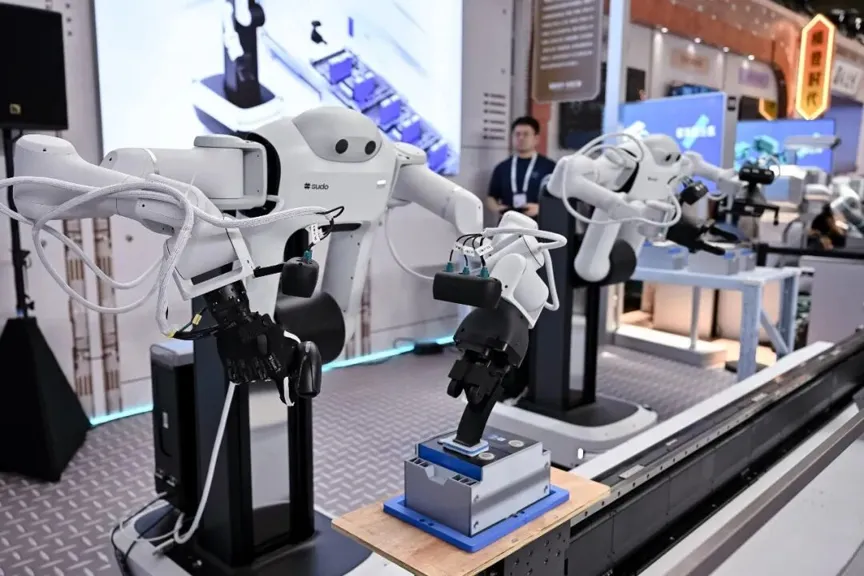
The company plans to complete early concept verification and small batch landings with the main customers in the second half of 2026, to achieve 100 stage delivery and enter scale paving in 2027, and to enter 1000 stage paving in 2028.
In the process of writing public narratives about the quantity of deliveries, the real concern is the ability to replicate with deployment. After all, it is only when the same underlying capabilities move quickly to different scenarios that the robotics industry really enters an expandable stage.
And the path of Sudoku technology is really on the way to scale.
04.
Link to the Future
The point of value of the physically intelligent is moving from the self-propelled cylinder to the cylinder-powered underlying cylinder; the market compares, also, from the cylinder whose demo is more like the future cylinder, to the cylinder who can deliver continuous certainty on the real production line.
It's the market's vote, and it's the industry's test.
Of course, the biggest risks of the simulation route remain unresolved. The last 1% of the gap between simulation and reality is precisely the most expensive and stubborn part of the industry, requiring a large amount of engineering to fill.
Ninety-eight percent of the demonstrations and ninety-eight percent of the production lines running thirty thousand hours in a row were in two languages. Suzanne has said that we've seen a lot of great demos, but there's still a key disconnect between them and real generic capabilities.
This warning also applies to Sudotech itself.
But at least for now, Sudhu has demonstrated with a differentiated technological route that simulated trained robots can not only perform on stage, but also enter the production lines of the Ningde era.