"They completely destroyed my field of study".
Recently, the 2022 Fields Prize winner, French mathematician Hugo Duminil-Copin, lost his temper.
"On Tuesday night, I cried and woke my daughter up".
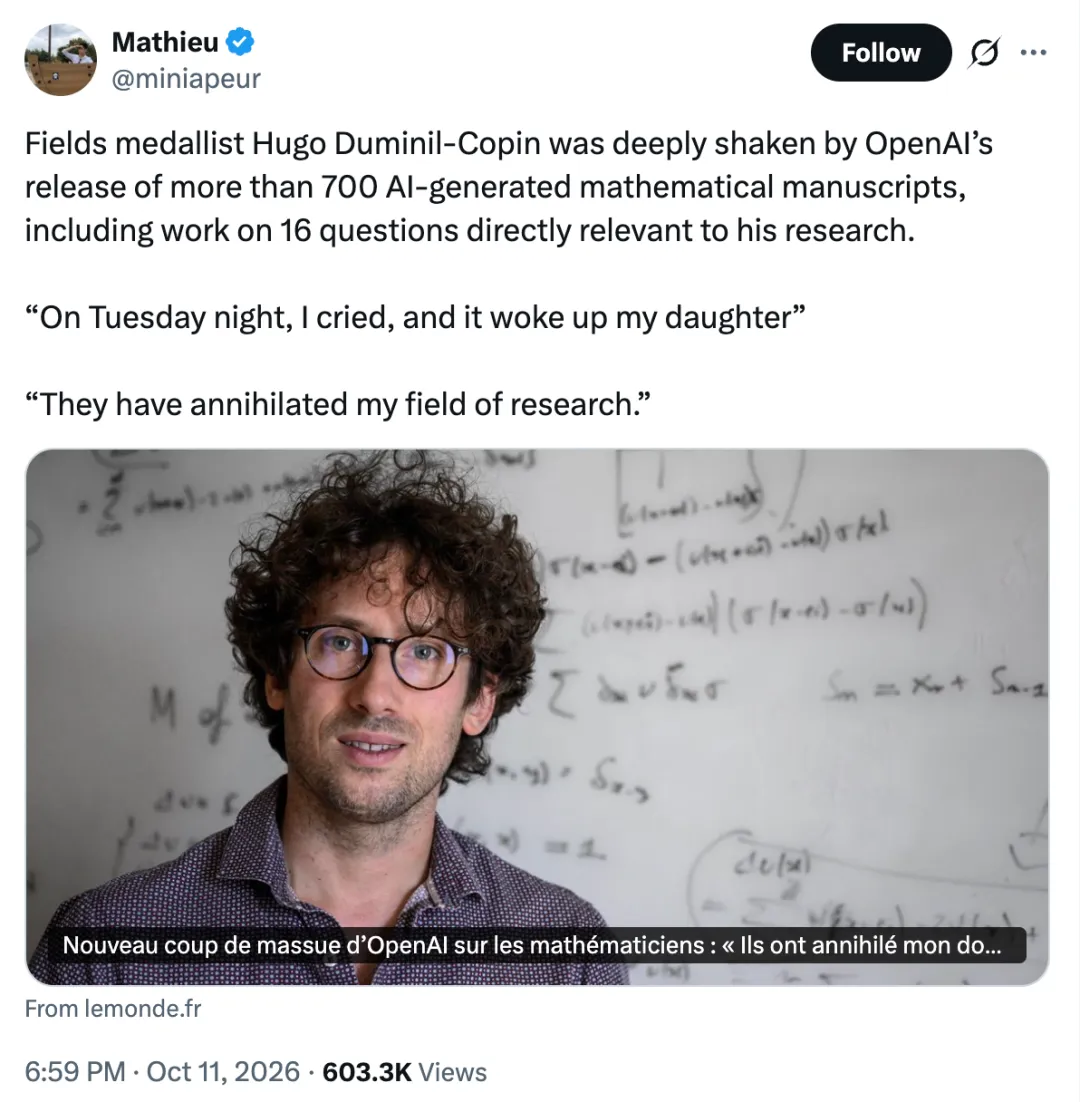
This was the result of a recent OpenAI publication, in which more than 700 mathematical manuscripts generated by AI were made public. 16 of these questions were the direction of Hugo Duminil-Copin's long-term research.
Previously, Hugo Duminil-Copin had compared the impact of AI as a "nuclear explosion". Every major problem AI solves, a mathematical map is hit, and the space for humans to continue exploring shrinks with it.
OpenAI published hundreds of results in this series, described by some mathematicians as a "carpet bombing".
It was a "carpet bombing".
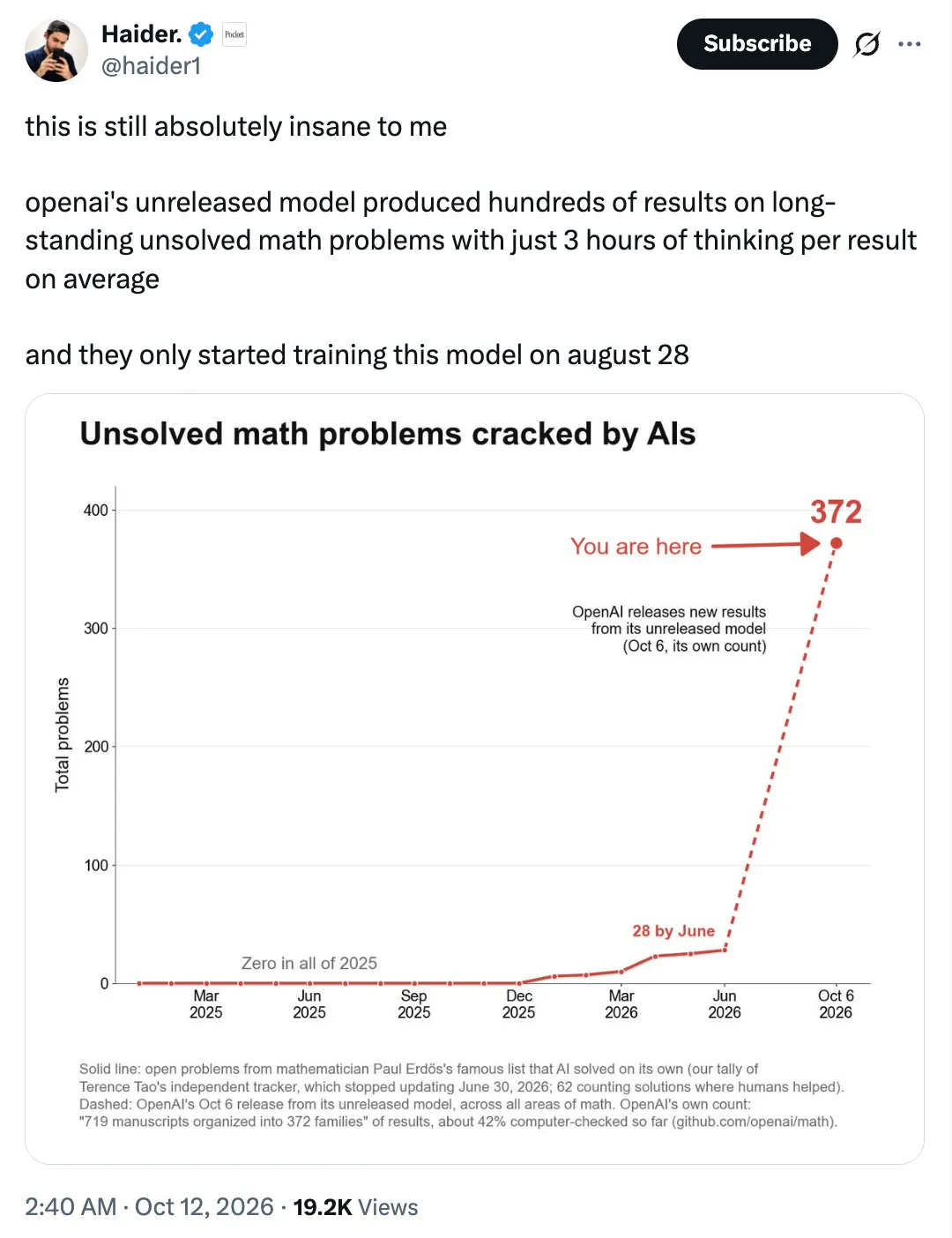
On October 6, OpenAI released 722 mathematical manuscripts on GitHub, which fall into 372 result families, a result family that may include core proofs, supporting arguments, inferences, and alternative proofs.
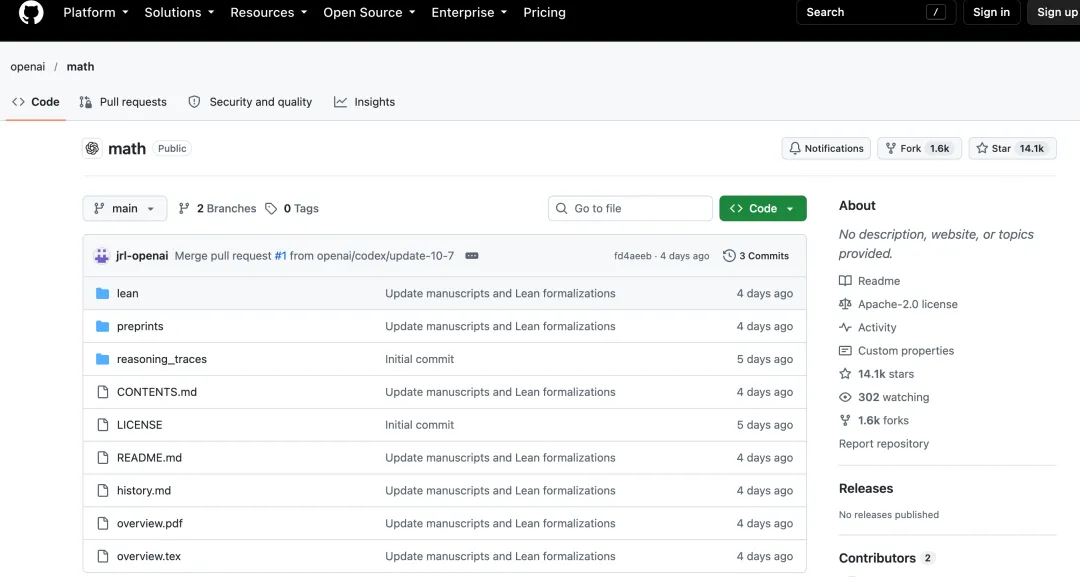
It was revealed that the manuscripts contained 377 new proofs. About one-third of them involved important speculations of widespread interest in the mathematical community, the other one-third had significant value in their respective fields, and the remainder were mainly smaller results or already proven variants.
According to OpenAI, the vast majority of these results were generated by the same unpublished internal model. The model began training on August 28, and the amount of computation consumed by each result, on average, was equivalent to about three hours of thought in ChatGPT Pro.
However, after publication, several mathematicians found that some manuscripts may not actually prove their claimed conclusions. Even if proven through Lean's formalized examination, the logical establishment of the internal logic of the formalized proposition can only be demonstrated, there is no automatic guarantee that it accurately corresponds to the original arguments in the natural language manuscript.
Two days after its release, OpenAI withdrew three erroneous papers, with 719 remaining in the warehouse.
How is the value of mathematical research measured?
The value of mathematical research is never limited to the final proof.
In the process of finding proof, researchers come up with new concepts, create new tools, and discover connections between different fields. A failed attempt may also open the door to another problem.
Hugo Duminil-Copin had mentioned that he had experienced multiple failures in attacking a certain probability hypothesis, which produced a large number of new ideas that were later used in other studies and led to previously unexpected discoveries.
AI directly demonstrates that it may have skipped this exploration process.
The 20th-century mathematician William Thurston reflected that, after rapidly proving a set of theorems, the relevant research directions gradually lost their focus. As the researchers left, the accumulated intuitions, experiences and networks of communication in this field began to dissipate. In his view, mathematical knowledge existed not only in papers but also in the brains and academic communities of researchers.
Young mathematicians are the first to jump
In the past, instructors would choose a problem for graduate students that is expected to be solved in a few months. Students train their intuition in repeated attempts to gradually learn to deal with more abstract, more complex studies.
Mathematicians who have secured stable positions can switch directions, PhD students and postdoctoral fellows do not have the same amount of time, their papers, positions and career prospects often rely on a few research questions, and once AI takes precedence, years of accumulation may lose value with it.
Open communication may also be affected. Mathematicians are accustomed to sharing immature ideas in meetings, emails, and discussions, and if AI companies can collect these clues and focus on models, researchers may reduce public discussion.
Hugo Duminil-Copin is concerned that the culture of free exchange that the mathematical community relies on is breaking down.
It's called "alien mathematics".
While some netizens reviewed an AI proof, they found that the model combined two ideas that had rarely been linked before. The proof was completely correct, tested, but the idea seemed strange. Some called it "alien mathematics".

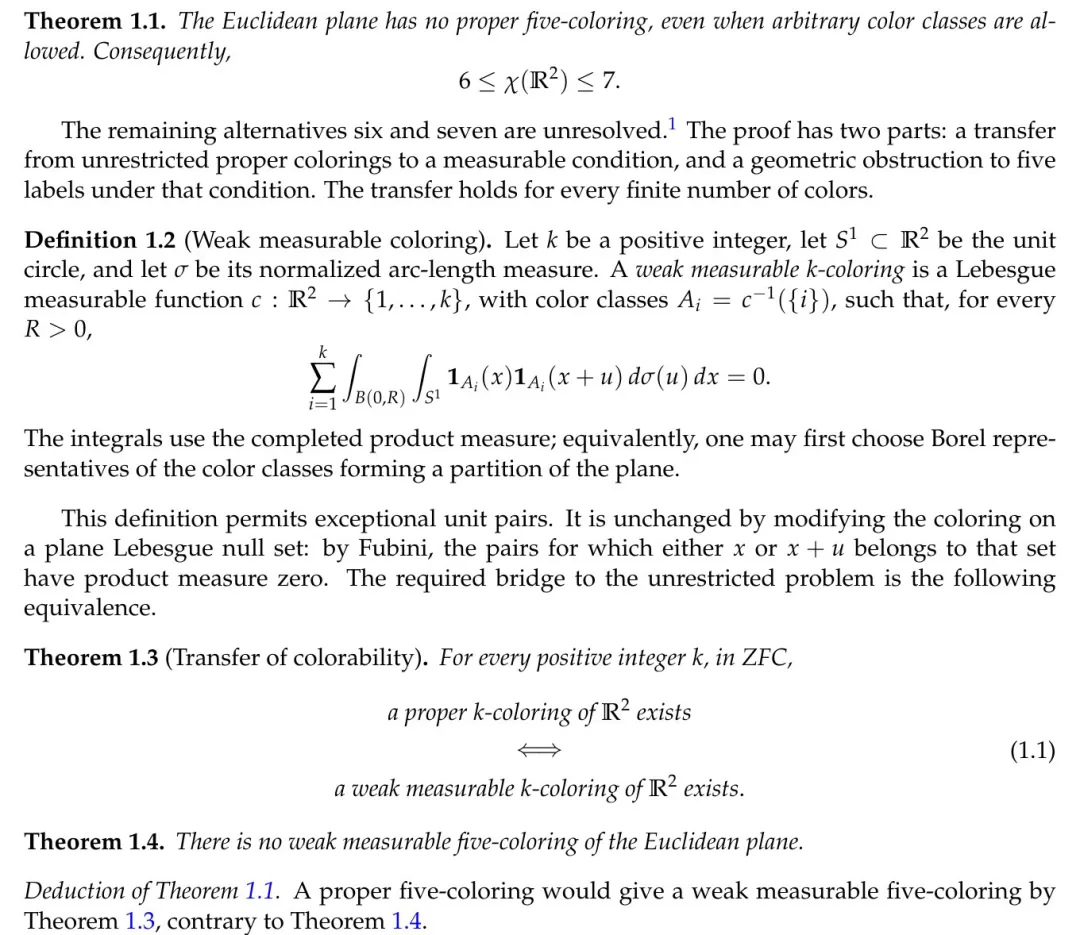
The netizens believe that similar phenomena could soon appear in the fields of physics, chemistry, materials, medicine and engineering.
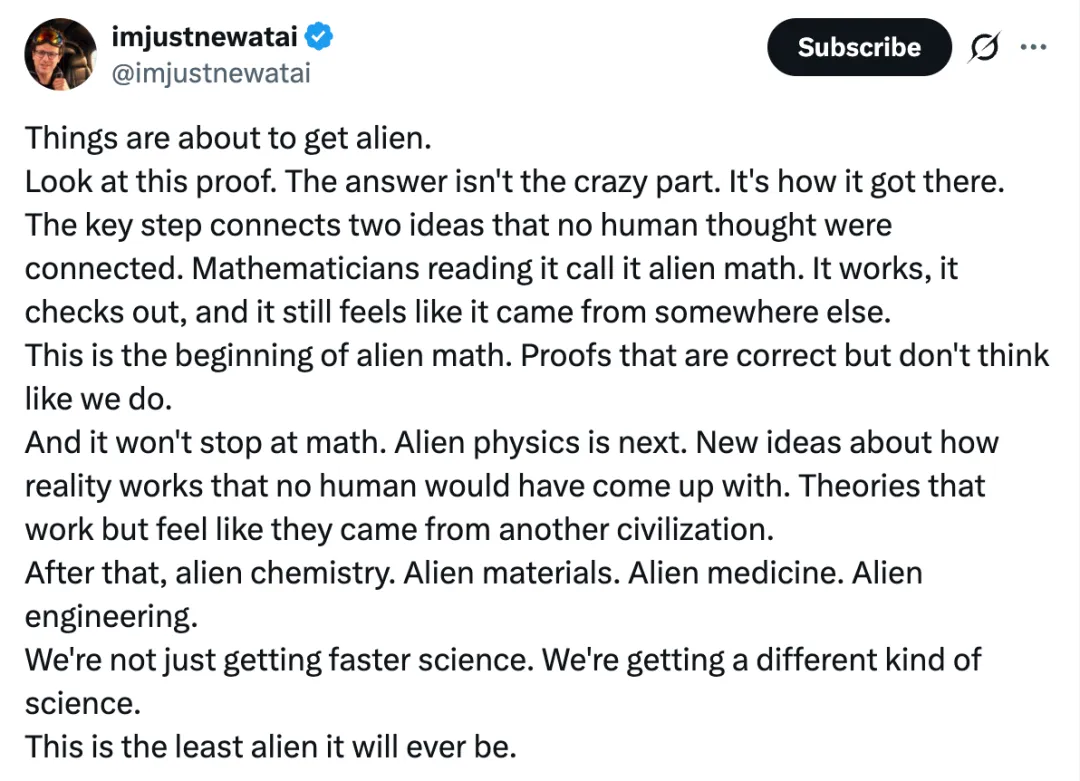
The way science is produced is changing, and new research pathways may no longer fully follow human thinking habits.
Today, perhaps, is the most "alien" time for science.
The link is as follows: