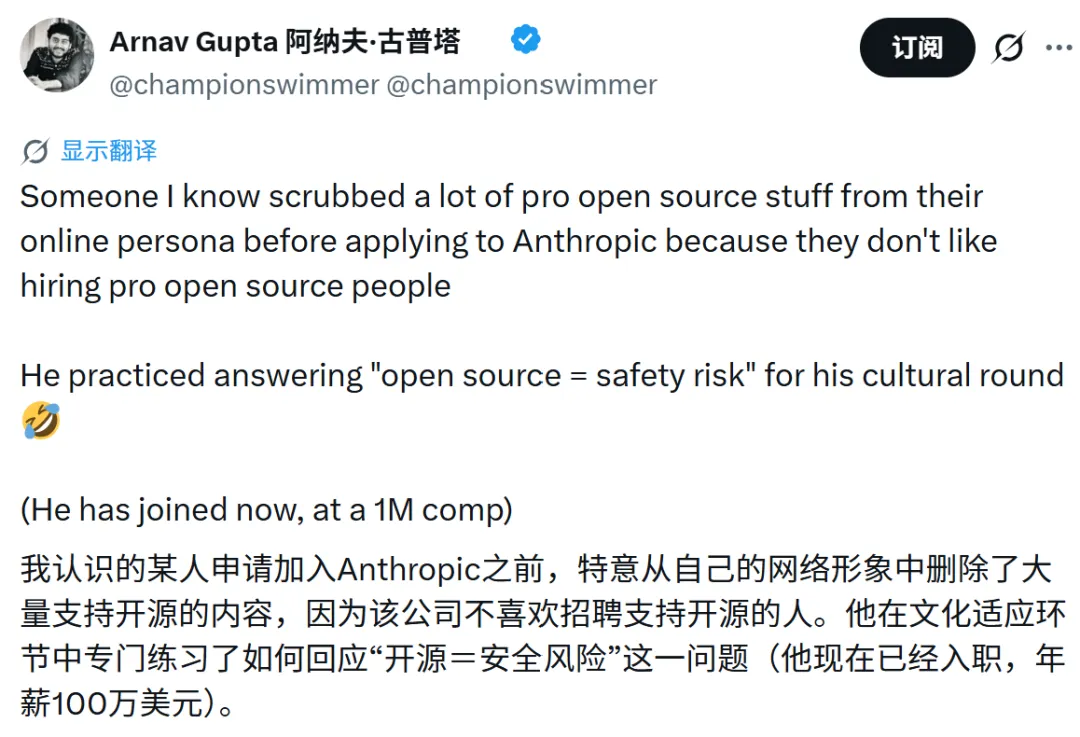
You're an open-source AI engineer who's participating in an Anthropic cultural interview.
As long as you've been through this, what's waiting for you is probably a million-dollar salary, adequate computing skills, and participation in cutting-edge model development.
The interviewer mentioned the "open source model", and you're confused, because you've prepared well in advance.
In addition to reciting the catchphrase "open source = security risk", you've even cleared open source-supported posts in your social accounts in advance so that past speeches don't affect interview results.
Is there anything more important than getting this job? In the end, you passed the interview successfully.
This is a story shared by a netizens.
At the same time, it's hard to judge whether "identification" is genuine or a "standard answer" prepared ahead of time when you're trying to find someone who agrees with you in a cultural interview.
According to Axios, such a "loyalty dilemma" is plaguing a growing number of frontline companies.
Anthropic CEO Dario worries that the company's new recruits are more about making money than the Anthropic mission.
A million-dollar entry ticket
The price of these frontline companies is really amazing.
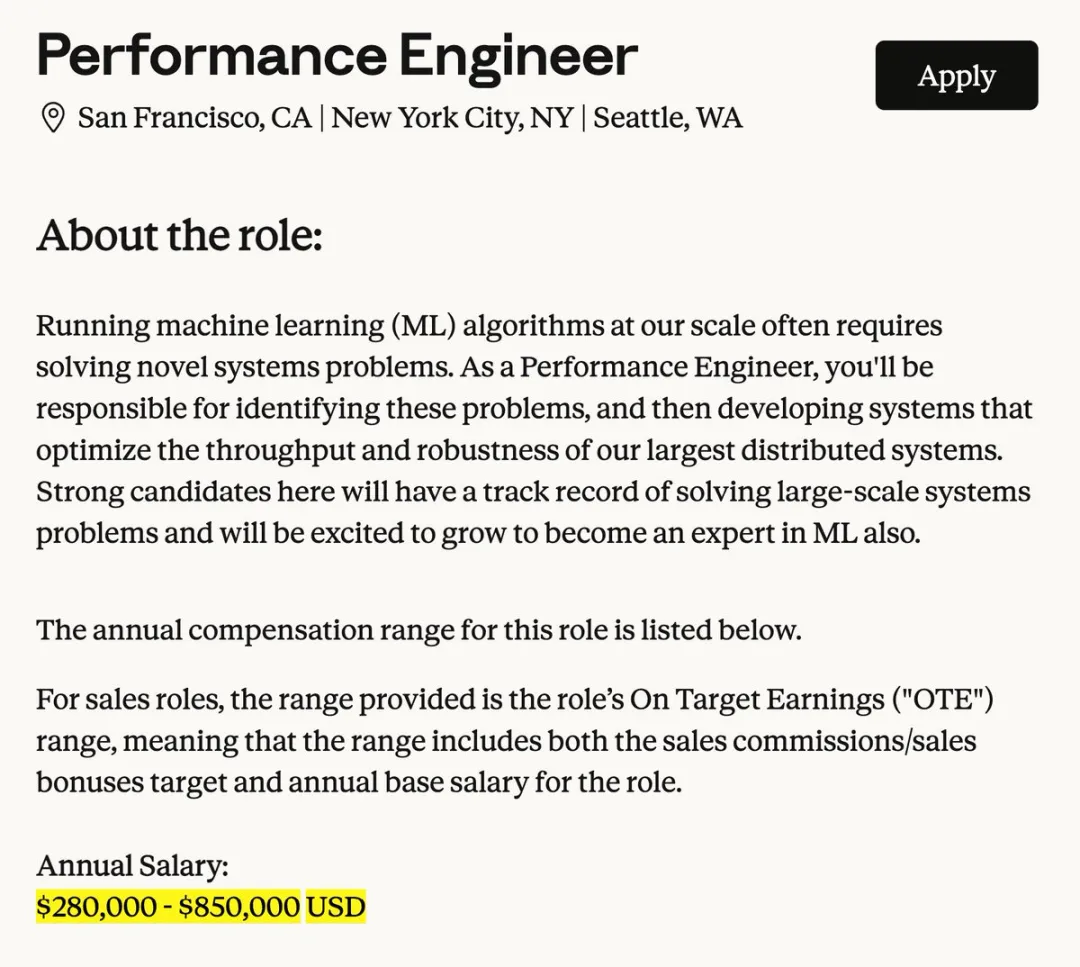
Anthropic's official recruitment information shows that its Performance Engineer position has an annual salary range of $280,000 to $850,000.
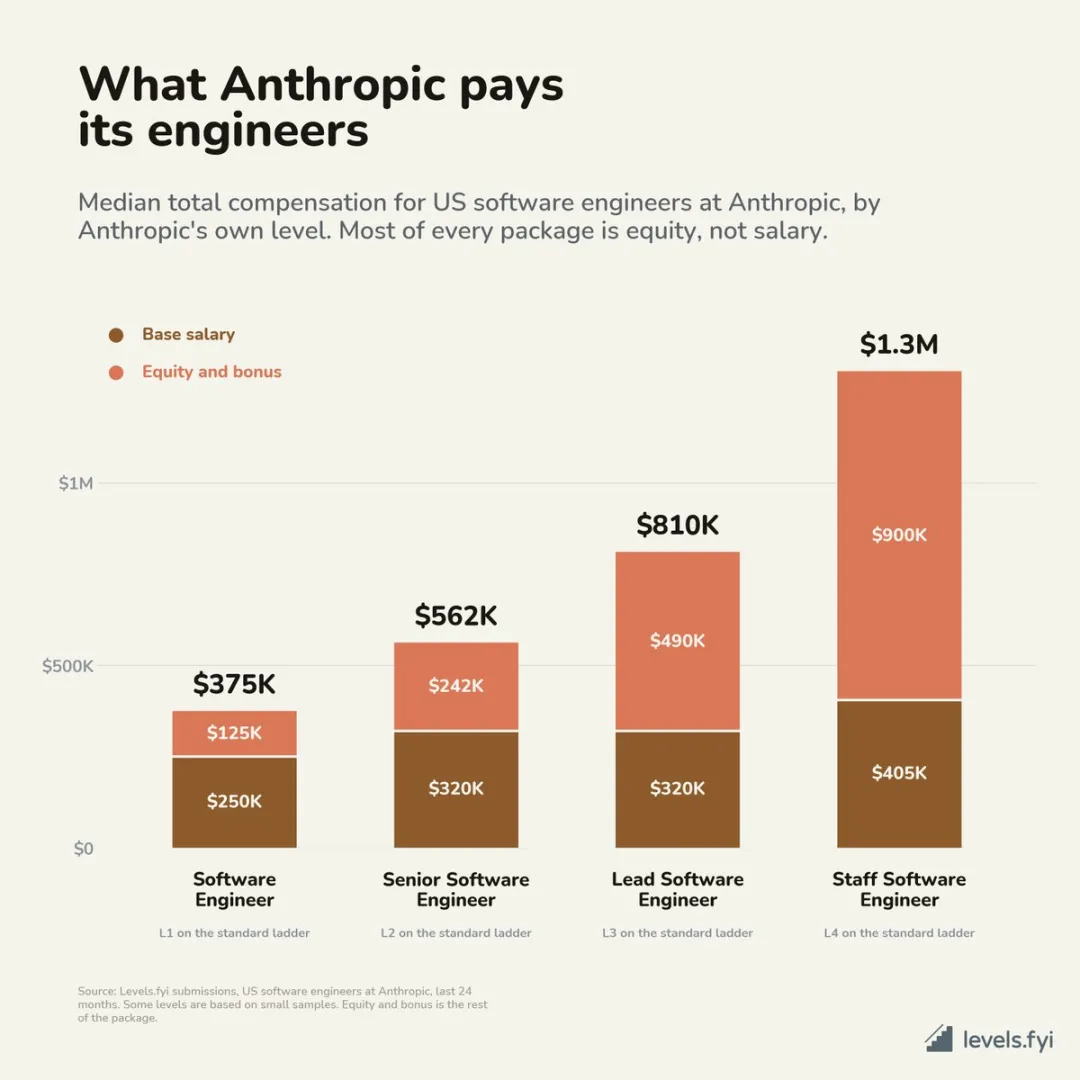
According to statistics, the median total salary for software engineers at Anthropic L1 in the United States over the past 24 months was about $375k; by L4, the figure had reached about $1.3 million.
Of these, the basic salary of L4 engineers is about $40,000, with $900,000 in equity and bonuses, accounting for nearly 70% of the total salary.
With OpenAI, Google, Meta, and a host of well-funded AI startups competing against the same small group of top researchers, it's hard for Anthropic to get out of this pay race.
It's hard to believe that Anthropic wants engineers to look at the $850,000 annual salary and say, "I don't care about the money, I just agree with the company".

In other words, the company wants employees to fully embrace the idea of the company after they get the money, so that those ideas that are not very compatible with the company will automatically disappear before they take office.
Have you been invited to stay?
A person's subjective identity will not disappear because of a paper contract, and a person's choice will not stop at the moment of entry into office.
A million-dollar salary can get people in, but it is not a guarantee that they will stay.
Recently, Aung San Suu Kyi left Thinking Machines to return to OpenAI. She also became the fourth co-founder to leave Thinking Machines in a year.
Similar stories have been told in other top teams.
One of the authors of the Transformer paper, Noam Shazeer, left Google to join OpenAI; Nobel Prize winner John Jumper also switched from Google to Anthropic.
Meta has been heavily involved in the creation of a team of super-intelligent researchers from other laboratories, some of whom soon left again and switched to OpenAI. Even the SSI, whose sole goal was "security super-intelligence", failed to retain its CEO, who eventually joined Meta.
In this round of talent warfare, recruitment notices are hardly considered a win. Companies spend a lot of money to recruit people and then think about how to stop them from going to the next company.
Millions of dollars can buy the next job, but not the next long-term commitment.
Are you really just making money?
To reduce the flow of talent to "money only" may underestimate the complexity of the competition.
According to Axios, in addition to remuneration, top researchers are also very concerned about how much computing resources they can access, how much influence they can have in real development, and whether they can freely explore the path of technology that identifies them.
For these researchers, choosing a company means choosing a team of GPUs that will be able to work together for the next few years, as well as a technical route that could determine the direction of the cutting-edge model.
Money is important, of course, but the work of AI companies at the forefront itself is also a mixture of industry status, technological differences and a desire to change the world.
This also makes Anthropic's concerns extremely subtle.
Companies must be paid high enough to compete with OpenAI, Google and Meta; when candidates are really attracted to high salaries, they begin to worry about their lack of mission.
But at the end of the day, it's a two-way choice.
Companies worry that employees only come for pay, and employees have reason to worry about whether a company can provide enough computing power, good teams, the freedom to research, and the space to actually participate in technical decisions in addition to high wages.
Companies can't attract talent with money and blame it on them.
Instead of constantly asking employees to be "loyal", it's better to prove to them that there is more to them than their pay.
The link is as follows: