In the field of computational advertising, real-time bidding (RTB) is the core paradigm: when users generate a single exposure opportunity on the media side, the ad trading platform sends bid requests to all competing advertisers, advertisers bid in real-time through DSP's automated bid algorithm, and the highest bidder wins the show. In this process, advertisers only need to set high-level targets (such as targeted CPA, budget caps), and automated bid algorithms automatically complete all bid decisions.
However, for a long time, automated bidding research and benchmarks have largely remained in the DSP perspective, focusing on maximizing the conversion of individual advertisers. Automated bidding in real-world industrial scenarios has been implemented within a unified platform system represented by the fast-moving advertising system: stream supply, advertiser bidding and bidding transactions are interconnected, and automated bidding algorithms not only optimize the performance of individual advertisers, but also take into account the overall effectiveness and constraint stability of platforms under multiple advertiser competitors. To address this problem, the first automated bidding platform in the industry to be designed from a unified bidding perspective, PlatformBid, has been proposed by the team; at the same time, a methodology based on Flow Matching (DDF) has been proposed.

The paper's title is PlatformBid: An Auto-Bidding Benchmark from a Unified Advertising Platform's Perspective.
The code repository:https://github.com/YsTvT/PlatformBid
Address of the paper:https://arxiv.org/pdf/2607.27265
I. Background: The neglected "platform perspective"
Traditional automated bidding research is DSP-focused, with the core goal of optimizing bidding strategies for individual advertisers so that they can get more conversions in competition. Public benchmarks such as iPinYou, AuctionNet follow this pattern: evaluating the performance of individual advertisers in the face of fixed historical bidding.
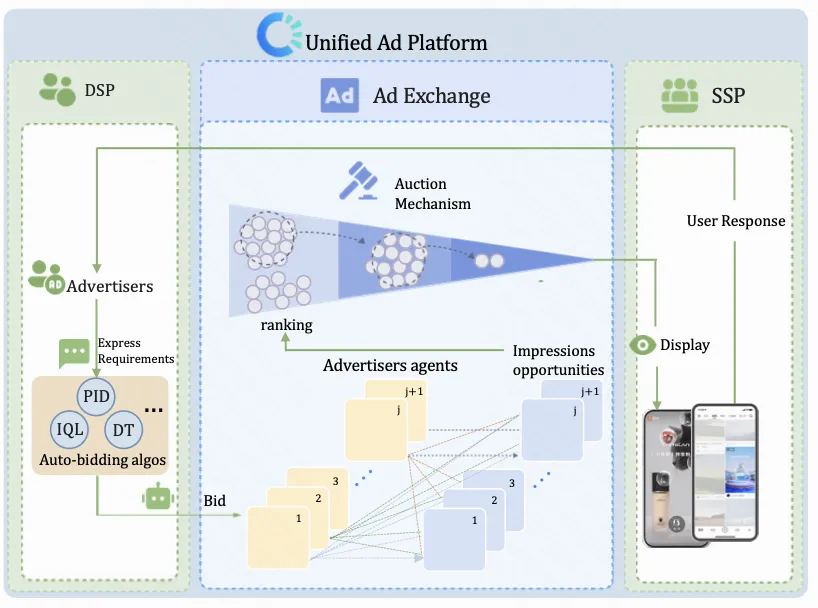
But the industry landscape has changed radically:
Platform Integration Trends: Real industrial advertising systems have integrated SSPs, DSPs and ad trading engines internally, with competitions between advertisers occurring within platforms rather than across platforms;
Assessing gaps: Existing benchmarks fail to assess the critical issue of "how the platform's overall revenue and fairness for advertisers change when all advertisers adopt new algorithms at the same time".
Lack of competitive dynamics: Criteria such as AuctionNet can't capture dynamic competition when multiple advertisers are adjusting their strategies simultaneously by replacing advertisers in sequence, reversing historical bidding.
The best of a single advertiser is not equal to the best of the whole platform. The paradigm shift from the DSP perspective to the platform perspective is the core issue to be addressed in this work.
Second, PlatformBid benchmarking design
2.1 Definition of the problem: Formalisation of the platform perspective
PlatformBid first redefines the automated bid optimization problem from a single platform perspective. Compared to traditional DSP formulas, the key difference is that it explicitly introduces the platform-level target constraint O_l:

In this case, O_l can require the platform's total revenue not to be less than the baseline strategy level, similar to the requirements of online A/B testing.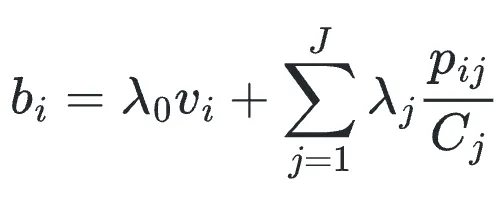 Algorithms update parameters at rough grain time intervals (such as 30 minutes) to leave ample computational space for complex algorithms.
2.2 Three major evaluation settings
Based on the platform's actual business scenario, PlatformBid has designed three representative assessment settings that accurately reflect the dynamics of real-world automated bidding competition:
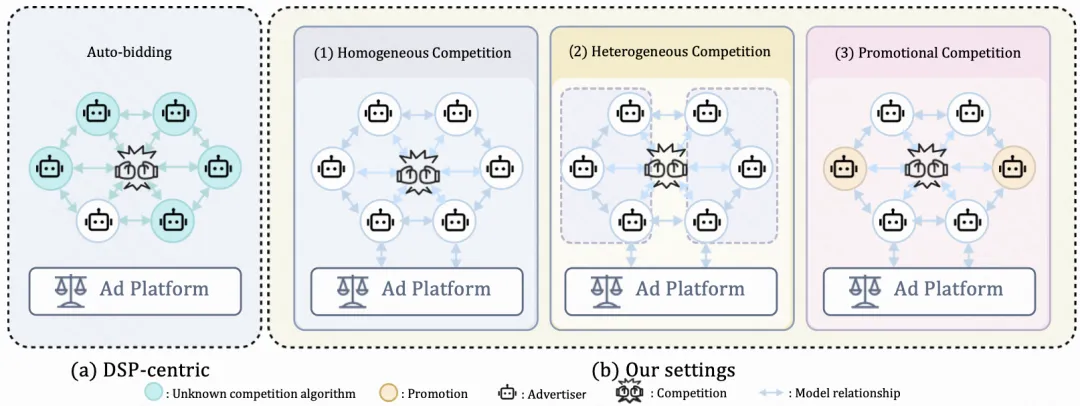
Setting 1: Homogeneous Competition
All of the N=48 advertisers deployed the same bidding strategy and competitive exposure through the GSP auction mechanism. This setup directly mapped new algorithms' full online scenarios, assessing platform-level average performance, and revealed whether the algorithm could achieve stable market equilibrium or trigger systemic efficiency losses (such as bid inflation or conspiracy pricing).
Setting 2: heterogeneous competition
Advertisers are divided into two groups: N/2 = 24 base-line advertisers using fixed reference strategies (Vanilla Decision Transformer) and N/2 = 24 test advertisers using an evaluation algorithm.
Setting 3: Promotional Competition
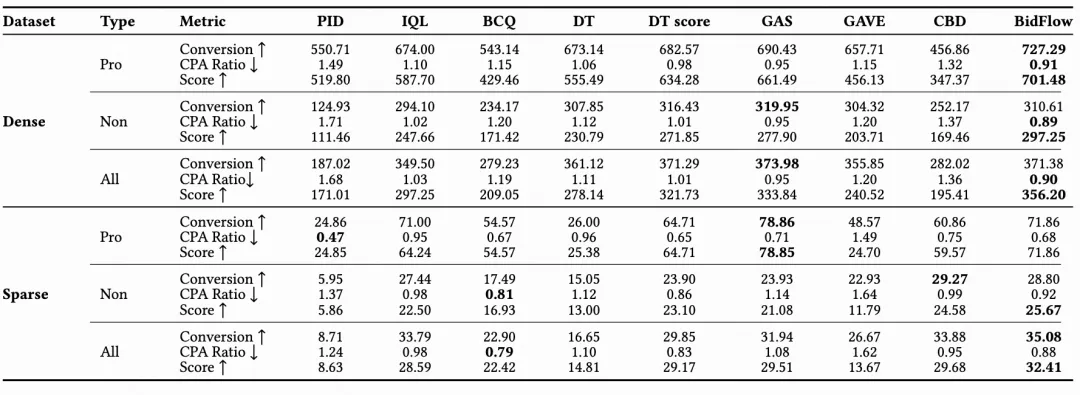
Simulating major promotional campaigns (such as Black Friday): 7 advertisers double their budgets and all of them use the same algorithm. They report promotional advertisers, non-promotional advertisers, and overall platform metrics, respectively. This setup tests two key capabilities: whether promotional advertisers can effectively leverage expanded budgets and still meet CPA constraints after budget increases; and whether non-promotional advertisers can maintain a stable placement effect in a competitive environment.
2.3 Assessment indicators
PlatformBid uses a system of two-dimensional indicators at the platform level and the advertiser's main level:
The platform indicators are: conversion rate, budget utilization, and budget utilization.
Advertiser-level indicators: CPA Ratio, CPA Ratio Variance, Exceed Rate, Qualified Rate
Comprehensive indicator Score: Balancing platform revenue with advertiser satisfaction:
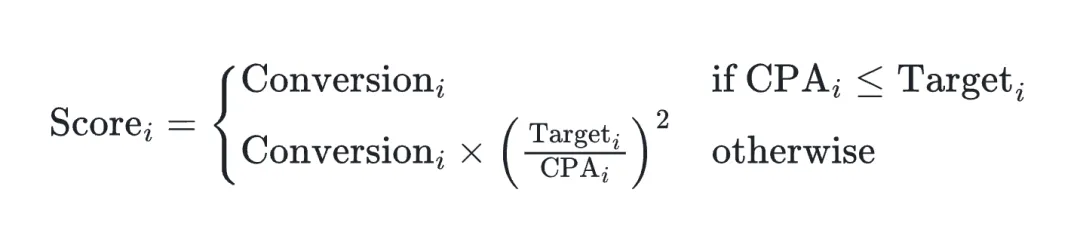
The indicator reflects the platform's preference for sustainable growth, which is punishable by high conversions obtained in violation of constraints, as this behavior erodes the trust of advertisers and the long-term health of the platform.
2.4 Data and implementation
PlatformBid, built on the AuctionNet data set and comprising 480K training tracks collected by 48 advertisers on a diversified budget and under CPA constraints, offers both Dense and Sparse reward scarcity variants. The key expansion is: from AuctionNet's single advertiser isolation assessment to the interactive simulation of a multi-advertiser shared auction environment.
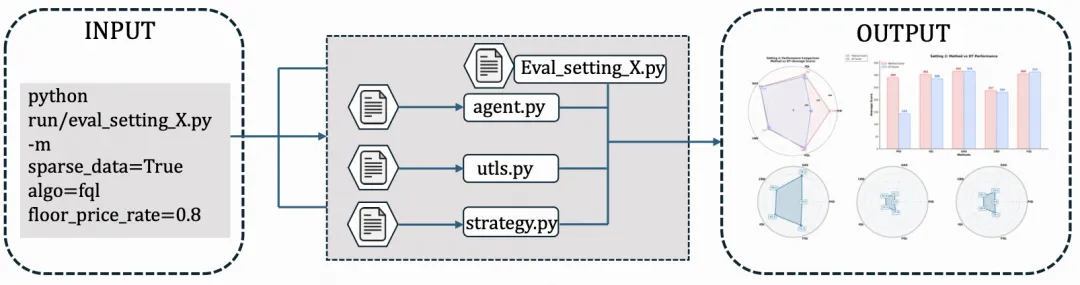
Third, BidFlow: Automated bidding methods based on Flow Matching
3.1 Motivation: Challenges of Multimodal Bid Distribution
Under the new setup of PlatformBid, the performance of existing automated bidding methods is limited. The underlying reason for this is that the platform-level competitive environment introduces more complex market volatility and competitive dynamics, which raises higher demands on the ability to model multi-modal bid distribution.
The limitations of three types of existing methods:
Classical control methods (such as PID): based on fixed mathematical formulas, unable to adapt to complex market dynamics;
Reinforced learning methods (such as BCQ, IQL): assuming a single-peak action distribution (such as the Gaussian strategy), it is difficult to express multi-modal bidding strategies;
Production methods: Decision Transformer methods (GAS, GAVE) typically model determinism or single-point Gaussian distribution; Distributed Modeling methods (CBD) have strong expressiveness, but shifting noise causes slow reasoning and difficulty in meeting the delay requirements of bidding systems.
For this purpose, the team proposed the BidFlow solution using the powerful distribution modeling capabilities of Flow Matching, while using Q-guided distillation to achieve efficient single-step reasoning.
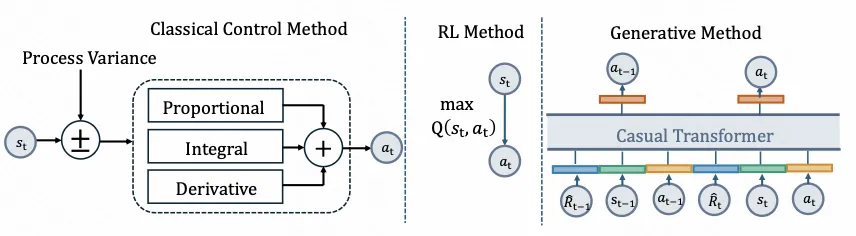
3.2 BidFlow architecture
BidFlow consists of three core components and is jointly trained:
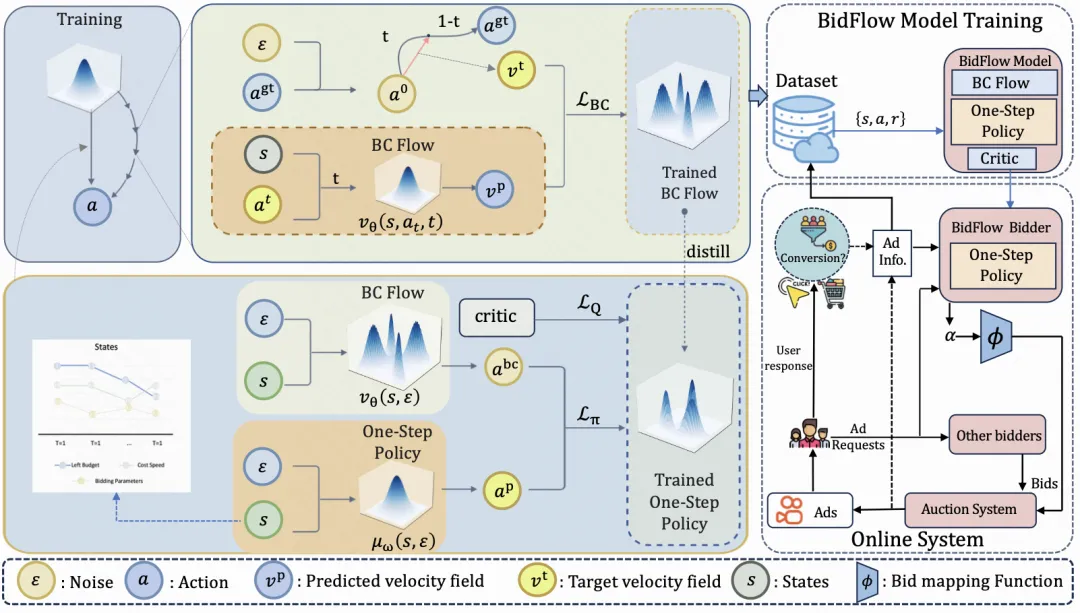
(1) Critical network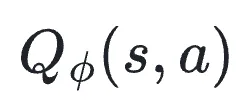
Training by standard time differentiation, estimated status - value of action:

(2) BC Flow Strategy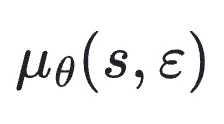
Through the Flow Matching training behavior cloning strategy, the learning speed field converts Gaussian noise into action:

where a_t = (1-t) a_0 + ta is a linear input value.
(3) One-step strategy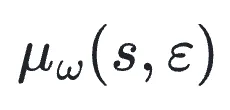
Using multi-step BC Flow distillation as a one-step strategy while maximizing performance beyond:

The first is to distill knowledge from BC Flow, and the second is to maximize Q values to go beyond behavior cloning and control normalization intensity. The three components are jointly trained in each iteration. In addition to this, there is no need to duplicate samples for efficient reasoning.
3.3 Algorithmic processes
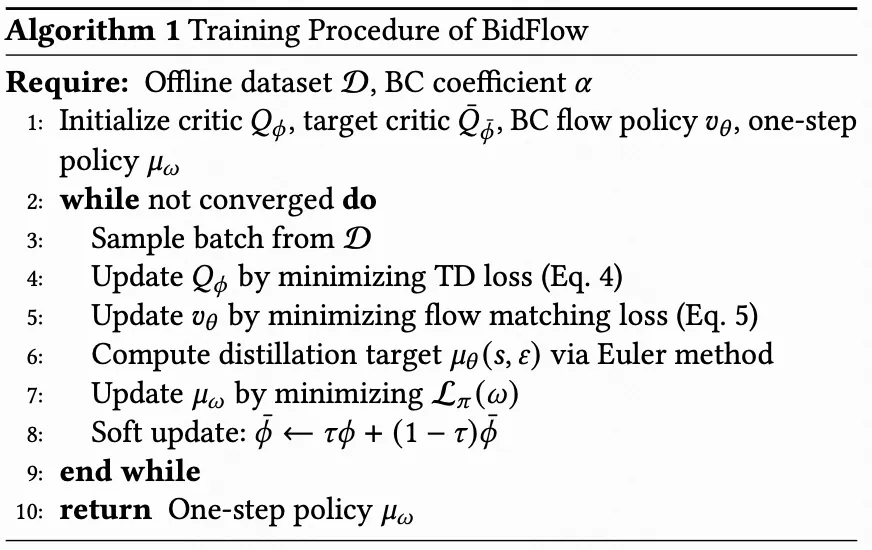
The algorithm first initializes the value network, the target value network, the BC Flow strategy and the one-step strategy. Each round is sampled from offline data sets, followed by value estimation, flow matching training, and the Euler method generates distillation targets to optimize the one-step strategy.
Four: Experimental results and analysis
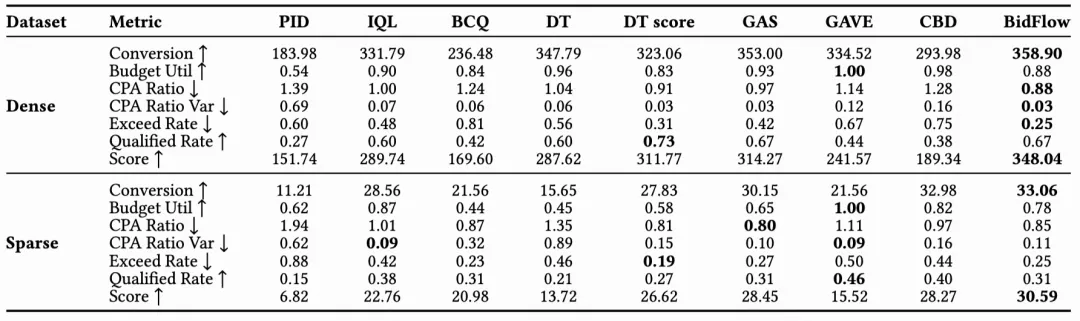
4.1 Setting 1: Equal Competition - Full Leadership in Full-Volume Deployment
In the Dense dataset, BidFlow significantly led all baseline methods with a Score of 348.04 (sub-GAS 314.27), while maintaining the lowest CPA override rate (0.25) and lowest CPA ratio difference (0.03). In the Sparse dataset, BidFlow also performed best with a Score of 30.59.
4.2 Setting 2: heterogeneous competition: robust performance of the sodium grey test
On the Dense dataset, BidFlow performed best on the platform's overall Conversion[347.96] without compromising the performance of the baseline advertisers. However, on the Sparse dataset, BidFlow performed poorly on the target group Score 35.97 vs. DT score 43.91).

4.3 Setting 3: Promotion and Competition Gendering under extreme budgetary imbalances
BidFlow performed best on both promotional advertisers (Dense Score 701.48) and non-promotional advertisers (Dense Score 297.25), with the platform's overall Score (Score 356.20) leading all baselines. This demonstrates that BidFlow can still effectively expand bidding strategies under extreme conditions of budget doubling, while maintaining strict compliance with CPA obligations.
4.4 Key findings: The combined benefits and competition of algorithm evolution - collaborative insights
From PID to BidFlow, the evolution of algorithms has brought mixed gains:
Conversions improved significantly: BidFlow improved 95% over PID conversions in Set 1 and the Sparse dataset improved threefold;
Difference is competitive strength: CPA difference is strongly negative in relation to overall Score. BidFlow achieves the highest Score with the lowest difference, while PID performs the worst with the highest difference. Low difference strategies exhibit strong co-operation traits, allowing multiple advertisers to score at the same time; high difference strategies reflect destructive overcompetition, leading to budget depletion and declining platform revenue.
4.5 Cross-data set verification: iPinYou
To verify the universality of PlatformBid, the team performed cross-data set verification on iPinYou data sets with significant structural differences. BidFlow was ranked first in all three settings, further confirming that PlatformBid and BidFlow were not constrained by specific data sources.
Fifth, online testing
To verify the effectiveness of BidFlow in real production environments, the team deployed BidFlow in the fast-moving e-commerce advertising scene, comparing it to the strongest baseline on the line (full-optimized DT method + exclusive reward design).
The 0.68% increase in expected consumption not only demonstrates BidFlow's superiority in more complex industrial scenarios, but also confirms PlatformBid's offline-online consistency.
Six: Meaning and Prospects
The value of this work is in redefining the dimensions of the evaluation of automated bidding algorithms: from "single advertiser best" to "platform-wide win-win" and leveraging Flow Matching technology to develop BidFlow automated bidding algorithms to enhance the distribution modeling capabilities of bidding algorithms.
PlatformBid provides the first platform-level automated bid benchmark, a three-dimensional representative setup (e.g., homogenous, heterogeneous, promotional competition) system covering real-world business scenarios, making platform-level revenue and fairness for advertisers measurable and analyzable for the first time;
Using the powerful distribution modeling capabilities of Flow Matching and the efficient reasoning of Q-value steering distillation, BidFlow achieved SOTA in most settings and online experiments verified its offline-online consistency.
Competition - Cooperative insights reveal the role of CPA ratio inequality as a proxy indicator of competitive strength. Low-ratio "cooperative" strategies promote collective benefit and provide theoretical guidance for platform algorithm selection.