Turning a word to the left of the screen opens up a new field of view; adjusting the character's movements, the scene immediately gives feedback. Multimodal interaction requires visual generation to follow the person's actions, while long waits disrupt the entire experience.
This makes few-step generation, slow-step generation, a key ability for interactive systems. Compressing generation to step or a few steps to produce continuous response time and computational power while maintaining high quality is an important issue for generating models that move towards real-time multi-modal interaction and further connect world models.
A step-by-step chart reaches the SOTA level, with 8 cards arranged for 14 billion parametric flow video models after training. MGFlow and Elastic Forcing, researchers from institutions such as Tsinghua University, issued two corresponding results sheets.
MGFlow performed well in the production of ImageNet 256×256, after training pMF-H, JiT-H, with a cliff-like SOTA of 1.45×1.64 FDr6; in FLUX.2 [klein] 4B text graph control, the step generated GenEval reached 0.900, the PickScore reached 21.98, surpassed the original 4-step model, and led all the baseline of the same size. Elastic Forcing, on VBench, achieved a total score of 84.64, significantly exceeding Self Forcing, while on 8 H200, it completed the real-time production of the 14B generated model in 23.2 hours.
The common question between the two works is: when the generation process is compressed into a step or a few steps, can a set of generated results be learned directly from a set of reference results about what the whole should look like?
MGFlow theoretically explains how this type of supervision produces effective updates, while Elastic Forcing answers how it extends to expensive video training. Connecting the two, a new training method: sample distribution training (distributional training). This sample-based, statistical-based distributed-level training provides supervision by comparing generated samples to the overall distribution of reference samples, without having to specify a unique reference answer for each generated result beforehand.

Figure 1: Example of a step-by-step diagram of MGFlow.
Volcanic dusk is a volcanic dusk. Elastic Forcing is a five-step process.
A field of sunflowers E to sunflower fields E to plastic Forcing
From one-on-one, one-on-one, one-on-one learning to a series of results
Generating tasks usually do not have a single answer. Similarly, in the Silicon Valley, different viewpoints, lighting and composition can be created. What the model needs to learn is the richness of this set of rational results.
Multi-step dissemination can modify the results in turn, while step generators must complete the mapping from noise to image in a single network call. Can compressed models cover the content and changes in the target data?
The sample distribution training uses a frozen visual encoder to map the generated sample with the reference sample into the characteristic space, and then compare the distribution of the two sets of characteristics. If the reference set contains multiple patterns, the generator will only be one of them, even if the single result is beautiful, the whole is still unparalleled.
Feature spaces allow for this comparison: different encoders can focus on semantics, appearances, or timing structures, converting complex differences at the pixel level into comparable representations. Therefore, what results, how much of each, and how each varies from one to the other in the reference set can serve as training information.
How each sample should be updated is determined jointly by its relationship to the whole set. This relationship can be expressed as a shared statistic, or as an interaction between samples, which is collective oversight. Learning distribution is the goal of generating a model; the key here is to build this oversight directly from the sample set.
What follows are two interconnected questions: how to turn distribution differences into effective updates and how to make this training work on expensive video models.
MGFlow: Putting different approaches into the same distribution optimization framework
Methods have been used to demonstrate collectively supervised prototypes, but their starting points are not the same. FD-Loss introduces FD indicators as a loss, comparing the averages and coefficients of the two sets of characteristics from the gradient of the overall loss; drifting uses the attraction of reference samples, the exclusion between generating samples, to construct a direct update direction.
One asks how bad the whole pump is, and one asks where each pump goes. MGFlow incorporates both into the same set of distributed optimization frameworks.
It breaks down two key choices: what models to use to describe the distribution, and what guidelines to use to compare the distribution. The former can be single-gas, mixed-gas, or nuclear density estimates; the latter can be optimal transmission distance, KL scattering, or other measurements. The best transmission focuses on the cost of moving distribution, while KL measures the difference in probability distribution.
The connection between the two is the Wasserstein gradient flow: the generating characteristic is imagined as a group of particles, with the distribution-level goal of guiding the direction of motion of each location.
This means that loss functions and update rules can be analyzed in the same set of languages: it is possible to explain more clearly exactly what distribution differences are minimized and what distribution assumptions depend on.
In the setting of the paper analysis, the best transmission is FD-Loss; the Gaussian nuclear density estimate plus KL is given at the smoothest density by an update field corresponding to Gaussian nuclear Drifting, equal to one bandwidth-scale factor.
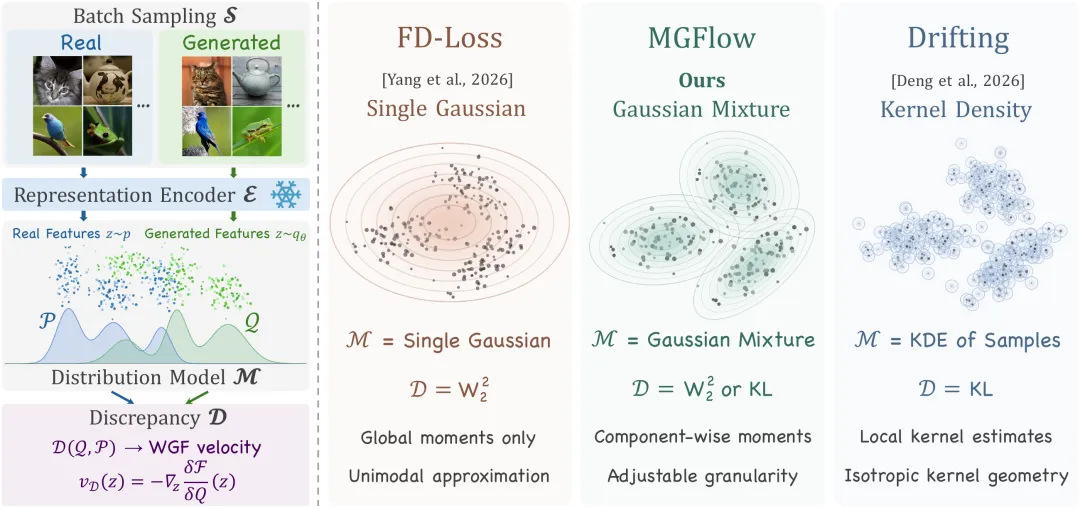
Figure 2: The distribution model determines what information to retain and how the matching guidelines determine alignment; gradient flow connects the overall goal to the sample update.
The value of this unified point of view is that the original methods of each design are transformed into a design space that can be systematically explored. For example, maintaining the single coefficient, converting the optimal transmission to KL, can result in another analytical update; using mixed coefficients, modeling particle density can be adjusted between the overall statistics and the local sample structure.
But describing multiple patterns is not the same as sending a sample to the right place. Assuming that the two types of results in the reference distribution account for half of each, the generator is clearly biased towards one category: even if the two types of results become more realistic internally, the overall ratio may still be incorrect. MGFlow therefore not only refines the distribution model, but also connects the distribution of samples with the updating direction, so that the number of samples that should be allocated to each model corresponds to each other, specifically where the samples are moved.
Along this line, MGFlow uses multiple Gaussian components to sketch different patterns, and combines the allocation of capacity-restricted samples with the correlation of updates, so that the allocation to which pattern matrix and the orientation of the updates matrix are consistent.
Intuitively, the individual Gaussian model is to summarize all the results with a set of aggregate statistics, whereas the hybrid Gaussian model allows different regions to have their own statistical characteristics; the allocation and updating of the co-operation makes these regions truly involved in supervision.
In an ImageNet 256×256 step-generation experiment, the FDr6 of MGFlow-KL on pMF-H, JiT-H reached 1.45/1,64 on the SOTA level, a significant reduction of about 23%-38% from FD-Loss. The lower the distribution differences in the six expression spaces combined, the better.
It is worth noting that MGFlow-KL did not directly use FD loss training to improve this indicator; in the three encoders that were not used to construct training loss, the integrated indicator was also improved, demonstrating that this method can go beyond the characteristics used in training and learn better distribution.
In the text graphics experiment, MGFlow trained FLUX.2 [klein] 4B as a step generator, and the graphics combined matching version of GenEval was upgraded from 0.794 on the original four-step model to 0.900, and the PickScore was upgraded from 21.85 to 21.98: surpassed the four-step result of the original FLUX.2 [klein] 4B, achieving the same-scale model SOTA performance.
For interactive image creation, users want to quickly see a new image that meets the requirements whenever they modify the prompts. MGFlow will put faster feedback and more accurate expression into the same post-training route.
Elastic Forcing: Training 14B video into a single eight-card node
The most important application scenario for reducing the number of production steps and improving the speed of production is self-return video generation: if the production speed exceeds the playback speed, then real-time stream generation and interaction experience can be achieved in the marginal generation of lateral playback chips. While the challenges faced by collective supervision increase as samples change from images to videos: videos are longer, models are larger, and comparisons between batches of results are more expensive.
Based on the Self Forcing method, all use asymmetrical DMD to distill two-way video scattering models into less-step regression models. This method is very effective on small models, but to expand to 10 billion-parameter large video models, training is unstable; computational costs are too high. Elastic Forcing switches to sample distribution training. The most intuitive advantage of the new method is that the post-training of the 14B regression video model is completed at a single 8-card node. If the Self Forcing method is used to train the 14B model, it will even appear to overflow on 64 cards; while Elastic Forcing uses 8 H200, 23.2 hours to finish, producing results that exceed the Krea-Real industry model.
This reduces the resource threshold for continuous iteration by making distributed training of billion-level video models into single-node executable experiments.
Single-node budgets also make it easier for teams to continue experimenting around new data, new goals. For products that require repeatedly improving roles, styles, or scenarios, training costs directly affect the frequency with which new programs are tested.
This advantage comes from the changes in the networks that need to be maintained after training. Monitoring along the score, the expansion generators will also carry the burden of assisting the spread network; switching from reference video to supervision, the resources can be used more for the generators themselves, so that the post-training of the multimillion-degree flow model has a clear, executable budget.
A clash above the clouds is created by Elastic Forcing.
A mountain sanctuary is a sanctuary in the mountains.
The larger the model, the higher the cost of maintaining these additional networks. Elastic Forcing maintains the regression generation process, modifies the maximum mean difference between reference video and video generation in frozen feature space (MMD) as supervision, and after training no longer maintains these two auxiliary scores.
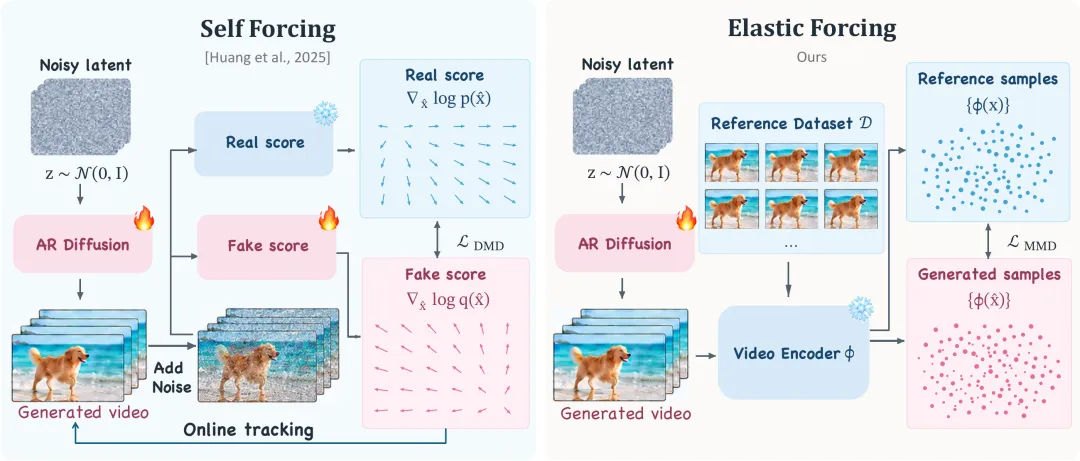
Figure 3: Elastic Forcing uses direct distributed-level supervision of reference sample characteristics to replace ancillary score networks.
However, removing additional networks is not enough. MMDs contain cross-sample interactions, often requiring huge batch training, which is often unrealistic in expensive video model training. If large batches are disassembled, the respective losses and incremental gradients will result in the loss of samples across smaller batches. Elastic Forcing's response is to break down the problem into two layers: first allow enough samples to jointly decide the direction of renewal in the character space, and then control the expense of transmitting this direction back to the generator.
Elastic Forcing combines pre-computed statistical summaries with random sampling to balance approximate biases and estimate fluctuations; uses whole sets of characteristics to determine the update direction at the generating end, re-splitting it into a computed graph; selects partial sample feedback, and scales it to the corresponding gradient.
This arrangement retains the most valuable part of collective supervision: allowing more samples to jointly decide the direction of updating, while avoiding keeping all of the same-sized computational charts on display. Statistical estimates of how many samples are needed and how much can be transmitted at a time have different adjustment spaces.
In 1.3B controls aligned with Self Forcing's architecture, initialization and generation processes, Elastic Forcing increased the total VBench score from 83.80 to 84.64, while maintaining a production speed of 17 FPS.
The quality of the 14B model has also received human-blind reviews. In blind reviews covering scenes such as character movements, animal movements and object interaction, 42 participants evaluated 20 sets of paired videos. On a 1×5 scale, the average score of Elastic Forcing 14B for a day of 8 card training was 3.354, significantly higher than the 3.054 of the Krea Realtime 14B, an industrial model, demonstrating the outstanding effects and powerful potential of sample distribution training in post-training streamlined video generation models.
Reference distribution, and what to learn in defining models
When a target is defined by a reference sample, changing the reference set can change the content to be learned after training. In 1.3B, Elastic Forcing shows the adaptation of the dragon characters, black and white styles and landscape projection constructs, without the need to re-adapt the spread teachers to these targets.
The source of the reference data is also more flexible: the standard experiment uses videos produced by Wan, and the paper also shows qualitative results for reference using OpenVid real video. The model can learn from what objectives, directly related to the choice of reference sets.

Figure 4: Self Forcing, Wan-14B and Elastic Forcing, respectively; the upper right-hand box illustrates the character. Elastic Forcing uses a 1.3B generator to cut the image from the paper.
MGFlow's graphic matching combines images with text characteristics, allowing direct supervision of the correspondence between text and images. The former adjusts what the reference set contains, the latter adjusts what the combined information trains to compare, so that the mouse model can learn what the mouse needs to become a designable object.
In MGFlow's text-based graphics control, both versions accept text conditions, but only when the image distribution is matched, GenEval is 0.856, upgraded to 0.900 after the image combinations are added.
For example, if a set of images contains both red cars and blue bicycles, a single view of the image collection can determine whether the content is rich, but to learn which results the instruction corresponds to, it is also necessary to retain the matching information of the conditions with the image.
The two works use different matching methods, but progress around the same research route: MGFlow explains how to unify the understanding of distribution supervision; system design; Elastic Forcing solves computational problems when it enters large-scale video; how to describe distribution; compare distribution; and then transform it into affordable training signals that are generating new exploration spaces for models.
Let the generation interact and move to the world model with the action model.
When a small step generates further access to the action conditions, the research route is linked to the world model, the world action model. The world model needs to predict how the environment will change, and the world action model also needs to link the action to the consequences: what will be seen from a mobile perspective, how the scenario will evolve after an operation is performed. Each prediction must be involved in the next decision, and the speed of generation is directly related to how often the system can observe, launch and respond.
Small-step generation here takes on the role of rapid prediction. In fixed time, shorter generation processes leave space for multiple candidate futures; spontaneous flow generation provides a continuous way to develop visual states. Movement-driven environmental simulation, the next step is to organize the current observation, movement conditions and subsequent visual trajectories into a common distribution, allowing the supervisor to focus on the rationality of the future image, as well as its relationship to the actions taken.
This expansion also coincides with the starting point of sample distribution training: the same scenarios, the same actions often have multiple rational sequels, and models need to learn their overall laws and proportions of occurrence. MGFlow provides a methodology framework for designing such a distribution oversight, while Elastic Forcing shows the training paths to extend direct sample oversight to large-scale video models. The link between interactive video, game environments and physical intelligence is clear: short feedback is generated in a few steps to combine distributed organizational conditions with results, so that training can continue to absorb new scene data.
From a suggestion generating content to new visual feedback with each operation, generating models are moving into continuous interaction. Making the model faster to generate and learn in a more efficient and economical way is exactly where MGFlow and Elastic Forcing are headed.
Both papers were produced in collaboration with the Meow Lab Laboratory of the Institute of Artificial Intelligence at Tsinghua University, Joint University of Pudong, Xi'an University of Transportation, Beijing University, Zhejiang University, University of Science and Technology of China, and the University of California, Berkeley.
Paper and project resources
MGFlow:
The paper:
Projects and examples:
The code is:https://github.com/shihaoyang0423/MGFlow
The model:https://huggingface.co/shy0423/MGFlow
Elastic Forcing:
The paper:
Projects and videos:
The code is: