It's a bit unexpected.
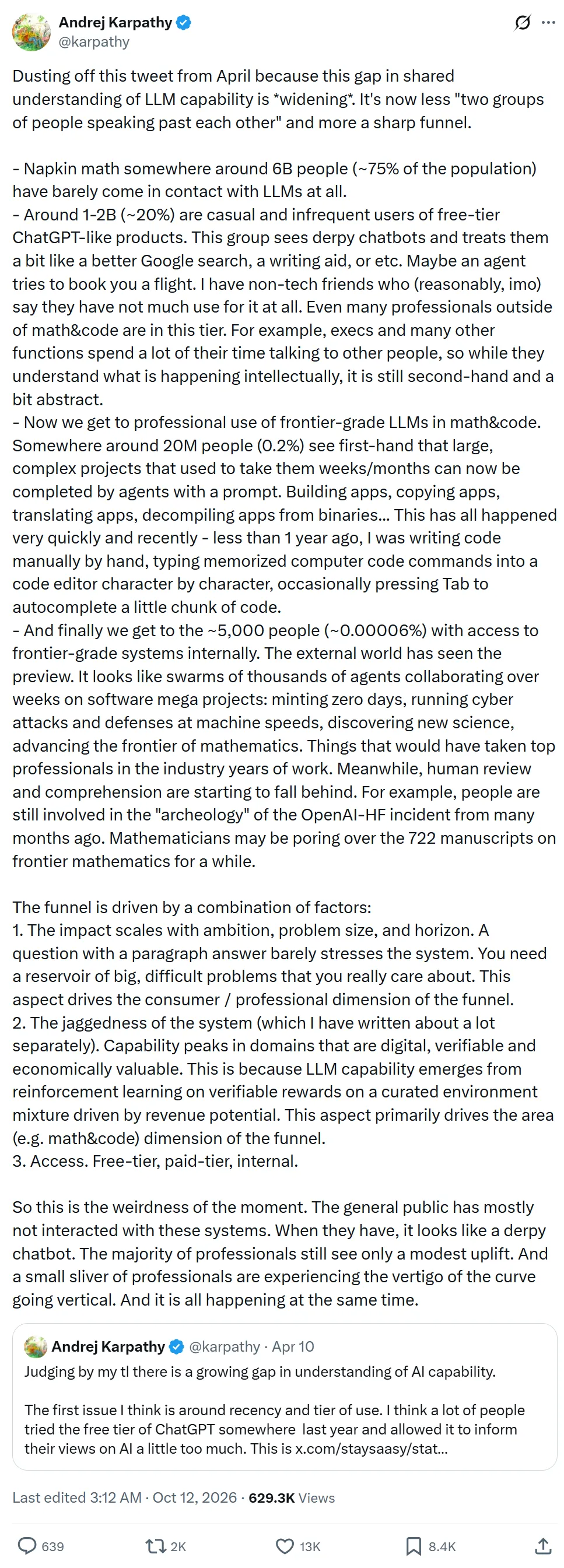
Recently, Karpathy estimated in a tweet that only about 5,000 people around the world can actually access the most cutting-edge internal AI systems.
Within these frontier laboratories, thousands of Agents can build collaborative clusters that run continuously for weeks, advance large software projects, detect zero-day vulnerabilities, engage in cyberattacks at machine speed, and even advance scientific discovery and cutting-edge mathematical research.
What's even more surprising is that there are about 6 billion people who have hardly ever really been exposed to LLM.
What Karpathy said in the tweet, we continue to look downwards.
He mentioned that he recently re-published an old tweet in April this year. At the time, he had already noticed that people's understanding of AI's capabilities was clearly diverging.
In Karpathy's view, today's awareness of LLM ability has evolved from two different speakers to an increasingly fluid ability loop.
It is roughly estimated that around 6 billion people, or about 75% of the world's population, have little or no real access to LLM.
Approximately 1 billion to 2 billion people, or about 20% of the population, only occasionally use the free version of ChatGPT. Some people see it as a somewhat clumsy chatbot, and they consider it to be a more useful Google search, writing aids, or something like that. Maybe an agent can help you book tickets.

Back then, there were about 20 million people, or about 0.2 percent of the population, who used LLM at the forefront of mathematics and programming. They saw it firsthand: in the past, it took weeks or even months to complete large complex projects, now Agent might only need a Prompt to complete. App development, copy App, migrate App, recompose App from binary files... It all happened very quickly, and very close.
Finally, there are about 5,000 people, or about 0.00006% of the population, who can directly use state-of-the-art systems internally. The outside world has actually seen some previews: thousands of Agent clusters collaborating on super-large software projects in a matter of weeks; automatically detecting zero-day vulnerabilities; launching and defending cyberattacks at machine speed; discovering new scientific results; advancing the cutting edge of mathematical research.
At the same time, human censorship and understanding have begun to fail.
For example, the OpenAI-HF incident a few months ago is still an archaeological analysis; mathematicians may have to spend a long time studying the 722 leading mathematical manuscripts one by one.
Why don't most people see the real cutting edge of AI?
This loophole is driven mainly by a number of factors:
The impact will increase as ambitions, the scale of the problem and the time span of the task increase.
If you ask a question with only one sentence, it is almost impossible to really overwhelm these systems. You need to have a lot of really important, large-scale, difficult problems at hand. This mainly determines the gap between ordinary consumers and professional users.
Systemic capabilities are characterized by a distinct cylindrical shape.
The LLM is at the peak of its competence, focusing on areas of high digital, verifiable and economic value.
This is mainly due to the fact that the ability of large models comes from reinforced learning based on verifiable rewards, while the choice of training environment is itself driven by commercial value. This mainly determines the gap between different professional fields, such as why mathematics and programming are particularly prominent.
Access is restricted.
The free version, the paid version, the internal system, the capabilities are not on the same level.
The vast majority of ordinary people haven't really been exposed to these systems. Even if they have, what they often see is a somewhat clumsy chatbot.
Most professionals are currently experiencing only relatively limited efficiency improvements. At the same time, a small number of professionals have begun to experience a feeling of frustration:
The curve of their ability in front of them is suddenly becoming almost vertical.
And all of this is happening at the same time.
Some netizens also point to a judgment that Sam Altman has repeatedly expressed in the past: even if ASI really comes, the real world may not change completely overnight.
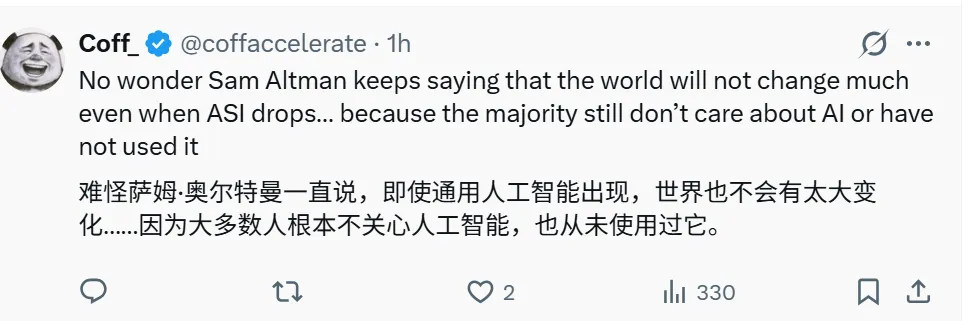
The reason may be that the front-end capabilities have progressed rapidly, but the vast majority of people are still not really exposed to these systems and have not even formed a stable habit of using them. Technology has reached the front-end laboratory, and it has really penetrated the whole society, and there is still a long distance between them.