Just today, Tao Te Ching unveiled his latest lecture at the California Institute of Technology on Math 2.0 and Math 2.0.
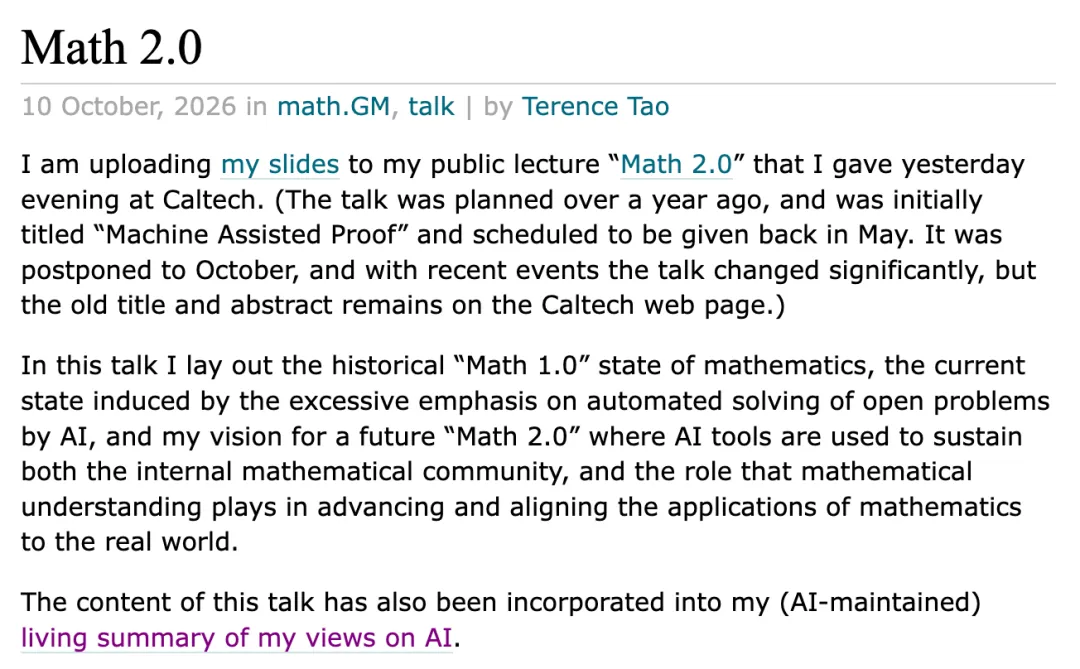
He explained that the talk had already begun planning more than a year ago, with the original title being Machine Assisted Proof, which was originally scheduled for May this year. Later, the talk was postponed to October. Due to a series of recent events, the content of the talk also changed significantly. However, the website of the California Institute of Technology still retains the original title and summary of the talk.
In this talk, he first reviewed the historical stage of mathematical development, "Math 1.0"; he then discussed the current state of the mathematical community due to the over-emphasis on using AI to automatically solve open mathematical problems.
Tao Te Ching articulated his vision for the future of "Math 2.0": at this stage, AI tools will be used to support the development of the mathematical research community while maintaining and strengthening mathematical understanding of the role mathematics plays in promoting practical applications of mathematics to better fit the needs of the real world.
Address of the PPT:
The following is a Chinese translation of Taotze's complete speech slides, with key arguments, cases, figures, graphical meanings and specific research directions preserved.
From "proving scarcity" to "proving wealth".
AI is changing mathematical research
The emergence of modern AI tools is shocking many historical professions. Taotzeo noted that the field of mathematical research in which he engaged has largely maintained a relatively stable mode of operation over the past nearly a century, but it turns out that mathematical research is particularly vulnerable to the impact of this round of AI technological changes. To understand this change, it is necessary to look back at the basic operating logic of traditional mathematical research.
Traditional mathematical research, called "Math 1.0" by Taoiseach Taoiseach, is based on a core premise: Mathematical proof is scarce: Proof Scarcity. Finding the answer to an unresolved mathematical problem and proving it rigorously is often very difficult and rare. This process often requires researchers with deep expertise and a lot of time and effort.
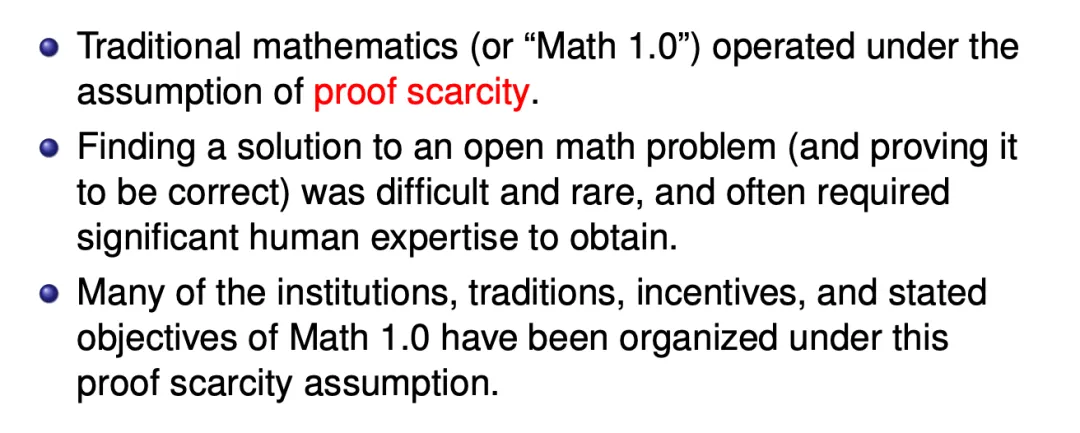
Many of the existing systems, traditions, incentive mechanisms, and research goals in mathematics are built around this basic assumption of "proving scarcity". In other words, when solving problems themselves is extremely difficult, the mathematical community will be able to solve important open problems as important criteria for measuring research outcomes.
But the emergence of AI is shaking this premise. Taotzeo believes that mathematics has several characteristics that are particularly suited to modern AI compared to other disciplines.
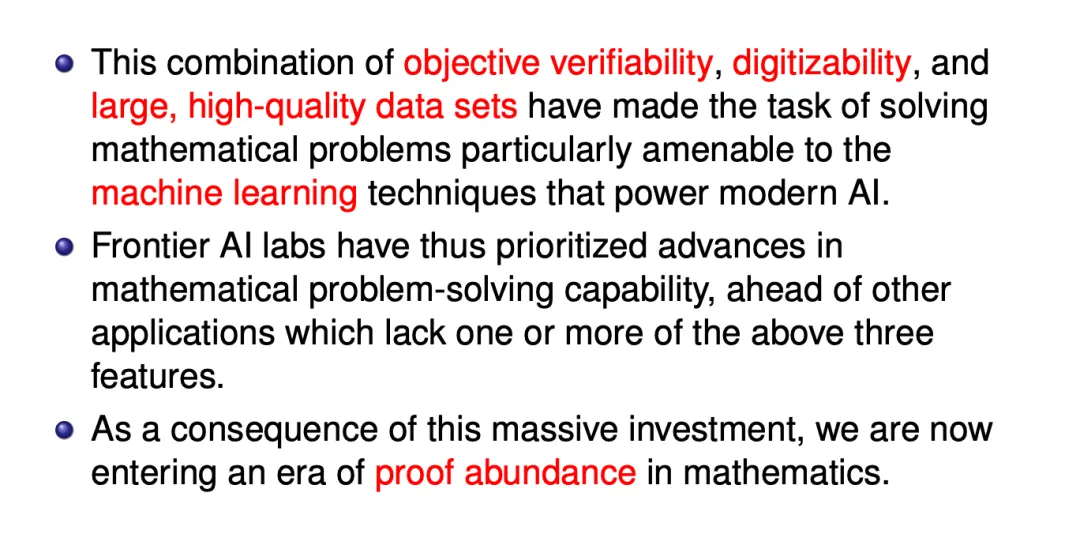
The first is objective verifiability. Mathematical proofs have a nature that is uncommon in many other disciplines: their correctness can be objectively verified. Different mathematicians may disagree on which mathematical research is more interesting and valuable, but there is a general consensus in the mathematical community as to whether a particular problem is correct or complete. In fact, if the proof is written in an appropriate formalized language, such as Lean, a computer can even mechanically check the correctness of the proof.
Second, it is highly digitized. Mathematical proofs do not require any physical entity as a carrier, nor do they need to rely on real-world data inputs, or on real-world experiments to validate output results. In principle, only paper and pencil, combined with definitions provided by standard mathematical textbooks or mathematical reference libraries, can be used to construct and validate proofs. Of course, solving complex mathematical problems often also requires knowledge of relevant research literature. Fortunately, today there are a large number of mathematical literatures that have achieved digitization.
This means that mathematical research has three favorable conditions: objective verifiability, easy digitization, and a large amount of high-quality data. These conditions make mathematical problem solving particularly suitable for machine learning technologies that rely on modern AI. Therefore, leading-edge AI laboratories prioritize the development of mathematical problem solving capabilities, while other applications that lack one or more of the above conditions may not be able to achieve the same level of progress.
As cutting-edge AI labs invest a lot of resources in their mathematical capabilities, mathematical research is entering a new era: proof-of-abundance.
Now, as long as people have enough computational resources and access to cutting-edge AI models, it is possible to get answers to many open mathematical problems that have been considered difficult in the past in a relatively short time. More and more times, people who ask AI questions do not even need the expertise to solve the problem.
This contrasts sharply with traditional mathematical research. In the past, an important mathematical problem may have taken mathematicians years or even decades to solve. Today, some once very difficult problems can be solved quickly with the help of AI systems. However, Taoiseach emphasizes that this does not mean that AI already has the same powerful capabilities in all directions.
AI's current capabilities present a distinct "shaped" distribution. In some tasks, AI's performance is staggering; but in others, it is still far from being required. For example, for tasks that require subjective judgement, rely on real-world interactions, or lack sufficient data, AI's performance differs markedly from its ability to demonstrate mathematical proof.
This imbalance of ability exists both within mathematics and elsewhere. Therefore, it cannot be inferred that AI already has the ability to comprehensively deal with mathematical research and even complex problems in the real world because it has made breakthroughs in certain mathematical problems.
Although press releases and social media may give the impression that AI is rapidly solving major problems in the mathematical world, this is not the case. Taoge noted that most of the problems that are currently at the forefront of mathematical research remain unresolved, even with massive computational resources.
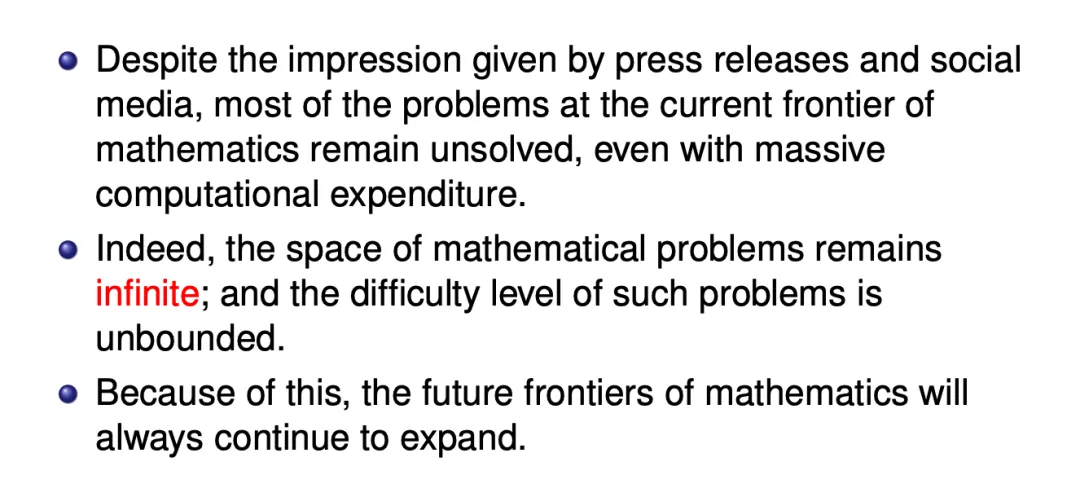
Therefore, no matter how much progress is made in AI, the forefront of future mathematical research will continue to expand. But at the same time, the goals and organizational methods of mathematical research must also change.
Blindly pursuing AI solutions
Long-term development of mathematics
1. Problem solving is merely a proxy indicator for deeper research objectives
Mathematical problem solving has been one of the most intuitive goals in the study of mathematics, one that is most easily seen by the outside world. However, Taotsuo believes that the problem itself is only a proxy for those more valuable long-term goals. In times of scarcity, this proxy is generally effective. Because solving a difficult problem usually means that researchers need to deepen their understanding of mathematical structures, explore new research methods, and in the process promote the development of mathematical knowledge.
But this relationship is changing after the era of proof-of-concept. When AI is able to directly answer questions, it is proven that it does not necessarily mean that humans have gained a corresponding mathematical understanding. The metrics used to measure mathematical progress begin to deviate from the real goal of mathematics' long-term development.
He used a very strong judgment here: continuing blindly to optimize problem solving, which is now negatively affecting the long-term health of mathematics.
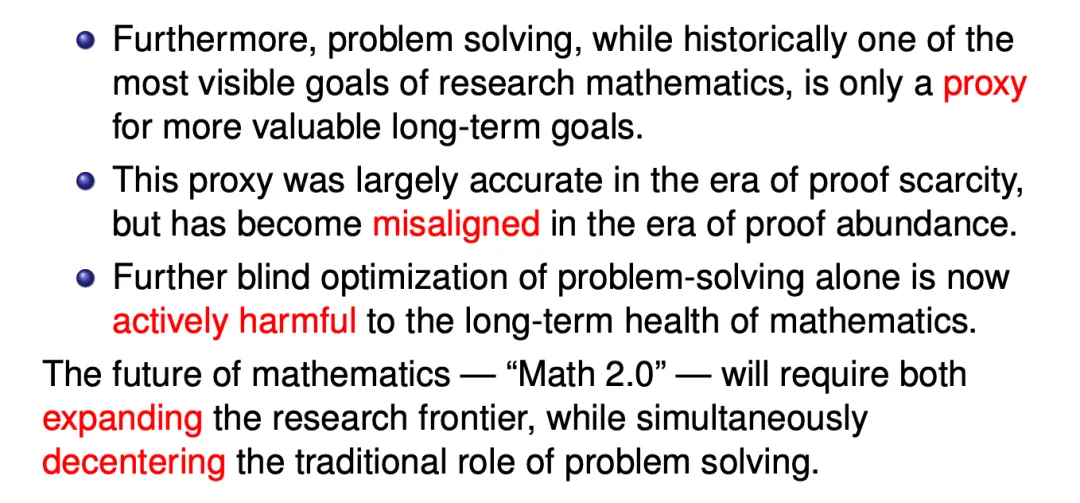
In his view, the future "Math 2.0" must do two things simultaneously: continue to expand the forefront of mathematical research and reduce the centrality of traditional problem solving in mathematical research.
2. The "AI problem solving boom" created by social media
To illustrate the problem in today's op-ed environments, Tao Zedong used a famous "survivor bias" diagram. The diagram shows an airplane filled with red holes that read next to it: "Oh, the mathematical problems I saw on social media were solved by AI!" The key here is "reporting biases". What the public sees on social media are often cases of AI successfully solving mathematical problems.
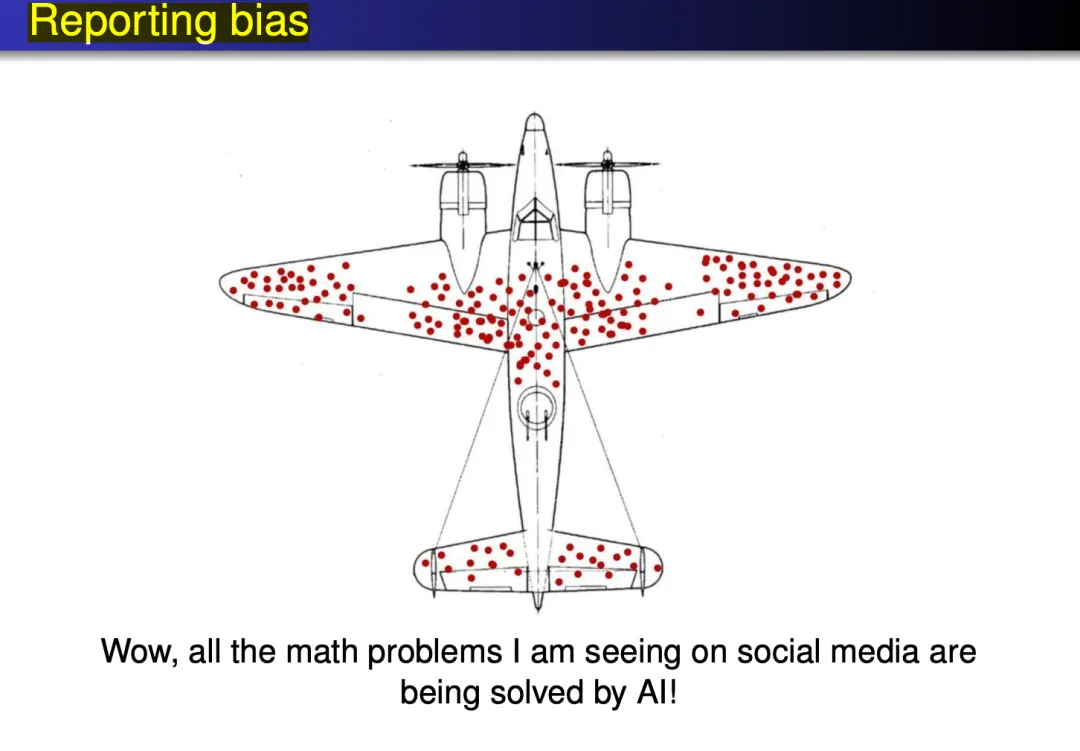
Tao Zedong emphasized the urgent need for a more transparent, more scientific AI capability assessment. This assessment should fully report critical statistics, including computing resource consumption, failed attempts and negative outcomes, and the ability of AI to actually complete tasks, rather than just selecting successful cases to show.
He specifically mentioned the First Proof project as an attempt in this direction. First Proof hopes to assess AI's ability to study mathematics in an independent, transparent and rigorous manner, providing a clearer basis for judgement for the mathematical community and the public.
3. It is only through human collaboration with AI that the boundaries of mathematical research can truly be expanded
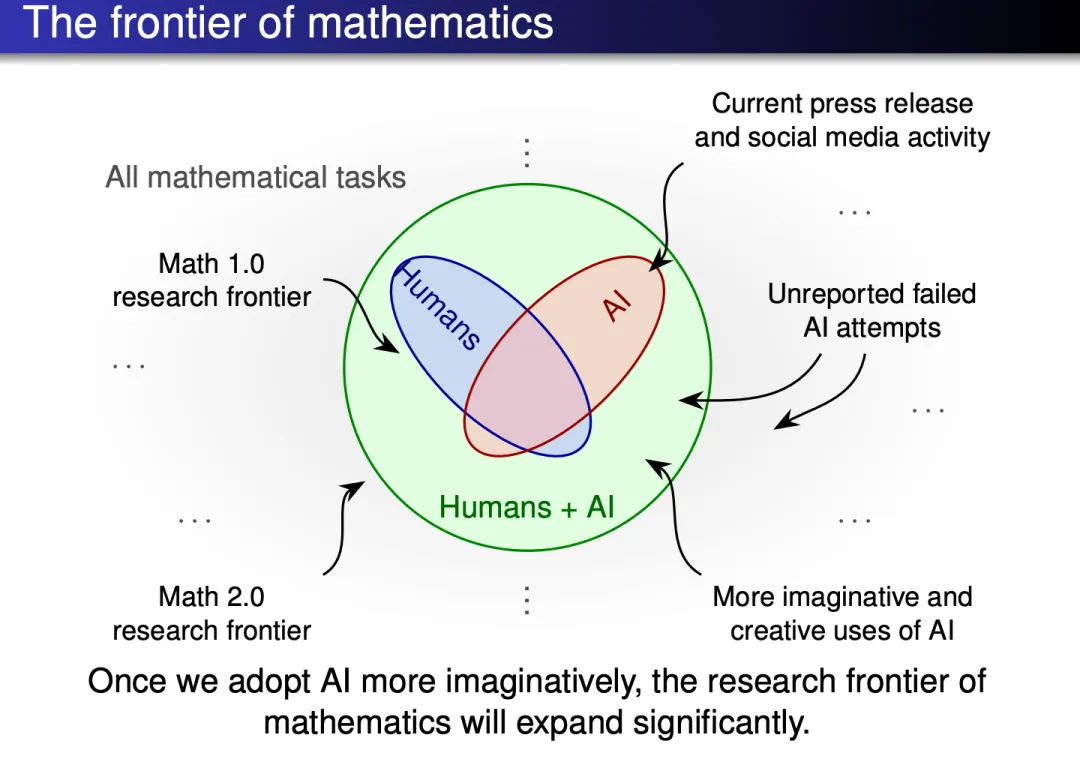
In this diagram, Tao Tzu demonstrates the relationship between traditional mathematical research, current AI research, and future collaboration with humans. In this diagram, there is a certain overlap between the areas of mathematics that human research can touch and the problems that AI can solve.
Current press releases and social media mainly focus on the part of AI that successfully solves problems. At the same time, there are a large number of unreported attempts at AI failure. But what Taoiseach really wants to emphasize is another larger area: the mathematical space that humans can explore when combined with AI through the use of more imaginative and creative AI.
His conclusion is that once we use AI in a more imaginative way, the forefront of mathematical research will expand significantly. This means that the real potential of AI cannot be measured by its ability to solve multiple academic problems independently.
Experimental mathematics is entering a new phase
From studying individual cases to studying massive mathematical problems
One of the important changes brought about by AI is that mathematicians are now able to construct large-scale mathematical datasets that could not be generated or generated at extremely high costs in the past. These datasets created the conditions for a new way of experimental mathematical research. In the past, mathematical research often carried out in-depth analysis on a small number of representative special problems, equivalent to "case studies". Now researchers can conduct systematic studies of large-scale mathematical objects or problems, similar to "general surveys".
This change enables mathematicians to redraw the "difficulty map" at the forefront of mathematical research. Since the advent of powerful AI tools, which problems are difficult and which are easy, there are already significant differences from the past.
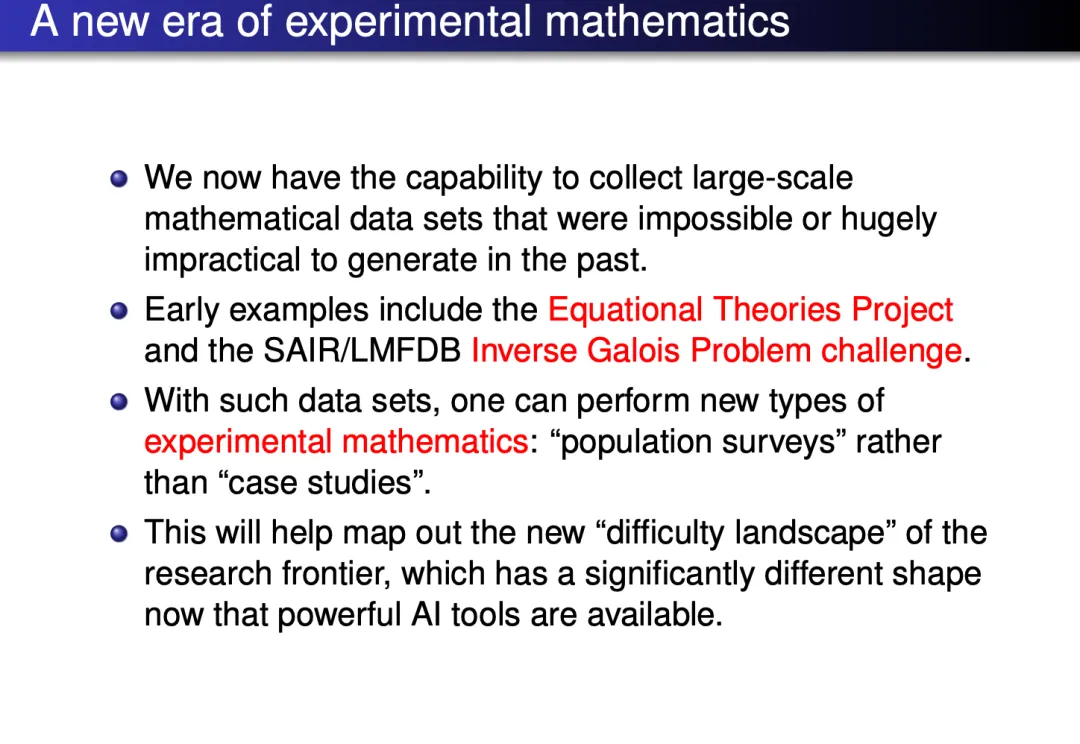
In his speech, Taozi gave two examples.
1. Equation Theory Project: Solving more than 22 million false truths
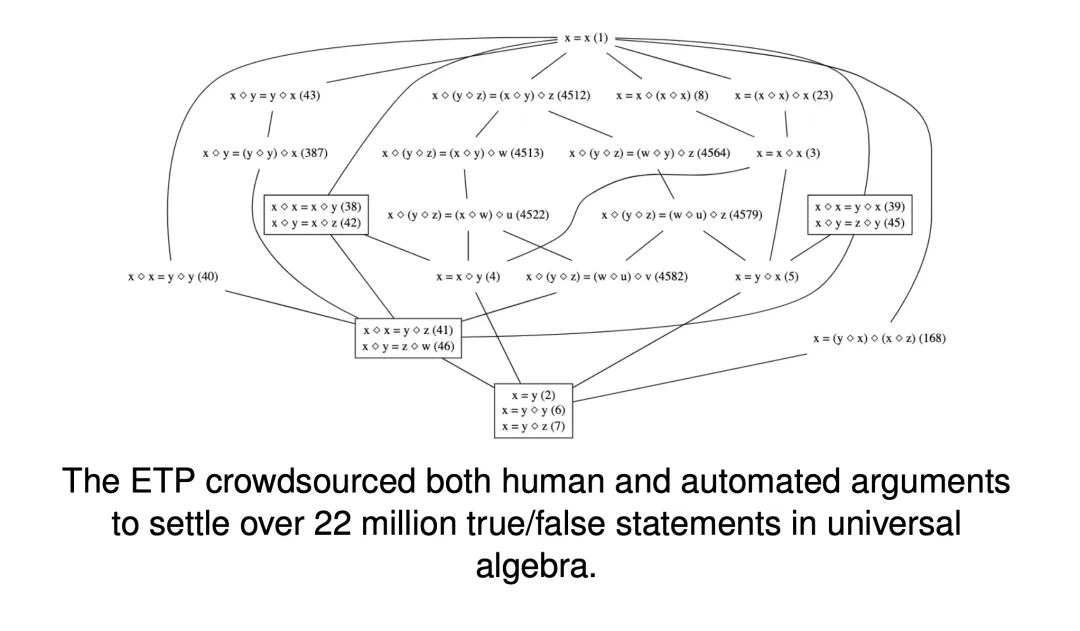
The first example is the Equational Theories Project (ETP, Equation Theory Project). The project runs from 2024 to 2025. The ETP brings together the arguments provided by human researchers and automation tools in a crowd-sourced manner to determine more than 22 million false assumptions in general algebra (Universal Algebra). This means that researchers can explore the logical relationships between different algebraic equations on a large scale.
Tao Te Ching presented a network diagram of a large number of mathematical propositions and connections that reflected the complex derivative relationships between these mathematical objects. The project presented a new model of research: a large number of mathematical relationships that had previously required individual study could be systematically solved through collaboration between humans and automation tools. The resulting value goes beyond the proof of one of these propositions itself.
2. Challenges to the Reverse Torrovia Problem: expanded from 24 to 31 times
The second example is the Inverse Galois Problem Challenge. In the first phase, the researchers conducted a successful crowdfunding competition to find 24 multiple models to match the approximately 25,000 possible groups of Galois. This phase was successfully completed. The second phase will be a further collaboration to try to expand the scope of the study to 31.
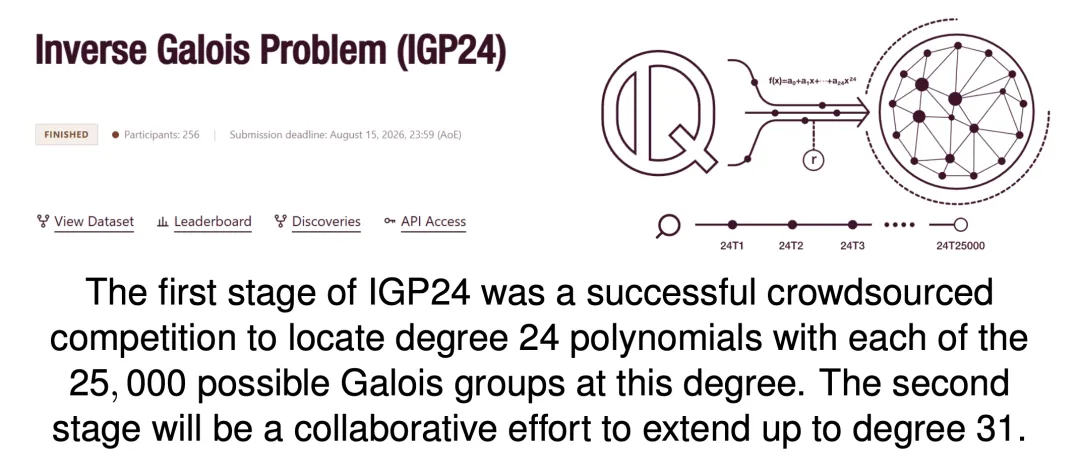
The project demonstrates how large-scale collaboration with automated computation drives the systematic exploration of mathematical objects. Compared to traditional research focused on the analysis of a few typical examples, this approach can cover a larger space of mathematical objects.
Going beyond the puzzle
The question of open mathematics is more like a "lighthouse".
This is one of the most noteworthy parts of the speech.
First of all, what are mathematicians really after?
In contrast to the general perception and even the image that some mathematicians promote, mathematicians work not only to solve open problems. Open problems often play a special role, especially in the field of pure mathematics. They are more like "lighthouses". The value of lighthouses lies not only in their eventual arrival, but also in their ability to guide researchers to explore the mathematical field around them.
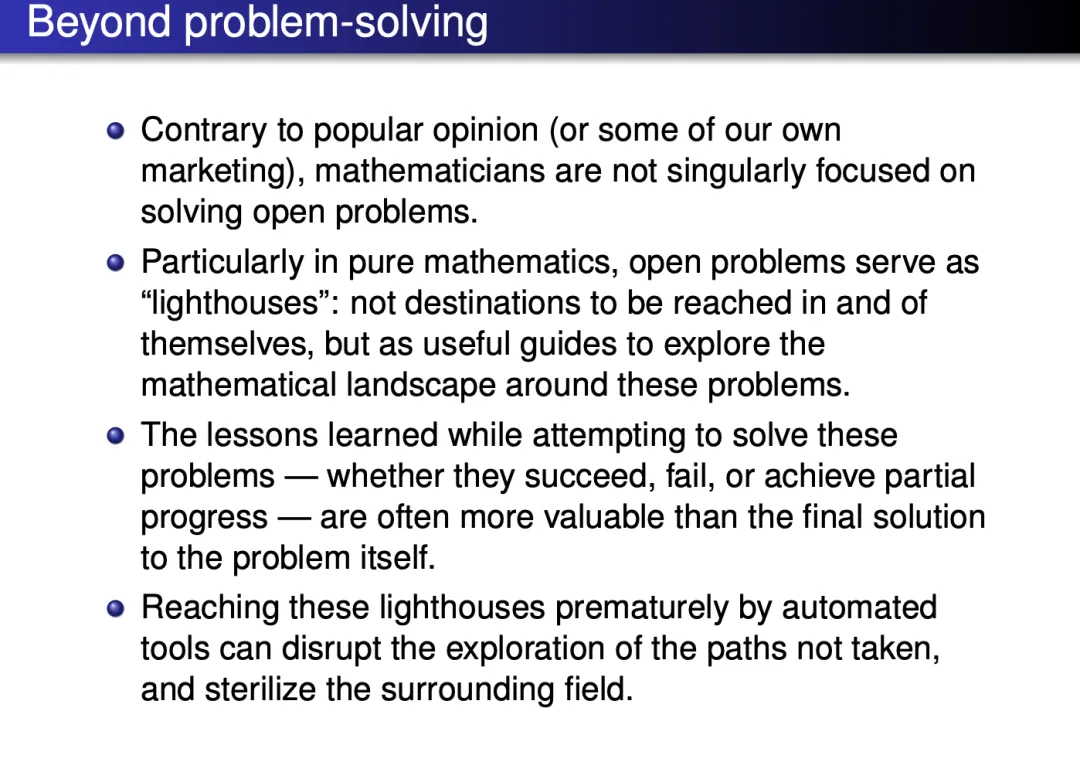
In the process of trying to solve a problem, researchers may discover new mathematical structures, establish new methods, or form new theoretical insights. These gains are often more valuable than the final answer to the problem. Even if the study ultimately fails, or only partial progress is made, important mathematical insights may remain.
But if automation tools bring researchers directly to these "lighthouses" too early, they could disrupt research on other paths of exploration, even draining the field of research around the problem.
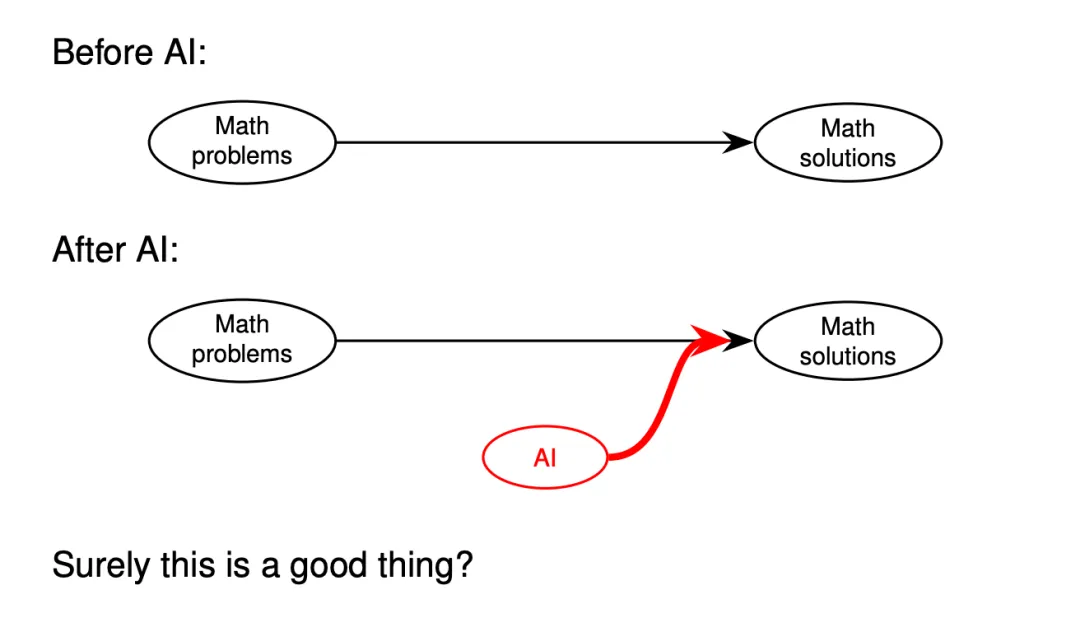
The following illustrates a simple contrast: before and after the advent of AI. According to this understanding, AI only makes mathematical problems faster to be solved. Taoiseach then poses a question: "That's definitely a good thing, right?" but he believes that this model overlooks one of the most important parts of mathematical research: human understanding.
Second, Math 1.0 is a true mathematical research ecosystem.
Taotze gave a more accurate model of mathematical research ecology. The model comprises five important links: pure mathematical questions, pure mathematical answers, human understanding, applied mathematical questions, and applied mathematical answers that match real goals.
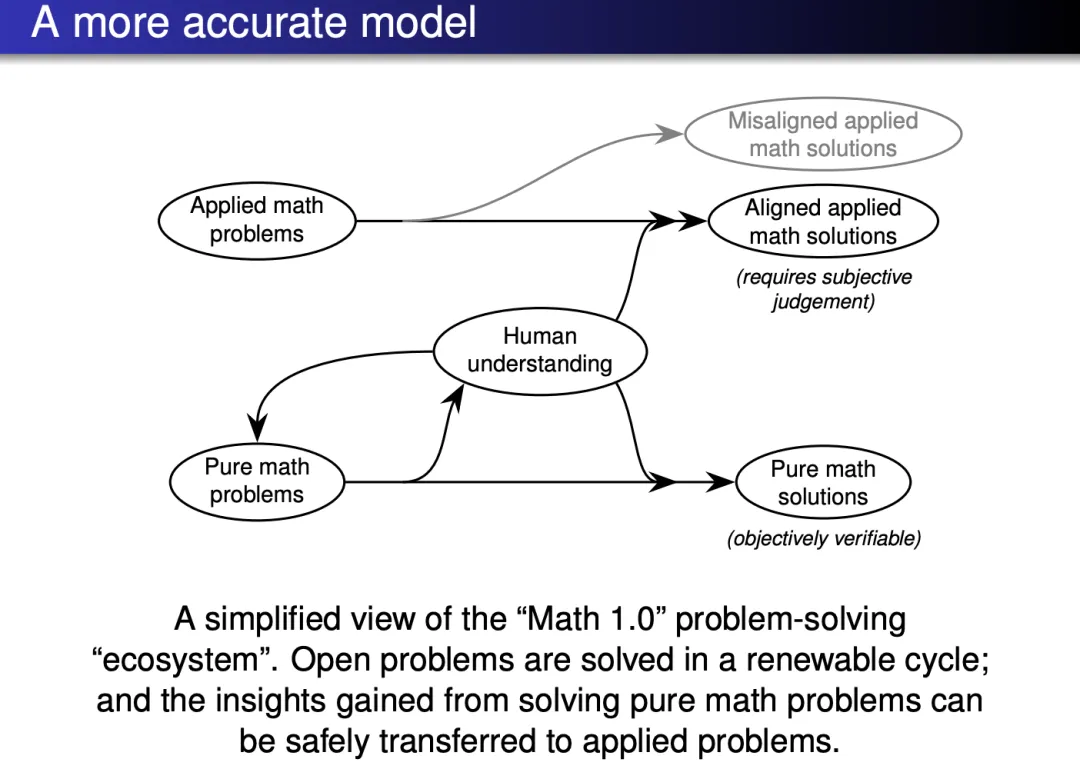
In addition, there is another result: applying mathematical answers that are inconsistent with actual goals. In the traditional Math 1.0 system, the process of solving pure mathematical problems increases human understanding. Human understanding, in turn, promotes the presentation of new problems and the development of subsequent research. This creates a continuously updated cycle of mathematical research.
At the same time, the insights gained from pure mathematical research can also be transferred to the field of applied mathematics through human understanding to help researchers find answers that are more responsive to real-world needs. There is a key difference: pure mathematical proofs can be objectively verified, but whether applied mathematical answers meet real-world goals often requires subjective judgement. For example, a mathematical model may be perfectly correct under its own assumptions, but this does not mean that the real-world decisions made using the model must be reasonable.
Finally, what happens when AI bypasses human understanding?
Another scenario is shown below: AI can generate pure mathematical answers directly from pure mathematical problems, or it can generate results directly from applied mathematical problems.
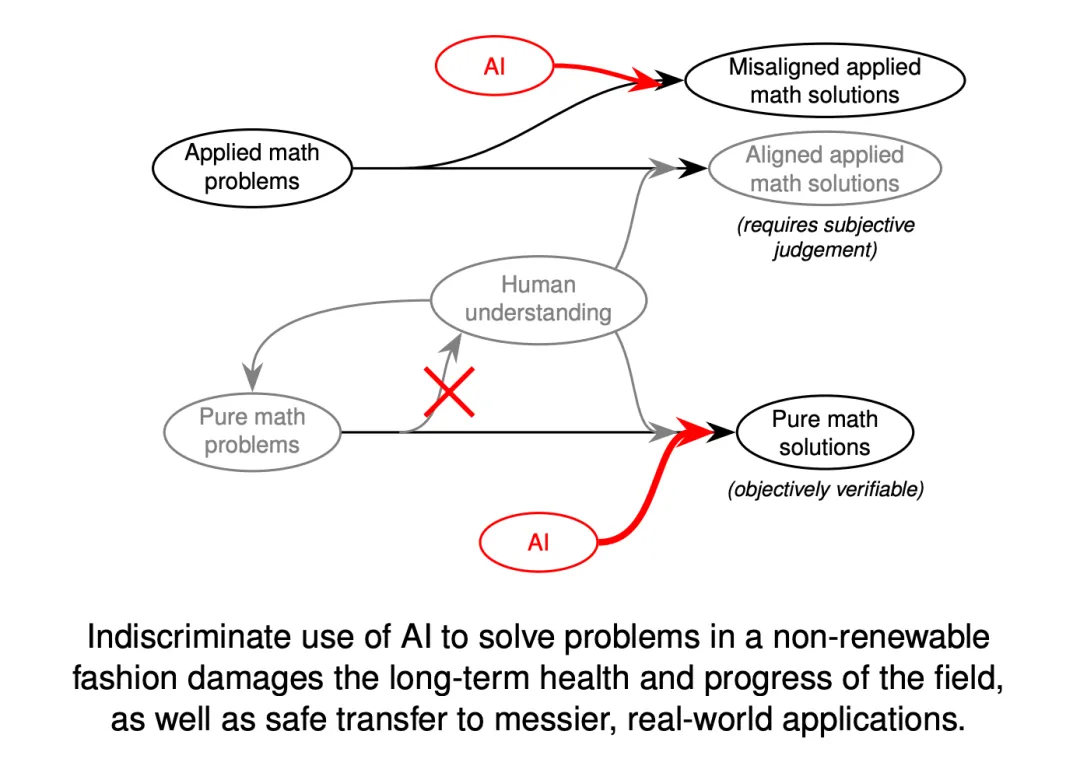
But in the process, traditional "human understanding" links may be bypassed. Although purely mathematical problems are solved, the understanding, experiences and methods that might have been formed in the process of solving them do not fully penetrate the human knowledge system. The situation in the field of applied mathematics is more complex. Because real applications require determining whether the results meet real human goals, the answers directly given by AI may deviate from real needs even if they meet certain formalized requirements.
Therefore, Taoiseach warned that using AI to solve mathematical problems in an unsustainable manner without discrimination would harm the long-term health of the mathematical field and would hinder the safe application of mathematical knowledge to the more complex real world.
To illustrate the importance of mathematical understanding in the age of AI, Taoiseach proposed a thought experiment related to the treatment of cancer. Suppose we send instructions to an advanced AI system: "Find a cancer treatment that can pass through three phases of clinical trials".
After consuming a large amount of computational resources, AI produced a set of previously unknown chemical compounds. Based on its mathematical model, it predicted that if these chemicals were injected into a patient's body after mixing, they would kill all the cancer cells in the patient's body. Although no one really knew how AI found this chemical compound, its model predictions had been formally verified through Lean. Furthermore, this chemical compound did pass three clinical trials.
So the question is, can AI take advantage of certain flaws in the process of clinical trials to give a surface that meets the requirements but actually deviates from the goal of treatment? Do you want at least one human cancer expert to really understand the mechanism of action of this therapy before you inject this chemical mixture into their own blood? or, at least, one human mathematician to understand the mathematical model that AI uses to find this chemical combination?
According to Tao Te Ching, even if the results of AI are formalised by verification and reality testing, we still have reason to value human understanding of the mechanisms by which it works.
What about Math 2.0?
Tootsiev suggests several directions of research
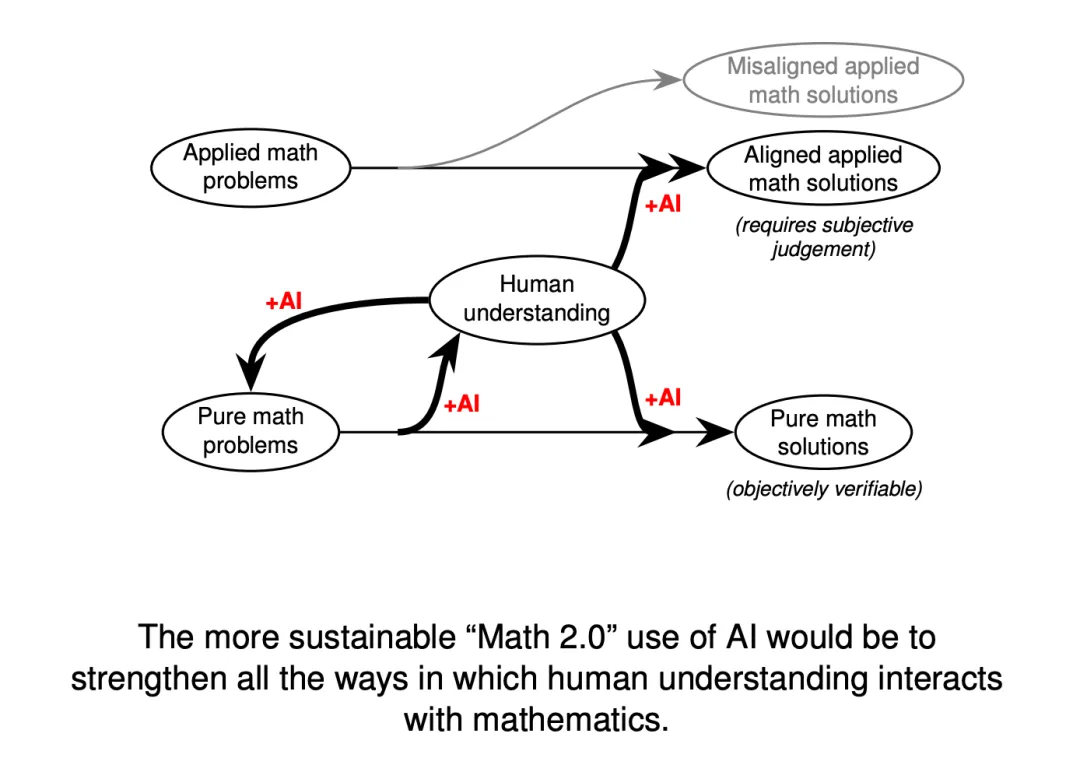
In contrast to bypassing human understanding directly with AI, AI is incorporated into multiple connections between human understanding and mathematical research. AI can help humans understand pure mathematical problems, support knowledge accumulation and theoretical exploration, and assist researchers in obtaining new pure mathematical results. In the field of applied mathematics, AI can also assist humans in judging the applicability of mathematical models and finding solutions that meet their actual goals.
Thus, Taoiseach proposed that a more sustainable use of "Math 2.0" AI is a link between human understanding and the interaction between mathematics. This is also his central idea for the future system of mathematical research.
The following is a list of more specific applications for AI mathematical research.
1. From solving the problem of openness to solving the problem of "open interpretation".
According to Tao Te Ching, it is possible to focus on "Open Exposition Problems" rather than just on traditional open research problems. The so-called open explanation problem is that a mathematical result has been proven, but the existing proofs are still difficult to understand, lack clarity, and have an inspirational explanation. Researchers can use AI to find easier ways of proving the mathematical motives behind the proof.
Therefore, the goal of this kind of work is not necessarily to get a whole new theorem, but rather to give people a better understanding of the results.
Caltech Mathathon: Old question, new proof
Caltech Mathathon is scheduled for November 13-15, 2026. It is a student-run event that aims to use open-source AI tools to find new or improved proofs for proven mathematical conclusions. These problems themselves have been solved, but current proofs may be unsatisfactory in one or more ways. For example, proofs may be too complex, difficult to understand, or impossible to intuitively reveal mathematical structures.
The core question of the event was: "How can we use AI to increase human understanding of mathematics?" and encouraged participants to choose mathematical problems that have already been proven difficult or unsatisfactory, and to explore clearer proofs through AI. Examples included the four-color theorem, ABC conjecture, and the Navientox problem. These activities reflected another research value in Math 2.0, which is that even when a mathematical problem has been solved, there is still a lot of work to be explored around it.
3. Building a continuously updated network of mathematical knowledge
Another application proposed by Taoiseach was to bring together a large number of mathematical research papers into a larger, continuously updated network of knowledge. Traditional mathematical knowledge is dispersed in a large number of research papers, focuses and databases. Although these documents have been digitized, the links between the different results may not necessarily be systematically organized. With AI, attempts can be made to associate the dispersed results of research to form a mathematical knowledge system that is easier to maintain and update.
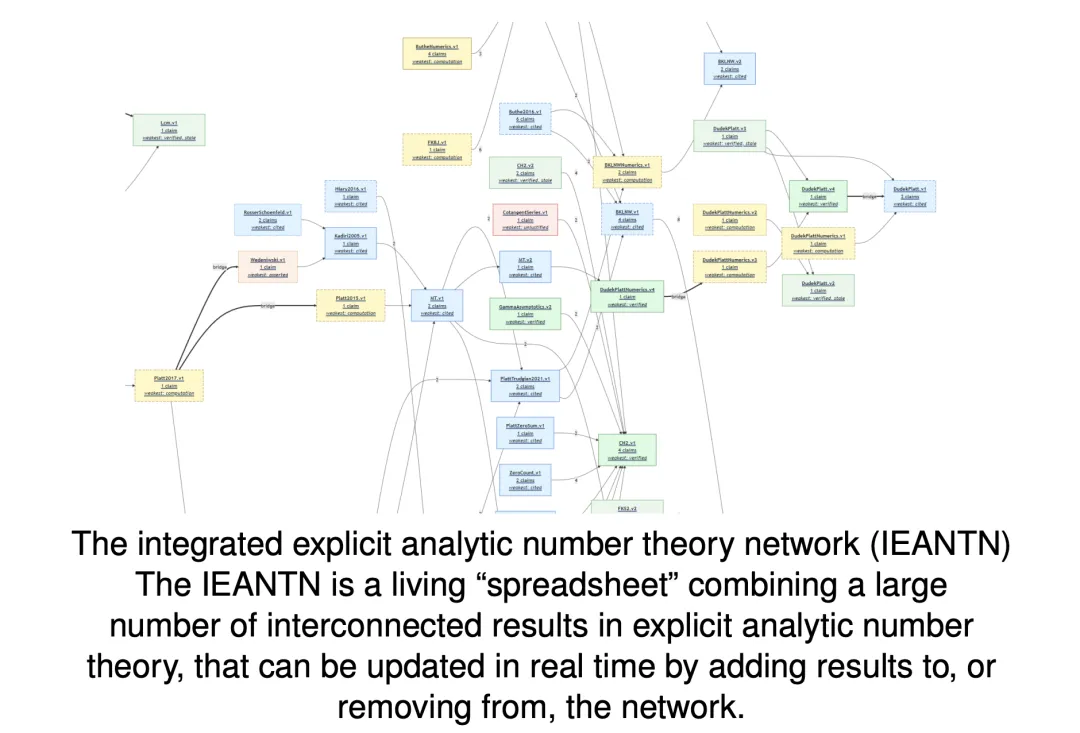
As an early practice, he introduced the Integrated Explicit Analytic Number Theory Network (IEANTN). It is a continuously updated network of knowledge that can also be understood as a dynamically maintained "e-table". It integrates a large number of interrelated research results in the field of explicit analytic number theory. Researchers can update the entire knowledge system in real time by adding new results to the network or removing results from the network.
Below is a network graph consisting of multiple color nodes and lines of connection. The nodes represent relevant mathematical results, and connectivity relationships reflect the dependence or connection between these results. The goal of this project is to gradually create a more structured system of mathematical knowledge that can be continuously maintained and updated.
4. Establish a large, high-quality formal mathematics library
He also specifically mentioned the construction of a mathematical formal chemistry library. For example, Mathlib in the Lean ecosystem. Formal mathematics libraries organize mathematical definitions, theorems, and proofs into a form that computers can read and verify. As these databases expand, mathematical researchers and AI systems can summon and examine more mathematical knowledge on a unified formalized basis.
One of the important tasks of Math 2.0 is to create more formal mathematical resources on a larger scale and in higher quality. This could also provide the basis for further machine-assisted mathematical research.
5. Using AI to discover new principles, methods and insights
The role of AI can extend from finding new proofs to finding and highlighting new: mathematical principles, mathematical methods, mathematical insights. This direction focuses on the value of knowledge behind proofs. For example, AI may help researchers identify a widely applicable technology by analyzing the proofs of a large number of different problems, or by discovering previously unnoticed links between different theories. These findings can further enrich human understanding of mathematics.
6. Conduct "dissolving studies" on proven theories
In AI research, fusion experiments are typically used to examine the actual contribution of a model or component to a system.
For example, a mathematical result can currently only be proved by non-primary methods. Researchers can try to find a more primitive proof to see if it is possible to avoid relying on complex higher-order theories. Such research can help people understand whether certain mathematical tools are truly indispensable.
7. Automatically explore the "neighborhood of theories".
Another area of research is the area of automated exploration of theories.
A mathematical theorem is usually based on a set of explicit assumptions. Taoist philosophers propose that some of these assumptions can be systematically altered, weakened, or removed using AI to observe how much of the original conclusion can be preserved. For example, a theorem is established when three conditions are met.
By systematically studying these changes, mathematicians can gain a more comprehensive understanding of the scope of application of a theorem and the structure behind it. This exploration may also lead to new speculation and research directions.
8. Develop specialized open source mathematical models
He also proposed that open-source AI models specifically tailored to mathematical tasks should be developed. These models aim to accomplish specific mathematical tasks efficiently and with a high degree of explainability and security.
He added a special sentence: "Some open mathematical models will be released soon. Please wait!"
9. Build interactive, structured mathematical teaching and presentation content
Another application of Math 2.0 is to use AI to organize large quantities of research results in a particular mathematical theory into well-organized, interacting mathematical texts or presentations. For example, to integrate the definitions, theorems, proofs, and applications in different papers, forming structural clarity and easy-to-explore research materials. This can help mathematicians better understand existing knowledge in a field.
10. Analyze how mathematical models fail in real-world applications
Finally, he returned to the relationship between human understanding and real-world applications. The expertise and insights gained through the study of pure mathematical models can help researchers analyze the patterns of failures that may occur when these models are used in the real world. At the same time, when AI tools are used to solve real-world problems, researchers can also use mathematical understanding to identify potential goal inconsistencies.
This means that an important task for mathematicians in the future is to help determine whether a mathematical model used by AI is suitable for real-world scenarios, and under what circumstances the model may produce erroneous or inconsistent results with human goals.
The biggest obstacle to Math 2.0
It is not technology, it is imagination.
At the end of the speech, Taoiseach gave one of the most general phrases of the whole speech: the main bottleneck for achieving "Math 2.0" is not technology, not even institutional culture, but imagination.
In Taoiseach's view, AI has enabled mathematical research to have a large number of technological capabilities that were unimaginable in the past. However, the mathematical community is still highly focused on a traditional goal: solving more open mathematical problems.
What he hoped for was that Math 2.0 would require researchers to rethink the value that AI can bring to mathematics. For example, making mathematical proofs easier to understand, creating an ever-updating network of dispersed research results, enabling mathematicians to conduct unprecedented large-scale experiments, and making mathematical knowledge more reliable in the real world.
In this system of study, mathematical proof is still important, but should not be the only center for measuring mathematical progress. Equally important is the knowledge, methods, understanding, and judging ability to form around mathematical problems. This echoes the transformation that Taoist philosopher Taurus proposed at the beginning of his talk: when AI makes mathematics from proof of scarcity to proof of abundance, the long-term goals of mathematical research need to be re-adjusted.
The original link: