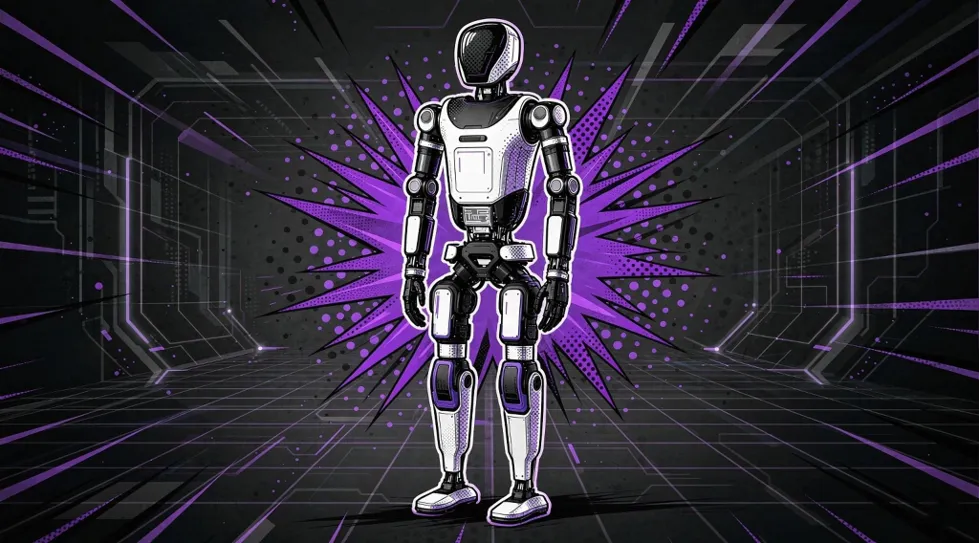
“ What do you think of Biadi's patent for a human figure?
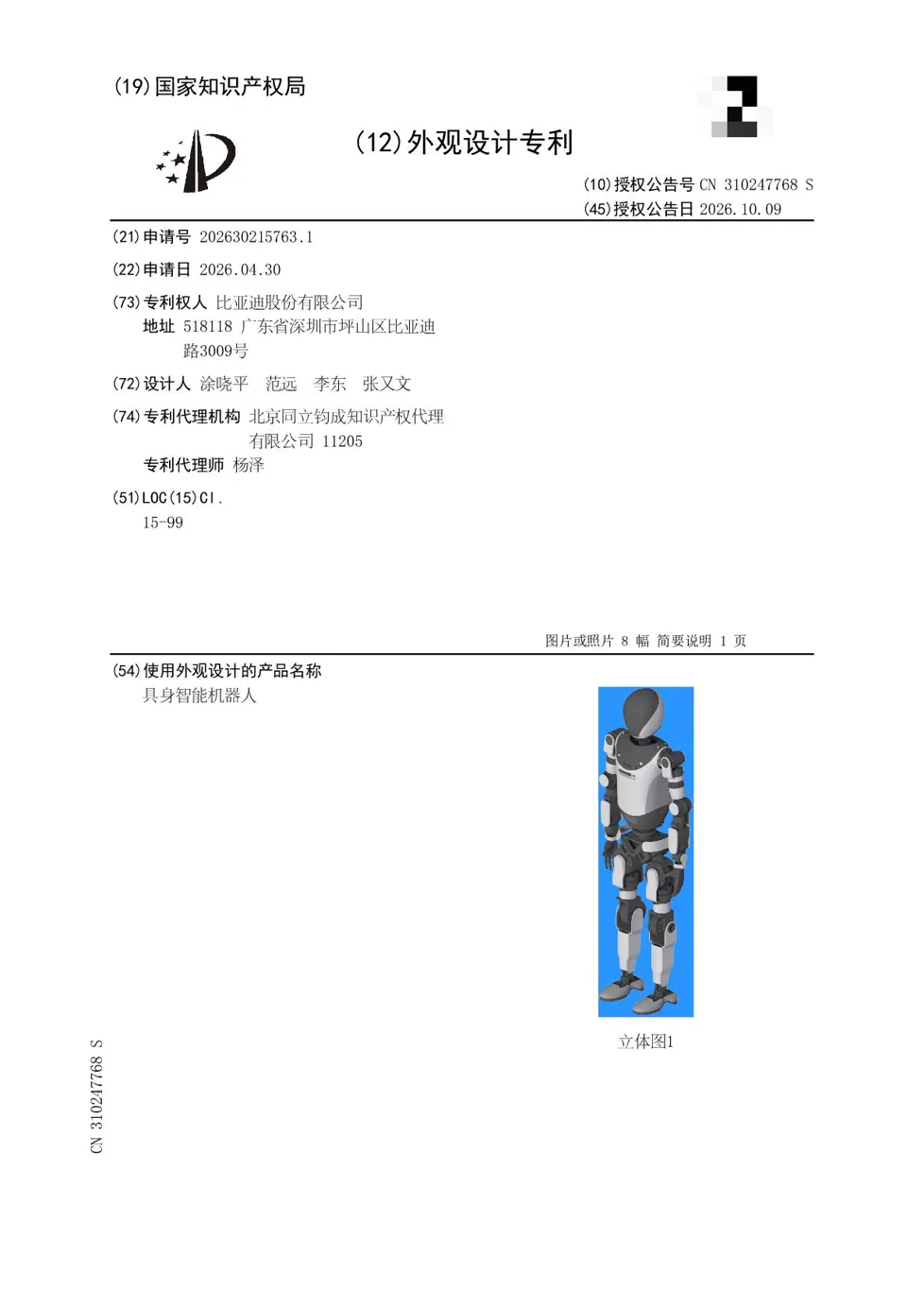
On October 9, the National Intellectual Property Office (NIPO) issued a patent. The six-letter product name authorizes the announcement CN310247768S, the application date is April 30, 2026, the authorization date is October 6, 2026, and the designer graffiti Xiaoping, Van Chang, Li Dong, Zhang Wen.01.
A patent that says nothing?
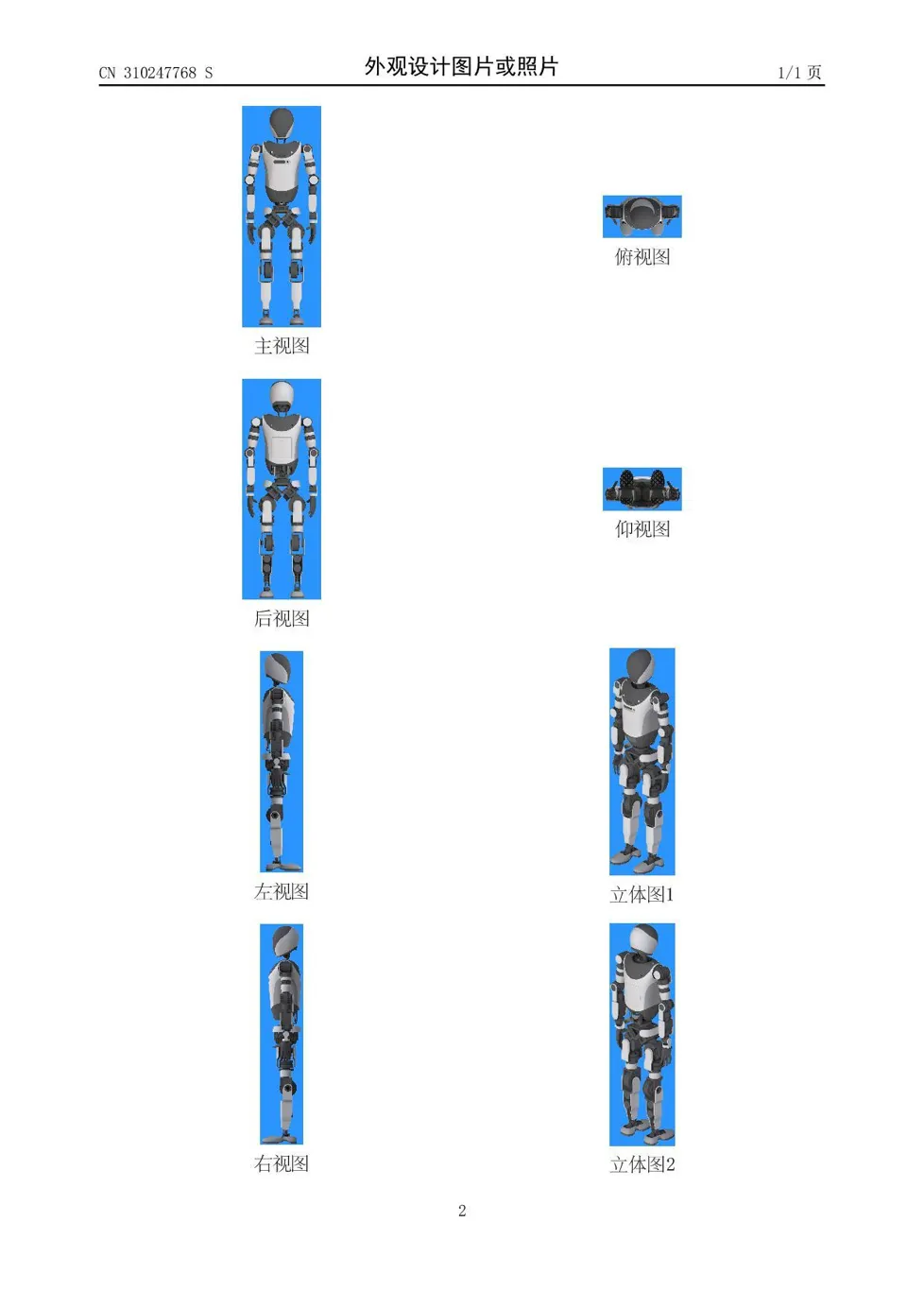
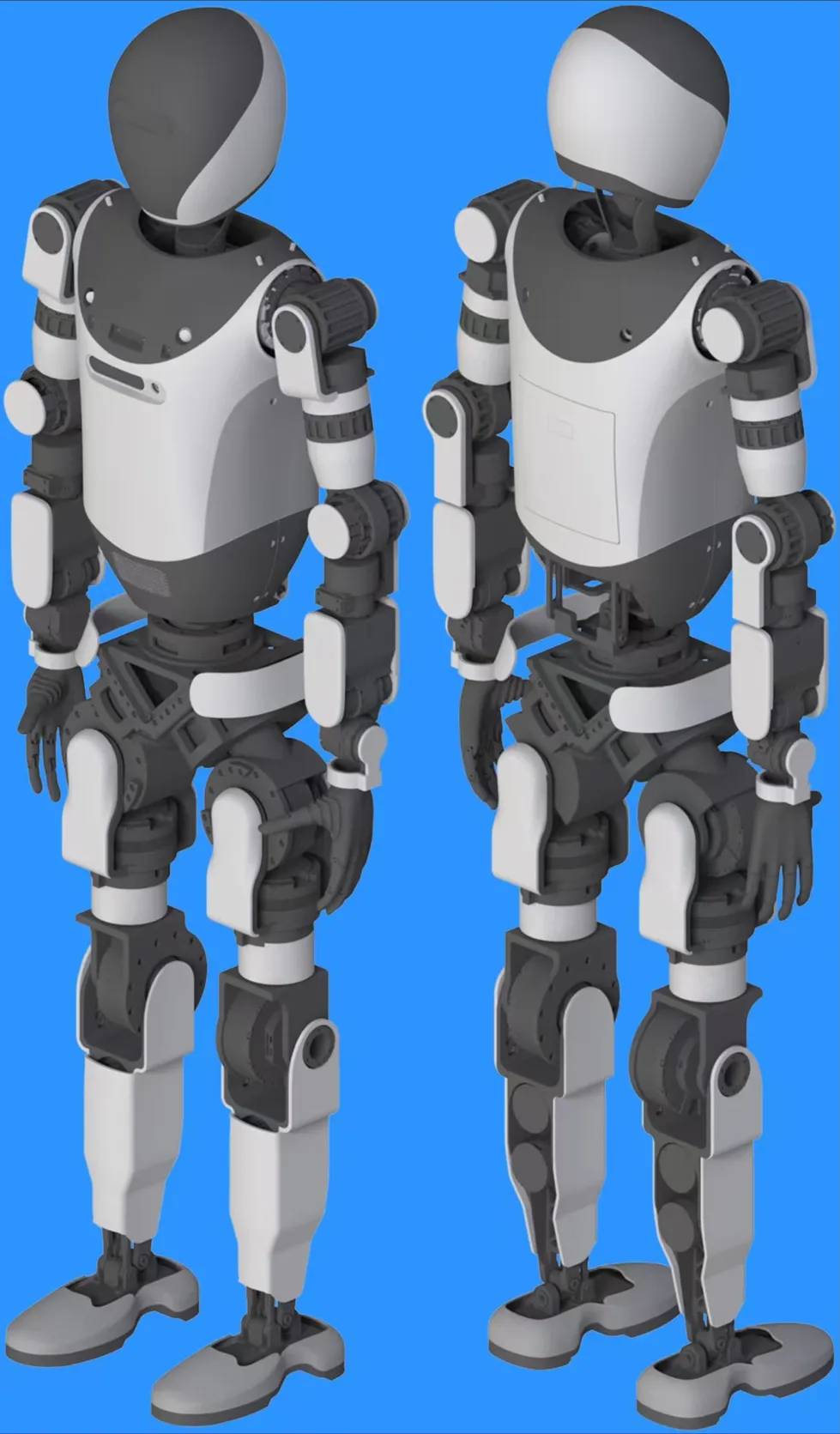
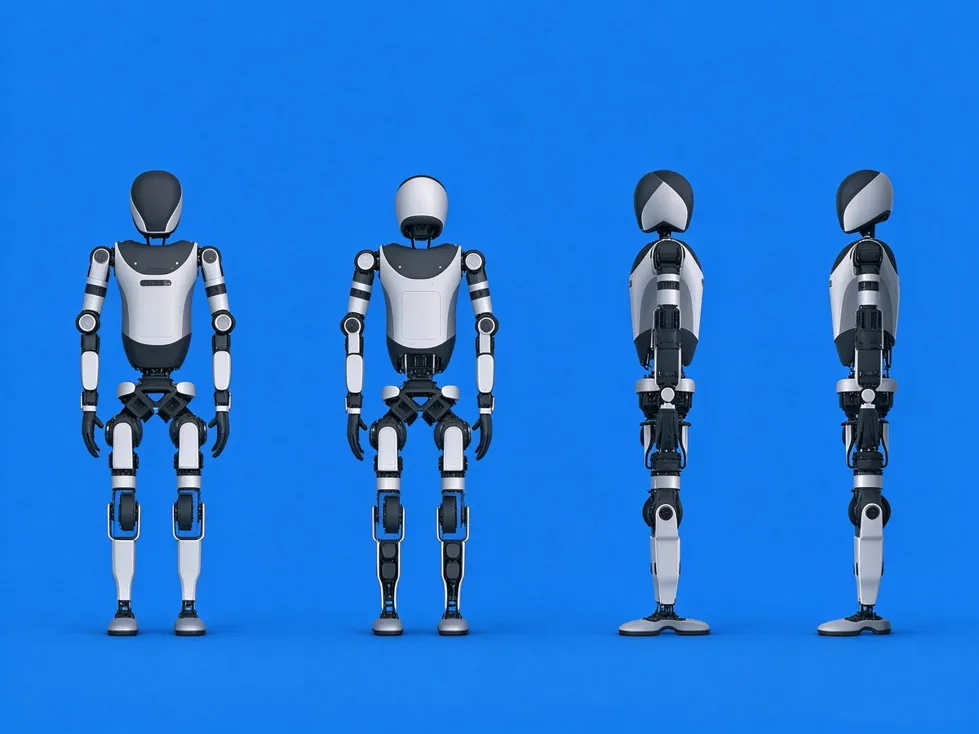
Let's see what the patent itself says. The name of the patent is a body-smart robot, a smart robot with walking, balancing and interacting capabilities, which can be used to serve robots, educational or industrial settings. The appearance is main view, rear view, left view, right view, overview, vertical view, three-dimensional map, with a total of eight illustrations plus a page summary.
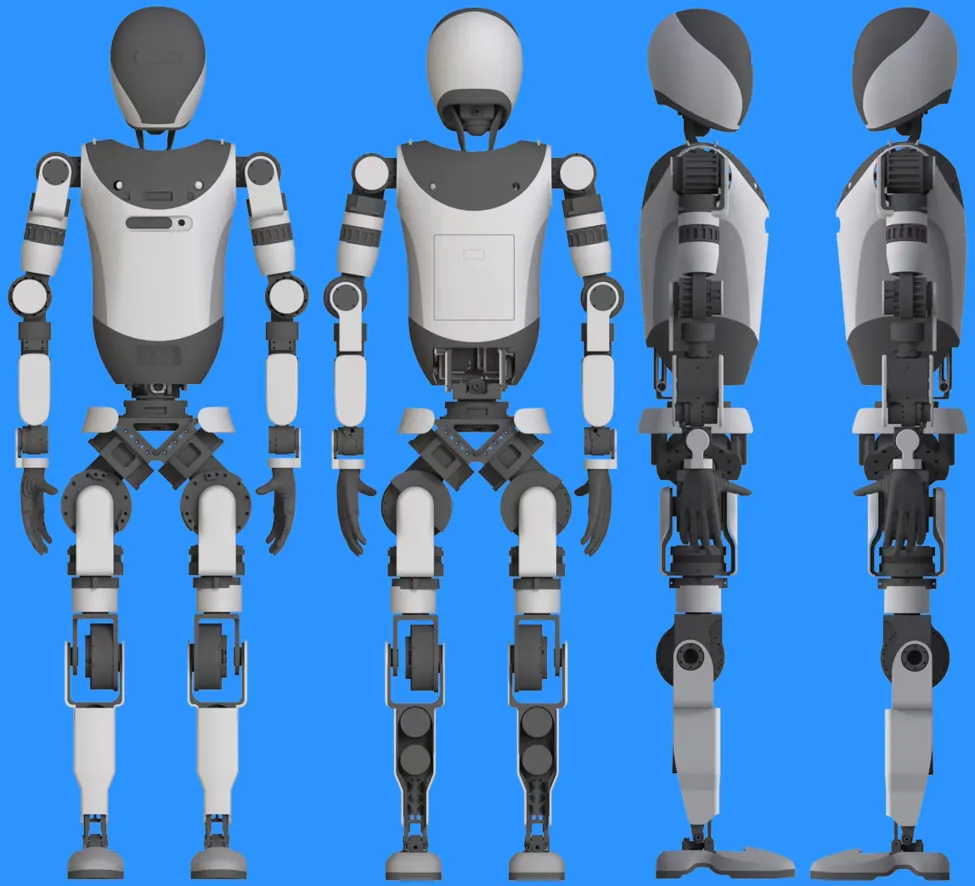
The information that can be read on the graph is all form and not function. The head is a complete circular arc, without any display, no eyes, no mouth, and no five-sensory features. Drying, arms, legs, shoulders, elbows, hips, and knees are the key locations of black balls or chains, with a white sheet covering the body. The upper half is white, the joints and the lower half are black, the separation of the blocks is very clean, and is a purely industrial mechanical design.
The most notable of the eight is that it may not have a screen, as there are no camera modules, no flashlights, and no decorations. A robot's face preparing to enter a 4S store is usually made into a screen that can play animation, as the screen is the most economical means of interaction in the showroom.
But the robot took the screen off, and the black-ball or chain structure appeared on the map, so what's that supposed to mean?
In fact, we can almost recover from what BYD has revealed in the past, and what exactly are these technologies?
02.
Three moves in five months
Let's take a look at the timeline.
Biadi's patent application date is April 30, 2026.[3] Two months earlier, on June 3, Biadi Group executive vice president Li Ko said three words in an interview program.[3] He said that Biadi is also developing humanoid robots, and that robots compete for who has the strongest manufacturing capabilities, software capabilities and hardware capabilities, while AI capabilities related to automobiles are synonymous with robots.[4] He added that if one day we believe robots can go home, we can sell Biadi's robots through distributor networks.[5]
At the same time, people close to BYD confirmed to First Finance that the company was indeed developing humanoid robots, but the actual progress and scale of deployment was greatly exaggerated.
Four days later, BYD officially began gossiping. Subsequent media reports showed that the official denial of claims focused on a set of numbers, code-breaking, the seventh-generation prototype had already been tested in Shenzhen and Shanghai factories, about 150 prototypes had been built, with a target of 20,000 per year. After this denial, the humanoid robot withdrew from BYD's public narrative until July 28.
On July 28, executive vice president of BYD, Ho Chi Minh, posted on social media with a concept cartoon poster of the day-to-day cry of the little guy who became a robot. This was the third day that the Federal Communications Commission announced a ban on Chinese humanoid robot-related devices entering the U.S. market.
On October 9, the patent was issued.
The five moves aligned together are a complete path: confirmation of R&D, denial of expectations, disclosure of claims, physical progress hall, patent appearance, you can see that BYD's R&D path is still very steady and is expected to have accumulated a generation in half a year.
03.
31 degrees of freedom and its technical accounts
Little Dee's official arguments have been made public since his debut on August 5.
He is 1.61 m tall, weighs 58.5 kg, and has a total of 31 degrees of freedom of movement, seven of which are distributed on the arm, with a clever repositioning accuracy of up to negative 1 mm, which is basically in line with the latest appearance patents.
These numbers go back to today's industrial coordinate system, where the height of 1.61 meters is not chosen at random. The showroom is a visitor's space, the height of the robot directly determines its feeling of oppression on the person. Likewise, the service robot, more than 1.8 meters of products in 4S stores that require a long distance close to the eye space will make customers uncomfortable, while about 1.6 meters just fall close to the height of the eyes of adults.
31 degrees of freedom is one of the most worthy in this table of parameters. Because this number is significantly higher than the configuration of general service robots in the industry. The degrees of freedom go up and down, with more than one joint, more than one set of motors, decelerators, encoders and torque sensors, along with more than one set of marking processes and more than one weight.
Another interesting indicator is that it is not the same as absolute positioning accuracy, which is far more than the actual requirement for a robot to host and deliver propaganda.
A robot that delivers items in a showroom, the precision required will not exceed 1 cm. Manufacturers are willing to give a far-over-demand figure in advertising, indicating that the robot has been repeatedly asked to demonstrate its hand function and basic functionality this year.
The higher the degree of freedom of a robot, the more it can act like a human; but freedom is not equal to ability, it is only a set of limitations of ability. The real determinants of how badly the robot is used in the showroom are whether its joints have power, and whether its control circuitry will collapse when it is suddenly touched by humans.
04.
What can't be found in a patent?
External patent protection is the shape, not showing much technology. But the technology's input is in BYD's own capacity.
In a public exchange, Biadi mentioned that the proportion of robot core components self-developed is more than 80%, including servo motors, filter waves and RV reducers, handhelds, controllers. The car and robot parts generalization rate is more than 60%, and the cost of self-development parts has decreased by up to 60% compared to over-the-counter imports. The software side self-developed the BYD RobotOS 1.0 robot operating system, and transplanted the intelligent driving range control algorithm, which delayed the control time from end to end by less than 50 milliseconds.
The overall rate of 60% is another very prominent figure. The part of a car and a humanoid robot sharing the motor is the torque. The part of the shared electrical control is the real-time control. The part of the shared battery is the energy management. The part of the shared domain control is the coordination of sensing and decision making.
These four constitute all the core modules of the robot, except for the clever hands and the precise structural parts.
Fuddy Power optimises the vehicle-driven motor into a robotic frameless joint servo motor, which is the plane of the motor. Blade batteries are converted into the power supply of the robot and paired with the battery management system, which is the plane of electricity and energy. The intelligent driving domain control algorithm is ported to RobotOS 1.0, which is the plane of computation.
That's the reason why BiDi's routes on robotics aren't quite the same as those of other companies.
In an interview in June, he added a not-so-joking phrase: "From the standpoint of today's robotics market, China's robots lack a brain, and America's robotic brains are developed but their limbs aren't, so in the future we're going to achieve a truly usable robot with both brains and limbs".
The phrase makes it clear that the position of the Beastie Boys is not that of the brain, but that of the limbs, which are powerful, consistent, and mass-produced.
This also explains why the robot was placed in a showroom instead of a factory. 7x24-hour continuous operation requires extreme cost control and very few types of movements. While the tasks in the showroom are to deliver, guide, explain, and operate in a limited way, the error space is large, and the loss of a failure is the customer experience rather than the production line shutdown.
This is a carefully selected robot in a mission environment, with all of its capabilities just within the range required by the showroom, much of which is wasted.
05.
What's the new technology on the black ball on the map?
Of course, on the patent chart, we think we also reveal something new, which are the black parts.
The linkage information that can be read on the diagram is clear, shoulders, elbows, wrists, waists, hips, knees and hips have independent joints, and key locations are painted in a black-ball or chain structure.
Public information indicates that BYD's use of the robot is a hybrid of split procurement and self-development. It has been reported that the RV reducer on the knee joint is supplied by a dual-loop transmission, the wavelength reducer on the upper limbs is supplied by a green wavelength reducer, the joint executor is supplied by the Top Group, and the servo link is participated by General Dynamics.
In the patent graph, the breakdowns point to a conclusion: the leg-carrying joints and the upper leg-carrying light joints use two different reduction schemes, the former for torque and life, and the latter for weight and back spacing.
These key locations on the patent chart are unified into black ball shapes or chain pieces, which correspond to the typical structural shape of the two types of schemes, as well as the applicability of the scenario.
A man-made robot's joints are a set of locally distributed schemes that have specific engineering reasons behind them. RV gear reducers are sliding needle gear reducers, high gear ratio, strong bearing capacity, long service life, cost large volume, heavy weight, and marked recoil. It is suitable for high-torque and high-frequency shocks, such as knee and knee joints.
In the end, the two schemes all fell under the same constraint. Byde's robot weighs 58.5 kg, the scene is a showroom, and if the entire leg is used for RV, the weight of the knee joint will directly eat a large part of the overall budget.
This distribution also has a more hidden cost. The wheels of the pump speed reducer are elastic and repeatedly strain fatigue, which is its short life span. The RV speed reducer relies on surface contact, wear slowly, but the cost of replacement is high. So a robot using a mixed scheme must be designed separately for maintenance cycle planning.
The joints on the legs of a humanoid robot count torque and lifespan, and the joints on the arms count weight and precision. These are not differences in technical preferences, but the weight budget and lifespan budget are at stake.
06.
The first set is only worth 3 million yuan.
Subsidies are another incentive for Beady to create dolls.
An easily overlooked date was the afternoon of 12 August, when the Department of Equipment and Industry of the Ministry of Industry and Communications released detailed implementations for the first set of large technical equipment for human-powered robots (2026 edition). The details included the first set of human-powered robots and core components in the national list of insurance premiums and government procurement priorities, with a maximum subsidy amount of 3 million yuan for a single set, and the first reporting window opened on 15 September, which smells a bit similar to the early days of new energy vehicles.
On the same morning, BiDi unveiled the first Di-space humanoid robot service experience center at its Shenzhen headquarters. LiKoo said at the conference that Di-space was not a technology showcase, but the first testing ground to verify the availability of robot services.
It is not a coincidence that these two things happened on the same day.
The first set of specifications has a hardness threshold, requiring the certified product to undergo a continuous reliability test of at least 2000 hours and submit an MTBF verification report issued by a third-party testing agency.
This door is not difficult for the samples in the lab, but for the industrial scene, it's already a product to enter 4S stores, to interact face-to-face with real people, a real trap. A robot that falls or dies in front of customers in the showroom is worse than a robot that can't leave the factory.
While the first scene of a robot in a store has a more realistic advantage. It brings with it a continuous, non-project-oriented flow of exposure. 150 machines in the factory can only prove that the robot can be used in its own production line if it works well. While the D-space in Shenzhen, Shenzhen, and Shanghai has a daily flow of customers, 110,000 times this quantity of contact opportunities, more than any industrial customer approval report can prove its interoperability.
Biadi offers two to three robots to each dealer's store, a figure LiCo said in June. This represents not just capacity planning, but a kind of tunnel test. The real purpose of the tunnel test is to verify that the robot can continue to function normally in a completely unprotected public space.
A robot that runs steadily on the production line demonstrates its manufacturing capabilities. A robot that runs steadily in a showroom demonstrates its product capabilities. The latter is more difficult, perhaps closer to the original intent of Beastie Man: to release the dividend on technology under policy certainty, to do business with high certainty.
07.
Four months between rumors and publicity
Now we can re-read the timeline of Beady's humanoid robot.
On June 3, Li-Koo confirmed the research and development, while denying 20,000 units. On July 28, Ho Chi Minh announced the debut of Little Dee. On August 5, Little Dee made its debut in Shenzhen. On August 12, the first set of details was released, the same day that the Shenzhen Space Experience Center unveiled.
It was four months between the rumors and the announcement.
During these four months, the information released outside by BYD was rhythmic. In June, direction was given, not numbers, because given would be followed by delivery. In July, a nickname was given and a slice was given, because the slice did not promise any parameters. In August, the parameters all pointed to a site that could be verified instantly, namely the showroom. In October, a graph was given, because the patent was the safest form, and it only described shape, not performance.
As you can see, when a car company is faced with a new business that they have not fully understood, the most rational strategy is not to say the words, but to release them: first give direction, then give image, then give parameters, and finally give legal documents.
Now it's easier to understand why the 20,000 units were rumored. A 1.61 m (58.5 kg) commercial service robot with 31 degrees of freedom, and an industrial robot to replace the flow line, are two completely different products.
A robot that delivers promotional materials in the showroom and a robot that carries parts on the production line may share the same set of motors and operating systems, but they are two completely different businesses. The former sells service capabilities and the latter sells alternative costs.
So what that patent is really doing is completely shutting this misconception out of the way. The name of the patent is a body-smart robot, not an industrial robot, not a transport robot, not even a man-made two words. It doesn't promise any capacity, it doesn't promise any plant deployment. It only promises a shape that looks soft, round, non-aggressive, suitable to stand in a car store.

08.
A road that doesn't require big capital
Of course, at the end of the day, what we think is interesting about the case of Beastie Boys is that it doesn't involve large amounts of capital. It's a company that has already made enough money to try something that might never make money.
It doesn't have to wait for the next round of financing, it doesn't have to give quarterly answers to investors, it doesn't have to prove itself before the market schedule. It needs something simpler, a supply chain that delivers a consistent set of joints in two months, a production line that suppresses costs when the rate fluctuates well, and a robot that can be repaired after sale in more than 2,000 stores nationwide.
The accumulation rate of these capabilities is year-on-year. Capital's patience is quarter-on-quarter.
So what's really scarce in this industry has always been not money, not models. A person who knows where to go and is willing to take three years to complete this path. These are few people. They are still coming out of the previous company with a decade of experience to find a job that hasn't been filled yet.
This phenomenon has also occurred in other industries. The rule of thumb is that after the founder leaves, the company will experience a noticeable deceleration because the people with the most judgment are not at the decision-making table.
When a robot actually starts working, it doesn't depend on whether or not it works, it depends on whether or not someone is willing to work for it after three years.