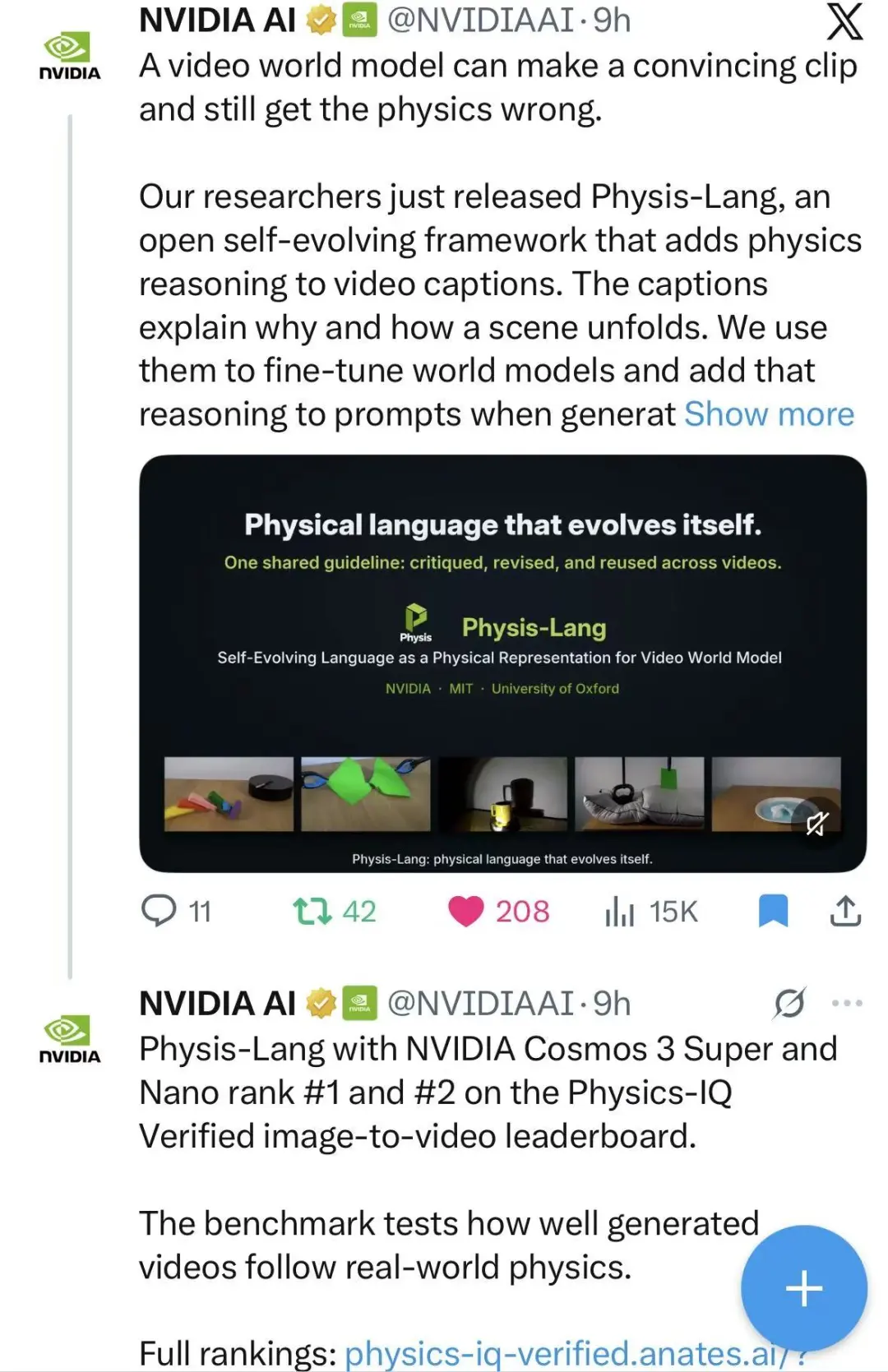
X:
From how a piece of butter melts to the top of the Physics-IQ Verified list, the physical details in the video are worth re-describing.
If you give a video model the term "heat-melting oil", what will it produce?
A little bit of butter, a circle of liquid spreading outward, or a yellow object suddenly softening? This sentence points out the event, but omits the intermediate process. How the heat changes its state, how gravity affects the shape, how solid shrinkage and liquid spread occur simultaneously, all require the model to replenish itself.
The Physis-Lang, developed by a team of researchers at MIT and the University of Oxford, starts with these often overlooked details: writing down physical causes, laws, and outcomes into language descriptions, and then making the description go through data screening, model training, and video production.
Full presentation of Physis-Lang: physical language representation, describing the evolution of guidelines, data retrieval and results of video production.
Physis-Lang article title, authors and research institutions.
In the list of authorities.Physics-IQ VerifiedAt the top, the Cosmos3-Super and Cosmos3-Nano versions of Physis-Lang scored 48.2 and 43.3 respectively, ranking first and second respectively, respectively.
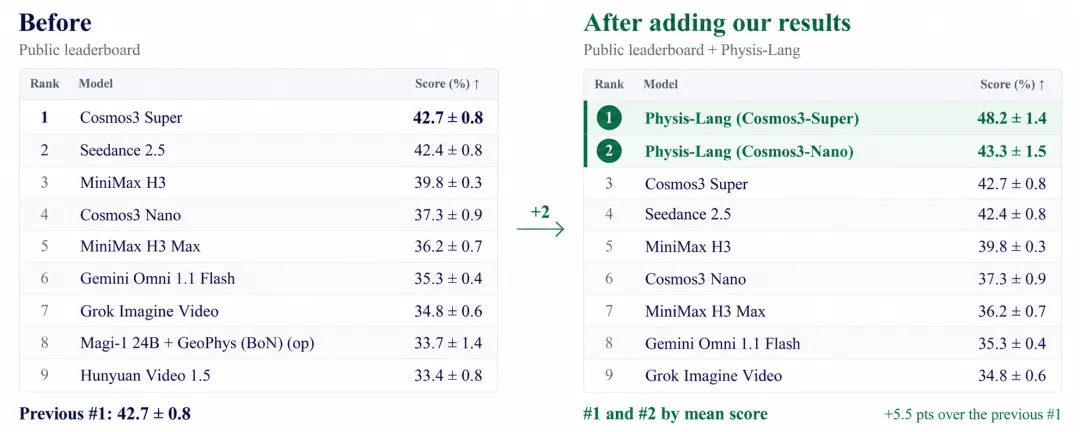
Figure 2 Physics-IQ Verified list comparison. Super and Nano versions of Physis-Lang are ranked first and second on average, with Super up 5.5 percentage points from the previous highest score.
List of addresses:
Of these, the previous high of 42.7 points in the Super Bit was 5.5 percentage points higher; the 16B Cosmos3-Nano, after joining the Physis-Lang, was even higher than the original 64B Super model.
In the caption of training and reasoning, insert the physics into the process.Typical video caption is often good at alternating scenes: what's in the picture, who's doing what. Physis-Lang further asks to describe the role between objects and how this role drives subsequent change.
Physis-Lang incorporates physical reasoning information beyond the basic description. In training, it reproduces more detailed text supervision for real video; in reasoning, it expands the user's short input and complements negative descriptions related to current scenarios that restrict unreasonable physical behavior.
A more complete description could be: continuous heating causes the oil to gradually melt, solid parts to collapse under the influence of gravity, volume to shrink, and liquid after melting to form a gradually expanding shallow liquid pool around it.
This passage gives continuous state changes. The generative model needs to be demonstrated, no longer just the two concepts of "oil" and "melting", but also the effects of warming on the material, the relationship between solids and liquids changing over time.
But longer descriptions can also mean more. If the model writes the unseen cause in the head as a path, it introduces incorrect supervision. Therefore, the key to this work is to allow physical descriptions to be checked and continually improved accordingly.
PhysCapBench: Physical sophistication& evolutionary caption promptVideo 2 describes the evolution of the code: a fixed-label model, based on a physics-assessed feedback-shared caption prompt, and validated by PhysCapBench.
The team built the PhysCapBench: a benchmark to assess whether the physical details in the video description are adequate and correct. It contains 246 physical videos, as well as 3,794 atomic affirmations that have been artificially verified, averaging about 15.4 articles per video.
The so-called atomic assertions can be understood as physical statements that can be separately judged to be true or false. For example, when a cup breaks after hitting a hard object, the entire process of collision, force, and rupture is first evaluated by breaking down the physical statement into a series of short statements, then judging it one by one, rather than giving an impression to the entire text.
The scores were divided into two directions: Precision checks to see if the content described is justified; Recall checks to see if the physical information in the manual labeling is covered. Both are composed of F1, so that "write correctly" and "write completely" have comparable scales.
With this scale, automation has only clear feedback. The system first generates a description on a fixed 20-section development video, points out omissions and errors by the physical evaluator, and then delivers the commonly used description code to modify the evolutionary intelligence. The updated code is also verified on the PhysCapBench to select the best-performing version.
In this process, the weight of the tag model remains unchanged. Each round of modification is a caption prompt shared by all videos, rather than a line-by-line response to a particular video: "Patch".
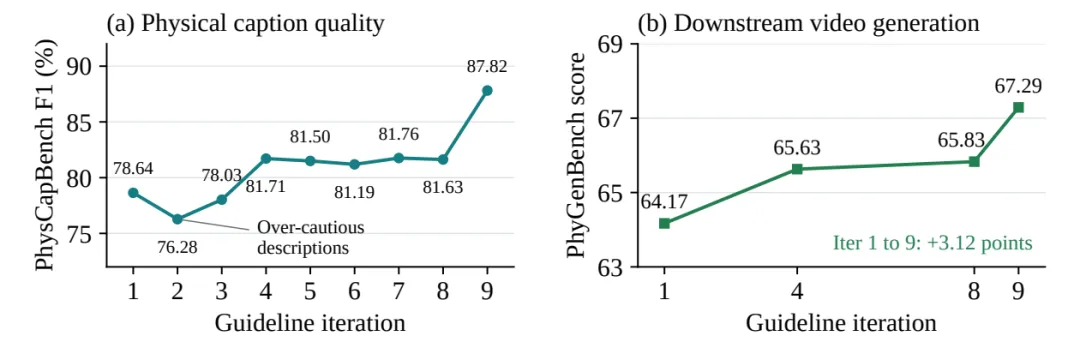
Figure 3 describes the benefits of guideline automation. Left: PhysCapBench F1 increased from 78.64 to 87.82; right: Fixed-generation model, only updated with reasoning descriptions, PhysGenBench score increased from 64.17 to 67.29.[3]
From Round 1 to Round 9, PhysCapBench F1 went up from 78.64 to 87.82.[13] The improvement was not a step up: The second round dropped to 76.28 each time, and the paper attributed it to an overly cautious description.
In addition, the fixed pre-training Cosmos3-Nano, which changed the description only when reasoning, improved the PhyGenBench score from 64.17 to 67.29.The evolution of language alone has not only improved the physical comprehension of multimodal models, but also further enhanced the physical generation of video models.
This expression of language can also be better used for data filtering.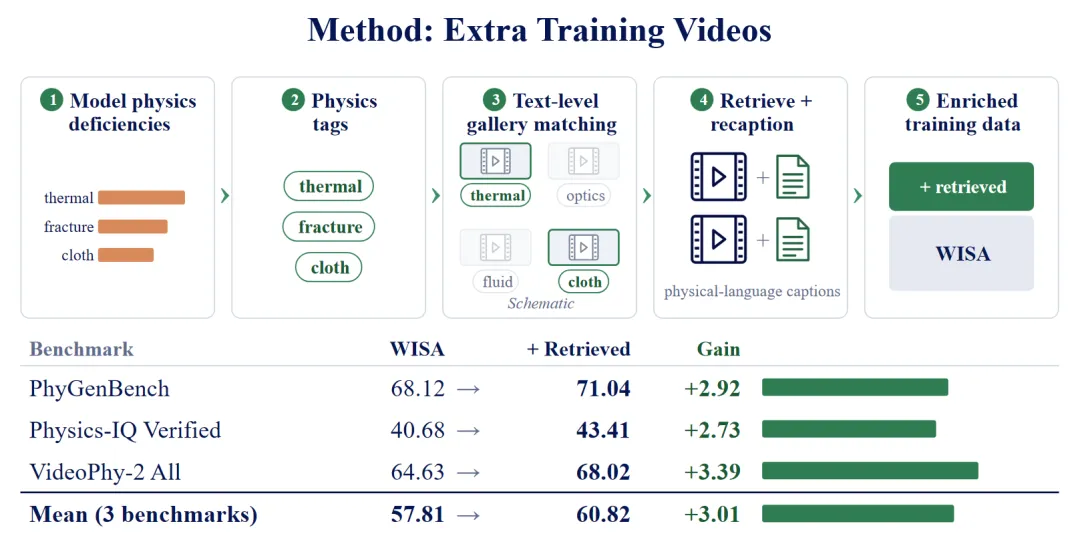
Figure 4 Language-guided data retrieval processes and effects: converting the model's physical capability shortcuts into retrieval tags, supplementing the relevant real-world video and re-marking to enhance training data.
The role of language also extends to data filtering. If the model always fails to physically transform, collide or rupture, continuing to randomly add video does not necessarily replenish these shortcuts.
Physis-Lang translates the model's exposed shortcomings into physical field labels and then retrieves real video. Retrieval focuses more on what physical processes the video contains: even if the subject, color and background of the image are different, it can be a valuable training sample as long as it involves physical mechanisms that need to be supplemented.
The final data set contains 183K segments of real video. Of these, 71K segments are from the WISA-80K data set, and 112K segments are supplemented by this retrieval process. They are then re-labeled by the optimized description code for model training.
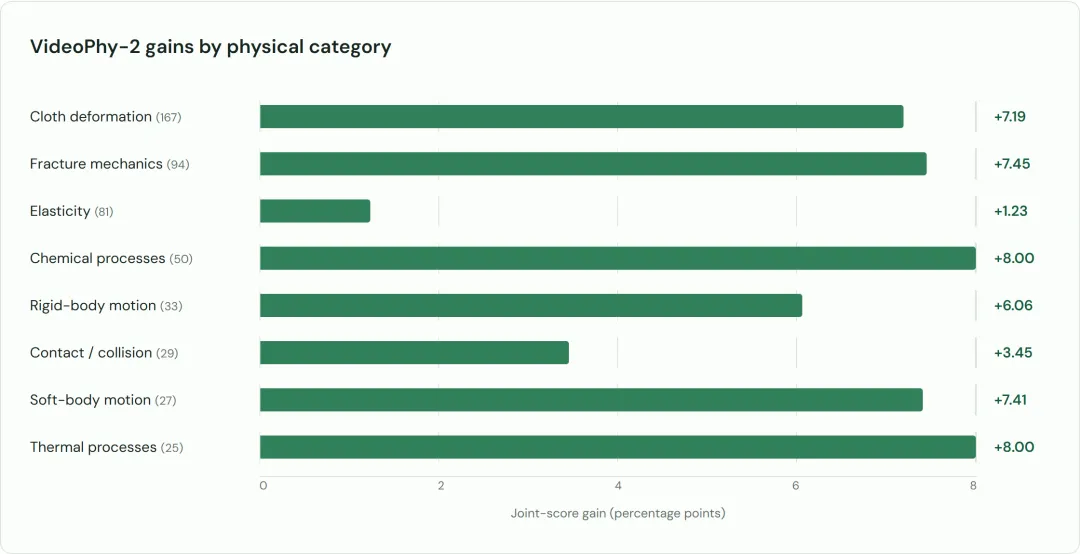
Figure 5 shows the benefits of the sub-physical categories of data retrieval. The horizontal axis is the increased width of the combined score of VideoPhy-2 (%) and the number of samples for each category in the brackets.
Divided into physical categories, in VideoPhy-2, both the chemical and thermal processes improved by 8.00 percentage points, the fracture mechanics improved by 7.45 percentage points, and the textile transformation improved by 7.19 percentage points. These results show more directly the changes in the ability of data to complement the correspondence.
In this way, the language connects several links: first to describe physical processes, then to describe finding problems, then to look for data, and finally to use complementary data and improved descriptions together for training.
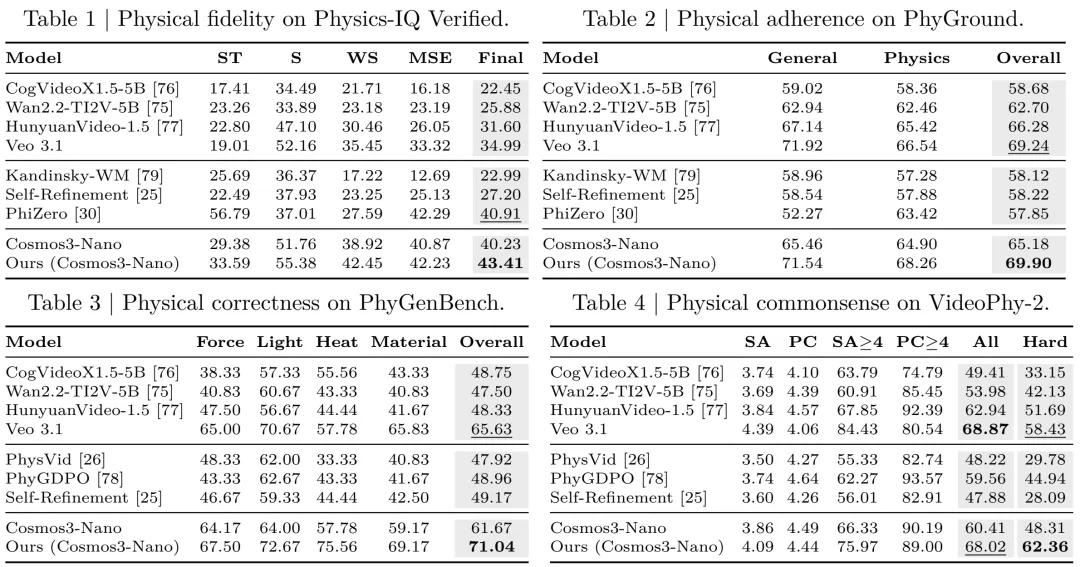
Four physics assessments of open source SOTA, three of which exceed Veo 3.1The advantages of Physis-Lang are directly reflected in the contrast to the leading video generation models. On the basis of the Cosmos3-Nano version, all four physical benchmarks evaluated in the paper achieved the best performance in open source models and methods; three of them exceeded Veo 3.1 overall.
This group of experiments covers both video and video. Opponents include general generation models such as Veo 3.1, HunyuanVideo-1.5, and Wan2.2 as well as methods specifically designed to improve physical performance. The four complete results are as follows:
 See what happens in the video generated.
From the transmission of collisions, to the tearing of paper, to the shape-shifting, several generating samples below show different physical processes.
Video 3: Contact and collision: A sample of wood produced on the basis of Cosmos3-Nano is subsequently dumped, showing the motion of the contact.
Video 4 Forced tearing: A paper sample produced on the basis of Cosmos3-Super shows the shape changes and cracks expanded when pulled to both sides.
Video 5 Portable shapeshifting: Based on Wan 2.1-14B samples of aluminum and pillow casings produced, showing traps and shapeshifting of soft materials after contact with heavy objects.
What is the meaning of this verse?Physis-Lang poses an easily overlooked question: Do we give the language of the video model a full description of the physical processes it needs to learn? Oil melting, paper tearing, pillow pressures, these seemingly simple events, all involve specific physical interactions and state changes.
From four open-source SOTAs in the main experiment, to the latest Physics-IQ Verified list comparison of Super scores of 48.2 points, to Nano scores of 43.3 points, the work provides quantifiable answers. Physis-Lang transforms these details into improvements in generative performance by describing guideline automation, data retrieval for capability shortcuts, and through the physical language of training and reasoning.
To make world models better understand physics, we can start with this important feature of re-optimizing language.