A humanoid robot pulled corn from the fridge, a silky U-type turned towards the air-fried pot, dropped the ingredients, quickly dragged down the receiver, picked up the scattered dolls one by one, and then got up and went to the bedroom to clean the potatoes.


This is a real-life depiction of the WR1 run of the general brain, recently released by West Lake Robot.
To make robots do household chores, it is difficult in the real housework is never a one-point movement, but a looped chain of tasks. From the refrigerator to the deck, from the couch to the mattress, anywhere to stop, break or unstable, the entire task will come back. While the general dilemma of today's humanoid robots is precisely that: the movement, gesture and hand operation separate the planning, the wheel moves unstable, the operator moves unsteady, often requires a stepping station to operate the wheel, difficult to cope with complex tasks that interfere with space, steps, and disruptions.
Based on the world's first-of-its-kind dual-brain pre-training architecture, WR1 delivers end-to-end cognitive decision-making and end-to-end motion control, breaks through high-dynamic, personalised, full-body motion operation integration key technologies, unlocks the complex, flexible operation capabilities of the world's first human-shaped robotic handheld autonomous coat, and achieves highly smooth trans-space long-range missions.

WR1 is redefining the limits of human-like robots' capabilities, from stationary functioning robots to pedestrian walking, from laboratory demos to real-world scenarios.
General size brain double pre-training architecture
Thinking and acting, solving breaking points
WR1 is a collaboration between the end-to-end intelligent brain and the two modules of General Action Expert GAE to achieve cognitive and executive depth integration.
The general brain: combines the world model (WM) with the visual language action model (VLA), which is responsible for environmental perception, task understanding and decision-making, directly outputting a complete body-wide sequence of movements that includes moving, dry posture, and agile hand-operation;
General Motion Expert GAE: As a robot's crane, it assumes the entire body movement sequence, ensuring a fast, stable landing.
For home dynamic environments, continuous tasks are vulnerable to motion breakage, loss of motion status, industry problems, WR1 configures long-time motion status review + real-time motion block welding mechanism, superimposes GAE frontal delay compensation capabilities. Robots are able to remember the context of motion, generate smooth transitions to movement segments, provide underlying motion guarantees for high-difficulty flexible operations, long chain complex tasks.
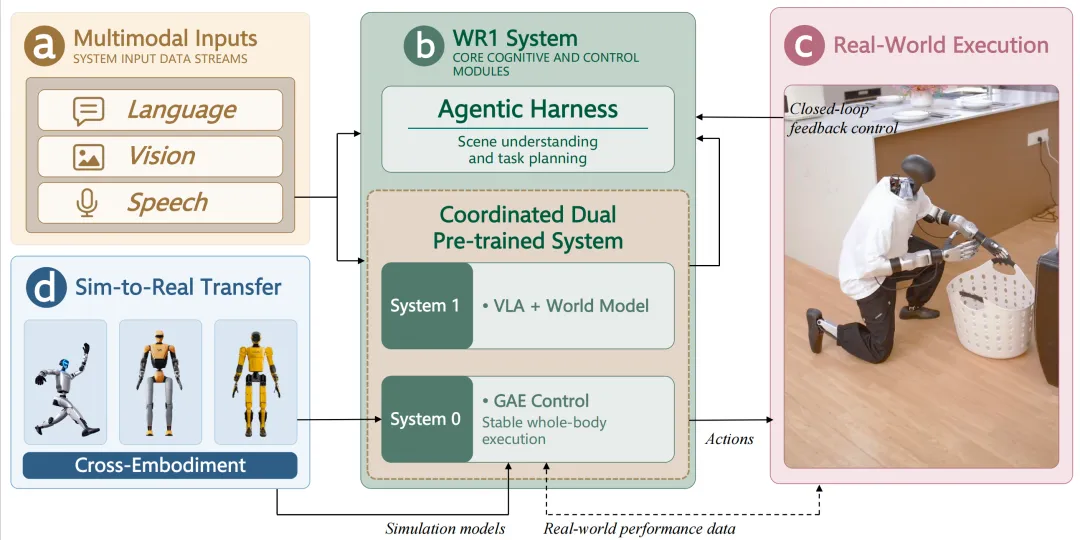
Technical architecture of the WR1 system of West Lake robots
Why is there a high dynamic dynamic?
Sliding U-shaped turn, complex environmental machinery operation
The high dynamic capabilities emphasized by WR1 are the ability of robots to accomplish fluid dynamics while performing tasks, fast physical movements, response speeds, smoothness of movement and environmental adaptability.
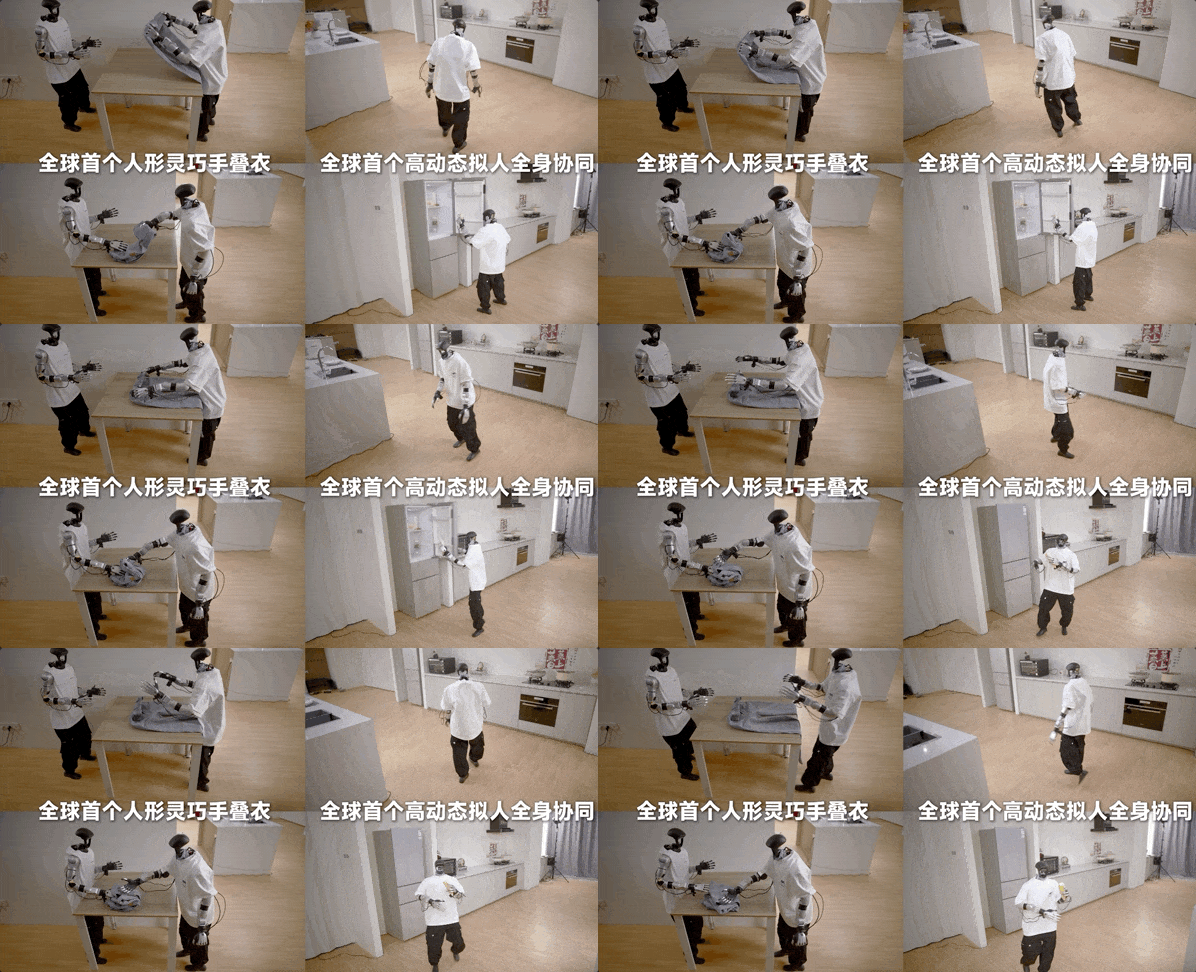
In a public long-distance housekeeping demonstration, after the robot takes the corn from the refrigerator, it completes a silky U-type turn, moving quickly and smoothly to the front of the air fryer, immediately adjusting the station position for operation.
In addition to U-turns, robotic downturns, large-scale walkways, edge-moving edge-operating objects, all fall into the category of high dynamic capabilities. This relies on GAE's pioneering mass-body movement, coupled with front-end delay compensation, compensating for hardware execution time delays, allowing robots to flexibly adjust their position in dynamically changing home spaces, laying a mechanical foundation for multi-room coherent tasks.
Why is it so hard for people to make mistakes?
Whole-body exercise coordination, doing household chores like a human
WR1's personalization is more than just an outsider, the core of which is the logical synergy of the feet, knees, arms, and hands, closer to the pattern of human behavior in doing household chores, in order to be able to move, adjust body posture, and operate hands simultaneously, rather than walking, stopping, and moving hands.
When humans do household chores, they move, adjust their postures, and handle items with their hands simultaneously; while many existing robots need to stand still after completing their walk, restart their arms, and make powerful cracking movements.
WR1 was implemented: the humanoid robot handles the corn synchronously turning and moving, simultaneously completes the receiving of the dolls during the downing process, turning and laying it on the table while carrying a long tray. The whole set of movements follows the logic of human body synchronousness, the dryer accompanies the task of the hand with natural inclination adjustment, the pace adapted to the weight and gesture of the hand, to achieve the humanoid robot's full body movement operation highly adapted.
It is much more challenging to simultaneously perform high-dynamic man-to-man movements in operational tasks than simple man-to-man movements (such as man-to-man walking) or single movements in high-dynamic man-to-man missions (such as robot balls). The former only needs to be solved by walking like a man-to-man, while the latter mainly solves to move fast enough, while full-body movement operation integration requires robots to implement multi-modal operations in dynamic mobility.
Flexible operation of hard nuclear breakthroughs
For the first time in the world, a man's hand completed the folding of clothes
Clothing belongs to irregularly flexible objects, drawers, linen shelves vibration, the disturbance of the surrounding objects continually changes the shape of the fabric, much higher difficulty of processing than regular fabrics such as towels, bath towels, and makes strict demands on perception, whole body coordination, and dynamic correction ability.

In several previous public demonstrations, West Lake robots have demonstrated that the WR1 is capable of self-supporting work on the machine arm platform, with the WR1's self-supporting arm achieving 36 seconds of self-supporting work as quickly as possible, 100% success rate, and extremely strong resistance to interference, achieving an international leading level. This public demonstration further transferred the flexibility of operation to the agility of human robots.
This is the world's first public demonstration of the complete folding of clothing by a human-like robot. The whole set of capabilities relies on multiple viewpoint visual perception combined with the robot's physical state, unified output of mobile gesture hand operation instructions, followed by complete body tracking and balance control by GAE to respond to the dynamic changes brought about by flexible objects.
Long-link capabilities
From the kitchen to the bedroom, running through the space household chain
The real value of a humanoid robot is not a one-point demonstration, but a series of multi-step tasks. However, the reality is that most products run the long process in three places: movement breakdown, scene switching failure, movement and operation clash.
In the family scene, the WR1 runs a complete chain of household tasks across the kitchen - living room - bedroom: moving autonomously to the refrigerator to extract corn→ U-type turning arriving at the air-fried stove and placing the ingredients→ dragging the receiver down the drawer and sorting out the dolls→ going to the bedroom to sort out the child.
The link is based on three mechanisms:
1. The whole body movements of the human figure are complete throughout life: the same sequence of movements simultaneously expresses the same movement, the same stance, the same hand gesture, the same hand gesture, the same footsteps, the same hand gesture, the same hand gesture, the same hand gesture, the same hand gesture, the same hand gesture, the same hand gesture, the same hand gesture, the same hand gesture, the same hand gesture.
2. Real-time block welding pre- and post-motion: When generating the next movement, full consideration is given to the trajectory of the movement being executed, while the robot is continuously moving, the backstage pre-generates subsequent movements, eliminating the cartoon mutations brought about by the update from the mechanism level;
3. Advance Delay Compensation Response Intent: GAE relies on large-scale, multi-source human exercise data to train full-body exercise skills through two phases and to execute delay in hardware compensation by means of adjustable Advance Delay Mechanisms; WR1 further calibrates residual delay in action to buffer, and jointly enhances consistency in welding mechanisms.
Specific actions include: body movements, gestural adjustments, and hand-operation are always tightly coupled when a robot handles a corn turn near an air-breathing stove; lowering the stove, picking up high and low different toys, walking, drying, hand coordination around the same goal; and minimizing the stops and mutations of the stove when the stove turns to the table.
This is the underlying support for WR1's long-link capabilities and the whole-body movement - the integration of operation. It's not about putting multiple modules together, but about making movement and operation the same thing from the moment it's created.
From demonstration to practical
Promoting real-world landscapes with physical intelligence
The company adheres to the general brain + humanoid full-bodied brain + self-developed humanoid core triad full-bodied self-development pathway, with the core goal of broadening mission understanding with full-bodied movement control, focusing on home service, industrial manufacturing and special workplace scenarios to create the core of artificial intelligence and robotics at West Lake University. The team is committed to pushing humanoid robots out of the laboratory unit demonstration bottleneck, achieving a continuous autonomous operation of long-chain under real-life production environments and highly disruptive scenarios.
The company is led by top scientific leaders: founder Wang Dong-lin, chief scientist of the National Science and Technology Innovation 2030 major project, lifelong professor at West Lake University, who is a leading figure in the field of robotic learning, who is a leader in domestic physical intelligence and robotic learning; co-founder Zhang Yue, lifelong professor at West Lake University, vice dean of the Faculty of Engineering, internationally renowned natural language processing experts.
From being the world's first person-formed folding operation to performing high-difficulty, flexible folding of clothing, to a multi-step homework run across the room, WR1 integrates task understanding, real-time feedback on the environment, and complete control of movement. It is no longer a single-action technical show, but is geared towards complex environments with continuous perception, dynamic adjustment, and long-range coherent execution of human-form robot general brain programs.
For the industry, WR1 represents a land-based approach: combining mission understanding with the depth of body movement, no longer tearing apart the creepy-thinking and the creepy-acting cracks. In the past, Humans presented more limited fabric folds such as towels, short snippets of single-point tasks, and WR1 refreshed the real-life boundaries of human robots in the home scene.
Faced with the complex task of the real world, West Lake robots will continue to transform the general brain system, sharpen the practical capabilities of humanoid robots in the broader scenes of domestic services, industrial manufacturing, special operations, etc. Based on self-development and general base, they will open the key links from algorithmic prototyping to commercialization, co-build the ecosystem of the humanoid robot industry, and contribute to the high-quality development of the domestic embedded intelligence industry.