
It's the first time in the history of the world.
Just recently, OpenAI announced that it is pushing GPT-6 to all ChatGPT users, while upgrading its Intelligent UI (smart interface).
From then on, ChatGPT's answers were no longer just words.
If you ask how to build a bicycle, it gives you a structural map of the parts you can pick up one at a time; if you ask how many meals to buy, it makes a calculator, changes the number of people and automatically re-calculates the amount.
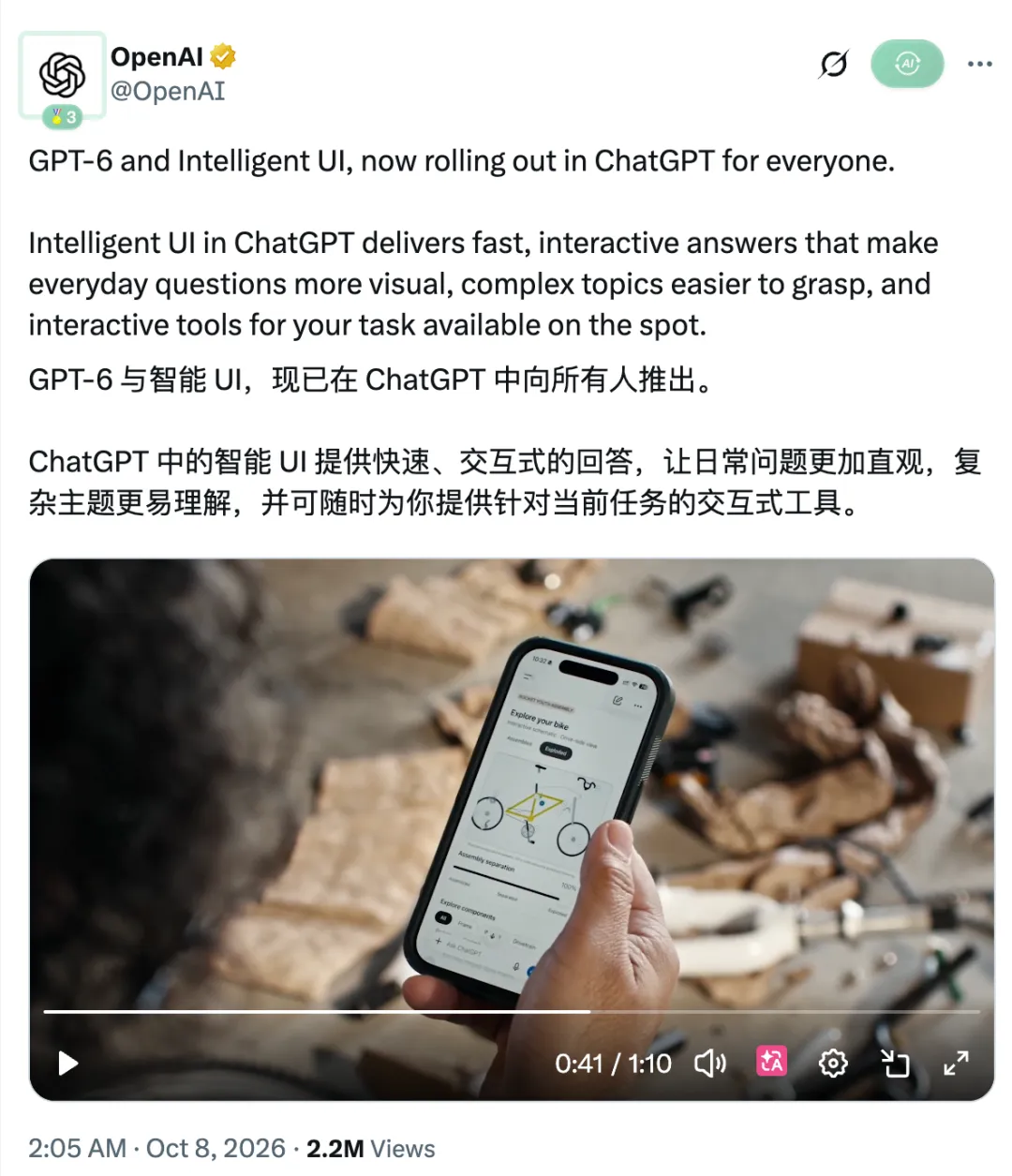
With around 1.2 billion weeks of live ChatGPT, he changed "text-only" to "interface-on-demand".
This is in line with what Eazo has always said:The end of Personal Agent is not a smarter command line, but a graphical interface.
It's not a coincidence.
However, there are also overseas netizens who have spoken out: Do not rebuild a wheel every two minutes, can we give a stable point?
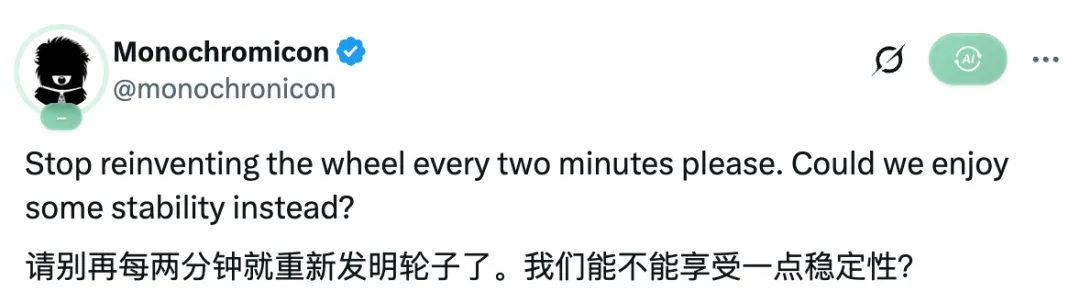
It's the point of the sentence.
Is the interface created by AI to answer the questions of the past, the next time you ask them again, or is it to stay and become something you can use every day and send to your family?
Eazo chose the latter route.
Let me tell you a story about two families.
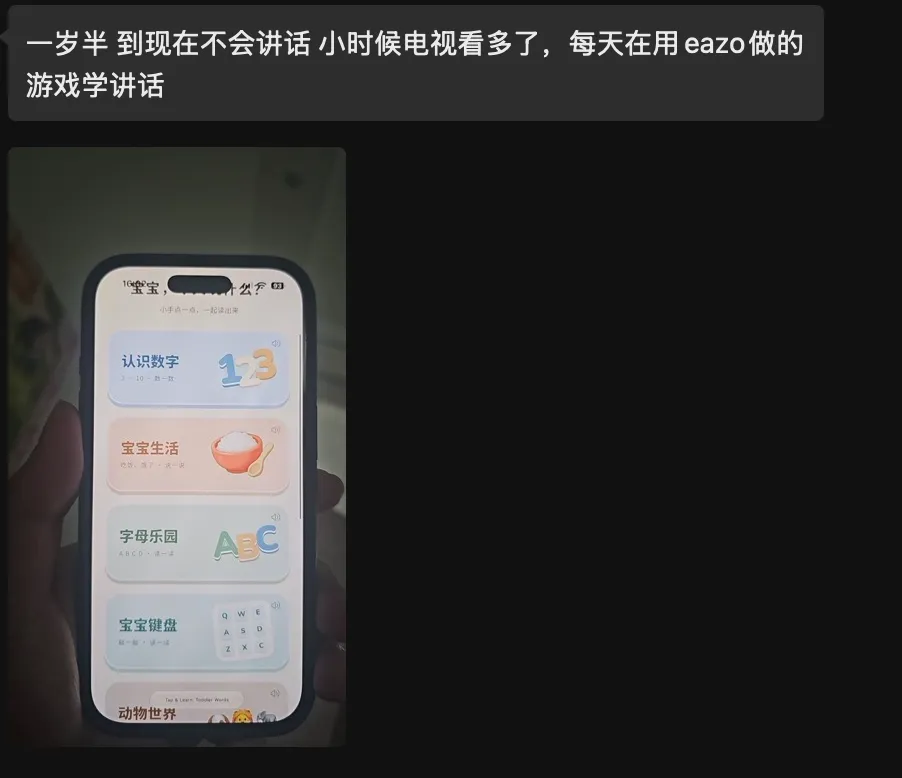
The first family has a one-and-a-half-year-old child who is less likely to talk. The family uses Eazo to create an App for learning conversations: big cards, voice, click to read, recognize numbers, letters, recognize life objects, recognize animals. The children use it every day.
The second family asked for a sleep consultant. The consultant gave them a conditional PDF: how long to stay awake, what to do after sleeping less, what to do after sleeping less. Adam Waxman spent a week of the night making it an app, after which he, his wife, and the three babysitters shared the same real-time sleep schedule.
These two apps are not available in any app store, nor are they worthy of any company's special consideration. They only matter to this family, and that's their value. They also show the same thing: the people who make them use conversations, the people who use them only need points; an app can even exist for only a short time.
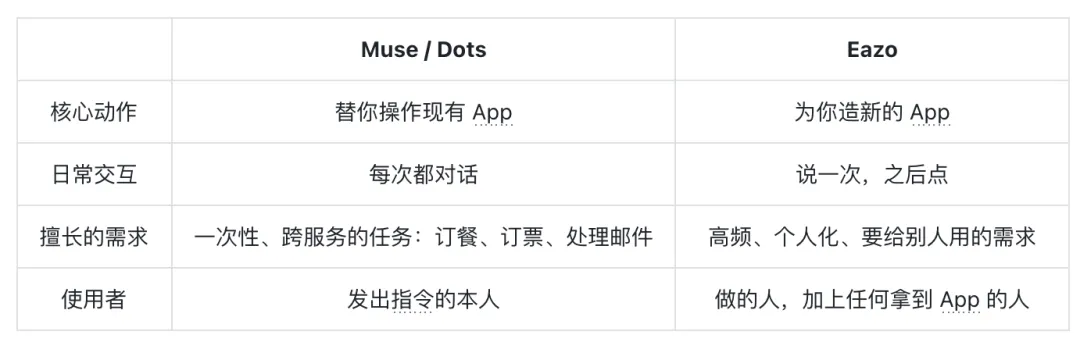
The dialog box is a demo of AI, not the end.In the last month, the focus on Personal Agent has exploded. Meta's Muse provides a cloud-based browser for you to process emails, calendars, payments and purchases, and OpenAI's Dots connect more than 4,000 apps to work for you.
A year ago, when Fellou was released, it was already possible for Agent to connect local computers to act on behalf of humans. It was too early to do so, and later a product like Codex proved this path to be correct.
Airbnb CEO Brian Chesky looked at the problem correctly. In an interview with TechCrunch on October 1, he said that he tried to put Airbnb in a consumer-level Agent like Muse, but it didn't work; consumer-level AI hadn't been solved, every app had to become an Agent, and they all needed an interface that was much richer than a dialog box.
One is that the interface will disappear and you just talk; the other is that every screen is temporarily generated and there is no longer a stable product at the bottom. Real people need something they can go back to, learn from, and trust, which means a designed, stable, graphical surface with AI working behind it.
The reason is simple. Select one of the 20 options, write down an expense, and plan a trip with three friends, take a look at a number each morning, which is essentially visual, spatial, repeatable, and a dialog box only compresses them into a volume of text.
So we gave Personal Agent a different definition:It requires new interactions, which are graphical interfaces. Eazo is the first product made according to this definition.
It's a conversation, it's an interface.Dialogue is the best way to express new needs, but not the best way to reuse them.When creating with natural language, when using customized interfaces for you.
It's like a lamp in a bedroom: you tell the electrician once, put the switch on the head of the bed, and then you reach out every night, and you don't have to shout "turn it off" to the air every night.
Today's Agent is an app for you to drive other people. The next step should be: Agent builds an app for you that you need, say one word and then click on it every day.
What people see now is not text, but a richly colored world. Richly colored, it takes graphics; to get something done every day, it takes convenience. The app itself carries these two capabilities, so the app will not disappear. Only one thing will change: the app is no longer made for everyone by a few companies, but everyone can make it for themselves.
App-based Personal AgentWhat does it look like?The moments of "a little bit better than a little bit better" that everyone encounters every day.
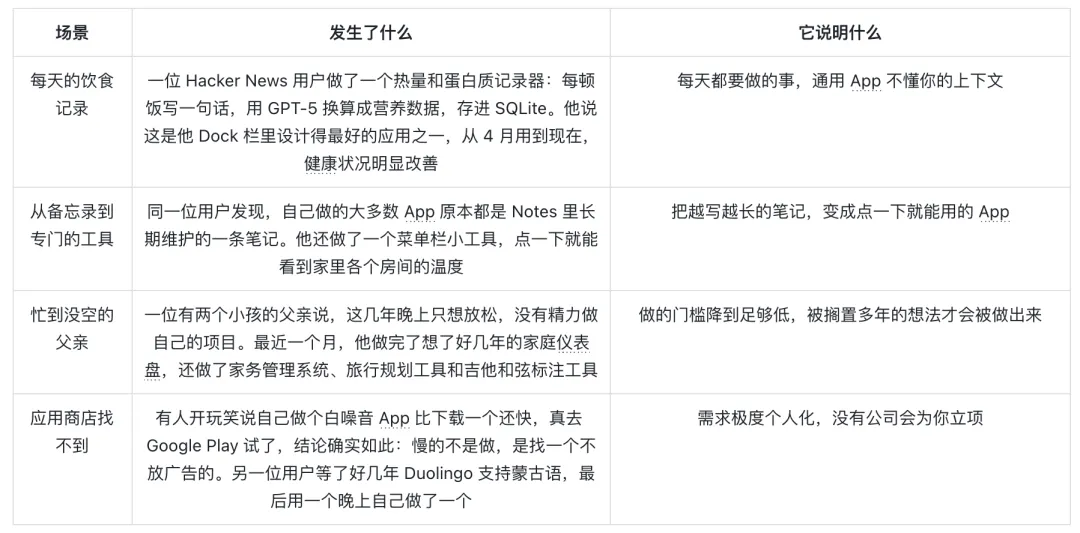
These scenes share three truths: high frequency, repeated demand, a bit faster than one sentence, and no one wants to re-describe it every time. Not every user can express their needs in language, children, the elderly, people with difficulty expressing themselves, the interface is much more friendly than conversation.
Eazo: App-centeredPersonal AgentThis is where we start Eazo. Another Personal Agent operates the app for you; another Personal Agent creates the app for you. Once you talk about your needs in natural language, Eazo turns it into something that you can see, touch, and share, and then you just click a little bit every day.
Dialogue is still at the heart of Eazo, but we use it where it's best: to understand you and then create something. Everyday use, given customized interfaces for you.
 It's a bit of a blurb to get a complete app.
The hardest thing about making an app is never to write code, but to make the needs clear. Most AI tools assume that you are a product manager: you write down the needs, dismantle the functionality, change the prompt, and the last thing you get is a half-finished product that doesn't work.
Wild Design: A built-in AI design agent that generates six or more different professional visual directions around the same needs, covering layout, composition, color, dynamics, and material ambiance. You compare specific designs, then choose a direction, and continue without any design terms. If you want to be "warmer" or "simple", the agent will translate the feeling into specific design adjustments and tell you what's changed.
Cases
Daily learning tools materials: It's would include the basic features: upload or import the video and podcast from URL; transform the video and podcast speaker voice to text content; user can control the video and podcast speed to learn the speak which aka shadow reading; user can mark the new vocabulary and the system support to explain the meaning. design the more good feature for the application.

generate
interact
3D animation app (using blender) case
User Prompt: Help me to restore this scene and characters, characters with animation can move.
Eazo gives users process generators to view:
 |  |
Two characters generate three views to confirm the user.

Animated material confirmed
Users added the need to use animated finished products to create an app: make it an app that can switch time zones to view time zones in different places, the colors of the sky and the time zones currently selected, and style reference the time display desktop of the iphone.

The full spectrum of whitening: one-word generating front-end, back-end, database, login and payment; authentication systems; 49 built-in AI models; Stripe global receipts; high-performance storage; Skills markets; and one-click publishing of links that are accessible globally, all without the use of optional technologies; without the use of servers; without the purchase of API keys.
Multimodal materials are created together: interfaces, images, 3D characters and scenes, animations and audio are created in the same dialogue without switching to other tools.
Active Task Recommendation: In addition to the main agent, there is a set of interactive content experts that continuously recommend what to do next and which you decide to do; the main agent has the ability to use BrowserUse and ComputerUse to make sure that what you see is consistent with what it sees by screening itself.
The creator's biggest surprise for Eazo was that "every step is a complete product": every update is a version that can run, can be sent, can be shared, rather than a demo that gets bigger and never goes online.
The biggest surprise for Eazo users is that "every step is a complete product".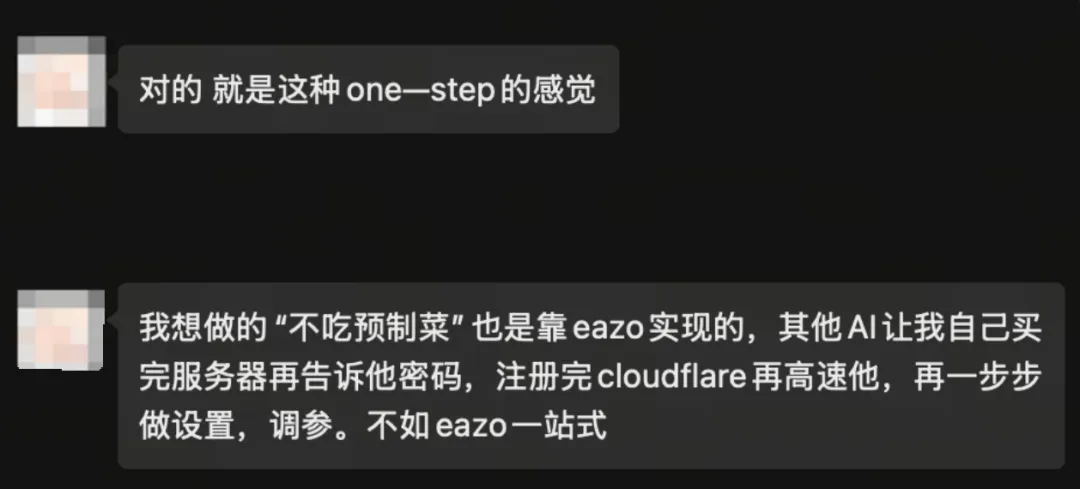 | 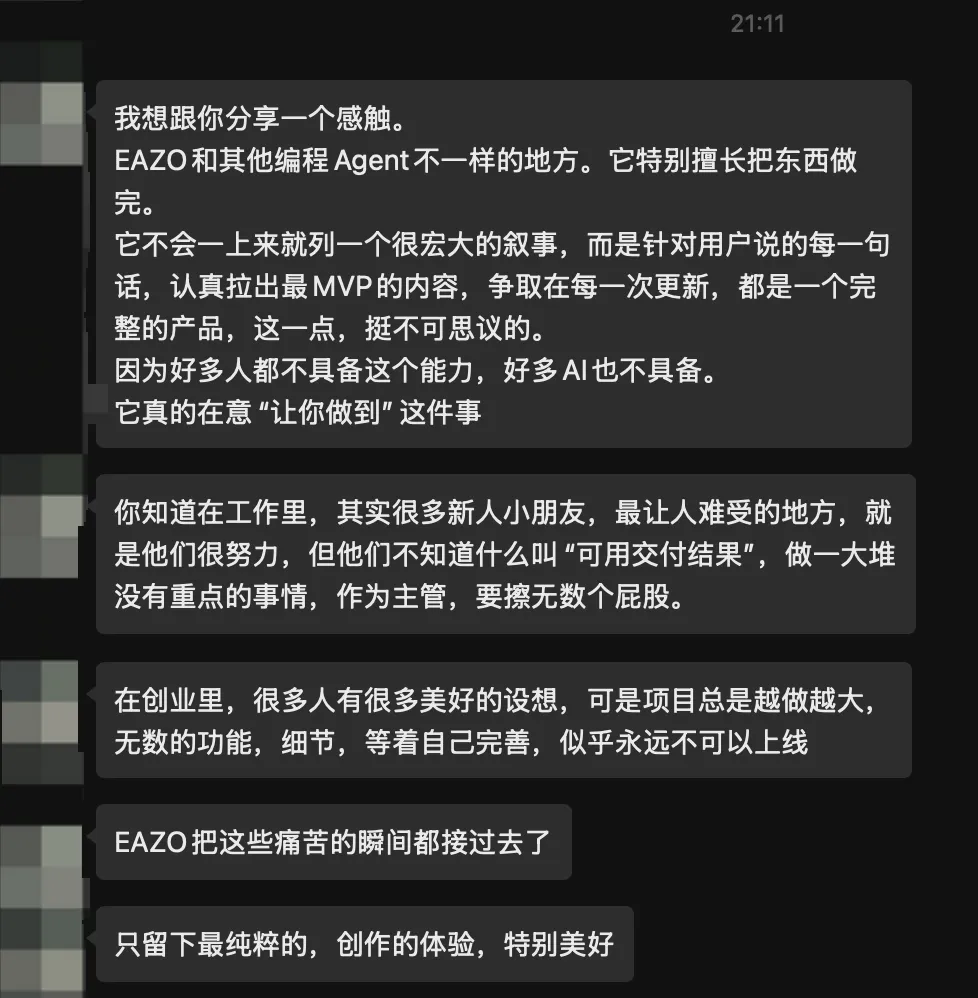 |
 |  |
 |  |
Security certification:
Add a login system to the current project.
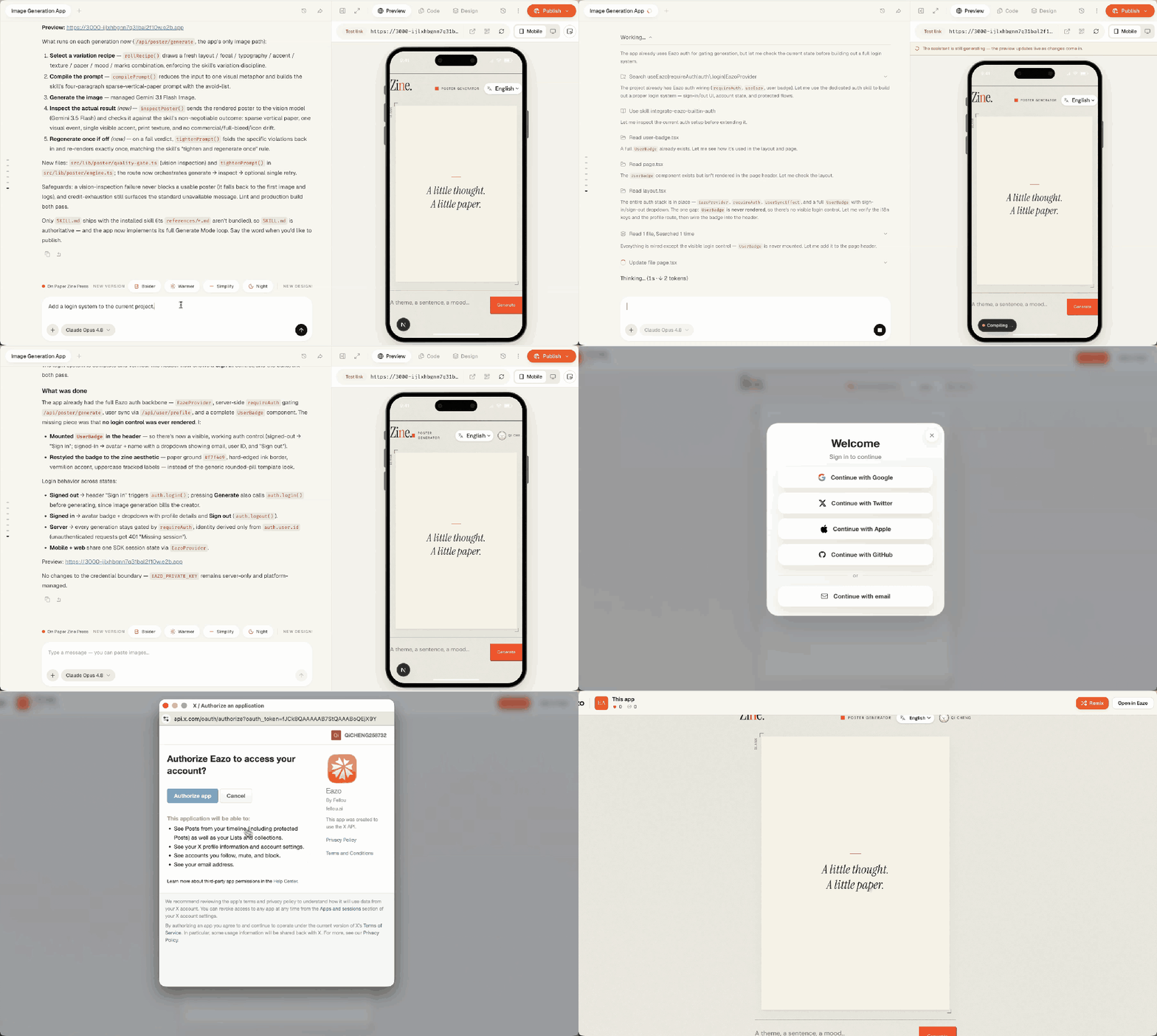
Built-inAIThe model is fast-paced.AppAdding AI capabilities

Global receipts
A payment feature has been added with a price of $3; members enjoy unlimited use of the image generation function

High-performance storage:
I want to see how many users have logged in and used my app.

The market for Skills:
Help me build an image generation app that randomly creates images matching the current context based on user input; the app needs to call this specific skill each time an image is generated /gc-minimal-zine-poster-v0-3
One-click global releases can be shared directly.AppFor others:
Who will use Eazo?Eazo is gearing up for a global Vibe coder: people who want to use AI to turn ideas into work will not be able to code. When they think about "making an AI-enabled customized app", "saying that ambiguous needs can get 100 points", "making an MVP quickly" or "generating high-aesthetic design", we want them to think about Eazo and Codex, Cursor together.
For these people, there are only three layers of information that EAZO has to convey in order of priority: to be able to make it, to develop a truly mini-white-scale, to generate a front-end, a back-end, a database, to log in, and to make a global revenue; to look good, Wild Design creates a vague need for more than six professional visual directions, to say goodbye to cheap AI; to be valuable, based on the combination of OpenAI, Claude and self-developed models, to be more efficient and cost-reduced.
Open BenchmarkEazo Benchmark is an open evaluation system for Creative Agent, based on the team's years of coding experience. It not only looks at whether AI will write code, but how it can actually turn an individual's idea into a workable, responsive, and remixable work. v3.0 has 147 entries, divided into eight capability dimensions along the entire path from idea to community, with themes that include real material such as 3D models, videos, databases, fonts, and Figma, from a real multi-cycle creation process.
On this set of assessments, Eazo has an overall score of 88.0 and Codex CLI of 84.4.
The gap is from EazoTack's self-developed General Agent framework, EazoTack. It uses only 15 core tools and 1 metric tool, with a 7 day network caching rate of 98.3%, achieving an effect that surpasses Codex on the same model, reducing the cost by about a third. Fewer tools, the same model, higher quality, lower cost.
EazoTack has been rebuilt five times, incorporating a four-tiered architecture that separates creation interaction, Agent collaboration, tools and professional capabilities, and operational foundations. Execute the Agent with cache-priority context management, maintaining system front-end stability, adding dynamic information, and replicating context in subtasks. 15 basic tools plus a subtool called invoke_skill, on-demand graphics, 3D-generation and scene access, six-way parallel design, browser verification capabilities.
The evaluation package is available to the public at eazo.ai/benchmark, updated at any time; for more graphic personal assistant cases see eazo.ai/creator.
Qoni: Every Personal AgentThe back seat.It looks like just a couple of cards, but to really use it, it has to know whose kids it is, remember where the kids learned yesterday, and be able to find new material online for the family when necessary.
Every Personal Agent can't get around these three things:Knowing who you are, remembering what you've done, can take action for you.The Muses and the Dots are not models.It's about identity, actions and memories.We created this underpinning for Eazo and are now releasing it as Qoni: Cognitive: Developing the Hosting Infrastructure for Personal Agents.
One sentence summarizes Qoni's ability to let agents in, to do, to remember.
From now on, anyone, any business, any developer can build an exclusive Personal Agent based on Qoni for themselves, their families, and their employees.Imagine any company can use it to make its own Muse or Dots, and that's what Qoni is all about: technology parity.
The two accumulated pieces joined together to form a lineQoni didn't start from scratch. Seven years ago, its founder, Shenyan, made Authing, which continues to be GenAuth today; one year ago, he made Fellou, which evolved its browser and action capabilities into today's Qoni; and memory capabilities come from his past research into knowledge graphs.
In 2001, the inventor of the World Wide Web, Tim Berners-Lee, described the semantic web in his book Science American: a software agent that can read the meaning of web pages, make appointments, compare choices, manage tasks for people. In 2018, a recent university graduate promoted the SoLiD project in the country, which was a failed experimental product of the semantic web that also included identity, data and memory. Eight years later, Qoni introduced a whole new technology to complement identity and memory to Agent, bringing this idea to reality: an identity and memory Agentic Web, a true AI Native browser, starting today.
At the opening ceremony of the 2012 London Olympics, Berners-Lee wrote "This is for everyone".
I'm going to be a personal agent.Graphical interface momentsEveryone is saying, "Apps will disappear, only dialogue will remain". What we are saying is that dialogue is about creating things, not everything should be done through dialogue.
Eazo is a graphical personal agent for everyone; Qoni allows every developer, every business, to create a personal agent for themselves, for their families, for their employees.But that's not the end of Eazo.。